

TL;DR:
- Avoiding common Spanish mistakes, such as confusing ser and estar or misgendering nouns, improves learners’ confidence and natural speech. Focusing on context-based usage, memorizing nouns with their articles, and practicing pronunciation with native speakers are essential strategies. Embracing errors as learning tools accelerates progress and deepens fluency quickly.
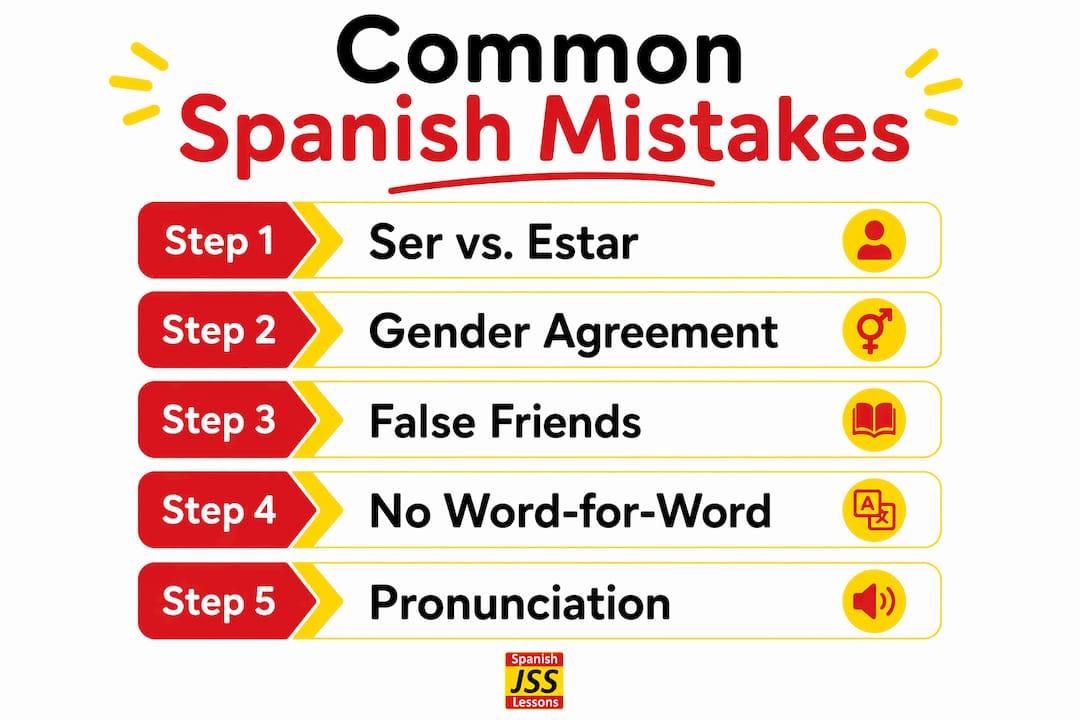
Avoiding common Spanish mistakes is the fastest route to confident, natural conversation with native speakers. English-speaking learners consistently stumble over the same linguistic pitfalls: ser versus estar, gender agreement, false friends, and the trap of word-for-word translation. These are not random errors. They follow predictable patterns, which means they can be understood, practised, and overcome. This guide covers each one directly, with concrete examples and practical techniques drawn from real learner experience and expert guidance.
How to avoid common Spanish mistakes with ser and estar
The ser versus estar distinction is the single most misunderstood area of Spanish grammar for English speakers. Both verbs translate as “to be,” yet they are not interchangeable. Getting them wrong does not just sound odd. It can completely change your meaning.

The traditional “permanent vs. temporary” has some exceptions. Another framework is essence versus condition. Use ser for identity, origin, profession, and inherent characteristics. Use estar for states, locations, emotions, and the results of actions.
The classic example makes this vivid. Soy aburrido means “I am a boring person.” Estoy aburrido means “I am bored right now.” One word changes your meaning from a permanent character flaw to a passing feeling. Native speakers notice this immediately.
Two mnemonics help anchor the distinction:
- D.O.C.T.O.R. for ser: Description, Origin, Characteristics, Time, Occupation, Relationships
- P.L.A.C.E. for estar: Position, Location, Action, Condition, Emotion
Pro Tip: Rather than memorising abstract rules, collect a personal bank of ten to fifteen example sentences for each verb. Reviewing real contexts beats drilling grammar tables every time.
What are the biggest challenges with gender and noun agreement?
Gender and number agreement errors are the most audible signs of non-native speech. Spanish assigns a grammatical gender to every noun, and every adjective must match that noun in both gender and number. When this breaks down, native speakers hear it instantly.
The most reliable strategy is to learn every noun with its definite article from the start. Do not learn mesa (table). Learn la mesa. Do not learn banco (bank or bench). Learn el banco. This anchors gender in memory rather than leaving it as an afterthought.
Spanish also contains exceptions that catch learners off guard. Certain masculine nouns end in -a, such as el problema and el sistema. Some feminine nouns take a masculine article in the singular for phonetic reasons, such as el agua (water), even though agua is feminine. These require deliberate memorisation with their articles, not guesswork.
Adjective agreement follows the same logic. Un coche rojo (a red car) becomes una casa roja (a red house). The adjective ending shifts to match the noun. Changing adjective endings to reflect gender and number is non-negotiable for natural speech.
Pro Tip: Keep a short running list of tricky nouns with their articles. Review it weekly. Ten minutes of focused revision beats an hour of passive reading for this kind of pattern.
How can understanding false friends improve your Spanish?
False friends are words that look or sound similar in English and Spanish but carry entirely different meanings. They are one of the most embarrassing types of Spanish mistakes to avoid, precisely because learners feel confident using them.
The most cited example is embarazada. It looks like “embarrassed,” but it means “pregnant.” Saying Estoy embarazada when you mean “I’m embarrassed” creates a social misunderstanding that no amount of confident delivery can rescue. Other common false friends include:
- Sensible in Spanish means “sensitive,” not “sensible”
- Éxito means “success,” not “exit”
- Realizar means “to carry out or achieve,” not “to realise”
- Molestar means “to bother or annoy,” not what English speakers might assume from its appearance
The most efficient strategy is to maintain a focused false friends list and review it regularly. This targeted approach outperforms broad vocabulary drills because it directly addresses the specific confusion point. Group them in pairs: the Spanish word, its actual meaning, and the English word it resembles. Reviewing this list once a week for a month will make these pairs automatic.
The deeper lesson here is to resist the temptation to assume that visual similarity means shared meaning. Spanish and English share Latin roots, which creates genuine cognates like hospital and animal, but it also creates dozens of traps. Treat every similar-looking word as a question until you have confirmed its meaning.
Why is word-for-word translation a problem in Spanish?
Word-for-word translation from English produces sentences that are grammatically plausible but sound unnatural or carry the wrong meaning. Avoiding direct translation reduces errors in word order and idiomatic expression, and it is one of the most important strategies for better Spanish.
Spanish structures thought differently. English says “I like football.” Spanish says Me gusta el fútbol, which translates literally as “Football pleases me.” The subject and object are reversed. Forcing English word order onto Spanish produces Yo gusto fútbol, which is simply wrong.
The practical solution is to learn verbs together with their prepositions in context, not in isolation. Consider these examples:
- Pensar en means “to think about” (not pensar sobre, which sounds translated)
- Soñar con means “to dream about” (not soñar sobre)
- Casarse con means “to marry” (literally “to marry with”)
- Depender de means “to depend on”
Each of these is a fixed phrase. Learning the verb and its preposition as a unit, rather than translating each word separately, produces natural Spanish. This is the same way children acquire language: through whole phrases in context, not grammar tables.
Exposure to real spoken Spanish accelerates this shift. Listening to native conversations, even at a level slightly above your current ability, trains your ear to expect Spanish patterns rather than English ones. Practising Spanish conversation for real fluency is the fastest way to make these patterns feel instinctive.
Pro Tip: When you catch yourself translating word for word, stop and ask: how would a Spanish speaker express this idea? If you do not know, write it down and look it up. That moment of uncertainty is where real learning happens.
What pronunciation challenges should English speakers watch out for?
Pronunciation errors can undermine communication even when your grammar is correct. Even perfect grammar cannot compensate for mispronunciation that confuses native speakers. The good news is that Spanish pronunciation is highly consistent. Once you learn the rules, they apply almost universally.
The most frequent pronunciation challenges for English speakers include:
- The silent h: The letter h in Spanish is always silent. Pronouncing hola with an audible “h” sound marks you immediately as a non-native speaker.
- The rolled r: The single r in pero (but) and the double rr in perro (dog) are distinct sounds. Confusing pero and perro changes the meaning entirely and can cause real confusion in conversation.
- Pure vowel sounds: Spanish vowels are short and consistent. The a in casa does not shift the way English vowels do. English speakers often add a glide to vowels, which muddies the sound.
- The Spanish v and b: These are pronounced almost identically in Spanish, both closer to the English b. Treating the v as an English v sounds foreign.
The most effective training method is to listen to native speech and repeat aloud immediately. Recording yourself and comparing the result to a native speaker’s version reveals gaps that reading alone never will. Jamesspanishschool’s WordAmigo system addresses this directly, using strategic repetition to embed correct pronunciation alongside vocabulary so the two are learnt together from the start.
Key takeaways
Consistent progress in Spanish depends on tackling the same predictable errors that trip up almost every English-speaking learner, and addressing them with targeted practice rather than passive study.
| Point | Details |
|---|---|
| Ser vs. estar | There are exceptions to permanent versus temporary. |
| Gender and agreement | Learn every noun with its article from day one to anchor gender in memory. |
| False friends | Maintain a reviewed list of false friend pairs to prevent embarrassing errors. |
| Avoid direct translation | Learn verbs with their prepositions as fixed phrases, not word by word. |
| Pronunciation matters | Practise the silent h, rolled r, and pure vowels aloud with native audio. |
What forty years in Spain taught me about making mistakes
Most learners treat mistakes as evidence that they are not ready to speak yet. I have seen this hold people back for months, sometimes years. The truth is the opposite. Embracing errors as diagnostic tools is what separates learners who progress quickly from those who stay stuck at the same level indefinitely.
The learners I have seen succeed fastest are not the ones who studied the most before speaking. They are the ones who started speaking early, paid attention to where communication broke down, and used those moments to ask questions. Conversation is not just the goal of learning Spanish. It is the most effective method for reinforcing Spanish skills and identifying exactly what to work on next.
One more thing: do not try to fix everything at once. Pick one area, ser versus estar or false friends or pronunciation, and work on it deliberately for two to three weeks. Focused attention on a single pattern produces faster results than spreading effort across every grammar rule simultaneously. Patience and specificity are the real strategies for better Spanish.
— James
How James Spanish School helps you speak Spanish with confidence
Knowing the theory behind common errors is one thing. Having a structured system that trains you to avoid them automatically is another. Jamesspanishschool’s 100-lesson course is built around exactly the pitfalls covered in this article, using Radical Simplification to explain Spanish structure in plain English rather than grammar jargon.

The WordAmigo system embeds vocabulary and pronunciation together through a five-step retention loop covering reading, listening, speaking, and writing. You do not just learn what a word means. You learn how it sounds and how to use it in a real sentence. Explore the full range of learning materials and resources in the Jamesspanishschool shop, or take a closer look at practical steps to fluency to see how the course is structured. Everything is available on demand, with no expiry date and no pressure.
FAQ
What is the most common Spanish mistake for English speakers?
Confusing ser and estar is the most frequent error, and it carries real social consequences. Saying soy aburrido instead of estoy aburrido tells someone you are a boring person rather than that you are bored.
How do I remember Spanish noun genders?
Always learn nouns with their definite article, la mesa rather than mesa, so gender is stored as part of the word from the beginning. Pay particular attention to exceptions such as el problema and el sistema, which are masculine despite ending in -a.
What are false friends in Spanish?
False friends are Spanish words that resemble English words but mean something different. Embarazada means “pregnant,” not “embarrassed,” and éxito means “success,” not “exit.” Keeping a regularly reviewed list of these pairs is the most efficient way to avoid the confusion.
Why should I avoid translating word for word from English?
Spanish sentence structure and idiomatic expressions differ significantly from English. Phrases like me gusta (I like) and verb-preposition combinations such as soñar con (to dream about) do not follow English patterns and must be learnt as fixed units in context.
How can I improve my Spanish pronunciation quickly?
Listen to native speech and repeat aloud immediately, then record yourself and compare. Focus first on the silent h, the distinction between pero and perro, and the pure, consistent vowel sounds that differ from English’s shifting vowel patterns.