

TL;DR:
- Understanding European Spanish pronunciation and verb uses is essential for authentic communication.
- Combining structured courses, audio practice, and real-life scenarios accelerates learning.
- Embracing cultural nuances and authentic expressions builds confidence and fluency in Spain.
You know a handful of Spanish words. You’ve sat through a few lessons, maybe even memorised some verb tables. Then you arrive in Spain, someone speaks at full speed, and your mind goes completely blank. It’s one of the most common experiences for English-speaking adults learning Spanish, and it’s not your fault. Classroom Spanish and real-life Spanish are two very different animals. This guide walks you through the foundations, the right tools, the practical steps, and the cultural confidence you need to hold genuine everyday conversations in Spain.
Table of Contents
- Unlocking the basics: what every beginner needs
- Your language starter kit: must-have tools and resources
- Step-by-step: building your conversational Spanish foundation
- Common pitfalls and how to track your progress
- What most beginner guides miss about real-world Spanish
- Your next step: learn Spanish with expert support
- Frequently asked questions
Key Takeaways
| Point | Details |
|---|---|
| Focus on European Spanish | Learning regional pronunciation, slang and culture helps you fit in and communicate confidently. |
| Master the essentials | Prioritise key verbs, handy phrases, and core topics for real-life conversations. |
| Use the right resources | A mix of apps, audio, and live practice is best for developing your skills. |
| Embrace mistakes | Making errors is part of learning—stay relaxed and keep talking, even if you slip up. |
Unlocking the basics: what every beginner needs
Now that you know what lies ahead, let’s start with the very foundations for beginner Spanish. The first thing worth understanding is that Spain speaks a particular variety of the language. European Spanish (Castilian) uses distinct pronunciation and regional slang that differs noticeably from Latin American varieties. The most obvious difference is the ‘th’ sound: Spaniards pronounce the letter ‘c’ before ‘e’ or ‘i’, and the letter ‘z’, like the English ‘th’ in think. So gracias sounds more like grath-yas in Spain. This isn’t just a quirk. It’s a marker of local identity, and getting it right helps you sound less like a tourist.
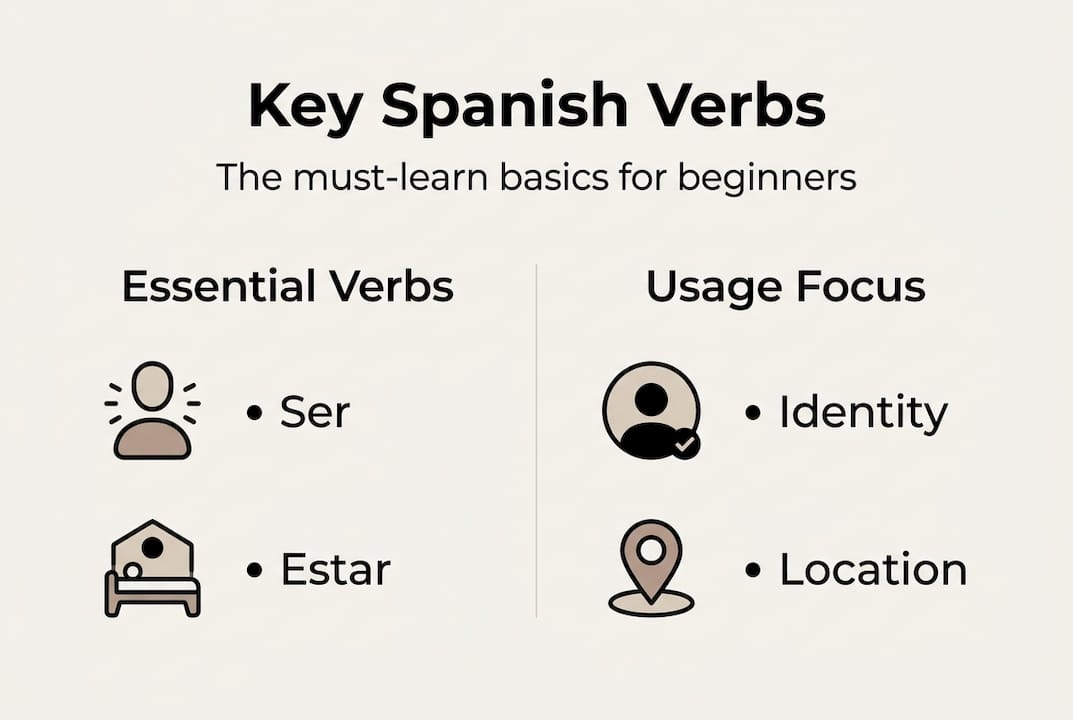
Beyond pronunciation, beginners need a grip on three fundamental verbs: ser, estar, and haber. All three translate loosely as ‘to be’ or ‘to have’, but each carries a specific use. Ser describes permanent states (nationality, personality), estar covers temporary conditions (mood, location), and haber acts as an auxiliary for compound tenses. Understanding Spanish structure basics early on saves enormous frustration later.
You’ll also need a working knowledge of adjective agreement. In Spanish, adjectives change their ending depending on whether a noun is masculine or feminine, singular or plural. It sounds fiddly, but with practice it becomes second nature.
Essential polite phrases to learn first:
- Por favor (please) and gracias (thank you)
- ¿Puede repetir más despacio? (Can you repeat more slowly?)
- No entiendo (I don’t understand)
- ¿Cuánto cuesta? (How much does it cost?)
- Perdone (Excuse me, to get attention politely)
Spaniards tend to communicate directly and efficiently. This can feel blunt to British ears, but it’s simply the local style. There’s no offence meant. Understanding this cultural tone early on means you won’t misread a perfectly friendly exchange as rudeness.
Comparison: European Spanish vs Latin American Spanish for beginners
| Feature | European Spanish | Latin American Spanish |
|---|---|---|
| ‘c/z’ pronunciation | ‘th’ sound | ‘s’ sound |
| Informal plural | vosotros | ustedes |
| Common slang | vale, tío | órale, chévere |
| Accent speed | Variable by region | Variable by country |
BBC Bitesize covers essential grammar topics for beginners and is a useful free reference to supplement your early learning. For a focused list of verbs you’ll actually use, you need a core verbs list is built specifically around real-life Spanish interactions.
Pro Tip: When you are learning vocabulary, don’t try to learn every thing at once. Focus on the 25 or so words and phrases you’d need to get through a single day in Spain. Start small, build confidence, and layer in complexity as you go.
Your language starter kit: must-have tools and resources
With the essentials in mind, it’s time to gather the best tools for starting your journey. The good news is that there are more quality resources than ever before, but the sheer volume can be overwhelming. The key is choosing tools that match how you actually learn, rather than piling up apps you’ll never open.
BBC Bitesize Beginner Spanish is a structured resource for Spanish grammar that works well alongside audio-based learning. For those who prefer learning through context, the JSS Spanish language course includes family-themed practice lessons which place vocabulary into realistic, everyday situations rather than abstract drills.
Top resources for beginner Spanish learners:
- A structured online course focused on European Spanish. Look for one that explains grammar in plain English without heavy academic jargon. The JSS course fits that need.
- A pronunciation tool such as WordAmigo, which is built into the JSS course and helps you hear and reproduce sounds accurately.
- A phrasebook or digital guide specifically for Spain. Avoid generic Latin American guides that teach vocabulary or slang you won’t encounter locally.
- Podcasts or audio content for passive listening. Even 15 minutes a day while commuting or cooking makes a measurable difference over time.
- A sentence practice tool to reinforce structure. The JSS sentence practice tools are designed to build your ability to construct sentences, not just memorise phrases.
Comparison of main beginner learning methods:
| Method | Best for | Limitation |
|---|---|---|
| Audio/podcast | Passive daily exposure | No visual grammar support |
| Language apps | Vocabulary building | Often Latin American focused |
| Online course | Structured progression | Requires commitment |
| Live lessons | Speaking confidence | Expensive and time-dependent |
| Phrasebooks | Quick reference | No depth or context |
The most effective approach is to combine two or three methods rather than relying on just one. Pair a structured course with regular audio exposure, and add a phrasebook for those moments when you need a quick answer on the spot. Switching between formats also keeps learning fresh and prevents the kind of mental fatigue that makes people quit.
Step-by-step: building your conversational Spanish foundation
Armed with your toolkit, you’re ready to get stuck into real language learning, one step at a time.
- Learn core verbs and sentence structure first. Before memorising lists of nouns, understand how a Spanish sentence is put together. Verbs are the engine room of Spanish, and knowing how to use even ten of them correctly unlocks an enormous range of conversation. Visit JSS practical conversation tips for a clear walkthrough of sentence-building logic.
- Practise key real-life scenarios. Focus on ordering food, shopping, introducing yourself, asking for directions, and visiting a pharmacy. These are the interactions you’ll have on day one in Spain. Rehearse them until they feel automatic.
- Use local expressions and authentic pronunciation. Common phrases like vale (meaning ‘ok’) are used constantly in Spain and signal to locals that you’re making a genuine effort. Regional expressions like these matter more than textbook perfection.
- Use spaced repetition and audio training for memory. Spaced repetition means reviewing material just before you’d naturally forget it, which dramatically improves long-term retention. Audio training, the ‘ear-tuning’ approach at the heart of JSS, helps you keep pace when native speakers talk at full speed.
Cultural note: In Spain, silence in conversation is rarely comfortable for locals. If you hesitate too long while searching for a word, your conversation partner may jump in or finish the sentence for you. Don’t be embarrassed. They’re being helpful, not impatient. Embrace the pace and keep going.
For a deeper look at authentic language habits, the JSS guide to tips for real conversations covers the nuances that most beginner courses ignore.
Pro Tip: Learn the words for common daily topics before you travel. Whether it’s essential topics vocabulary around family, food, or home life, having those words ready means you can steer conversations into territory where you feel comfortable.

Common pitfalls and how to track your progress
Now you’ve got the steps, it’s vital to avoid pitfalls and know when you’re making real progress.
The most frequent mistakes English speakers make include:
- Literal translation. English and Spanish sentence structures don’t map onto each other neatly. Translating word-for-word in your head leads to confused or unnatural phrases.
- Mixing formal and informal registers. Spanish has distinct forms for addressing someone formally (usted) versus informally (tú). There are now completely different usuages in European and Latino Spanish Using the wrong one in the wrong situation can cause awkwardness.
- Ignoring local idioms. Learning slang like vale or hablar hasta por los codos (meaning ‘to talk someone’s ear off’) helps you blend in socially and understand the texture of real conversations.
- Skipping pronunciation practice. Reading Spanish silently and speaking it aloud are completely different skills. Practise speaking from day one.
Practical milestones to aim for:
- Introduce yourself confidently and ask basic questions about others
- Complete a purchase at a market or shop without switching to English
- Order a meal and understand the waiter’s reply
- Handle a basic phone call or appointment booking
- Follow a short conversation between two native speakers
Self-testing is simple and effective. Every week, pick one scenario and run through it entirely in Spanish, out loud, without notes. If you get stuck, note exactly where and return to that gap in your next study session. For ongoing tips for everyday Spanish, the JSS resource library covers practical fluency techniques grounded in real Spanish life.
Pro Tip: Find a language partner, either a native Spanish speaker learning English, or a fellow learner at a similar stage. Regular spoken practice with another person accelerates progress faster than any app or course can on its own.
What most beginner guides miss about real-world Spanish
Here’s something worth saying plainly: most beginner guides teach you how to pass a language test, not how to chat over a coffee in Seville or negotiate with a plumber in Alicante. Textbook Spanish is clean, measured, and polite in a very formal way. Real Spanish is faster, slangier, and shaped by centuries of regional culture.
Cultural confidence matters just as much as grammar. Knowing when to use a phrase, how to respond to directness without taking offence, and how to laugh at your own mistakes, these are skills no conjugation table can teach. Spain rewards effort enormously. Make a genuine attempt in Spanish and most people will meet you more than halfway.
The uncomfortable truth is that fear of embarrassment holds more learners back than lack of knowledge. Nobody sounds fluent on their first attempt. Understanding why Spanish is easier for English speakers than most imagine helps dismantle that fear before it takes hold. Embrace the stumbles. They are not failures. They are the fastest route to sounding natural.
Your next step: learn Spanish with expert support
If you’ve read this far, you’re already more prepared than most people who attempt Spanish without a clear plan. The difference between learners who plateau and those who break through is usually structured, real-life focused guidance.
At James Spanish School, every lesson is built around the Spanish you’ll actually use in Spain. From the starter resources that get you moving quickly, to the full library of Spanish lessons online covering sentence-building and ear-tuning, everything is on demand and designed for adult learners with real lives. There’s no jargon, no countdown clock, and no pressure. Just practical, confident Spanish for the conversations that matter. Carefully structured lessons that get you constructing sentences from lesson one and take the next step at your own pace.
Frequently asked questions
What are the main differences between European and Latin American Spanish for a beginner?
European Spanish uses a ‘th’ sound for c/z and has a distinct informal plural form, vosotros, alongside unique local slang and cultural habits not found in Latin American varieties.
What basic phrases should I learn first for travelling in Spain?
Start with greetings, polite essentials, and key expressions for food, shopping, and directions. Phrases like vale for ‘ok’ are used constantly and immediately signal genuine engagement with the language.
How can I practise Spanish in real-life situations if I’m not in Spain?
Use structured online courses, audio tools, and find conversation partners through language exchange platforms. BBC Bitesize is also recommended for grammar practice alongside spoken exercises.
How do I make my Spanish sound more authentic?
Listen to native speakers regularly, learn regional slang, and mimic the polite but direct conversational style typical in Spain. Picking up expressions like hablar hasta por los codos adds genuine texture to your speech.