

TL;DR:
- Mastering European Spanish pronunciation involves understanding the language’s syllable-timed rhythm, five pure vowels, and pitch patterns. Effective practice includes shadowing, native media exposure, and self-recording to develop natural intonation and avoid fossilized errors. Consistent, focused effort over several months, supported by expert guidance, accelerates achieving native-like fluency.
You know the vocabulary. You have studied the grammar. Yet the moment a Spaniard replies at full speed, your carefully prepared phrases dissolve into confusion. Knowing how to sound like a native Spanish speaker is a different skill from knowing the language on paper, and it is one that most learners never deliberately practise. This guide focuses on European Spanish specifically, covering the vowel sounds, stress patterns, intonation, and rhythm that separate a textbook student from someone who genuinely fits in at a Madrid bar or a Seville market. Every technique here is practical, actionable, and built for adult English speakers.
Table of Contents
- Understanding the foundation: European Spanish sounds and stress
- Gathering your tools: resources and techniques for practice
- Executing the practice: step-by-step pronunciation and intonation drills
- Common pitfalls and how to avoid them on your path to sounding native
- Measuring your progress and achieving natural fluency
- Why conventional wisdom on Spanish pronunciation often misses the mark
- Accelerate your journey with professional Spanish courses and resources
- Frequently asked questions
Key Takeaways
| Point | Details |
|---|---|
| Master stress rules | Most European Spanish words stress the penultimate syllable unless marked otherwise, which helps you sound natural. |
| Practice with shadowing | Repeating native speech daily using shadowing trains your brain for native rhythm and intonation. |
| Focus on unique sounds | Castilian Spanish features distinct sounds like the rolled r and the ‘th’ (theta) sound requiring dedicated practice. |
| Record and compare | Regularly recording your speech and comparing it with natives helps identify and correct pronunciation issues. |
| Use filler words | Incorporating filler words like ‘pues’ and ‘vale’ enhances naturalness and fluency in conversation. |
Understanding the foundation: European Spanish sounds and stress
Let’s begin by understanding the sounds and stress patterns that form the foundation of European Spanish pronunciation, because this is where most learners go wrong before they even open their mouths.
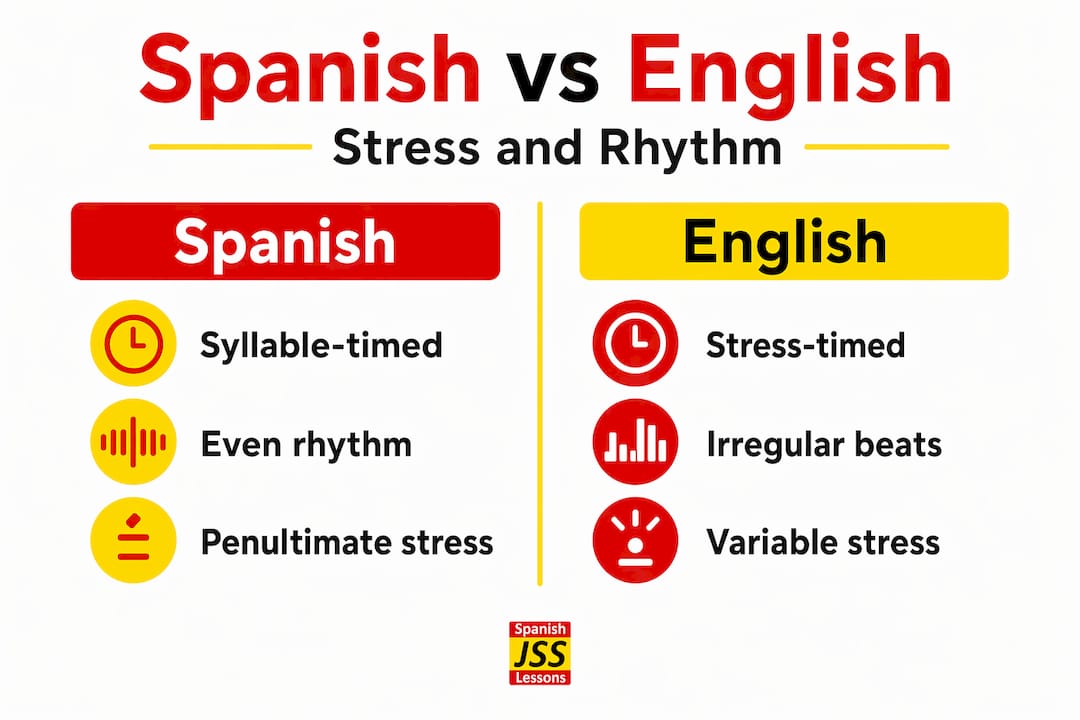
English is a stress-timed language, meaning stressed syllables arrive at roughly regular intervals and unstressed syllables get squashed in between. Spanish is syllable-timed. Every syllable gets roughly equal weight. When you carry English timing into Spanish, the result sounds immediately foreign, no matter how accurate your vocabulary is.
The five pure vowels
Spanish has just five vowel sounds: /a/, /e/, /i/, /o/, and /u/. Each one is short, clean, and consistent. English, by contrast, has around 20 vowel sounds and we naturally stretch and slide between them. The word “no” in English slides from /n/ toward a /w/. In Spanish, the “o” in no is a single, held note. Train yourself to cut vowels cleanly and you will instantly sound more Spanish.
- /a/ as in casa: open, front of the mouth, never the English “ay”
- /e/ as in mesa: mid-tongue, lips slightly spread, never the English “ee”
- /i/ as in sí: shorter and sharper than the English “ee”
- /o/ as in poco: rounder than English, no glide toward /w/
- /u/ as in tú: tight and rounded, no glide toward /w/
Stress and accent marks
In European Spanish, stress falls on the penultimate syllable for 80 to 90% of words ending in a vowel, -n or -s, with written accent marks overriding that rule for exceptions. So hablan is stressed on the first syllable (HAB-lan), while hablé carries an accent to signal the final syllable is stressed instead.
| Sound | Example word | English equivalent |
|---|---|---|
| Pure /a/ | hablar | Shorter than “father” |
| Castilian /θ/ (th) | cerveza, zapato | Same as “think” |
| Rolled /r/ (rr) | perro | No English equivalent |
| Single tap /r/ | pero | American “butter” (flap t) |
| Guttural /x/ (j/g) | jefe, gente | Scots “loch” |
Intonation basics
Declarative sentences in European Spanish fall in pitch at the end. Questions rise. This sounds obvious, but English speakers habitually end statements with a slight rise, which in Spanish makes everything sound like a question. That habit needs active correction from day one.
Pro Tip: Record one sentence in English and one in Spanish and compare the pitch at the end. You will hear your English habit immediately. Catching it is the first step to fixing it.
Mastering these phonological building blocks is essential. If you want to understand more about why Spanish accent differences trip up English learners even at an intermediate level, it is worth exploring how perception and production are connected.
Gathering your tools: resources and techniques for practice
With the basics understood, you need the right methods and resources to start practising effectively. Three tools dominate the field for good reason: shadowing, native media exposure, and self-recording.
Shadowing is the practice of repeating native speech immediately as you hear it, milliseconds behind the speaker, matching their rhythm, speed, and intonation. It is physically demanding at first. Your mouth simply is not trained for Spanish sounds, and the effort shows. That is exactly the point.
Why native media matters
Passive exposure to authentic spoken Spanish, through films, radio, and podcasts, trains your ear to accept the sounds as normal before your mouth attempts them. The ear comes first. Daily 30 to 60 minutes of shadowing combined with native media exposure over 3 to 6 months yields native-like rhythm in syllable-timed Spanish.
Self-recording is non-negotiable. Most people hate hearing their own voice. Do it anyway. Your brain corrects errors automatically when you speak, so you rarely notice them in the moment. A recording does not lie.
| Method | Pros | Cons | Best for |
|---|---|---|---|
| Shadowing | Builds rhythm, intonation, and speed simultaneously | Tiring; errors can fossilise without transcripts | Active practice sessions |
| Native media | Natural exposure; improves ear-tuning | Passive; easy to zone out | Background listening |
| Self-recording | Reveals real errors; tracks progress | Requires courage and consistency | Weekly review sessions |
| Dictation | Sharpens listening and spelling | Slow; does not train speaking directly | Vocabulary and ear work |
Getting started: a simple setup
- Choose a native Spanish podcast or YouTube channel aimed at Spaniards, not learners.
- Download or print the transcript if one is available.
- Listen once without stopping to absorb the overall rhythm.
- Shadow a single paragraph, reading the transcript simultaneously.
- Record your attempt and play it back against the original.
Accessing authentic spoken Spanish materials built for real-life conversations rather than classroom Spanish makes a significant difference at this stage.
Pro Tip: Commit to one short clip of two to three minutes rather than attempting long sessions. Intensity beats duration. Five focused minutes of shadowing outperforms an hour of half-hearted listening.
Consistent practice also requires the right outlets. Exploring structured approaches to practising Spanish conversation will help you convert drill skills into real dialogue.
Executing the practice: step-by-step pronunciation and intonation drills
Now that you have the right tools, let’s apply them through specific pronunciation and intonation exercises targeting the sounds that genuinely separate European Spanish from everything else.
Drilling the hard sounds
The Castilian theta requires 20 to 30 minutes of daily tongue practice to become automatic. This is the “th” sound you produce in English with “think” or “thumb,” applied to the letters c (before e or i) and z. Words like cerveza, ciudad, and zapato all carry this sound in Castilian Spanish. Say “this” then “think” out loud and notice the tongue position. Hold it there and practise gracias, Barcelona, hacer.
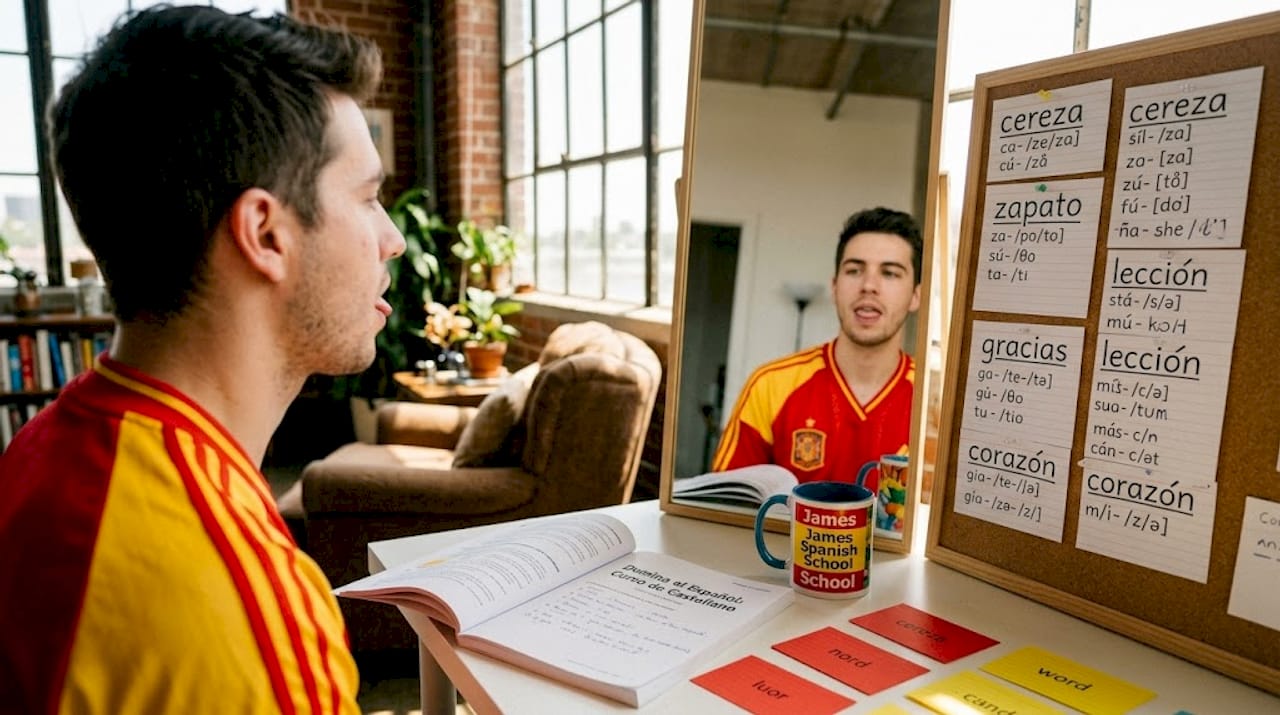
The rolled rr is a trill produced by rapid tongue-tip vibrations against the alveolar ridge (the bony shelf just behind your upper front teeth). Practise the sound “dr” as in “dream” and then replace the “d” with a sustained tongue flutter. It takes weeks. Expect that and keep going.
Step-by-step shadowing routine
- Read the transcript silently first and make sure you understand every word.
- Listen to the clip at 50% speed (most podcast apps allow this) and shadow aloud.
- Increase to 75% speed once the shapes of the sounds feel natural.
- Move to full speed and shadow without looking at the transcript.
- Record the full-speed attempt and compare it directly with the original.
Stress placement exercise
Take any word and divide it into syllables: ha-blar, ca-mi-nar, a-bri-go. Mark the stressed syllable with a capital letter: ha-BLAR, ca-mi-NAR, A-bri-go. Read the word aloud, exaggerating the stressed syllable slightly. Do ten new words every day.
Natural filler words
Native speakers use filler words constantly: pues (well/so), vale (okay), o sea (I mean), venga (come on/alright). Using them at natural pause points buys thinking time and makes your speech sound far less stilted. They signal to your conversation partner that you are a real participant, not a learner reading from a script.
Pro Tip: Exaggerate your falling intonation in statements until it feels theatrical. Your brain will overcorrect and land somewhere closer to native pitch than your default English pattern.
Building these skills into genuine conversation takes support. Structured guidance on reinforcing conversational Spanish skills helps you transfer drill-room progress into real dialogue with real people.
Common pitfalls and how to avoid them on your path to sounding native
Having drilled effectively, it is important to recognise and overcome the key obstacles that could block your progress.
The transcript trap
Jumping straight into shadowing without reading the transcript first is the single most common mistake. When you mimic sounds you do not fully understand, errors embed themselves deep into muscle memory. Those errors are called fossilised mistakes, and they are genuinely difficult to undo once set.
- Always read and understand the transcript before shadowing.
- Look up every word you are unsure about.
- Only then listen and shadow.
English intonation carryover
English rising intonation in statements is deeply wired. It signals uncertainty or friendliness in English. In Spanish it signals a question. Skipping transcripts during shadowing leads to fossilised errors; recording yourself weekly and comparing to native speakers is the most reliable way to catch persistent English intonation habits.
“Most learners plateau not because they lack ability but because they never systematically compare their output to native speech. Weekly recording reviews accelerate improvement faster than any other single habit.” — James Bretherton, James Spanish School
Vowel purity drift
Even learners who nail the vowels in isolation drift back to English vowel shapes when speaking at speed. Slow down. Accuracy at 70% speed beats inaccuracy at full speed. Build speed gradually once the vowel shapes are automatic.
- Record yourself once a week.
- Listen specifically for vowel slides and intonation rises at sentence ends.
- Mark the errors and target them in the next session.
Recognising the broader common Spanish listening challenges helps you understand why certain sounds are hard to hear as well as produce.
Measuring your progress and achieving natural fluency
Finally, let’s explore how you can actively measure your improvement and maintain motivation on your journey toward mastering Spanish sounds.
Progress in accent work is invisible day to day. You will not notice small improvements as they happen. Structured measurement solves that problem.
A simple weekly review routine
- Record yourself speaking for two minutes on any topic in Spanish.
- Play it back alongside a two-minute native clip on a similar topic.
- Note three specific differences: pitch at sentence end, vowel clarity, and stress placement.
- Target those three points in the following week’s practice.
- Keep all recordings so you can compare yourself now to yourself six weeks ago.
Milestone targets by month
Aiming at vague fluency is discouraging. Set specific, observable targets instead.
- Month one: all five vowels consistently pure in slow speech
- Month two: stress placement automatic in familiar vocabulary
- Month three: rolled rr present in at least 50% of attempts
- Month four: falling intonation consistent in statements
- Month five: shadowing at full native speed without transcript
- Month six: native speakers comment positively on your accent
The neuroscience behind why this works
Humans unconsciously converge accents via mirror neurons activated when mimicking native speakers, which explains why consistent shadowing builds native intonation naturally within 4 to 8 weeks. This is not motivational language. It is how auditory-motor learning actually functions. Your brain is physically rewiring itself every time you shadow correctly.
Accessing authentic Spanish speech examples aligned to real-life situations gives your mirror neurons exactly the input they need.
Pro Tip: Celebrate the small wins openly. Tell someone when you nailed the rolled rr for the first time. Positive reinforcement is not indulgent, it is neurologically useful. It keeps you returning to practice when progress feels slow.
Why conventional wisdom on Spanish pronunciation often misses the mark
Most pronunciation advice focuses almost entirely on individual sounds. Get the rr right. Learn the Castilian theta. These matter, but they are not what actually makes the difference between sounding like a learner and sounding like someone who lives there.
The real gap is prosody: the music of the language. Rhythm, intonation, pace, and stress working together. A person with a slightly imperfect rr but perfect rhythm sounds more native than someone with a technically perfect rr firing at English timing.
The second blind spot is what I call the inner voice. Most learners still think in English and translate. The shift happens when you begin to rehearse in Spanish internally, silently forming sentences in Spanish before you speak them. That rehearsal sharpens pronunciation because your inner voice does not fall back on English muscle memory. It is awkward at first. It is also the fastest route to automatic, natural-sounding speech.
There is also a structural reason why European Spanish sounds like a machine gun to English ears. The syllable timing means no syllable is sacrificed for speed. Everything fires at equal weight. Mirror neurons activated during mimicry help your brain adapt to this timing pattern within 4 to 8 weeks of daily shadowing, but only if you are shadowing syllable by syllable, not word by word.
Shadowing with transcripts is genuinely the fastest method available to adult learners. The risk is going too fast too soon. Learners who push to full speed before the sounds are secure end up training their mouth to reproduce a foreign approximation of Spanish rather than the thing itself. Slow is smooth. Smooth is eventually fast.
The practical spoken Spanish skills built on this approach are different from anything you get in a classroom, because classrooms optimise for correctness rather than naturalness. Real-life Spain optimises for speed and familiarity. Closing that gap is the real work, and it rewards those who take it seriously with practical spoken Spanish skills that hold up in real conversations with real people.
Accelerate your journey with professional Spanish courses and resources
You now have a clear path forward. The techniques above will take you a long way on their own, but structure and expert guidance make the journey significantly faster.
At James Spanish School, the entire curriculum is built around the kind of Spanish you actually encounter in Spain: your neighbours, the builder, the receptionist at the health centre, the market stallholder. James Bretherton’s 40 years of living in Spain as a dual-native speaker shape every lesson. The WordAmigo system embeds vocabulary and pronunciation through a five-step retention loop, tackling the two problems that frustrate adult learners most. Explore professional online Spanish lessons designed specifically for English-speaking adults, browse the Spanish learning resources shop for targeted pronunciation tools, or check out the special offers currently available for new learners.
Frequently asked questions
How long does it take to sound like a native Spanish speaker?
With consistent daily practice, 30 to 60 minutes of shadowing combined with native media exposure over 3 to 6 months yields native-like rhythm in syllable-timed European Spanish. Individual results depend on consistency and starting level.
What is the most challenging Spanish sound for English speakers?
The rolled rr and the Castilian theta requiring daily tongue practice of 20 to 30 minutes are consistently the hardest for English speakers, as neither sound exists in standard British or American English.
Why is shadowing effective for improving Spanish pronunciation?
Shadowing activates mirror neurons that converge accents and intonation patterns unconsciously, producing measurable improvement in native-like speech within 4 to 8 weeks of consistent daily practice.
How can I avoid fossilising bad pronunciation habits?
Always read and understand the transcript before shadowing, then record and compare weekly against native speakers to catch persistent errors, particularly English rising intonation in statements, before they become permanent.
What role do filler words play in sounding more native?
Filler words like pues and vale add natural flow to speech and give you thinking time at pauses, signalling to native speakers that you are a genuine conversational participant rather than someone reciting rehearsed phrases.