

TL;DR:
- Spain’s authentic culture is deeply regional, shaped by diverse influences like Moorish, Romani, and Catholic traditions. Social customs such as sobremesa and late-night dining highlight the country’s emphasis on human connection and leisure. Modern shifts in religious identity and regional pride reflect Spain’s dynamic, layered societal identity.
Spain gets flattened into a handful of postcards. Bullfights, flamenco, late-night tapas, siesta. Those images are not wrong exactly, but they are so incomplete they become a kind of fiction. What is genuine Spanish culture goes far deeper than any tourist brochure will tell you. It is a living, regionally varied, historically layered way of being in the world. This article unpacks the real thing: the social values, the artistic heritage, the shifting religious identity, and the everyday rhythms that shape life for millions of Spanish people today.
Table of Contents
- Key takeaways
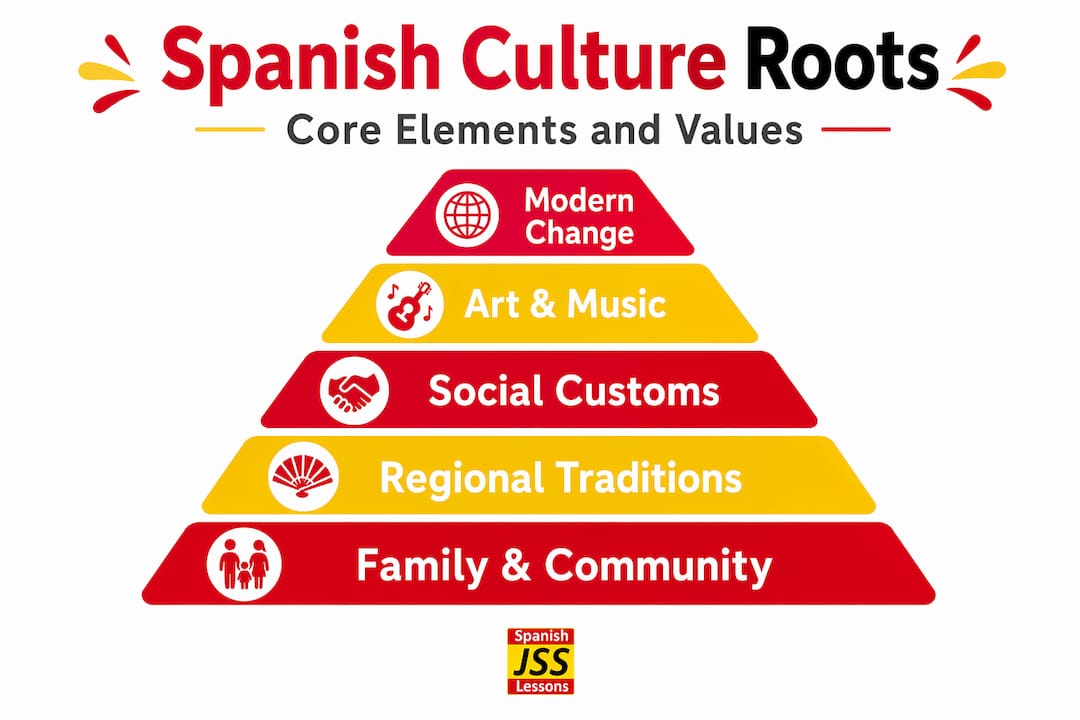
- What genuine Spanish culture is built on
- Social customs and family life
- Flamenco and Spain’s artistic heritage
- How Spanish culture is changing today
- How to engage respectfully with Spanish culture
- My perspective on what makes Spain genuinely different
- Deepen your cultural understanding with Jamesspanishschool
- FAQ
Key takeaways
| Point | Details |
|---|---|
| Spain is deeply regional | Cultural identity varies sharply between Catalonia, Andalusia, the Basque Country, and beyond. |
| Sobremesa defines social life | Lingering after meals is a deliberate cultural practice that prioritises people over schedules. |
| Flamenco is UNESCO heritage | It reflects a fusion of Romani, Moorish, and Andalusian history, not just a dance style. |
| Religious identity is shifting | Only 55% of Spanish adults identified as Catholic in 2025, down from 90% in the late 1970s. |
| Culture is dynamic, not frozen | Younger generations are reshaping Spanish traditions while core social values remain strong. |
What genuine Spanish culture is built on
Most people arrive in Spain expecting one country. What they find is closer to several, stitched together under one flag. Understanding Spanish heritage begins with this single fact: Spain is a nation of autonomous communities, each with its own festivals, language variants, education priorities, and cultural rhythms. Catalonia, the Basque Country, Galicia, and Andalusia are not just geographic regions. They are distinct cultural worlds.
This decentralisation is not a modern invention. It runs all the way back through centuries of conquest, coexistence, and conflict. The Moorish presence in Spain lasted nearly 800 years and left architectural, culinary, linguistic, and musical fingerprints that are still visible today. The Romani people, who arrived in the Iberian Peninsula in the 15th century, contributed directly to what would eventually become flamenco. The Catholic Church shaped everything from the calendar to the layout of town squares. No single thread defines Spanish cultural identity. It is a weave.
Here are the key historical influences that shaped authentic Spanish culture:
- Moorish heritage: Visible in Andalusian architecture, Arabic loanwords in Spanish, and geometric decorative traditions across southern Spain.
- Romani culture: Central to the development of flamenco, cante jondo (deep song), and musical improvisation traditions.
- Catholic tradition: Shaped public festivals, family values, the rhythm of the working week, and social norms around community and generosity.
- Jewish heritage: Present in the Sephardic musical tradition and the architectural layers of cities like Toledo and Girona.
Pro Tip: If you want to understand a Spanish town or city properly, ask a local which regional festival matters most to them. The answer will tell you more about their cultural identity than any guidebook entry.
Social customs and family life
One of the most misunderstood elements of authentic Spanish culture is the relationship with time. Spain does not run on a tight clock. It runs on events and people. Dinner at 8pm is widely considered early, even touristy. Locals in Madrid or Seville might not sit down until 10pm on a weekday. This is not disorganisation. It reflects a deliberate approach to time that places the quality of experience above the efficiency of the schedule.
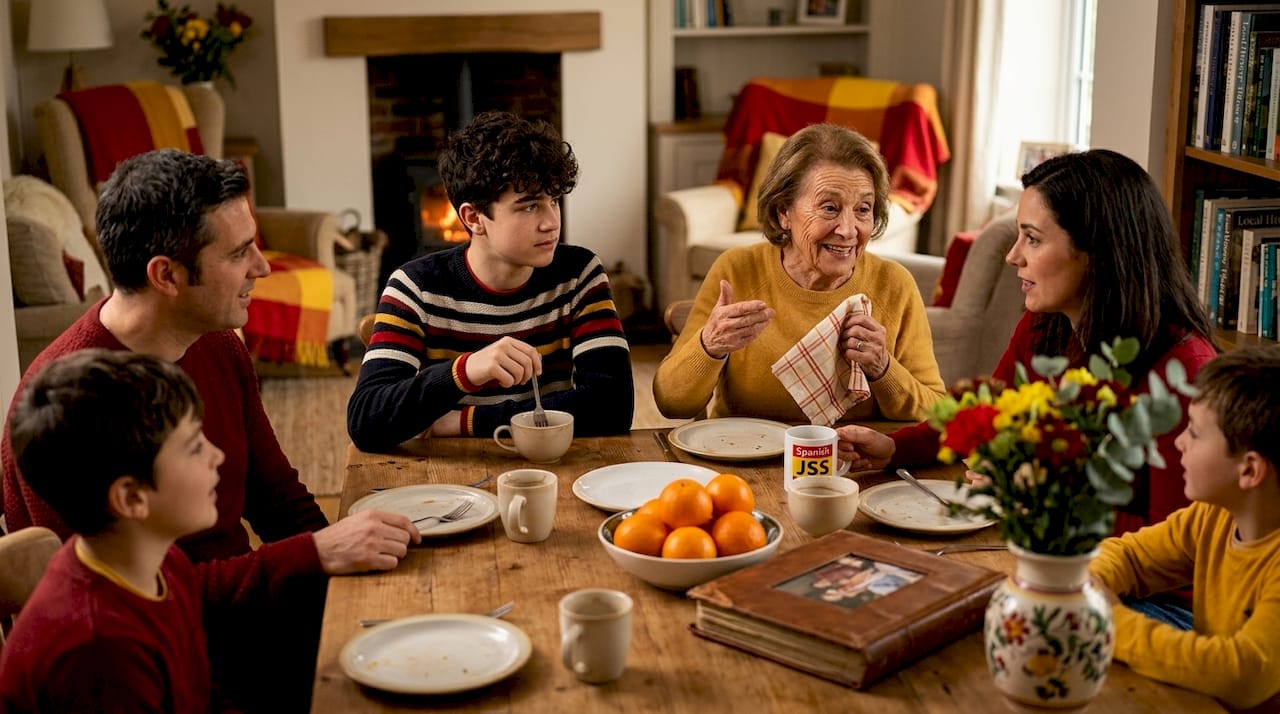
At the centre of this is sobremesa. The word literally means “over the table,” and it refers to the Spanish tradition of staying at the table after a meal is finished, talking, laughing, arguing gently, and simply being together. Average sobremesas last 45 minutes on weekdays and well over two hours at weekends. Sunday family lunches can stretch to three hours or more without anyone considering that unusual.
“Rushing to leave the table after a meal in Spain is not just odd. It is considered rude. The meal is not over when the food is gone. It is over when the conversation is ready to end.” — Spanish cultural etiquette, widely held
This mindset shapes life well beyond the dining room. Here is how it plays out across everyday Spanish social customs:
- Family gatherings are events, not obligations. Three or four generations around one table is normal, not remarkable. Grandparents are not sidelined to a different room or a separate schedule.
- Meals take precedence over meetings. Many Spanish businesses still observe extended midday breaks to protect sobremesa time, particularly outside large cities.
- Elders receive visible respect. Terms of respect are used naturally in conversation, and older family members are included rather than managed.
- Conversation is considered productive. Talking at length over food is not wasted time. It is how relationships are maintained and how social trust is built.
The siesta, though far less universal than it once was in urban Spain, reflects the same underlying value: life should accommodate human needs, not the other way around.
Flamenco and Spain’s artistic heritage
Few art forms carry the weight of a culture’s entire history. Flamenco does. Recognised by UNESCO as Intangible Cultural Heritage since 2010, it is a fusion of Romani, Moorish, Jewish, and Andalusian influences that developed over centuries in the south of Spain. It is not one thing. It contains dozens of distinct palos (styles), ranging from the raw, sorrowful soleá to the joyful bulerías, each carrying its own emotional register and social context.
What makes flamenco particularly revealing as an element of authentic Spanish culture is how it is transmitted. It was not born in academies or conservatoires. Flamenco originated in family gatherings and courtyards, passed from parents to children, from neighbours to neighbours, through listening and watching rather than formal instruction. That oral, family-based transmission is itself a reflection of broader Spanish cultural values: the primacy of personal connection, the trust in lived experience over institutional learning.
| Flamenco element | Cultural significance |
|---|---|
| Cante (singing) | Expresses deep emotion, historical memory, and personal struggle |
| Baile (dance) | Communicates feeling through body language and improvisation |
| Toque (guitar) | Provides the harmonic and rhythmic foundation; deeply linked to Moorish musical heritage |
| Palmas (clapping) | Audience participation; reinforces communal nature of the art form |
Pro Tip: Avoid tablaos aimed purely at tourists in major cities. If you want to experience flamenco as a living cultural practice, look for a peña flamenca, a local flamenco club, where the audience is Spanish and the atmosphere is genuine.
How Spanish culture is changing today
Culture is never static, and Spain is no exception. One of the most striking shifts in contemporary Spanish identity is the decline in Catholic affiliation. In 2025, only 55% of Spanish adults identified as Catholic, compared with roughly 90% in the late 1970s. The non-religious population has risen to 42%. This is a profound cultural shift in a country where the Church once governed the rhythm of public and private life.
Yet the picture is more textured than a simple turn towards secularism. Around 40% of Spanish agnostics still report believing in some form of spiritual reality or force. A further 15% describe themselves as spiritual but not affiliated with any religion. Spain is not abandoning meaning. It is reorganising where meaning comes from.
For English speakers trying to grasp what defines Spanish culture today, this matters practically. Key aspects of Spanish culture to understand in a contemporary context include:
- Religious festivals persist as social, not purely spiritual, events. Semana Santa processions in Seville draw enormous crowds from people of all beliefs. The cultural and aesthetic experience is the draw, not doctrinal observance.
- Younger Spaniards are reshaping tradition. Urban millennials and Gen Z Spaniards may eat later, embrace international influences, and reject some older social expectations. But the value placed on family, community, and genuine social connection remains remarkably consistent.
- Regional identity is strengthening, not weakening. In Catalonia and the Basque Country especially, local cultural identity has intensified in recent decades, making regional context more important than ever when understanding Spanish heritage.
How to engage respectfully with Spanish culture
Knowing about a culture and knowing how to move within it are two different things. These practical steps will help you engage authentically with Spanish social life, whether you are visiting, relocating, or simply deepening your understanding.
- Stay at the table. When you eat with Spanish people, do not reach for your phone or signal that you are ready to leave the moment the plates are cleared. Sobremesa is an invitation, not a formality.
- Adjust your time expectations. If a Spanish friend invites you to dinner at 9pm, they mean 9pm. Arriving at 7:30pm would be genuinely confusing. Dinner at 10pm on a Friday is not unusual.
- Learn some Spanish, even the basics. Speaking even a few phrases of local Spanish, including everyday slang, shifts how people respond to you. It signals respect and genuine interest.
- Engage with regional culture specifically. Ask which local festival is the most important, which dish the region is known for, which dialect feature marks a local. Spanish people take pride in this specificity.
- Avoid defaulting to clichés. Asking a person from Barcelona whether they enjoy bullfighting is the cultural equivalent of asking someone from Edinburgh whether they wear a kilt every day. It flattens identity rather than engaging with it.
Understanding living in Spain as a practical reality, rather than a fantasy built from holiday memories, is the foundation of genuine cultural engagement.
My perspective on what makes Spain genuinely different
I have lived in Spain for 40 years. I speak Spanish as a native. And I will tell you honestly: the thing that still surprises outsiders most is not the food, the weather, or the architecture. It is the social seriousness of leisure.
In my experience, the English-speaking world tends to treat relaxation as a reward for productivity. You earn your rest. In Spain, the relationship is reversed. The meal, the conversation, the time with family: these are not what you do after the real business of the day. They are the real business. I have watched newly arrived expats fidget through a three-hour Sunday lunch because they could not shake the feeling that they should be doing something. They were doing something. They just had not learnt to recognise it yet.
What I have also learnt is that Spain resists generalisation more than almost any other country I know. The cultural gulf between a village in Extremadura and a neighbourhood in central Barcelona is genuinely vast. Anyone who tells you they understand Spanish culture after a fortnight in Málaga is, kindly put, just getting started.
The richness is in the regional detail, in the social rituals, and in the willingness to sit still long enough to let a culture show you who it actually is. That takes time. But it is worth every minute.
— James
Deepen your cultural understanding with Jamesspanishschool
Language and culture are not separate subjects. Every word you learn in Spanish comes loaded with social context, regional flavour, and cultural meaning. At Jamesspanishschool, the 100-lesson course taught by James Bretherton, a dual-native speaker with 40 years of life in Spain, goes well beyond grammar. You learn practical conversational Spanish rooted in real situations: talking to neighbours, understanding tradesmen, following local news, and holding your own during a two-hour sobremesa.
The WordAmigo system locks vocabulary and pronunciation into memory through a five-step retention loop, so the words you learn stay with you. Everything is available on demand, with no deadlines and no pressure. If you are ready to move from understanding Spanish culture intellectually to living it with confidence, explore the full course here.
FAQ
What is the most important social custom in Spanish culture?
Sobremesa, the practice of lingering at the table after a meal, is one of the most defining social customs in Spain. Average weekday sobremesas last around 45 minutes, with weekend gatherings often extending well beyond two hours.
Is flamenco genuinely part of everyday Spanish culture?
Flamenco is authentic cultural heritage, but it is specific to certain regions, particularly Andalusia. Recognised by UNESCO since 2010, it remains a living art form passed down through families and community gatherings rather than formal institutions.
Is Spain still a Catholic country?
Spain’s religious identity has shifted significantly. In 2025, only 55% of Spanish adults identified as Catholic, down from around 90% in the 1970s. Religious festivals still carry strong cultural significance even among non-religious Spaniards.
How does Spain’s regional diversity affect its culture?
Spain’s autonomous communities control their own education, festivals, and languages, meaning cultural experiences can differ dramatically from one region to the next. Authentic engagement with Spanish culture requires attention to where in Spain you actually are.
Why do Spaniards eat so late?
Spain’s relationship with time is event-based rather than clock-based. Meals are social occasions that happen when people are ready and together, not because a schedule dictates it. Evening meals at 9pm or later are entirely normal for most Spanish households.