

TL;DR:
- Mastering Spanish sentence construction begins with understanding that it follows a subject-verb-object order similar to English, but with flexible word arrangements and placement rules. Learning core verbs, practicing simple affirmative, negative, and question sentences, and gradually adding adjectives and pronouns develop fluency more effectively than memorizing complex grammar; consistent daily practice accelerates this process. Internalizing verb conjugations and the function of building blocks allows learners to speak naturally, omit subject pronouns, and communicate confidently in real-life conversations.
Learning how to build Spanish sentences feels straightforward until you actually try it. The words are there, but they refuse to line up the way they do in English. Suddenly “I see him” becomes Le veo, and the object has jumped in front of the verb. If you are an English speaker preparing for real life in Spain, whether as a retiree, an expat, or someone planning a long stay, this guide walks you through the building blocks of Spanish sentence construction, from simple affirmative statements all the way to natural, flexible phrasing that does not sound like a translation.
Table of Contents
- Key takeaways
- How to build Spanish sentences: the foundations
- Step-by-step guide to building simple sentences
- Adding detail: adjectives, adverbs, and clauses
- Pronouns, word order flexibility, and natural phrasing
- Practice habits, common pitfalls, and building fluency
- My honest advice after 40 years in Spain
- Build faster with Jamesspanishschool
- FAQ
Key takeaways
| Point | Details |
|---|---|
| SVO order is your starting point | Spanish follows subject-verb-object order by default, just like English, making the basics familiar. |
| Verb conjugation replaces pronouns | Once you know your conjugations, dropping “yo” or “tú” makes you sound far more natural. |
| Adjectives follow nouns | Unlike English, Spanish adjectives usually come after the noun and must agree in gender and number. |
| Negative sentences are simple | Place no directly before the verb and you have a negative sentence. Double negatives reinforce, not cancel. |
| Twenty percent of structures carry eighty percent of conversation | Mastering a small set of high-frequency verbs and core patterns gets you speaking faster than memorising grammar charts. |
How to build Spanish sentences: the foundations
The first thing that surprises most English speakers is that Spanish sentence structure is not wildly different at the core. Both languages use a Subject-Verb-Object order as the default. “María drinks coffee” becomes María bebe café. The subject comes first, then the action, then what the action involves. That familiarity is genuinely good news.
Where things diverge is in the details. Spanish offers considerably more word order flexibility than English. You can rearrange elements to shift emphasis without losing meaning, which is a feature you will want to use eventually. For now, stick with SVO and let the complexity arrive gradually.
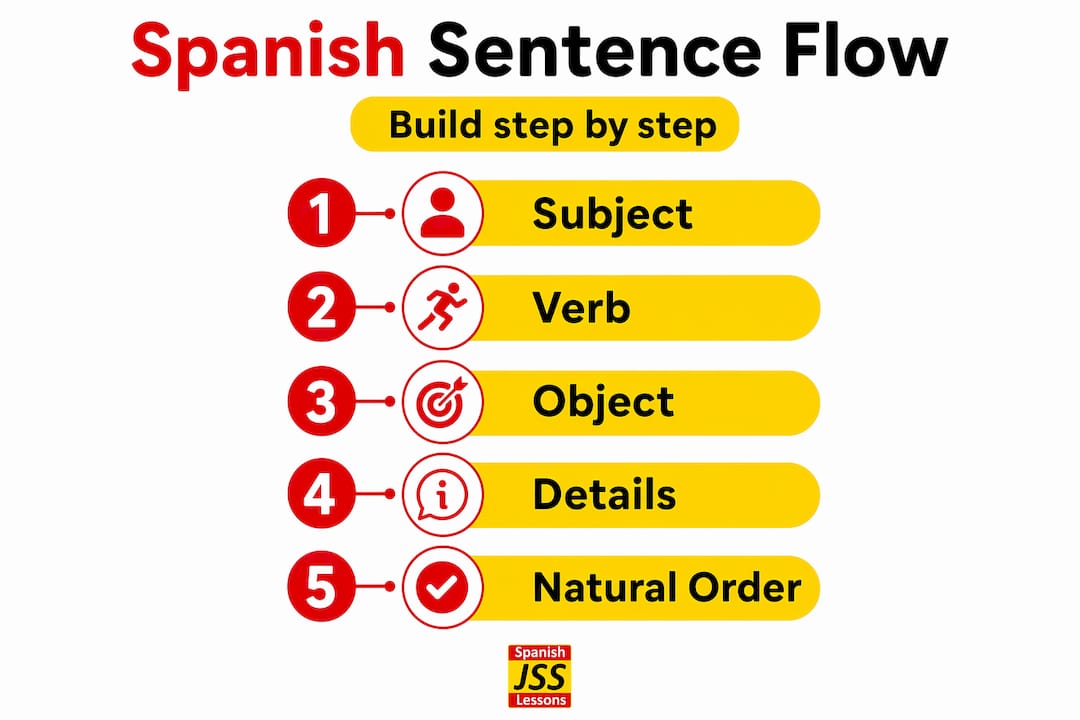
Here is a comparison of how the same sentence elements behave in each language:
| Element | English behaviour | Spanish behaviour |
|---|---|---|
| Subject pronoun | Required (“I eat”) | Usually optional (“Como” means “I eat”) |
| Adjective position | Before the noun (“red car”) | Typically after the noun (“coche rojo”) |
| Object pronoun | After the verb (“I see him”) | Before the verb (“Le veo”) |
| Negation | “not” after auxiliary verb | no directly before the main verb |
| Question formation | Auxiliary verb inversion | Intonation or inversion, both acceptable |
A few things to fix in your mental model straight away:
- Adjectives follow nouns in almost all everyday cases. “A cold beer” is una cerveza fría, not una fría cerveza.
- Object pronouns precede conjugated verbs, which feels backwards at first but becomes automatic with practice.
- Subject pronouns are optional. Context and the verb ending tell your listener who is performing the action.
Pro Tip: When you learn a new verb, practise it immediately in a full sentence rather than in isolation. Writing “Como una manzana” (I eat an apple) is worth ten repetitions of the word “comer” alone.
This is the structural logic that underpins everything. Nail these basics and the rest of the guide to Spanish sentence structure will slot into place much more quickly.
Step-by-step guide to building simple sentences
Most learners try to run before they can walk by jumping into complex tenses and lengthy sentences. The smarter approach is to build short, correct sentences first and expand them deliberately. Think of each sentence as an engine room: the verb is at the centre, and everything else connects to it.
Here are the core Spanish sentence building steps you need to follow:
- Choose a high-frequency verb. Start with verbs you will use every day: ser (to be, permanent), estar (to be, temporary), tener (to have), ir (to go), querer (to want), poder (to be able to). Mastering these core structures accounts for the majority of your daily conversational needs.
- Add a subject if you need clarity. In a conversation with your plumber, saying Tengo un problema (I have a problem) is perfectly clear. But if you are specifying who has the problem, add the noun: Mi vecino tiene un problema (My neighbour has a problem).
- Build your affirmative sentence. Subject (optional) + verb (conjugated) + object. Quiero un café con leche. Done. No auxiliary verbs, no “do” constructions.
- Turn it negative. Place no directly before the verb. No quiero un café con leche. Spanish uses double negatives for reinforcement, not to cancel out. No tengo nada means “I have nothing.” Both negatives stay.
- Form a question. The simplest method is to raise your intonation at the end of an affirmative sentence. ¿Quieres un café? You can also invert the subject and verb: ¿Tienes tiempo? Both are correct in everyday European Spanish conversation.
- Drop the subject pronoun once the verb is clear. Instead of Yo quiero ir al mercado, say Quiero ir al mercado. The -o ending already tells your listener the subject is “I.”
Pro Tip: For your first week of practising, write five sentences a day using only the verbs ser, estar, tener, and querer. Restrict yourself to three or four words per sentence. Short, correct sentences build confidence faster than long, error-filled ones.
If you find yourself knowing vocabulary but struggling to assemble it, you are not alone. A guide for learners who know words but cannot form sentences explores exactly why this gap happens and how to close it.
Adding detail: adjectives, adverbs, and clauses
Once a basic sentence feels natural, the next move is to enrich it. This is where forming sentences in Spanish starts to feel genuinely expressive rather than transactional.

Spanish adjectives usually follow the noun and must agree with it in gender and number. “A comfortable flat” is un piso cómodo, but “two comfortable flats” becomes dos pisos cómodos. The adjective changes its ending to match. A handful of adjectives change meaning depending on whether they appear before or after the noun: un gran hombre means a great man, while un hombre grande means a big or tall man. These exceptions are worth learning individually as they arise.
Adverbs are less complicated. Most of the time, Spanish adverbs sit directly after the verb they modify or at the beginning of the sentence for emphasis. Habla lentamente (she speaks slowly) keeps the adverb right after the verb, while Normalmente como a las dos (I normally eat at two) places the time adverb at the front. Neither position is wrong.
Here are practical tips for adding sentence detail without losing control of the structure:
- Use que (that/which) to join two thoughts. El fontanero que llamé ayer es muy bueno. (The plumber that I called yesterday is very good.) This single word does the work of a relative clause.
- Add time expressions to give context without complexity. Mañana voy al médico. (Tomorrow I am going to the doctor.) These slot in at the start or end of a sentence without disturbing the core structure.
- Use conjunctions like pero (but), porque (because), and aunque (although/even though) to connect clauses. No puedo ir porque trabajo means “I cannot go because I work.” Two complete thoughts, one clean sentence.
- Layer description gradually. Start with the noun, add one adjective, then a time expression. Do not attempt three subordinate clauses until the basic pattern feels effortless.
The building blocks approach to beginner Spanish structure works well here: treat each element as a module that clips onto the core sentence rather than something that rewrites the whole structure.
Pronouns, word order flexibility, and natural phrasing
This is the section where many learners feel the ground shift beneath them. Pronouns, in particular, behave very differently from English, and understanding their placement is what separates stilted, translated Spanish from the real thing.
Here is a quick reference for pronoun placement and word order variants:
| Feature | Rule | Example |
|---|---|---|
| Direct object pronoun | Before the conjugated verb | Le veo (I see him) |
| Indirect object pronoun | Before the conjugated verb, before direct | Te digo la verdad (I tell you the truth) |
| Both pronouns together | Indirect first, then direct | Me lo explica (He explains it to me) |
| Emphasis via word order | Move subject to the end | Llama María (It’s María calling) |
| Dropping the subject | Conjugation makes subject clear | Vamos al bar (We are going to the bar) |
The reason learners must embrace word order flexibility is not just stylistic. Moving elements around is how Spanish speakers signal what is new information versus what is already known. When a Spanish speaker says A mí me gusta el café rather than Me gusta el café, the emphasis lands on “me” specifically. That nuance communicates something.
Native speakers omit subject pronouns constantly because verb conjugations make the subject unambiguous. Developing this habit requires solid conjugation knowledge, but once it clicks, your Spanish begins to sound genuinely fluent rather than textbook-correct.
Pro Tip: Record yourself saying five sentences with object pronouns each day, then compare them to native audio. Your ear will adjust faster than your eye. This is how real fluency is built, through listening and mimicking, not just reading grammar rules.
Practice habits, common pitfalls, and building fluency
Knowing how to construct a sentence and being able to do it mid-conversation are two very different things. The gap closes with the right kind of practice, not just more study.
Experts recommend at least 15 minutes of daily practice using active recall and sentence building from scratch. That means writing or speaking sentences without prompts, not filling in blanks in a worksheet. Active creation forces your brain to retrieve and assemble, which is exactly what it does in a real conversation.
Common pitfalls to avoid, and good habits to build instead:
- Pitfall: Memorising verb conjugation tables without ever using them in sentences. Better approach: Conjugate into a complete sentence immediately. Yo tengo, tú tienes, él tiene is forgettable. Tengo hambre, ¿tienes tiempo?, ella tiene razón is memorable and useful.
- Pitfall: Translating word by word from English before speaking. Better approach: Think directly in Spanish by starting with a verb and building out from there.
- Pitfall: Trying to learn every tense and structure before speaking. Better approach: Prioritising core grammar structures reduces the cognitive load and gets you conversational faster.
- Pitfall: Correcting every sentence in your head before saying it, causing long pauses. Better approach: Speak with acceptable errors, then self-correct afterwards.
- Good habit: Creating sentences from scratch based on your real life. What did you do this morning? Describe it in Spanish in three sentences.
Constructing Spanish sentences well is ultimately about pattern recognition built through repetition, not rules memorised in the abstract. The moment a structure feels like a reflex rather than a calculation, you have genuinely learned it.
My honest advice after 40 years in Spain
I have worked with hundreds of adult learners, and the most common trap I see is treating Spanish as a coded version of English. People arrive with their English sentence fully formed in their head and then try to find Spanish words to fit the same slots. That process is exhausting, slow, and unnecessary.
What actually works is learning to think of sentence components as building blocks. The verb is the centre. The subject may not even need to appear. The object pronoun clips on in front of the verb. Once you internalise those positions as physical slots, not translation decisions, your fluency accelerates noticeably.
In my experience, the learners who progress fastest are not the ones who study the most grammar. They are the ones who commit to verb conjugations early, because conjugation proficiency is what unlocks pronoun omission and that single shift makes a speaker sound dramatically more natural. Get your conjugations solid and the rest follows.
Do not be afraid of making mistakes. A shopkeeper in Madrid would rather hear you attempt Quiero medio kilo de jamón, por favor with a few rough edges than watch you freeze trying to construct a perfect sentence. Communication always wins over perfection.
— James
Build faster with James Spanish School

If this guide has given you a clearer picture of Spanish sentence structure, Jamesspanishschool can take you much further. The 100-lesson course at James Spanish School is built specifically for English-speaking adults who want to hold real conversations in Spain, not pass academic exams. Half of those lessons are dedicated to sentence building using the Radical Simplification method, which strips out confusing grammar terminology and replaces it with plain English explanations you can actually use.
The WordAmigo vocabulary system works alongside the course to lock new words and correct pronunciation into long-term memory through a five-step retention loop. You can explore all available course materials and learning tools on the Jamesspanishschool shop page, where options for every starting level are available on demand, with no expiry date and no pressure.
FAQ
What is sentence building in Spanish?
Sentence building in Spanish means assembling a subject, verb, and object in the correct order, while applying rules such as adjective placement after nouns, pronoun positioning before the verb, and using verb conjugations to indicate who is acting. It is the core skill that connects vocabulary knowledge to actual speech.
What is the basic word order for Spanish sentences?
Spanish uses a Subject-Verb-Object order by default, identical to English. However, Spanish allows more flexibility than English for shifting elements to create emphasis, so the SVO order is a starting point rather than a fixed rule.
How do you make a negative sentence in Spanish?
Place no directly before the conjugated verb. Spanish uses double negatives for reinforcement rather than cancellation, so No tengo nada (I have nothing) is correct and standard in everyday speech.
Why do Spanish speakers often drop the subject pronoun?
Because verb conjugations in Spanish already reveal who is performing the action, the subject pronoun becomes redundant in most situations. Dropping “yo” or “tú” is a natural fluency marker, not an error.
How long does it take to build sentences naturally in Spanish?
With at least 15 minutes of daily practice or 3 hours per week focused on active sentence creation rather than passive study, most adult learners begin constructing simple sentences with confidence within a few weeks. Fluency with complex structures takes longer but develops steadily when core verb patterns are prioritised first.