

TL;DR:
- Many English speakers in Spain mistakenly view customs like meal times and greetings as optional, risking social disconnect.
- Understanding Spanish social rhythms, communication styles, and regional variations fosters genuine integration and community belonging.
Living in Spain and feeling like an outsider at your own dinner party? You are not alone. Many English speakers arrive here assuming that Spanish customs are decorative, perhaps charming, but ultimately optional. That is a costly misreading. Understanding why understand Spanish customs matters is not about becoming a textbook Spaniard. It is about unlocking the social logic that holds communities together, so that your neighbours, your local shopkeeper, and your doctor’s receptionist actually warm to you. This guide cuts through the surface to show you what is really going on.
Table of Contents
- Key takeaways
- Core Spanish customs shaping daily life
- How Spanish communication differs from British norms
- Time perceptions and social expectations
- Practical benefits of understanding Spanish customs
- Tips for learning and adapting to Spanish customs
- Start learning with the right support
- FAQ
Key takeaways
| Point | Details |
|---|---|
| Customs drive daily rhythm | Spanish meal times, greetings, and social pace are not quirks. They structure the entire social day. |
| Communication style differs | Spanish expressiveness, close contact, and directness can be misread by British speakers without cultural awareness. |
| Time works differently | Arriving 20 minutes late to a social event is normal and expected, not rude. |
| Integration requires cultural fluency | Building genuine rapport depends on understanding social expectations, not just learning vocabulary. |
| Learning language and customs together | Grasping cultural context alongside language accelerates real confidence in everyday situations. |
Core Spanish customs shaping daily life
Spain’s social rhythms are unlike anything most British expats have encountered before. They are not random. They follow a deeply embedded logic that prioritises community, pleasure, and shared time over efficiency and scheduling.
The most obvious difference is food timing. Lunch falls between 2 PM and 4 PM, with dinner typically beginning at 9 PM or later. If you try to eat at noon, you will often find restaurants closed or serving only snacks. These are not inconvenient leftovers from another era. They reflect the Spanish understanding that a proper meal is a social event, not a fuel stop. The midday meal is still the main meal of the day for many families, shared at length with conversation, wine, and no particular rush.
Then there are greetings. Spanish greetings involve a double cheek kiss, starting with the right cheek, used commonly between friends and acquaintances. Men who know each other well often do the same. Walking into a room of ten people and offering a limp handshake to the nearest person, then nodding at the rest, will register as cold. The greeting ritual matters because it signals belonging.
Family bonds are another pillar. Family and multigenerational households sit at the centre of Spanish society, with strong ties between grandparents, parents, and children. It is entirely normal for three generations to share Sunday lunch every week without fail. When your neighbour mentions a family gathering, she is not describing an unusual occasion. She is describing her regular weekend.
Key customs to be aware of from the outset:
- Meal timing: Adjust your expectations around when restaurants open and when social eating happens.
- Physical greetings: Practise the double cheek kiss so it feels natural rather than awkward.
- Sunday lunch culture: Understand that this is sacred social time for many families.
- Tapas etiquette: Ordering tapas is a social activity, not just a food order. Sharing is expected.
Pro Tip: If you are invited to a Spanish home for dinner and arrive at the stated time, you may well be first. Arriving 15 to 20 minutes after the invited hour is the culturally comfortable zone for social gatherings.
How Spanish communication differs from British norms
One of the sharpest contrasts for British expats is how Spaniards actually talk to each other. Spanish communication is expressive, proximate, and lively, involving close physical distance, frequent eye contact, and a vocal energy that can feel overwhelming at first.
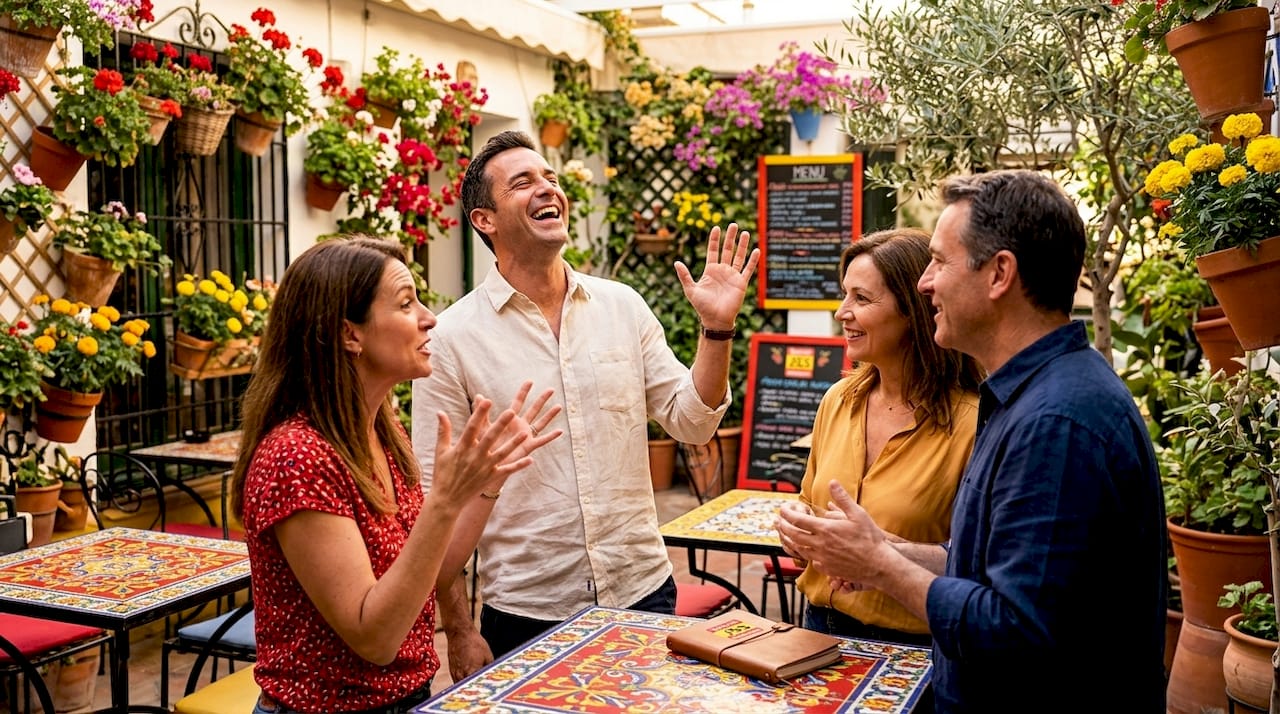
British conversational norms tend toward restraint. We leave pauses. We avoid interrupting. We moderate our volume in public. Spanish conversation often runs quite differently. Interrupting a speaker mid-sentence is not necessarily rude. It frequently signals enthusiasm and engagement. If someone cuts across your story to add their own experience, they are joining in, not dismissing you.
Directness is another area where cultural awareness matters. A Spaniard who thinks your plan is a bad idea will often say so plainly. There is no softening through hedging phrases like “I’m not sure that’s entirely ideal.” This directness is not unkindness. It is respect. Once you understand that framing, a candid “no, that won’t work” stops feeling like a rebuff and starts feeling like honest engagement.
Consider these common misreads that occur without cultural awareness:
- Loud conversation: Often interpreted by British ears as an argument. Usually it is not.
- Close physical proximity: Spanish conversational distance is shorter than British norms. Stepping back may read as aloofness.
- Emotional expressiveness: Animated gestures and strong facial expressions are normal emphasis, not drama.
- Apparent interruptions: Often a sign of interest rather than disrespect.
Understanding Spanish etiquette at this level, the conversational texture rather than just the words, is where real connection begins. You can find more on this idea at genuine Spanish culture, which looks at how authenticity in culture differs from surface-level observation.
Time perceptions and social expectations
Perhaps nothing confuses newly arrived British expats more than Spain’s relationship with time. It is one of the most misunderstood aspects of the culture, and getting it wrong affects how people perceive you.
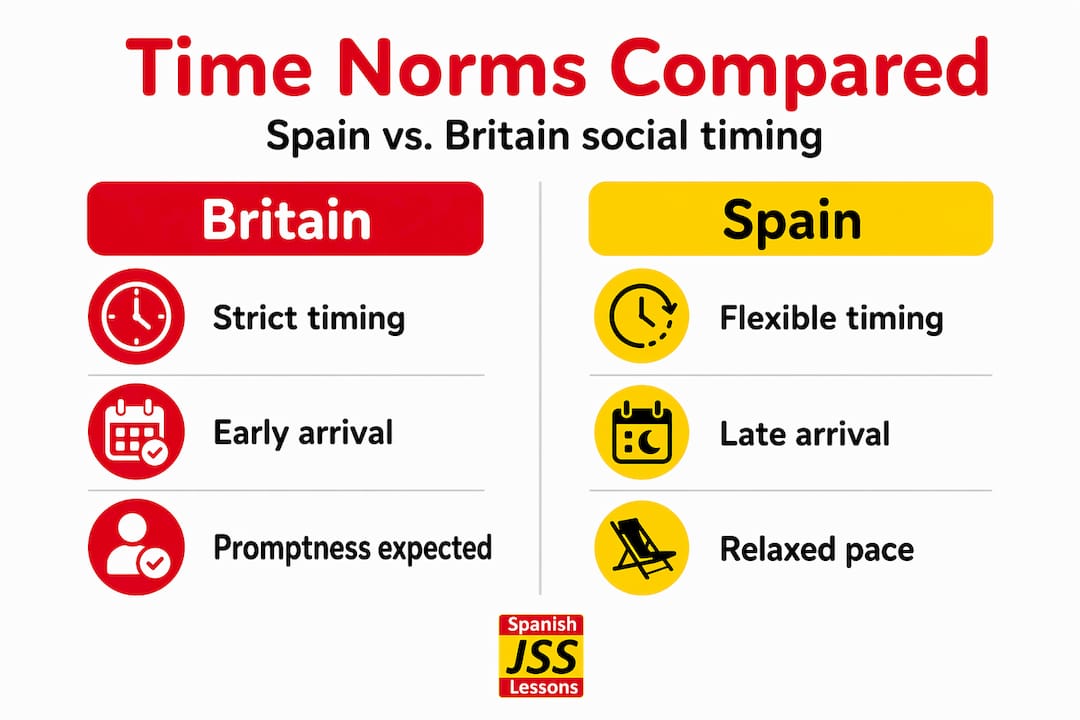
Arriving up to 30 minutes late for informal social events is broadly accepted and often expected in Spain. This is not disorganisation. Time flexibility in Spanish culture prioritises social harmony over rigid scheduling. The logic is that social occasions should unfold naturally, not be clocked to the minute. When a Spaniard says “hasta luego” in a social context, it might mean they will see you in ten minutes or in two hours. The relationship matters more than the clock.
| Setting | British expectation | Spanish norm |
|---|---|---|
| Social gathering | Arrive on time or slightly early | Arrive 15 to 30 minutes after stated time |
| Business meeting | Punctual to the minute | Generally punctual, though slight flexibility exists |
| Restaurant reservation | Arrive at stated time | Often flexible by 10 to 15 minutes |
| Family lunch | Fixed start time | Fluid, food comes when it comes |
The concept of mañana is frequently mocked by expats, but newcomers who treat time flexibility as inefficiency often find themselves perpetually frustrated and perpetually isolated. The adjustment is not about lowering standards. It is about recognising that a different priority system is in operation, one that places the quality of the interaction above the speed of completion.
The siesta tradition is relevant here too. Whilst the full post-lunch nap is less universal in cities than it once was, the quiet period between roughly 2 PM and 5 PM remains real. Shops close, phone calls go unanswered, and attempting urgent business during these hours will routinely fail. Working with this rhythm rather than against it will save you considerable frustration.
Pro Tip: When scheduling anything practical, such as a plumber, a council appointment, or a shop visit, aim for morning slots. The Spanish working day front-loads its activity, and afternoons are more social in orientation.
Practical benefits of understanding Spanish customs
The cultural significance of Spanish customs is not abstract. There are concrete, everyday benefits to understanding them, and they accumulate quickly once you start paying attention.
- Avoiding culture shock. Newcomers who prioritise transactional speed over relationship-building frequently experience culture shock in Spain. Awareness of customs means you can anticipate situations rather than being blindsided by them.
- Building trust and rapport. Spanish social interaction places relationships before objectives. Understanding this means you stop trying to get to the point and start investing in the conversation first. That shift alone will change how local people respond to you.
- Enjoying festivals and local events fully. Spain’s calendar of festivals, from local fiestas to Semana Santa, carries layers of meaning that are invisible without cultural context. When you understand the social mechanisms behind community customs, you move from observer to participant.
- Gaining language confidence. Cultural understanding and language learning reinforce each other. When you know why a phrase is used in a particular situation, it sticks. Context beats vocabulary lists for precisely this reason.
- Earning genuine acceptance. Local communities notice when you make the effort. Attempting the double cheek kiss, adapting to meal times, and showing patience in conversations signals respect. That respect is reciprocated.
Tips for learning and adapting to Spanish customs
The benefits of understanding Spanish culture are clear. The practical question is how you actually go about it.
Observation is your most powerful starting tool. Before acting, watch. Notice how people greet each other in your local bar. Watch who pays the bill and how that is negotiated. Observe how a Spanish mother talks to her adult children in public. You will learn more in twenty minutes of genuine watching than in any guidebook chapter.
Language exchange is another underused approach. Understanding the cultural reasoning behind expressions is far more valuable for real connection than memorising vocabulary. A conversation partner who can explain why something is said, not just what it means, will accelerate your integration considerably. You can also explore reinforcing Spanish conversational skills through structured practice that mimics real exchanges.
Practical habits that speed up adaptation:
- Learn regional variations. Spain is not culturally uniform. Catalan, Andalusian, and Basque customs differ meaningfully. Know where you are.
- Ask questions respectfully. Spaniards are generally proud of their culture and delighted when foreigners show genuine curiosity.
- Accept invitations. Turning down a social invitation, even once, can close a door that takes months to reopen.
- Be patient with yourself. Cultural fluency takes time. Progress is measured in months, not days.
Language exchange builds cultural values understanding, moving you from someone who knows Spanish words to someone who thinks in Spanish social terms. That is the real goal
Start learning with the right support
Understanding Spanish customs deepens considerably when language and culture are learned together rather than separately. At James Spanish school, the 100-lesson course is built around exactly this principle. Real Spanish as it is spoken in daily life, not textbook phrases stripped of context.
James Bretherton has spent four decades immersed in Spanish society, and that experience shapes every lesson. The online Spanish course at JSS covers sentence-building and ear-tuning alongside genuine cultural insight, from how to handle a conversation with your local builder to navigating a visit to the health centre. The WordAmigo system embeds vocabulary and pronunciation so that words stay with you. No expiry dates, no countdown clocks. Learn at your own pace and build shop Spanish confidence in the places that matter most to your daily life.
FAQ
What does it mean to understand Spanish customs?
Understanding Spanish customs means recognising the social rules and values that shape daily interactions in Spain, including greetings, meal times, time expectations, and communication styles. It goes beyond surface-level awareness and supports genuine integration into local communities.
Why does understanding Spanish customs matter for expats?
Cultural awareness helps expats avoid misunderstandings, build trust with local people, and participate fully in community life. Newcomers who overlook relationship-building in favour of transactional interactions often find integration significantly harder.
How long does it take to adapt to Spanish customs?
Adaptation varies by individual, but most expats find that active observation and participation in daily social life produce noticeable comfort within several months. Patience and a willingness to adjust expectations are the biggest factors in how quickly that comfort arrives.
Is punctuality expected in Spanish social life?
No. Arriving up to 30 minutes after the stated time is perfectly normal for social events. Professional settings are generally more punctual, though some flexibility exists there too.
Do Spanish customs vary by region?
Yes, significantly. Catalonia, the Basque Country, Andalusia, and Galicia each carry distinct cultural identities, local languages or dialects, and social norms. Understanding the regional culture where you live adds an important layer of nuance to your integration.