

TL;DR:
- Academic Spanish is a formal, written standard that often does not reflect how people speak in daily life. Relying solely on it can hinder real fluency, listening comprehension, and natural conversation skills. Instead, learners should prioritize authentic spoken input, social register awareness, and practical communication to connect effectively in Spain.
If you have ever spent months studying Spanish textbooks and then frozen solid when a local spoke to you at machine-gun speed, you already know the problem. Understanding why avoid academic Spanish is not an abstract debate for linguists. It is the difference between sounding like a walking grammar exam and actually connecting with your neighbours, your doctor, and the man fixing your roof. This guide breaks down what academic Spanish actually is, the genuine disadvantages of academic Spanish for everyday use, and what to focus on instead if your goal is real communication in Spain.
Table of Contents
- Key takeaways
- Why avoid academic Spanish in everyday life
- How academic Spanish blocks real fluency
- Common pitfalls of relying on formal Spanish
- How to learn practical, everyday Spanish
- My honest take on academic Spanish
- Start learning Spanish that actually works
- FAQ
Key takeaways
| Point | Details |
|---|---|
| Academic Spanish is prescriptive | It follows elite written standards that often do not reflect how Spanish is genuinely spoken in daily life. |
| Over-formality causes social awkwardness | Misusing usted instead of tú can make you sound stiff or even rude, even when grammatically correct. |
| Accuracy habits slow fluency | Classrooms that reward correctness over communication produce learners who hesitate rather than speak. |
| Literal translation traps you | Knowing individual words without understanding idioms and spoken context leads to comprehension gaps. |
| Practical methods close the gap | Audio-based, context-rich learning focused on register and spoken patterns builds real-life fluency faster. |
Why avoid academic Spanish in everyday life
Academic Spanish is the version taught through prescriptive rules, standardised grammar, and formal written norms. Think of it as the language of official documents, university essays, and the Real Academia Española. It sets out how the language should be used according to a long-established elite standard. The trouble is, Spanish language academies have historically wrestled between prescriptivism, telling people how to speak, and descriptivism, which simply describes how people actually do speak.
Everyday Spanish in Spain is a living, breathing thing. It shifts by region, age group, social setting, and the time of day. The language your butcher uses on a Tuesday morning in Valencia is not the language of a formal letter to your town hall. Both are valid. But only one will get you through real life.
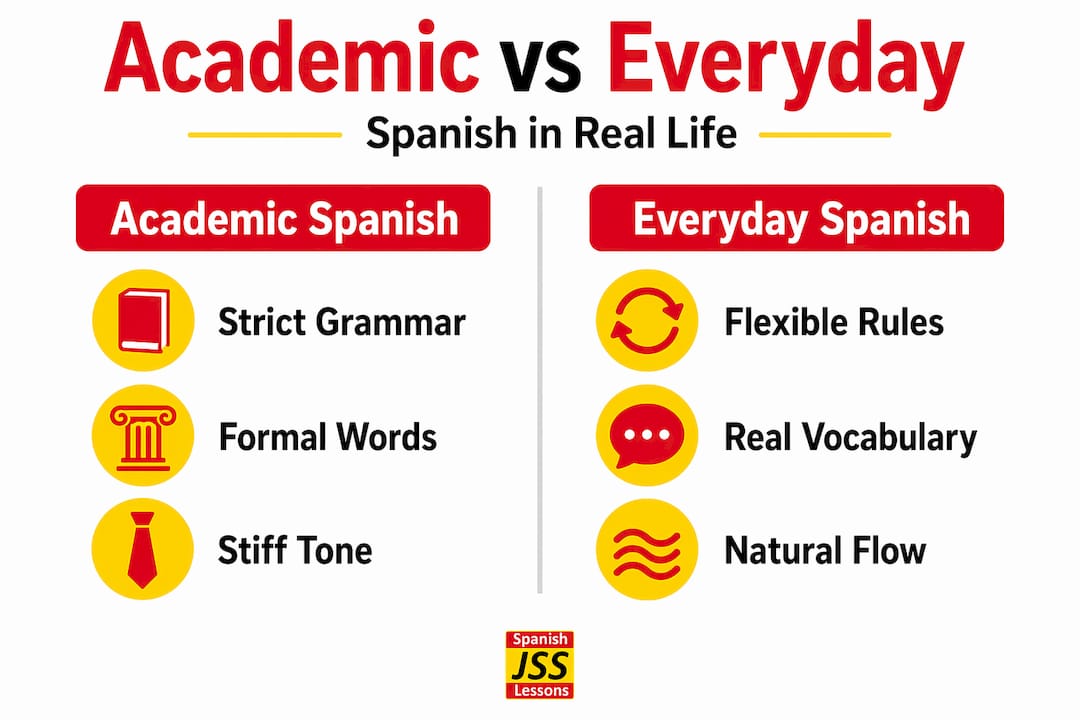
Here is how the two versions compare:
| Feature | Academic Spanish | Everyday Spanish |
|---|---|---|
| Grammar | Strictly prescribed, full subjunctive use | Natural, sometimes incomplete sentences |
| Vocabulary | Formal, Latinate, precise | Colloquial, idiomatic, regional slang |
| Sentence length | Long, structured, complex | Short, clipped, context-dependent |
| Register | Formal to neutral | Casual to informal in most social settings |
| Tone | Distant, authoritative | Warm, direct, sometimes abrupt |
The core issues with scholarly Spanish for everyday use come down to register. If academic Spanish is your only tool, you will use it in situations where it does not fit, and that creates friction with native speakers who were not expecting it.
How academic Spanish blocks real fluency
The disadvantages of academic Spanish go deeper than sounding a bit formal. They can actively slow your progress as a learner, particularly when it comes to listening and spontaneous speech.

Accuracy-focused classroom tasks dominate traditional Spanish instruction, which conditions learners to check every sentence in their head before speaking. In a real conversation, that internal grammar check becomes a wall. Native speakers do not wait. By the time you have assembled the perfect subjunctive clause, they have already moved on to another topic.
The consequences of academic vocabulary are just as significant. Learners who have absorbed formal word lists often understand Spanish in writing but struggle when the same meaning is expressed through idioms, contractions, or regional phrases in speech. Classroom input patterns are deeply ingrained and difficult to unlearn without dedicated conversational practice. The habits you build in a classroom, rewarded for correctness, can stick around long after you move to Spain and make real-time conversation feel surprisingly hard.
There is also the listening problem. Academic Spanish trains your ear for clear, measured speech. Authentic spoken Spanish in Spain, however, is fast, clipped, and full of dropped syllables and regional inflections. The gap between the two is often the biggest shock for new expats.
Pro Tip: Balance accuracy practice with regular exposure to authentic spoken Spanish. Even ten minutes a day of listening to a Spanish podcast, radio programme, or conversation recording will help your ear adjust to real speech patterns far faster than grammar drills alone.
Consider what this means for should I avoid academic Spanish as a learning focus. The answer is not to abandon grammar entirely. It is to stop treating academic norms as the end goal and start treating them as one small part of a much bigger picture.
Common pitfalls of relying on formal Spanish
Academic Spanish pitfalls tend to cluster around a few predictable mistakes. Recognising them early can save months of frustration.
- Translating word for word. Literal translations are one of the most common barriers to fluency. Spanish idioms, phrasal constructions, and even basic expressions often have no direct English equivalent. Trying to map English grammar onto Spanish sentences produces something technically understandable but noticeably foreign.
- Overusing usted in casual settings. Register use is socially loaded in Spain. Misapplying formal address such as usted in an informal context can come across as cold, sarcastic, or simply odd. Most adults in Spain use tú with strangers of similar age or younger without a second thought.
- Over-applying the subjunctive. Academic Spanish courses drill the subjunctive extensively because it is grammatically complex and testable. But forcing it into casual speech where a simpler construction would do can make you sound like you are writing a legal brief rather than chatting over coffee.
- Missing idiomatic meaning. Learners who know words but lack context-based practice often understand individual vocabulary but miss how meaning is built dynamically through discourse, tone, and shared cultural reference. A phrase like “ya” can mean yes, I understand, I am done, fine then, or give it a rest, depending entirely on context.
- Ignoring regional variation. Academic Spanish presents a uniform standard. Real spoken Spanish in Spain, particularly between Castilian, Andalusian, and Valencian varieties, is anything but uniform. Sticking rigidly to academic norms leaves you unprepared for the richness and variation of genuine spoken Spanish.
These issues with scholarly Spanish are not signs of failure. They are the predictable outcome of learning a language primarily through formal, written instruction rather than through communicative, contextual practice.
How to learn practical, everyday Spanish
Knowing why not use formal Spanish as your main focus is only useful if you know what to replace it with. The good news is that shifting your approach does not mean starting over. It means redirecting your effort.
- Prioritise spoken, contextual input. Audio-based learning builds the kind of natural pattern recognition that grammar textbooks cannot replicate. Hearing real voices in real situations rewires your listening expectations.
- Learn register, not just grammar. Understanding when to use tú, usted, and vosotros and what each communicates socially is as important as knowing how to conjugate them. Pragmatic awareness is what separates a proficient speaker from one who merely passes exams.
- Study real-life speaking situations. Grounding vocabulary and phrases in practical speaking contexts means that when the situation arises, the language is ready. Abstract vocabulary lists rarely produce fluent recall under conversational pressure.
- Build tolerance for imperfection. Native speakers are remarkably forgiving of accents and small grammatical slips. What disrupts communication is hesitation and over-caution. Prioritising flow over flawlessness will make you more engaging and more understood.
- Use methods built around real-life fluency. Explore real-life Spanish conversation resources that put communication first and treat grammar as the support structure, not the main event.
The goal is not perfection. It is connection.
My honest take on academic Spanish
I have been teaching English speakers to speak Spanish in Spain for a long time, and I have watched the same pattern play out more times than I can count. Someone arrives with solid textbook Spanish. They can conjugate beautifully. They know their irregular verbs. And then they walk into a bar in Seville and understand almost nothing.
The problem is not intelligence. It is what they practised. Accuracy-driven instruction produces learners who are excellent at producing correct written Spanish but slow and uncertain in real spoken exchanges. The habits formed in the classroom, the internal checking, the fear of making a mistake, follow them into real conversations.
What I have learned over four decades in Spain is that the language people actually speak here is warm, fast, idiomatic, and deeply contextual. It rewards engagement over precision. A learner who speaks imperfect but confident Spanish will always get further in daily life than one who speaks perfect but hesitant Spanish.
My advice is simple. Stop chasing the academic standard as your primary goal. Learn how people actually talk, practise spoken Spanish skills with authentic materials, and embrace the messy reality of a living language. Spain will meet you more than halfway.
— James
Start learning Spanish that actually works
At James spanish school, everything is built around real life in Spain, not passing formal exams. The 100-lesson course covers sentence-building and ear-tuning, specifically designed to help you follow fast native speech and hold your own in real conversations. The WordAmigo system uses strategic repetition to lock vocabulary and pronunciation in place permanently. If you are ready to move beyond academic habits and start building practical, confident Spanish, explore the current course options or check out the spoken practice lessons designed for everyday fluency. There is no countdown clock, no expiry, and a cast-iron guarantee that every lesson delivers something new.
FAQ
What does academic Spanish actually mean?
Academic Spanish refers to the formal, prescriptive standard based on written norms and elite usage rules promoted by bodies such as the Real Academia Española. It is the Spanish of textbooks, formal essays, and official documents, not daily conversation.
Should I avoid academic Spanish completely?
You do not need to avoid grammar entirely, but treating academic norms as your primary goal can slow real-life communication. Accuracy-driven habits built in classrooms are hard to unlearn and can hinder spontaneous spoken fluency.
Why does formal Spanish cause problems in Spain?
Overusing formal register such as usted in casual situations can come across as cold or socially inappropriate, even if grammatically correct. Spain’s spoken culture is informal and direct in most everyday settings.
What is the biggest pitfall of academic Spanish for learners?
The single biggest trap is literal translation. Word-for-word reading causes learners to miss idiomatic meaning, discourse structure, and contextual signals that are essential for genuine comprehension in speech.
How can I improve my practical Spanish quickly?
Focus on listening to authentic spoken Spanish daily, learn social register cues, and practise in real-life contexts rather than grammar drills. Methods that prioritise communication over correctness produce noticeably faster results for everyday use.