

Why learning shop Spanish unlocks confidence in Spain. There is a curious trick that can speed you on the journey to fluency. Spain catches many English-speaking visitors and residents off guard. You might expect that a popular destination for British expats and tourists would be well set up for English speakers, but Spain ranks 36th globally in English proficiency, scoring in the moderate band. Step outside the tourist zones and into a local market, a neighbourhood bakery, or a supermarket fish counter, and the reality becomes clear very quickly. Shopping in Spain without any Spanish is not just inconvenient; it can be genuinely stressful. This guide gives you the vocabulary, cultural knowledge, and practical strategies to shop with confidence from day one.
Table of Contents
- Why English alone leads to confusion when shopping in Spain
- Essential shop Spanish: Key vocabulary, phrases, and mechanics
- Cultural norms and nuances in Spanish shopping
- Building practical independence and rapid confidence
- What if you rely on English, online shopping, or expat options?
- Find your path to practical shop Spanish with expert guidance
- Frequently asked questions
Key Takeaways
| Point | Details |
|---|---|
| English proficiency is limited | Most shops outside tourist areas in Spain require at least basic Spanish for confident interaction. |
| Shop Spanish builds confidence | Learning key vocabulary and phrases transforms shopping from stressful to enjoyable. |
| Cultural norms matter | Understanding Spanish etiquette and customs is just as vital as language skills for seamless shopping. |
| Rapid results are possible | Daily practice delivers usable shop Spanish within weeks, enabling a smoother everyday life. |
Why English alone leads to confusion when shopping in Spain
There is a common assumption that English gets you through most situations in Spain. In the main tourist resorts and expat-heavy coastal towns, that assumption holds reasonably well. Walk into a local supermercado in a Spanish town or city, however, and the picture changes entirely.
Spain’s moderate English proficiency means that staff at local shops, market stalls, and assisted service counters are often working entirely in Spanish. Pointing and guessing works up to a point, but it quickly breaks down when you need to ask about prices, request a specific cut of meat, or understand a promotional offer.
The practical consequences are real. Without Spanish, shoppers regularly face:
- Confusion at fish and produce counters where staff ask how you want items prepared
- Misunderstandings over prices, special offers, or loyalty card schemes
- Inability to ask for specific quantities or request alternatives
- Embarrassment and frustration that makes the whole experience feel exhausting
As expat integration research shows, many English speakers retreat into expat bubbles, shopping only in familiar international supermarkets and missing out on the richness of local Spanish life. A Spanish course that focused on practical independence changes that dynamic entirely.
“The language barrier in everyday situations like shopping is one of the most commonly cited frustrations among English-speaking residents in Spain.”
Essential shop Spanish: Key vocabulary, phrases, and mechanics
Once you understand the gap that English leaves, the solution becomes straightforward. You do not need to be fluent. You need a working toolkit of words and phrases that cover the situations you actually encounter.
The core vocabulary for shopping in Spain centres on a handful of essential nouns, verbs, and questions. Here is a quick-reference table of the most useful phrases:
| Spanish phrase | English meaning | When to use it |
|---|---|---|
| ¿Cuánto cuesta? | How much does it cost? | Checking any price |
| ¿Puedo pagar con tarjeta? | Can I pay by card? | At the till |
| Me pones medio kilo, por favor | Can I have half a kilo, please? | At counters |
| ¿Tienes…? | Do you have…? | Asking for a product |
| ¿Dónde está…? | Where is…? | Finding items in a shop |
| La cuenta, por favor | The bill, please | Paying up |
| ¿Está incluido el IVA? | Is VAT included? | Checking final price |
Beyond the phrases themselves, a few key verbs do a lot of heavy lifting: comprar (to buy), pagar (to pay), costar (to cost), necesitar (to need), and querer (to want). Combine these with numbers and basic nouns and you can handle most shop interactions confidently.
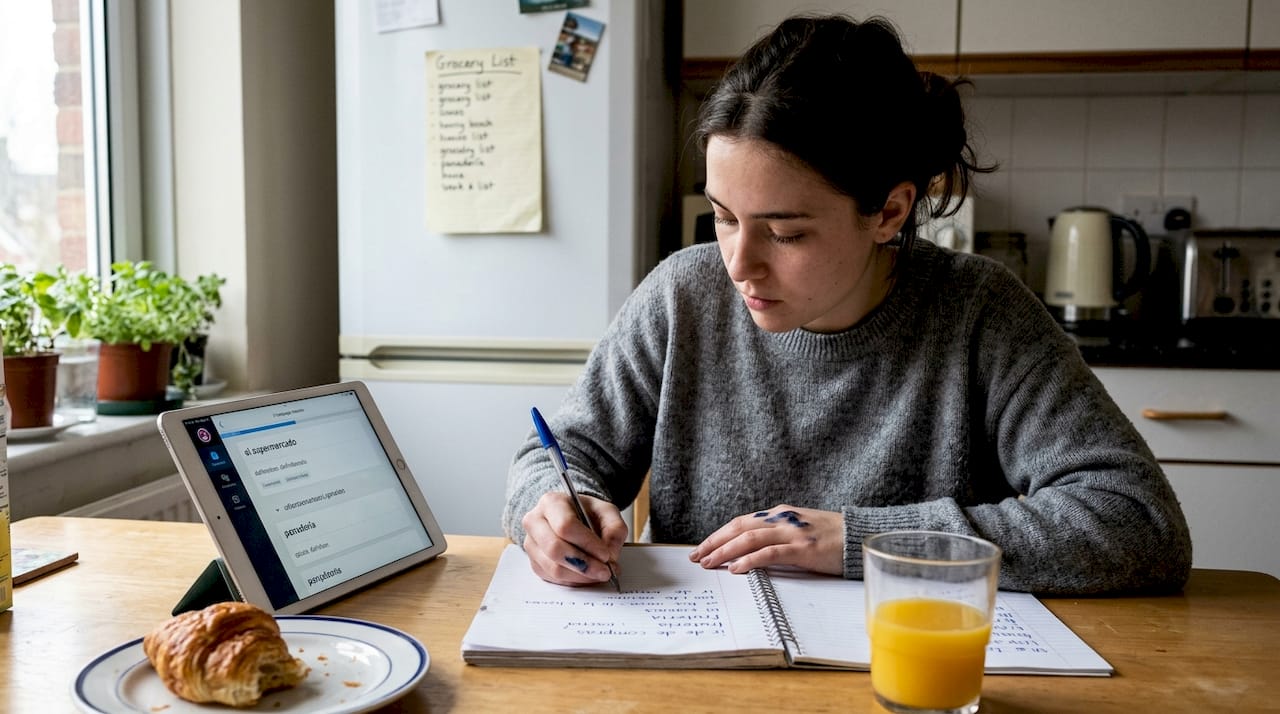
The cultural approach matters too. Always greet with Hola or Buenos días when you enter a small shop. Use por favor and gracias consistently. These small courtesies signal respect and make staff far more willing to help you through any language gaps.
Key shop-related vocabulary to learn first:
- Supermercado (supermarket), panadería (bakery), mercado (market), carnicería (butcher), pescadería (fishmonger)
- Caja (till/checkout), bolsa (bag), recibo (receipt), oferta (offer/sale), precio (price)
- Fresco (fresh), congelado (frozen), ecológico (organic), sin gluten (gluten-free)
Pro Tip: At assisted counters, the phrase Me pone… is your best friend. It literally means “put me” but functions as a polite way of requesting something. Add the quantity and the item: Me pone dos filetes de merluza, por favor (Two hake fillets, please). Staff will immediately recognise you as someone making a genuine effort.
Cultural norms and nuances in Spanish shopping
Vocabulary alone will not fully prepare you. Spain has its own shopping culture, and understanding it saves you from avoidable confusion and the occasional awkward moment.
Here are the practical norms that most foreigners discover the hard way:
- Take a ticket at counters/or último. At busy fish, meat, and deli counters, there is usually a ticket machine. Take a number and wait to be called. Jumping the queue, even accidentally, causes real friction… Or be aware of the traditional Spanish queuing question – Who is the last? ¿Quién es el último?
- Bring a coin for the trolley. Many Spanish supermarkets still require a €1 coin deposit for trolleys. Supermarket practicalities like this catch newcomers off guard regularly.
- Bring your own bags. Plastic and paper bags are charged for in Spain, so most locals bring reusable bags. Having them signals that you know the routine.
- Plan around Sunday closures. Outside tourist areas, most supermarkets and local shops close on Sundays. Saturday afternoon shopping is also quieter than you might expect and expect fresh fruit shortages.
- Bargaining is rare. Unlike some markets elsewhere in Europe, haggling in Spanish shops and supermarkets is not the norm. The exception is some outdoor flea markets (rastros).
There is also an important linguistic distinction worth knowing. Spanish shopping culture distinguishes between hacer la compra (doing the grocery shopping, a practical task) and ir de compras (going shopping for pleasure). Using the right phrase in conversation signals genuine cultural awareness.
| Situation | What to do | Phrase to use |
|---|---|---|
| Entering a small shop | Greet the staff | Hola, buenos días |
| At the fish counter | Specify preparation | Limpio y fileteado, por favor |
| At the till | Confirm payment method | ¿Puedo pagar con tarjeta? |
| Leaving any shop | Say goodbye | Hasta luego, gracias |
Building practical independence and rapid confidence
The most encouraging thing about learning shop Spanish is how quickly it pays off. You do not need months of study before you see real results in daily life.
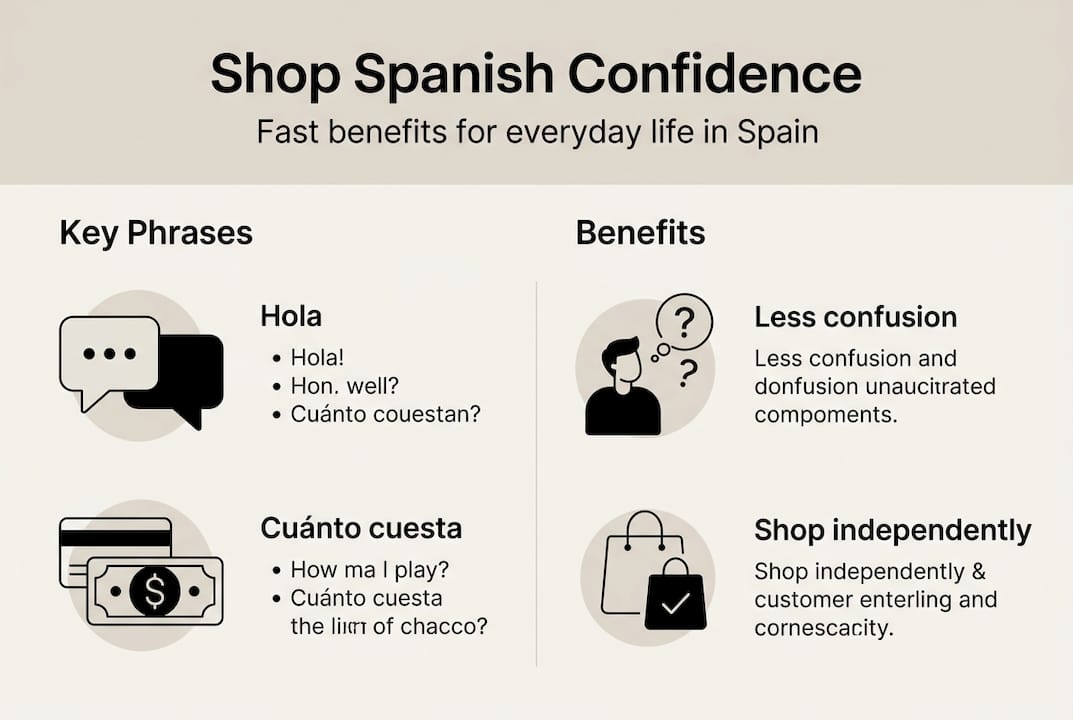
Basic conversational ability, including greetings, numbers, and key phrases, is achievable within one to four weeks with just 15 to 30 minutes of daily practice. That is enough to handle most shopping situations with confidence.
The benefits go well beyond convenience:
- Micro-interactions build confidence fast. Every successful exchange at a counter or till reinforces your ability and motivates you to keep going.
- You integrate rather than isolate. Shopping locally in Spanish connects you to the community in a way that English-only shopping simply cannot.
- You get better value. Local markets and neighbourhood shops often offer fresher produce and lower prices than international supermarkets catering to expats.
- You reduce daily stress. Knowing you can handle a shopping trip removes a significant source of anxiety for many expats and visitors.
- You build a foundation for broader Spanish. The vocabulary and confidence gained through shopping transfers directly to other everyday situations.
“Learning even a small amount of Spanish for practical daily tasks like shopping creates a ripple effect. Confidence in one area quickly spreads to others.”
The practical independence that comes from achievable shop Spanish is not a small thing. For many English-speaking residents in Spain, it marks the turning point between feeling like a permanent outsider and genuinely feeling at home.
What if you rely on English, online shopping, or expat options?
It is worth being honest about the alternatives, because they do exist and they do work, up to a point.
In coastal expat areas, British and international supermarkets stock familiar products, staff often speak English, and you can get by without any Spanish at all. Online shopping in Spain through platforms like Amazon Spain and El Corte Inglés is also well developed, allowing you to browse and buy in English or with translation tools.
But these options come with real trade-offs:
- You miss the local experience. Spanish markets and neighbourhood shops are where real community life happens. Avoiding them means missing a significant part of living in Spain.
- You pay a premium. International supermarkets in expat areas typically charge more than local alternatives.
- You limit your integration. Tourist and expat zones provide a comfortable bubble, but they actively slow down your connection to Spanish culture and people.
- You remain dependent. Relying on English or online options means any situation outside those zones, a rural market, a local pharmacy, a town hall, still feels daunting.
The numbers tell their own story. Foreigners now make up 14% of supermarket customers in Spain, a figure projected to grow by 75% over the next 15 years. That is a significant community, and the ones who thrive are those who engage with Spanish rather than work around it.
“Expat communities offer comfort and familiarity, but they can also become a ceiling that prevents genuine connection with the country you have chosen to live in.”
Find your path to practical shop Spanish with expert guidance
If this article has shown you anything, it is that shop Spanish is not about passing exams or memorising grammar rules. It is about real conversations with real people in the places you visit every day.
At James Spanish School, the entire course is built around exactly this kind of practical, everyday Spanish. James Bretherton has lived in Spain for 40 years and designed his 100-lesson programme using Radical Simplification, stripping away confusing grammar jargon and replacing it with plain English explanations that actually make sense. The course covers sentence-building and ear-tuning so you can both speak and understand fast native Spanish. You learn on demand, at your own pace, with no expiry date and no pressure. Whether you are planning a move, already living in Spain, or visiting regularly, this is the most direct route to confident, practical Spanish for daily life. To see James no-nonsense short list approach click here.
Frequently asked questions
How quickly can I learn shop Spanish for everyday use?
With daily 15 to 30 minutes of practice, most adults reach a basic shop Spanish level within one to four weeks, enough to handle greetings, prices, and counter requests confidently.
Are most shops in Spain open on Sundays?
Supermarkets and local shops outside tourist areas are generally closed on Sundays, so it is worth planning your weekly shop around this.
Can I shop in Spain with English only?
English is limited outside tourist and expat zones, as Spain ranks 36th globally in English proficiency. Learning key shop Spanish phrases makes a significant practical difference.
What are the most useful shop Spanish phrases?
The most practical phrases include ¿Cuánto cuesta? (how much does it cost?), ¿Puedo pagar con tarjeta? (can I pay by card?), and Me pone medio kilo, por favor (half a kilo, please) for counter requests.