

TL;DR:
- Spanish sentence simplification involves transforming complex sentences into clearer, more natural versions while maintaining meaning. It helps learners achieve real conversational fluency by focusing on common verbs, active voice, shorter sentences, and recognizing natural phrase shortening. AI tools like GPT-4 support this process, but human oversight ensures the resulting speech sounds authentic and fluent.
Spanish sentence simplification is the deliberate process of transforming complex Spanish sentences into clearer, easier versions without changing their meaning. For English-speaking adults learning European Spanish, this process is the engine room of real comprehension. Research using the Newsela and ClearSim corpora shows that transformer models reach strong scores when identifying complex words and restructuring sentences, confirming that simplification is both a teachable skill and a measurable one. Tools like GPT-4 and methods developed by linguists at James Spanish School demonstrate that accessibility and clarity are the twin goals, not simply making sentences shorter. Understanding this distinction is what separates learners who plateau from those who genuinely begin to follow native speech.
What is Spanish sentence simplification and why does it matter?
Spanish sentence simplification is defined in natural language processing research as a task that transforms complex texts into easier versions by rephrasing or splitting sentences while preserving meaning. In plain terms, it means taking a sentence that would stop you in your tracks and rebuilding it so the meaning lands immediately. This is not about dumbing the language down. It is about matching the structural logic of a sentence to what your brain can process at speed.
For English speakers learning European Spanish, the stakes are practical. You need to follow a pharmacist in Madrid, understand a plumber explaining a problem, or catch what your neighbour says over the fence. None of those conversations wait for you to parse a subjunctive clause. Simplification gives you the tools to both produce and receive Spanish at a level that works in real life, not just in a classroom exercise.
The standard academic term for this process is text simplification, with a specific branch called lexical simplification focused on replacing difficult words. James Spanish School refers to its own version as Radical Simplification, which removes grammar terminology entirely and explains Spanish structure through plain English. Both approaches share the same core principle: clarity first.
What are the main techniques for simplifying Spanish sentences?
The most effective techniques for Spanish grammar simplification fall into five clear categories. Each one addresses a specific source of complexity that trips up English-speaking learners.
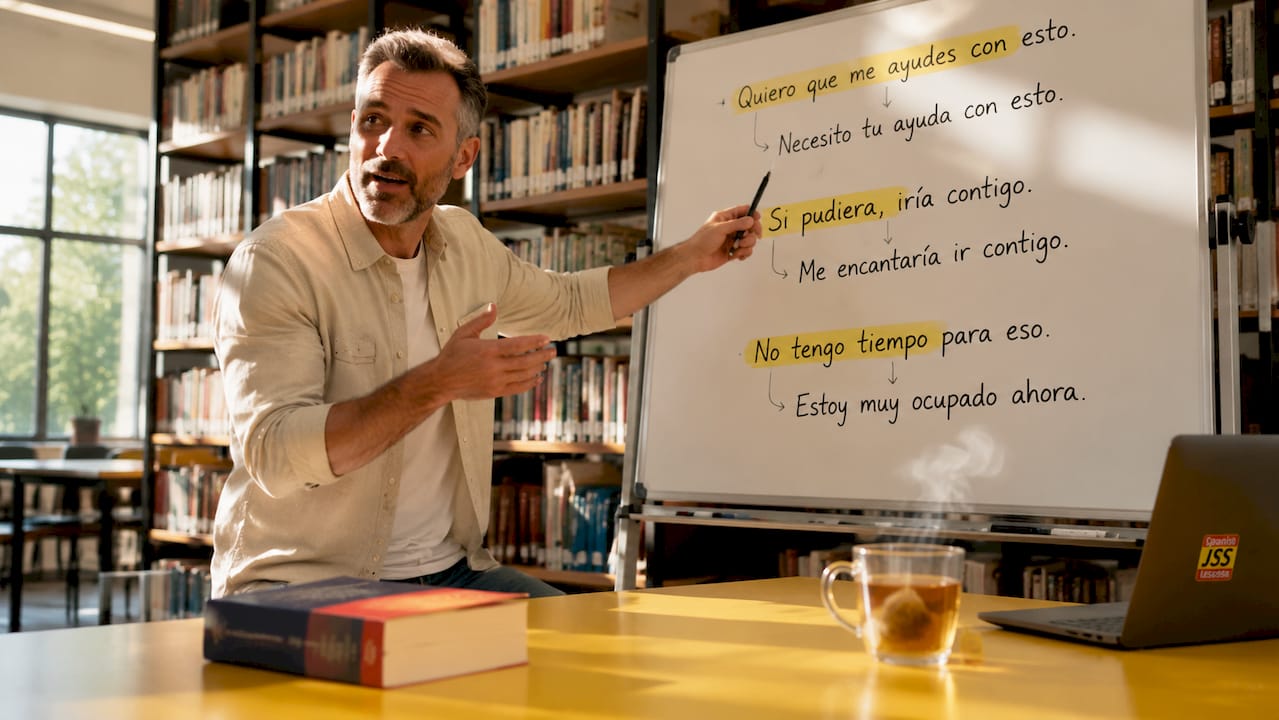
- Use common, everyday verbs. Replace formal or compound verb constructions with the verbs native speakers actually reach for first. Necesito beats me es preciso. Quiero beats tengo el deseo de. The simpler verb carries the same weight with none of the friction.
- Favour active voice. Passive constructions in Spanish, such as el problema fue resuelto por el técnico, add length and cognitive load. The active version, el técnico resolvió el problema, is shorter, clearer, and far more common in spoken European Spanish.
- Replace academic nouns with everyday synonyms. Lexical simplification is a core step in text simplification, demonstrated through datasets like Newsela Spanish. In practice, this means swapping adquisición for compra, or residencia for casa, wherever the context allows.
- Cut complex subordinate clauses. A sentence with three nested clauses is a sentence waiting to be misunderstood. Break it into two or three shorter sentences. Each one should carry a single idea.
- Use clarifying phrases to restate meaning. In casual contexts, o sea is a natural and widely accepted way to rephrase something more simply. In formal or professional settings, es decir or en otras palabras carry the same function without sounding abrupt.
The goal is not to produce textbook Spanish. The goal is to produce Spanish that a native speaker would actually say, and that another native speaker would understand without effort.
Pro Tip: If you want a native speaker to slow down or rephrase, try saying “¿Me lo puedes decir de otra manera?” (Can you say that another way?) or “¿Puedes explicarlo más sencillo?” (Can you explain it more simply?). These are natural, polite requests that any Spanish speaker will respond to warmly.
How does Spanish sentence structure differ from English?
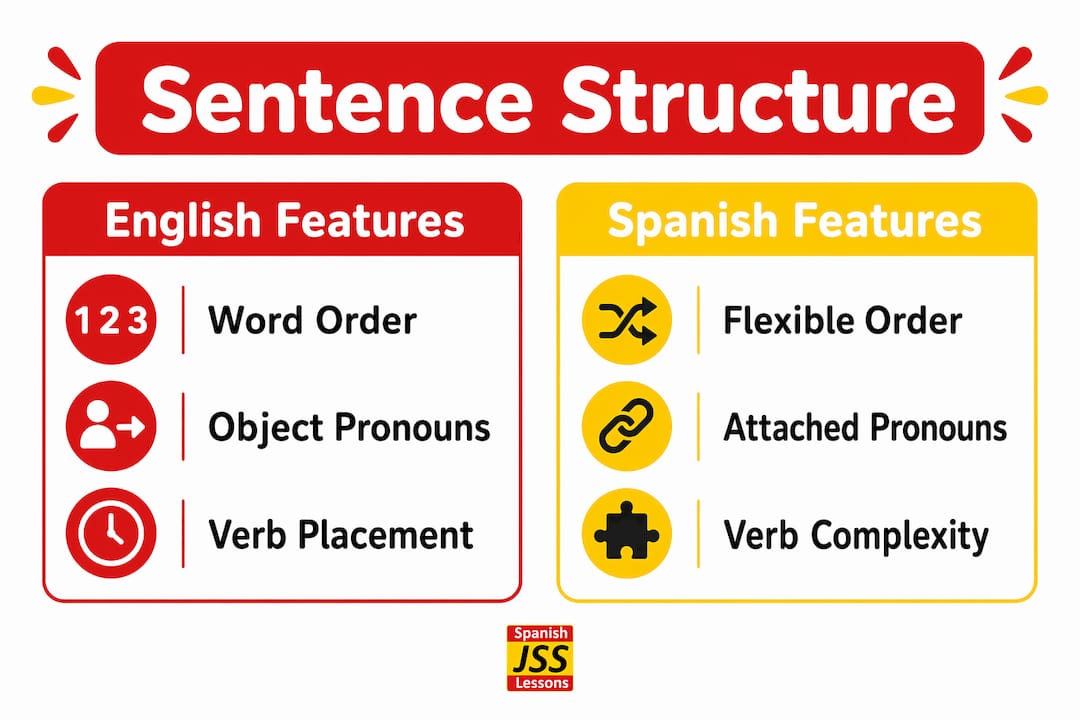
Spanish and English share the same basic Subject-Verb-Object word order, which is one reason Spanish is easier for English speakers than many people assume. The complications arise in three specific areas: pronoun placement, reflexive verbs, and the flexibility Spanish allows in rearranging sentence elements for emphasis.
The table below shows where the two languages diverge most sharply, and how simplification addresses each gap.
| Feature | English structure | Spanish structure | How simplification helps |
|---|---|---|---|
| Object pronouns | After the verb: “I see him” | Before the verb: Lo veo | Use short, fixed pronoun phrases until placement becomes automatic |
| Reflexive verbs | Rare and predictable | Common and varied: me llamo, se llama | Learn reflexive constructions as fixed phrases rather than grammar rules |
| Word order flexibility | Rigid: SVO only | Flexible: Ayer fui al mercado or Fui al mercado ayer | Stick to standard SVO order when speaking; recognise variations when listening |
| Passive voice | Frequent in formal writing | Less common in speech; se constructions preferred | Replace passive forms with active equivalents in your own speech |
The flexibility of Spanish sentence structure is actually an advantage once you understand it. Native speakers move elements around to shift emphasis, not to confuse you. A simplified approach treats word order as a tool rather than a rule to memorise, which makes the whole system far less intimidating.
What role does phrase shortening play in natural Spanish?
Phrase shortening, known linguistically as elisión, is a natural process where native speakers omit redundant words to communicate efficiently and naturally. This is not lazy speech. It is a mark of fluency and social ease. Understanding it is one of the most underrated techniques for Spanish simplification available to adult learners.
Here are four common examples of how full phrases become shortened in everyday European Spanish conversation:
- “Voy a ir al cine” becomes “Voy al cine.” The intended meaning is identical. The shorter version is what you will actually hear.
- “¿Qué es lo que quieres?” becomes “¿Qué quieres?” The extra structure adds nothing to the meaning in casual speech.
- “Tengo que ir a comprar” becomes “Voy a comprar” or simply “Voy a por pan” in many regional contexts.
- “No sé lo que voy a hacer” becomes “No sé qué hacer.” The subordinate clause collapses into an infinitive, which is cleaner and faster.
Phrase shortening signals informality and friendliness among speakers who are comfortable with each other. When a native speaker uses shortened forms with you, it is a sign of warmth, not carelessness. Recognising these patterns transforms your listening comprehension because you stop waiting for the full grammatical form that never arrives.
Pro Tip: Record short clips of European Spanish television or radio, then write out what you hear. Compare your transcription to the full grammatical form. This trains your ear to bridge the gap between textbook Spanish and the machine-gun speed of native replies.
How can AI tools assist with Spanish sentence simplification?
AI language models have become genuinely useful for learners who want to practise Spanish sentence simplification methods at home. GPT-4, in particular, has been applied to simplify Spanish medical texts, and controlled studies show significant readability improvements (P<.001) when it is used for this purpose. That result matters for learners because it confirms that AI can reliably reduce linguistic complexity while preserving meaning.
Here is how adult learners can put AI tools to practical use:
- Generate simplified reading practice. Paste a complex Spanish news article into GPT-4 and ask it to rewrite the text at a lower complexity level. Use the simplified version as your reading material, then compare it to the original.
- Create personalised vocabulary lists. Ask the AI to identify the ten most complex words in a passage and suggest everyday synonyms. This mirrors the lexical simplification process used in academic research.
- Practise sentence reconstruction. Give the AI a complex sentence and ask it to produce three simpler versions. Study the differences to understand which structural choices create clarity.
The important caveat is that combining Google Translate with GPT-4 for initial translation and then simplification offers more balanced performance than either tool alone. AI is a practice aid, not a teacher. Human guidance, particularly from someone with deep knowledge of European Spanish as it is actually spoken, remains the difference between technically correct Spanish and Spanish that sounds natural.
Key takeaways
Spanish sentence simplification is the most direct route from textbook knowledge to real conversational fluency in European Spanish, and it works through five consistent techniques: common verbs, active voice, lexical substitution, shorter sentences, and recognition of natural phrase shortening.
| Point | Details |
|---|---|
| Core definition | Simplification transforms complex sentences into clearer versions while preserving meaning. |
| Five key techniques | Use common verbs, active voice, simple vocabulary, short sentences, and clarifying phrases. |
| Structural differences | Spanish pronoun placement and word order flexibility are best learned as fixed patterns, not grammar rules. |
| Natural phrase shortening | Elisión is a mark of fluency; recognising it dramatically improves listening comprehension. |
| AI as a practice tool | GPT-4 and similar tools support simplification practice but require human oversight for natural results. |
Why simplification is the fastest route to sounding Spanish
After 40 years living in Spain and working with hundreds of English-speaking adult learners, I have noticed the same pattern repeatedly. Learners who try to produce grammatically perfect, fully formed sentences freeze. Learners who focus on clear, simple communication start having real conversations within weeks.
The fear of sounding less proficient by simplifying is, frankly, misplaced. Native speakers prioritise clarity and brevity for natural communication. They shorten phrases, drop redundant words, and reach for the simplest verb available. That is not a sign of limited vocabulary. It is a sign of fluency. When you do the same, you sound more native, not less.
The learners I see struggle most are those who have been taught to think about grammar labels rather than sentence patterns. Once you stop asking “is this the subjunctive?” and start asking “does this sentence say what I mean clearly?”, everything shifts. Simplification is not a shortcut around Spanish. It is the direct path through it. The grammar tips for real conversations that actually stick are always the ones grounded in how people speak, not how textbooks are written.
— James
Start building simpler, more natural Spanish sentences today
James Spanish School was built specifically for English-speaking adults who want to speak European Spanish in real life, not pass an exam. The 100-lesson course uses Radical Simplification to strip away grammar jargon and replace it with plain English explanations of how Spanish sentences actually work. The WordAmigo system then embeds vocabulary and pronunciation through strategic repetition, so words stay in memory rather than fading after a week.
If you are ready to move from understanding Spanish in theory to using it with confidence, the course materials and learning tools at Jamesspanishschool give you everything you need. For learners just starting out, the everyday Spanish phrases resource is an excellent first step into natural sentence construction. There is no expiry date, no countdown clock, and a cast-iron guarantee: if a core lesson teaches you nothing new, James credits you with extra practice modules at no cost.
FAQ
What is Spanish sentence simplification?
Spanish sentence simplification is the process of rewriting complex Spanish sentences into clearer, shorter versions that preserve the original meaning. It involves techniques such as using common verbs, active voice, and everyday vocabulary in place of formal or academic language.
How do I simplify Spanish sentences as a beginner?
Start by replacing complex verbs with common ones, breaking long sentences into two shorter ones, and using active rather than passive constructions. Phrases like o sea and es decir help you restate ideas more simply in both speech and writing.
Why do native Spanish speakers shorten their phrases?
Phrase shortening reflects fluent, efficient speech rather than a lack of vocabulary. It signals informality and ease between speakers, and is a natural feature of everyday European Spanish conversation rather than a grammatical error.
Can AI tools help me practise Spanish simplification?
Yes. Tools like GPT-4 can generate simplified versions of complex Spanish texts and suggest everyday synonyms for difficult words. Research confirms significant readability gains when AI is applied to Spanish text simplification, though human guidance remains important for natural results.
Does simplifying Spanish make me sound less fluent?
No. Research confirms that native speakers use simplification for clear, natural communication. Producing clear, direct sentences is a hallmark of fluency, not a sign of limited ability.