

TL;DR:
- Culture shock influences Spanish language acquisition by triggering anxiety cycles that limit social practice and fluency development. Recognizing its stages and managing identity friction through preparation and social scripts significantly speeds up adaptation and progress. Understanding cultural differences and expectations minimizes misunderstandings, fostering confidence and more consistent real-life communication.
Culture shock is a defined psychological and sociocultural process that directly shapes how quickly and confidently English speakers acquire Spanish during immersion in Spain. The role of culture shock in Spanish learning goes far beyond feeling homesick or finding the food different. It disrupts communication confidence, alters social behaviour, and triggers anxiety cycles that can stall language progress for weeks or months. Academic researchers call the broader process cross-cultural adaptation, and understanding its mechanics gives learners a genuine advantage. A systematic review of 37 studies confirms that language issues are central to sociocultural adaptation during immersion, either opening doors to relationships and growth or slamming them shut.
How do language barriers and anxiety create a cycle in Spanish learning?
Language functions as a gatekeeper to sociocultural adaptation, and culture shock often first appears as raw language frustration. You arrive in Spain, you know your vocabulary, and then a local speaks at machine-gun speed and you freeze. That moment of failure triggers anxiety, and anxiety makes the next conversation feel even more threatening.

Research into acculturation and anxiety shows that learners caught in this cycle typically cope in one of two ways: they default to English whenever possible, or they retreat into solitary study. Both responses feel logical in the moment. Neither breaks the cycle. Defaulting to English removes the very practice opportunities that build fluency. Studying harder in isolation improves grammar knowledge but does nothing for the real-time processing speed that Spanish conversation demands.
The consequences compound quickly:
- Reduced social initiation means fewer hours of authentic spoken input each week.
- Heightened self-monitoring during conversations slows processing and increases errors.
- Avoidance of unfamiliar situations cuts off the informal, unscripted exchanges where real fluency is built.
- Negative self-assessment after failed interactions lowers motivation and willingness to try again.
A qualitative study on international students found that social withdrawal due to anxiety reduces practice opportunities, creating a cyclical barrier to language development that is genuinely difficult to escape without deliberate intervention. This means the problem is structural, not personal. It is not a sign that you lack ability.
Pro Tip: Before arriving in Spain, write out five short scripts for everyday interactions: ordering a coffee, asking for directions, greeting a neighbour, buying bread, and thanking a shopkeeper. Rehearse them until they feel automatic. These low-stakes exchanges build early wins that interrupt the anxiety cycle before it takes hold.
“Willingness to engage socially is the single most critical factor in language growth during immersion. The learner who speaks imperfectly but often will always outpace the learner who waits until they feel ready.”
What are the stages of culture shock and how do they affect Spanish progress?
Culture shock does not arrive as one sustained blow. It moves through recognisable stages, and knowing which stage you are in changes how you respond to it. The two most widely cited frameworks are the U-Curve model and the Revised W-Shape model, both of which map the emotional journey of cross-cultural adaptation.
- Honeymoon stage. Everything feels exciting. Spanish sounds beautiful, locals seem warm, and motivation to learn spikes. Language progress during this phase can be rapid because emotional energy is high and social inhibition is low.
- Crisis stage. The novelty fades. Misunderstandings accumulate. Fatigue from constant cultural decoding sets in. This is where most learners hit a plateau, and many mistakenly conclude they are not cut out for Spanish.
- Adjustment stage. Routines form, cultural norms become familiar, and communication confidence begins to recover. Language acquisition accelerates again as cognitive load decreases.
- Adaptation stage. The learner functions comfortably in both cultures. Humour, nuance, and informal register become accessible. This is where genuine fluency lives.
The crisis stage deserves particular attention because it is so frequently misread. Culture shock creates cognitive overload during this phase: the brain is simultaneously processing unfamiliar social norms, managing emotional stress, and attempting to produce a foreign language. The result is a plateau that feels like failure but is actually a normal adaptation response.
| Stage | Typical language learning impact |
|---|---|
| Honeymoon | High motivation, rapid early progress, strong willingness to speak |
| Crisis | Plateau, increased errors, social withdrawal, reduced practice time |
| Adjustment | Gradual confidence recovery, improved listening comprehension |
| Adaptation | Accelerated fluency, access to humour and informal register |
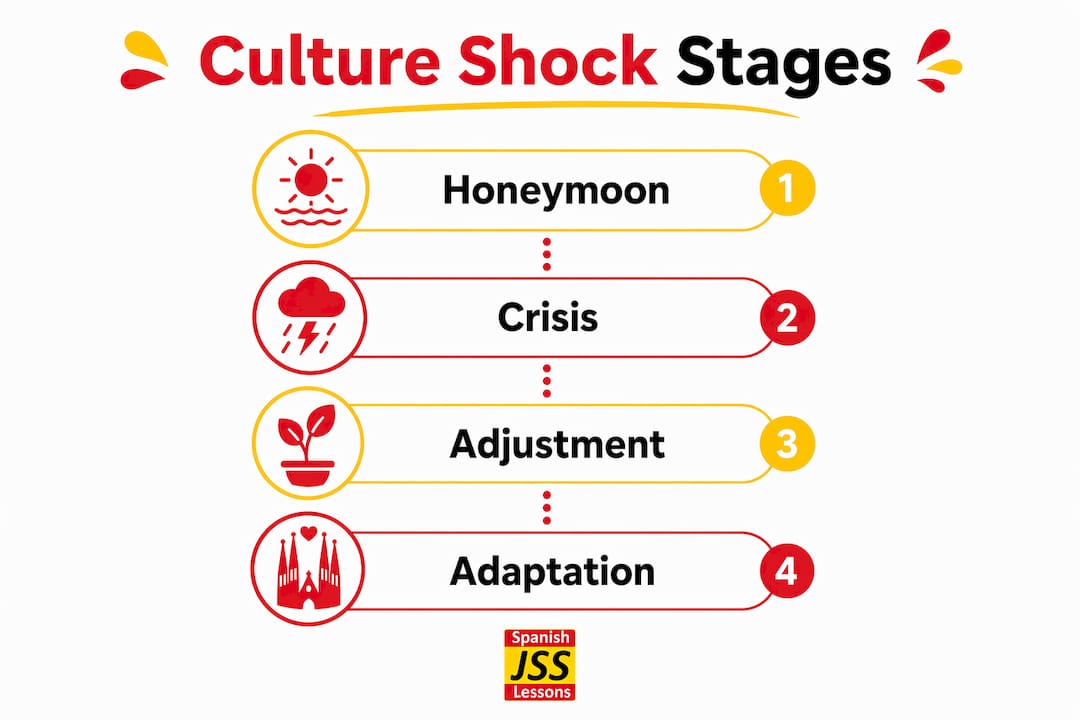
Knowing this table in advance is genuinely useful. When the plateau arrives, you can name it as the crisis stage rather than treating it as evidence of personal failure.
How does identity negotiation shape Spanish language acquisition?
Immersion in Spain does not just test your vocabulary. It tests your sense of self. Learners in immersion continuously negotiate identity and otherness, and this process directly influences communication confidence and the willingness to practise Spanish in real social settings.
The mechanism works like this. At home, you are articulate, funny, and socially capable. In Spain, you become someone who cannot follow a fast conversation, misreads social cues, and occasionally offends people by accident. That gap between your home identity and your Spanish-speaking identity creates friction. For some learners, the friction is motivating. For others, it triggers shame and withdrawal.
Identity shifts during culture shock affect communication confidence, which in turn shapes how much language practice actually happens each day. A learner who feels socially competent will seek out conversations. A learner who feels perpetually inadequate will avoid them. The difference in practice hours over a three-month immersion period is enormous.
Practical ways to manage identity friction during immersion include:
- Choose structured social contexts first. Language exchange groups, local classes, and organised activities give you a defined role and reduce the pressure of unscripted interaction.
- Acknowledge the gap openly. Telling a Spanish neighbour “My Spanish is still developing, please be patient with me” reframes the interaction and usually generates goodwill.
- Seek out conversational fluency practice that mirrors real-life exchanges rather than academic exercises.
- Track small wins daily. A successful exchange with a shopkeeper is genuine evidence of progress, even if the grammar was imperfect.
Pro Tip: Construct at least one weekly social situation where you control the context. Attending the same café at the same time each week, for example, builds familiarity with the staff and reduces the unpredictability that feeds anxiety.
Why does cultural awareness reduce culture shock during Spanish immersion?
Cultural awareness reduces misunderstandings and frustration, and this is not a soft benefit. It is a concrete mechanism that shortens the crisis stage and improves the quality of social interactions that drive language learning forward.
Spanish communication culture differs from British norms in ways that regularly catch English speakers off guard. Directness that feels rude in Britain is simply efficient in Spain. Interrupting a conversation is often a sign of engagement rather than disrespect. Silence in social settings carries different weight. Meal times, working hours, and the pace of bureaucratic processes all operate on a different rhythm. Without preparation, each of these differences registers as a small shock that accumulates into the broader crisis stage.
| Cultural difference | British expectation | Spanish reality |
|---|---|---|
| Directness in conversation | Indirect, softened phrasing | Direct, efficient, no hedging |
| Interrupting in conversation | Considered impolite | Often signals active engagement |
| Meal and social timing | Early evenings, fixed schedules | Late dinners, fluid social timing |
| Pace of official processes | Relatively swift | Slower, relationship-dependent |
Informed preparation improves psychological adaptation and social integration in measurable ways. Learners who understand Spanish customs before arrival report fewer negative surprises and recover from the crisis stage faster. They also initiate more social interactions because they are not constantly second-guessing whether they have caused offence.
Foreign language anxiety varies by skill, context, and individual factors, but cultural preparation consistently reduces the situational triggers that amplify it. Knowing what to expect from a conversation with a Spanish builder or a visit to the local ayuntamiento removes a layer of cognitive load and frees mental capacity for actual language processing.
Key takeaways
Culture shock is a predictable, stage-based process that directly determines the pace and depth of Spanish language acquisition during immersion, and managing it deliberately produces faster, more durable fluency.
| Point | Details |
|---|---|
| Culture shock follows stages | The honeymoon, crisis, adjustment, and adaptation stages each produce distinct effects on language progress. |
| Anxiety creates a withdrawal cycle | Language anxiety reduces social practice, which slows skill growth and deepens the crisis stage. |
| Identity friction is real but manageable | Choosing structured social contexts reduces the self-perception gap that drives communication avoidance. |
| Cultural awareness shortens the crisis stage | Understanding Spanish directness, timing, and social norms reduces daily misunderstandings and speeds adaptation. |
| Pre-planned scripts break the cycle early | Rehearsed low-stakes interactions build early confidence before anxiety becomes entrenched. |
Culture shock is not the enemy. Ignoring it is.
After 40 years living in Spain, I have watched hundreds of English speakers arrive full of enthusiasm and hit the crisis stage like a wall, usually around week three or four. The ones who recover fastest are not the most talented linguists. They are the ones who expected the wall and had a plan for when they hit it.
The uncomfortable truth about culture shock is that most language courses do not mention it at all. They teach you vocabulary and grammar and send you off to Spain as if fluency were simply a matter of accumulating enough words. It is not. The psychological and social dimensions of immersion are at least as important as the linguistic ones, and pretending otherwise sets learners up for a crisis they interpret as personal failure.
What I have found actually works is treating culture shock as a curriculum subject in its own right. Know the stages. Expect the plateau. Build social scripts before you need them. Seek out real-life Spanish practice rather than academic exercises that bear no resemblance to what a Spanish neighbour actually says to you. And accept that feeling temporarily incompetent in a second culture is not a setback. It is the process working exactly as it should.
The learners who come out the other side with genuine fluency are the ones who stayed in the discomfort long enough to let adaptation happen. That takes preparation, not just persistence.
— James
How Jamesspanishschool supports learners through culture shock
Jamesspanishschool was built specifically for English-speaking adults who want to function in real Spanish life, not pass academic exams. James Bretherton’s 100-lesson course addresses the anxiety and confidence gaps that culture shock creates, with ear-tuning lessons designed to help you follow fast native speech and sentence-building modules that give you the tools for unscripted conversation. The WordAmigo system permanently embeds vocabulary and pronunciation so that words are available to you under pressure, not just in quiet study sessions. If you are preparing for immersion or already living in Spain and struggling with the crisis stage, explore the beginner resources at Jamesspanishschool and start building the practical fluency that real Spanish life demands.
FAQ
What is the role of culture shock in Spanish learning?
Culture shock directly affects Spanish learning by triggering anxiety cycles that reduce social interaction and language practice. A systematic review of 37 studies confirms that language issues are central to sociocultural adaptation during immersion, either accelerating or blocking progress depending on how they are managed.
How long does the culture shock crisis stage last for Spanish learners?
The crisis stage typically lasts between two and eight weeks for immersion learners, though this varies by individual preparation and social engagement. Learners with cultural awareness and pre-planned interaction strategies tend to move through it faster.
Does culture shock cause language learning plateaus?
Culture shock creates cognitive overload during the crisis stage, which slows language acquisition even when learners are studying diligently. The plateau is a normal adaptation response, not a sign of inability.
How does cultural awareness help with adapting to Spanish culture?
Cultural awareness reduces the frequency of misunderstandings and social missteps that accumulate into the crisis stage. Understanding Spanish directness, meal timing, and conversational norms removes daily friction and frees cognitive capacity for language processing.
Can identity issues really affect Spanish language acquisition?
Identity negotiation during immersion is a documented factor in communication confidence and directly shapes how much language practice a learner seeks out each day. Learners who feel socially competent in structured contexts practise more and progress faster.