

TL;DR:
- Plain English provides clear, concise explanations that enhance understanding and reduce translation errors in Spanish learning. It simplifies complex grammar by removing jargon, making features like verb conjugation and the subjunctive accessible to learners. Applying plain language principles increases confidence and speeds up mastery of authentic, practical Spanish.
Plain English is defined as clear, concise communication that a reader can understand the first time, without jargon or unnecessary complexity. For English speakers learning European Spanish, this principle is not a shortcut. It is the most direct route to accurate comprehension and effective communication. Plain language increases understanding by roughly 30%, which means the cognitive foundation you build in English directly shapes how well you grasp Spanish structure, grammar, and meaning. Authorities such as IHA Academy and LEXIGO both confirm that plain language reduces ambiguity at the source, and that reduction pays dividends the moment you start working with a second language.
Why use plain English for Spanish translation and understanding?
Translation is interpretation, not word-for-word substitution. Literal Spanish translation often looks correct on the surface but fails in real-world accuracy because Spanish encodes meaning through grammar and formality in ways that English simply does not. When your source English is cluttered with idioms, passive constructions, or vague phrasing, the translator or learner must make judgement calls. Those judgement calls introduce errors.
LEXIGO makes the point clearly: ambiguity in English source text forces multiple inaccurate interpretations across languages, and each ambiguous phrase multiplies the risk. For a learner trying to map English concepts onto Spanish grammar, this is not an abstract problem. It is the reason so many adult learners stall after the basics.
Consider a few common examples of what goes wrong:
- “It was decided that the meeting would be held on Friday.” The passive voice hides the subject entirely. Spanish requires a subject, so a learner or translator must invent one, which changes the meaning.
- “We’ll cross that bridge when we come to it.” Translated literally, this produces nonsense. The Spanish equivalent is a completely different expression, and learners who rely on English idioms never find it.
- “The project is moving forward.” “Moving forward” is corporate filler. In Spanish, it forces a choice between several verbs with distinct meanings, and the wrong choice signals poor fluency immediately.
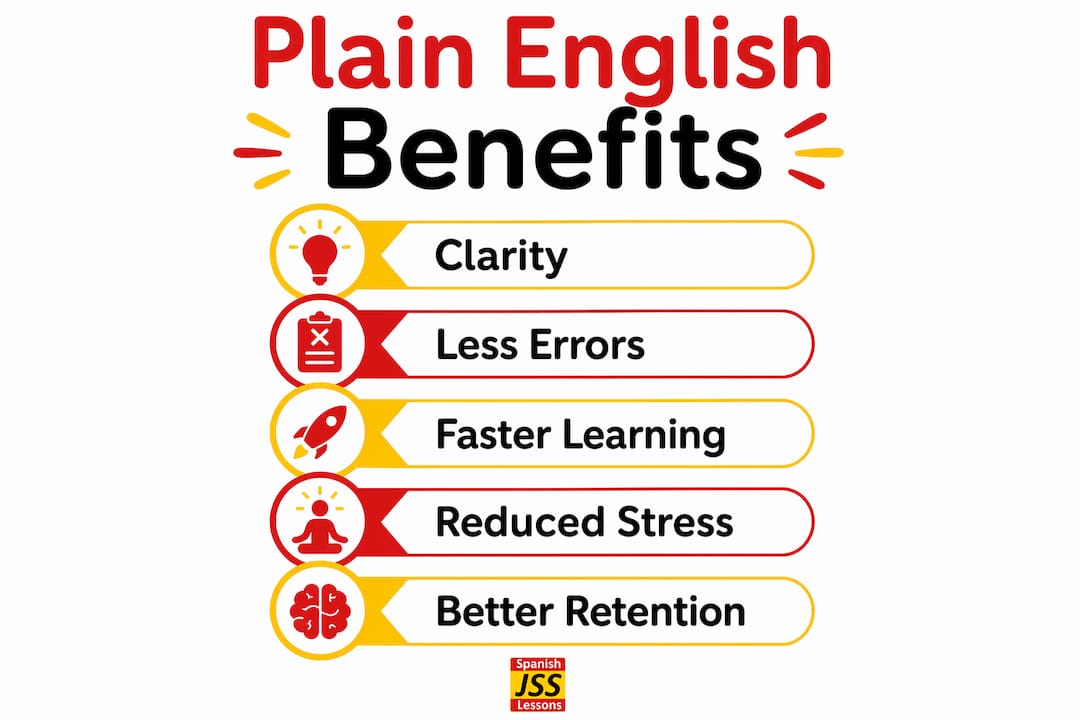
Plain English removes these traps before they form. When the English source is direct and active, the path to accurate Spanish is shorter, faster, and cheaper in terms of both time and mental effort.
Pro Tip: Before practising a Spanish sentence, write the English version in plain language first. Subject, verb, object. No idioms. This single habit will cut your translation errors significantly.
What Spanish complexities make plain English necessary?
Spanish is not a more complicated version of English. It is a structurally different language, and several of its features have no direct English equivalent. Understanding why plain English matters requires understanding what Spanish actually demands of you.
- Formal and informal address. Spanish distinguishes between tú (informal) and usted (formal), and regional pronoun use varies significantly across Spain and Latin America. English has only “you,” which gives learners no instinct for this distinction. Plain English explanations make the rule explicit and learnable, rather than leaving it buried in a grammar table.
- Verb conjugation carries the subject. In Spanish, the verb ending tells you who is acting. Hablo means “I speak” without needing “I” at all. English learners who have never had this explained in plain terms often add unnecessary pronouns, which sounds unnatural to native ears.
- Adjective placement is reversed. English puts adjectives before nouns: “the red car.” Spanish typically places them after: el coche rojo. Learners who translate directly from complex English sentences frequently get this wrong, producing phrases that are grammatically possible but stylistically odd.
- The passive voice behaves differently. English overuses the passive voice in formal writing. Spanish prefers active constructions or uses se for impersonal statements. Learners trained on complex English prose carry this habit into Spanish, where it creates unnatural, stilted sentences.
- Subjunctive mood is obligatory, not optional. Spanish uses the subjunctive in situations where English uses simple present or conditional forms. Without a plain English explanation of when and why, learners either avoid it entirely or apply it randomly.
Each of these features demands a clear, accurate explanation in language the learner can absorb without effort. When the explanation itself is tangled in jargon or academic phrasing, the learner spends cognitive energy decoding the instruction rather than learning the rule. Plain English clears that obstacle. It is the reason Spanish structure explained in English produces faster, more durable results for adult learners than traditional grammar-heavy methods.
Is plain English just dumbing things down?
Plain English is not about removing grammar or nuance. IHA Academy defines plain language as communication people can understand the first time, without jargon or unnecessary complexity. That definition contains a critical word: unnecessary. Complexity that serves understanding stays. Complexity that serves no one gets removed.
This distinction matters enormously for Spanish learners. The goal is not to pretend Spanish has no grammar. It has a great deal of it, and you need to learn it accurately. The goal is to explain that grammar in language that does not require a linguistics degree to decode. “The subjunctive expresses doubt, emotion, or hypothetical situations” is plain English. “The subjunctive mood is employed in subordinate clauses governed by expressions of volition, affect, or epistemic uncertainty” is not. Both describe the same rule. Only one of them helps a learner in a conversation with a neighbour.
Cognitive overload is a real barrier for adult learners. When explanations are dense and jargon-heavy, working memory fills up with the effort of parsing the instruction, leaving no room for the actual Spanish. Plain English explanations free up that mental space. The learner arrives at the Spanish rule with full attention available, which is precisely when retention improves.
Pro Tip: If you cannot explain a Spanish grammar rule in two plain English sentences, you have not understood it well enough yet. Use that test on every rule you study.
How to use plain English techniques in your Spanish study
Applying plain language principles to your own study is practical and immediate. The following approaches produce measurable results for adult learners working on European Spanish.
- Use active voice when practising sentences. Write “I asked the shopkeeper” not “The shopkeeper was asked by me.” Active constructions map more cleanly onto Spanish word order and reduce the risk of structural errors.
- Avoid idioms until your foundation is secure. Passive voice and idioms are the two most common sources of translation failure. Build your Spanish on literal, direct sentences first. Idiomatic expression comes naturally once the grammar is solid.
- Introduce vocabulary with clear, consistent examples. One word, one meaning, one sentence. Do not introduce llevar as “to carry, to wear, to take, to bring” all at once. Start with the most common usage and add layers once the first is secure.
- Choose learning resources that explain Spanish in plain English. This is the single most impactful decision an adult learner makes. A course that explains everyday Spanish in context using clear, direct language will outperform a traditional textbook that uses academic grammar terminology at every turn.
Here is a direct comparison of plain English versus complex instruction for the same Spanish concept:
| Concept | Complex instruction | Plain English instruction |
|---|---|---|
| Ser vs estar | “Ser denotes permanent ontological states; estar indicates transient or contingent conditions.” | “Ser is for permanent facts. Estar is for temporary states. ‘She is tall’ uses ser. ‘She is tired’ uses estar.” |
| Reflexive verbs | “Reflexive constructions employ a coreferential clitic pronoun.” | “Reflexive verbs describe actions you do to yourself. Me lavo means ‘I wash myself’.” |
| Subjunctive trigger | “Subjunctive is governed by matrix clauses expressing deontic or epistemic modality.” | “Use the subjunctive after ‘I want that…’, ‘I hope that…’, or ‘It’s possible that…’” |
The plain English column does not remove grammar. It makes grammar learnable. That is the entire point.
Key takeaways
Plain English accelerates Spanish learning by removing ambiguity, reducing cognitive load, and making grammar rules immediately usable rather than academically correct but practically inaccessible.
| Point | Details |
|---|---|
| Plain English defined | Clear, jargon-free language that readers understand first time, not a removal of grammar or nuance. |
| Translation accuracy | Plain English source text reduces ambiguity, cutting translation errors and improving Spanish comprehension. |
| Spanish complexity | Features like tú/usted, verb conjugation, and the subjunctive require clear explanation to be learnable. |
| Cognitive load | Plain English frees working memory so learners can focus on Spanish rules rather than decoding instructions. |
| Practical application | Active voice, no idioms, and consistent examples are the three most effective plain English study habits. |
What forty years in Spain taught me about plain language
I have watched hundreds of adult learners arrive in Spain with textbook Spanish that falls apart the moment a native speaker replies at normal pace. The problem is almost never vocabulary. It is the gap between how the grammar was explained and how it actually works in a real sentence. When someone has been taught using dense academic language, they have memorised a definition rather than understood a rule. Those are very different things.
The learners who progress fastest are the ones who can explain a Spanish rule to themselves in plain, direct English before they attempt to use it. “In Spanish, the verb ending tells you who is speaking, so I often do not need a pronoun.” That sentence takes five seconds to say and unlocks a behaviour pattern that makes speech sound natural. A three-paragraph grammar note achieves the same thing in theory but rarely in practice.
I also notice that plain English explanations build confidence in a way that complex ones do not. When a learner understands why a rule works, they apply it with conviction. When they have only memorised it, they hesitate. Hesitation in conversation is what causes the machine-gun speed of native replies to feel overwhelming. Clarity at the foundation level is what gives you the composure to keep up.
The Spanish grammar tips that work in real conversations are always the ones explained simply and practised consistently. That is not a coincidence.
— James
How James Spanish School puts plain English into practice
James Spanish School was built on exactly this principle. James Bretherton, a dual-native speaker with forty years of living in Spain, designed the entire 100-lesson course around what he calls Radical Simplification. Every grammar rule is explained in plain, direct English, with no academic jargon and no grammar terms that native speakers never use. The WordAmigo system then locks vocabulary and pronunciation into long-term memory through a five-step retention loop covering reading, listening, speaking, and writing. If you are ready to learn European Spanish the way it actually works, explore the full course resources at James Spanish School and see how plain English transforms the learning experience.
FAQ
What does plain English mean in language learning?
Plain English means explaining concepts in clear, direct language that a learner understands the first time, without academic jargon or unnecessary complexity. IHA Academy confirms it is a method for presenting complex information clearly, not a method for removing it.
Why does plain English help with Spanish specifically?
Spanish encodes meaning through grammar and formality in ways English does not, so clear explanations of those differences are critical. Literal translation from English frequently fails because the structural logic of the two languages does not align word for word.
Does plain English mean avoiding grammar?
No. Plain English means explaining grammar in accessible language, not skipping it. Rules like the subjunctive, tú versus usted, and reflexive verbs are all taught, but in terms a learner can apply immediately rather than memorise abstractly.
How does plain English reduce errors in Spanish?
Ambiguous English phrasing forces guesswork when mapping onto Spanish, and guesswork produces errors. Plain English removes the ambiguity at source, giving learners a clean, accurate foundation to build from.
Is European Spanish harder to learn with traditional methods?
European Spanish has regional variations, formal pronoun distinctions, and a strong subjunctive tradition that traditional grammar-heavy methods often obscure with technical language. Plain English instruction, as used by James Spanish School, makes these features easier for English speakers to understand and apply in real conversations.