

TL;DR:
- Insider Spanish tips include natural expressions, slang, and filler words used daily by native speakers that textbooks rarely teach.
- Using these tips improves fluency faster by embedding vocabulary in real contexts and signaling cultural understanding to locals.
Insider Spanish tips are authentic, culturally specific language habits that native speakers use every day but that no textbook ever teaches. If you live in Spain as an English speaker, these tips are the difference between sounding like a tourist and sounding like someone who belongs. Standard courses give you grammar tables and vocabulary lists. What they rarely give you is the word a Spaniard actually uses when they agree, the filler that buys them thinking time, or the slang that signals you are one of them. Understanding why use insider Spanish tips matters is the first step towards real fluency, not just exam passes.
What are insider Spanish tips and how do they differ from textbook Spanish?
Insider Spanish tips are the colloquial expressions, filler words, and regional slang that native speakers use naturally but that standard courses almost never include. Textbook Spanish teaches you to say “sí” for yes. Real Spanish in Spain adds “vale,” “venga,” and “bueno” depending on the situation. These are not optional extras. They are the building blocks of natural conversation.
The gap between textbook Spanish and spoken Spanish is wider than most learners expect. Consider these expressions that locals use constantly:
- “Mola” — means “it’s cool” or “I like it.” You will hear this dozens of times a day.
- “Tío / tía” — literally “uncle / aunt,” but used between friends the way English speakers say “mate” or “pal.”
- “Vale” — the all-purpose agreement word. Think of it as “OK,” “right,” “fine,” and “understood” rolled into one.
- “Pues” — a filler word that buys thinking time, similar to “well” or “so” in English.
- “Venga” — used to mean “come on,” “let’s go,” “OK then,” or even “goodbye,” depending on context.
None of these appear in the first ten lessons of a standard course. Yet every one of them comes up in the first ten minutes of a real conversation in a Spanish bar, market, or neighbour’s kitchen.
The deeper issue is the difference between recognition and recall. You might recognise “mola” when you hear it. But can you produce it naturally, at the right moment, without pausing to translate? Contextual vocabulary learning closes that gap. Insider tips are not just vocabulary. They are vocabulary placed inside real situations, which is the only way the brain learns to retrieve them under pressure.
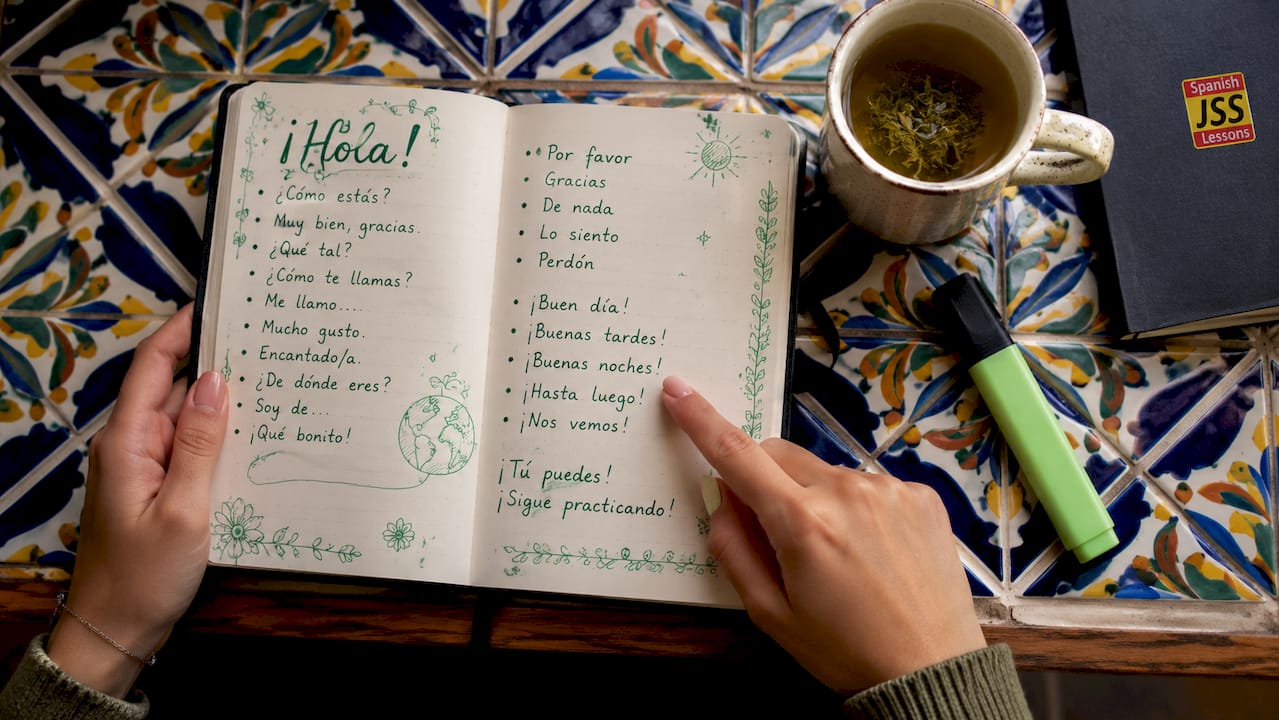
Pro Tip: Keep a small notebook or phone note labelled “Things I heard today.” Write down any word or phrase a local uses that you did not know. Look it up that evening and use it in a sentence the next morning.
Why do insider Spanish tips accelerate fluency in everyday life?
Memorising isolated vocabulary without context produces fragile knowledge. You recognise words on a page but freeze when a neighbour fires them at you in rapid succession. Insider tips solve this because they are learned in context from the start, which means the brain stores them with the situation attached.
The social dimension is equally significant. Only about 27% of Spaniards speak English, which means that in most everyday situations, your Spanish is the only tool available. At the pharmacy, the town hall, the hardware shop, or the local bar, you cannot fall back on English. Insider knowledge of how people actually speak makes those encounters far less stressful.
Regional slang also functions as a social signal. Correct use of local expressions tells a native speaker that you have made a genuine effort to understand their culture, not just their grammar. Misuse, or the absence of these expressions, marks you immediately as a tourist passing through. That distinction matters enormously for expats who want to build real relationships with neighbours, tradespeople, and local officials.
“Learners who incorporate insider tips and real conversational practice progress faster in fluency and are perceived more favourably by locals.”
The practical benefits compound quickly. Once locals sense you are genuinely trying to speak their Spanish, not a sanitised classroom version, they slow down slightly, speak more directly, and include you in conversations rather than around you. That shift in social dynamic accelerates your learning faster than any app.
How to incorporate insider Spanish tips into your daily routine
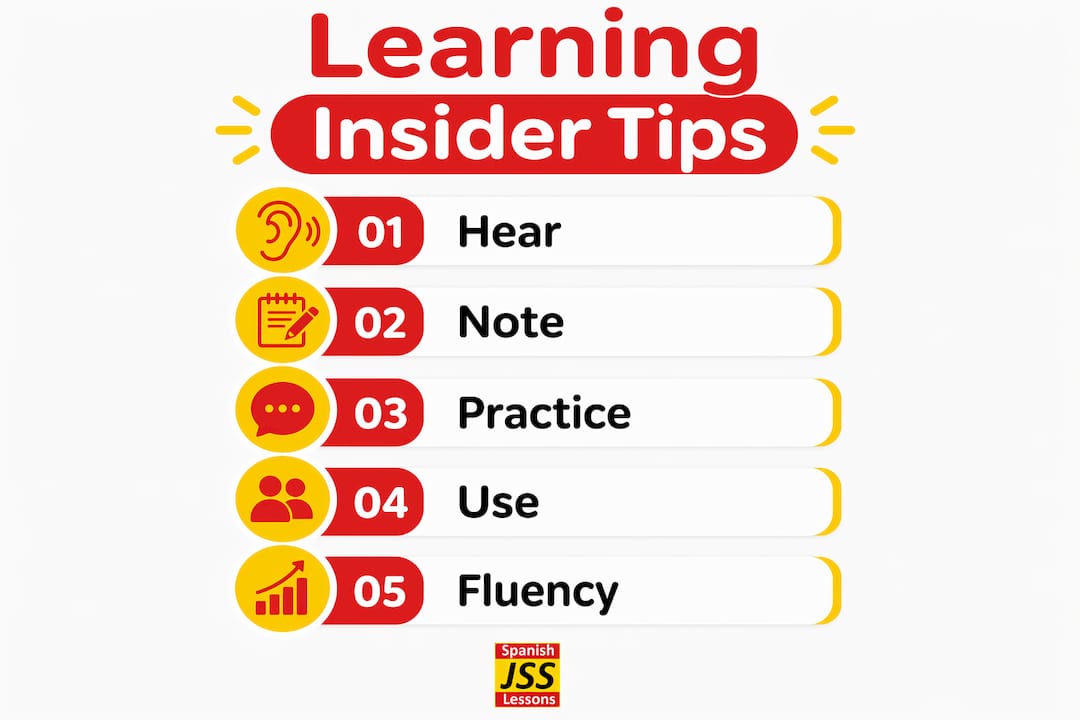
Knowing that insider tips matter is one thing. Building a system to absorb them is another. The following four steps form a practical routine that works for adult learners living in Spain.
- Learn phrases in full sentences, not as isolated words. Active recall of contextualised sentences significantly outperforms word lists for long-term retention. Instead of memorising “mola” alone, learn it as “Eso mola mucho” (That’s really cool) so your brain stores the word with its natural surroundings.
- Use AI conversation tools for low-stakes practice. Platforms like Kaiwa offer AI-powered conversation practice where you can use slang and colloquial expressions without the embarrassment of getting it wrong in front of a real person. This builds confidence before you take the expression into a live situation.
- Shadow native audio daily. Shadowing native audio is one of the most effective techniques for mastering Spanish prosody, rhythm, and intonation. Spanish vowels are sharp and consistent, with no schwa reduction as in English. The characteristic tapped “r” and the rhythm of connected speech are things you absorb through your ears, not through grammar rules.
- Immerse yourself in local media. Spanish television, radio, and podcasts expose you to the full range of regional expressions, filler words, and conversational rhythms. Even fifteen minutes of a Spanish chat show each morning trains your ear to the machine-gun speed of native replies.
Pro Tip: Pick one insider expression each week and use it deliberately in three real conversations. By the end of the week, it will feel natural rather than rehearsed. This is how contextual repetition builds a genuine instinct for appropriate slang.
Insider tips versus traditional vocabulary and grammar study
The table below shows the practical difference between the two approaches. Both have a role, but the balance matters enormously for learners living in Spain who need functional Spanish now, not in three years.
| Feature | Traditional study | Insider tip approach |
|---|---|---|
| Vocabulary source | Textbook word lists | Real conversations and local media |
| Learning unit | Isolated word or grammar rule | Full sentence in authentic context |
| Retention method | Repetition of written forms | Spaced repetition with audio |
| Output under pressure | Slow, translated, hesitant | Faster, more natural, contextually appropriate |
| Social effect | Marks learner as a student | Signals cultural belonging to locals |
| Pronunciation focus | Spelling-based | Prosody and rhythm-based |
Traditional grammar study builds the structural engine of the language. You need it. But without insider knowledge layered on top, your Spanish sounds like a well-written letter read aloud in a foreign accent. The insider tip approach fills the gap between correct and natural. The vocabulary building workflow that produces durable results always combines structure with authentic context. Neither alone is sufficient.
The key insight from research is that spaced repetition tied to audio creates durable neural connections that isolated word lists simply cannot match. Adult learners cannot absorb language subconsciously the way children do. They need a deliberate system. Insider tips, learned in context and practised through real conversation, provide exactly that system.
Key takeaways
Insider Spanish tips accelerate fluency because they teach the authentic, contextual language that native speakers actually use, replacing fragile recognition with reliable recall.
| Point | Details |
|---|---|
| Context beats isolation | Learn phrases in full sentences to build recall, not just recognition. |
| Social signals matter | Correct use of local slang marks you as culturally engaged, not a passing tourist. |
| Shadowing builds prosody | Daily audio shadowing trains rhythm and intonation faster than grammar study alone. |
| Only 27% of Spaniards speak English | Functional insider Spanish is a practical necessity for daily life, not a bonus. |
| Spaced repetition with audio wins | Contextualised phrase recall tied to audio creates durable retention for adult learners. |
Forty years in Spain: what I have actually learned about learning Spanish
They are not tricks or shortcuts. They are proof of effort. Spanish people notice when a foreigner has bothered to learn how they actually speak, and they respond with warmth and patience that they do not always extend to someone reciting textbook phrases.
I have also seen the missteps. Using “tío” too early with an older Spaniard can feel overly familiar. Dropping Andalusian slang in Catalonia can raise an eyebrow. Regional awareness is part of the insider knowledge. The expressions I teach at James Spanish School are rooted in everyday European Spanish, the kind that works across regions, in shops, surgeries, and town halls, without causing offence.
My honest advice is this: do not wait until your grammar is perfect before you start using real Spanish. The everyday phrases for life in Spain that matter most are not grammatically complex. They are culturally specific. Start there, and the grammar will follow naturally.
— James
How James Spanish School builds insider knowledge into every lesson
James Spanish School was built specifically for English-speaking adults living in Spain who need practical, real-world Spanish rather than academic credentials. The 100-lesson course covers sentence building and ear-tuning in equal measure, so you can both produce natural Spanish and follow it when locals speak at full speed. The WordAmigo system uses AI-powered spaced repetition to permanently embed vocabulary and pronunciation, addressing the two frustrations that stop most adult learners in their tracks. Every lesson reflects real-life fluency in Spain, from conversations with tradespeople to navigating the local health centre. Explore the full course range at the Jamesspanishschool course shop and start learning the Spanish that Spain actually speaks.
FAQ
What are insider Spanish tips?
Insider Spanish tips are authentic colloquial expressions, filler words, and regional slang that native speakers use in everyday conversation. They go beyond textbook vocabulary to include words like “vale,” “mola,” and “tío” that signal cultural fluency.
Why do insider tips help more than vocabulary lists?
Isolated word lists produce knowledge you can recognise but not reliably recall under pressure. Insider tips learned in full, contextualised sentences create stronger neural connections and faster retrieval in real conversations.
How quickly can insider tips improve my Spanish in Spain?
Learners who practise insider expressions in real conversations typically notice a shift in how locals respond within a few weeks. Social acceptance and conversational confidence improve together as you begin to sound less like a student and more like a resident.
Is it rude to use Spanish slang as a foreigner?
Used appropriately, slang signals respect and genuine effort. The key is regional awareness. Stick to widely used expressions across Spain rather than highly localised dialect terms until you know your area well.
How does James Spanish School teach insider Spanish tips?
James Spanish School embeds culturally relevant expressions into every lesson through contextualised sentence practice, audio-based ear-tuning, and the WordAmigo spaced repetition system. The focus is always on small talk and real-world fluency rather than passing written exams.