

TL;DR:
- Spanish small talk emphasizes rapport, warmth, and personal connection over transactional exchanges.
- Key phrases, body language, and time-sensitive greetings are essential for natural conversations.
- Real fluency develops through daily human interactions, not just language apps or textbooks.
You say Hola to your neighbour, she replies in a warm rush of Spanish, and suddenly you’re nodding politely while understanding almost nothing. Sound familiar? Millions of English speakers arrive in Spain with a handful of phrases from an app, only to find that real conversations move faster, feel warmer, and follow unwritten rules that no algorithm has ever taught them. This guide bridges that gap. You’ll discover what makes Spanish small talk tick culturally, pick up the essential phrases that open doors, and follow a practical daily routine that builds genuine confidence. No grammar jargon. No countdown clocks. Just real tools for real life in Spain.
Table of Contents
- What makes Spanish small talk different?
- Essential tools and phrases for natural small talk
- How to practise: real-life steps to Spanish small talk mastery
- Troubleshooting: common mistakes and how to keep conversations flowing
- Why true Spanish small talk fluency starts beyond the app
- Take your Spanish small talk further with James Spanish School
- Frequently asked questions
Key Takeaways
| Point | Details |
|---|---|
| Cultural connection first | Spanish small talk focuses on building personal rapport before diving into any business. |
| Essential phrases matter | Mastering a few context-based greetings and filler words is the fastest way into local conversations. |
| Practise daily in real life | True fluency comes from short, frequent exchanges with all kinds of people in Spain. |
| Adapt to directness | Expect overlapping speech and direct questions as positive signs of engagement, not rudeness. |
| Trouble? Politely clarify | If lost, asking for slower speech or repeating back shows respect and keeps the chat on track. |
What makes Spanish small talk different?
Spanish small talk is not simply English small talk translated word for word. It operates on a different emotional frequency. Where English conversations often stay transactional, “Did you find everything okay?” style exchanges, Spanish small talk is built on rapport. Locals want to feel a human connection before they get to the point, and that shift in expectation catches many English speakers off guard.
Greetings in Spain are time-sensitive and context-aware. Buenos días (good morning) gives way to buenas tardes (good afternoon) around 2pm, and buenas noches (good evening) takes over after dark. Walking into a shop, a waiting room, or even a lift and greeting everyone present is standard practice. Spanish social norms place enormous value on acknowledging the people around you, and skipping that greeting can read as cold or rude, even if it is perfectly normal back home.
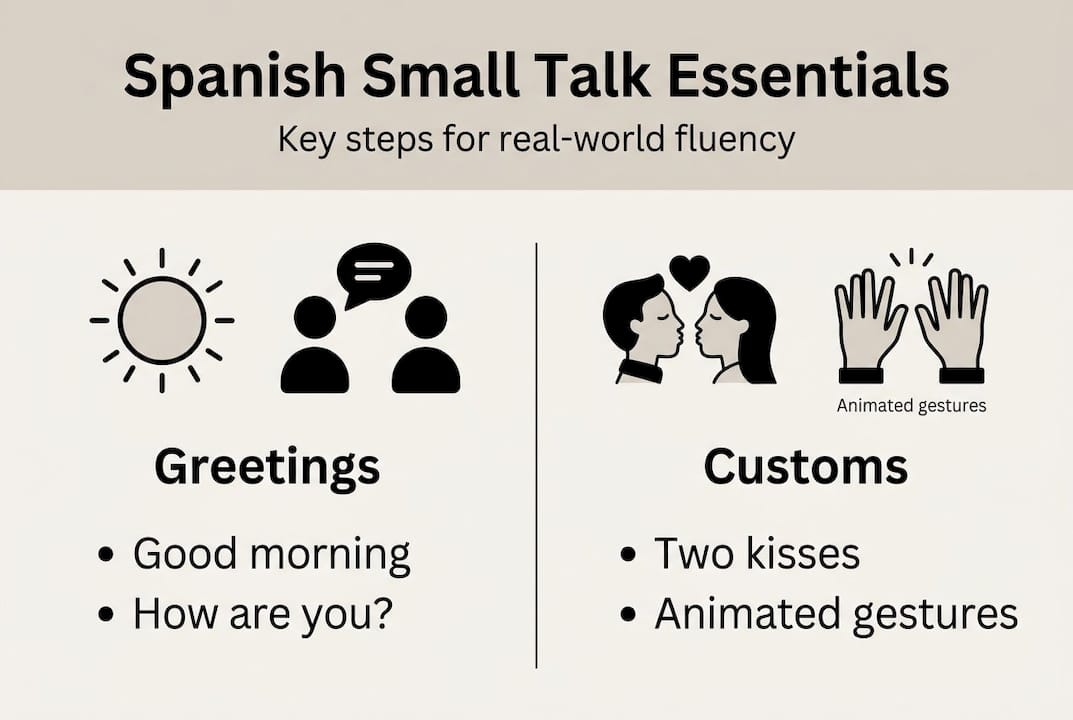
Physical customs matter too. The dos besos (two kisses on the cheek) between women and between men and women is common in social settings, though a firm handshake works fine in more formal ones. While once upon a time the advice was n Spain, use formal usted initially, that these days is more reserved for your Bank Manager, the Mayor or King Felipe or with Business clients, use Tu (informal) otherwise, greet upon entering shared spaces, and prioritise personal rapport before moving to any practical matter.
Topic-wise, Spanish small talk gravitates towards weather, weekend plans, food, and family. These are not throwaway subjects. They are genuine invitations to connect. Core mechanics of Spanish small talk include structured greetings, weather discussions, work and hobby inquiries, and smooth exits using time-specific phrases. Compare that to the typical English approach:
| Aspect | Spanish small talk | English small talk |
|---|---|---|
| Opening | Time-specific greeting, physical acknowledgement | Generic “Hi” or “Hello” |
| Tone | Warm, personal, expressive | Polite but often reserved |
| Common topics | Food, family, weekend, weather | Weather, work, sport |
| Physical contact | Dos besos or handshake | Handshake or wave |
| Formality | Tú with everyone these days, Usted with Bank Managers | Informal by default |
| Exit phrases | Time-referenced: Hasta luego, Que te vaya bien | “See you”, “Take care” |
“Starting with personal connection rather than task-completion is the engine room of Spanish social life. Master the warm opener and the rest of the conversation follows naturally.”
Understanding real-life Spanish conversation means accepting that the social ritual itself is the point, not a preamble to something more important.
Essential tools and phrases for natural small talk
Once you understand the cultural backdrop, the next step is filling your toolkit with phrases that actually get used. Core mechanics of Spanish small talk include structured greetings and typical phrases that signal friendliness and openness. Here are the ones worth learning first:
| Phrase | Pronunciation guide | English meaning |
|---|---|---|
| ¿Qué tal? | keh tal | How are things? |
| ¿Cómo estás? | koh-mo es-tas | How are you? |
| Muy bien, gracias | mwee byen, gra-thyas | Very well, thank you |
| ¿Y tu? | ee too | And you? (informal) |
| Hace buen tiempo | ah-theh bwen tyem-po | The weather’s nice |
| Hasta luego | as-ta lweh-go | See you later |
| Que te vaya bien | keh teh vah-ya byen | Hope it goes well for you |
| Perdona, ¿puedo…? | per-doh-na, pweh-do | Excuse me, may I…? |
These basic Spanish conversation starters are your entry points into almost any exchange. Learn them until they feel automatic, not rehearsed.
Non-verbal communication carries enormous weight in Spanish culture. A genuine smile, steady eye contact, and open body language signal that you are engaged and approachable. Standing slightly closer than you might in Britain is normal and expected. Pulling back can unintentionally suggest discomfort or disinterest.
Here are a few body language habits worth building:
- Maintain relaxed eye contact during conversation
- Nod and use small verbal affirmations like sí, sí (yes, yes) to show you are listening
- Mirror the energy of the person you are speaking with
- Avoid crossing your arms, which can read as closed-off
Pro Tip: Learn two phrases cold before any social outing: a warm opener like ¿Qué tal todo? (“How’s everything?”) and a polite exit like Bueno, te dejo, que tengo que… (“Right, I’ll leave you to it, I need to…”). These two alone will make every interaction feel far more natural. Pairing these with practising with audio cues will sharpen your ear for the rhythm of real replies.
How to practise: real-life steps to Spanish small talk mastery
Knowing phrases is one thing. Using them confidently in the wild is another. Methodologies emphasise daily real-life practice with strangers, active listening, and non-verbal techniques as the fastest route to genuine fluency. Here is a step-by-step routine that works:
- Start with low-stakes encounters. Your local panadería (bakery) or supermarket checkout is ideal. A simple Buenos días, ¿qué tal? costs nothing and builds enormous confidence over time.
- Use active listening fillers. Phrases like Oh, ¿sí? (“Oh really?”) and ¡Qué interesante! (“How interesting!”) show engagement and buy you a moment to process what has been said.
- Repeat the same scenario with different people. Ordering a coffee or asking about the weather becomes easier each time. Repetition with new faces expands your comfort zone faster than any textbook exercise.
- Debrief after each exchange. Note one phrase you heard but did not understand. Look it up. Use it the next day.
- Gradually extend conversations. Once greetings feel natural, add one follow-up question. ¿Y cómo ha ido el fin de semana? (“How was your weekend?”) is a reliable bridge into longer chat.
- Listen to Spanish radio or TV for ten minutes daily. You are not trying to understand everything. You are training your ear to the rhythm and speed of natural speech.
Handling nerves is part of the process. Most Spanish locals are genuinely warm and forgiving of mistakes. A stumbled sentence delivered with a smile lands far better than silence. These tips for speaking Spanish fluently are grounded in real-life experience, not classroom theory. Here are some basic tips from a dual native expert.

Pro Tip: Set yourself a small daily target: one new small talk exchange per day for two weeks. Track it. The cumulative effect is remarkable, and the practical steps for fluency compound quickly once you build momentum.
Troubleshooting: common mistakes and how to keep conversations flowing
Even with preparation, real conversations throw curveballs. Here is how to handle the most common ones.
Fast-talking natives are the number one challenge for English speakers. The advice is consistent: start with comprehensible input at a manageable speed, then gradually expose yourself to faster, more natural speech. Do not expect to follow everything immediately. That is normal, not failure.
Spanish conversations also feel more animated than English ones. Animated conversations and expressive gestures are cultural norms, not signs of conflict. Interruptions signal enthusiasm and engagement, not rudeness. If someone talks over you briefly, they are almost certainly just excited, not dismissive.
Here are the most common mistakes English speakers make, and how to pivot:
- Freezing when you do not understand. Instead, say ¿Puedes hablar más despacio, por favor? (“Could you speak more slowly, please?”) Most people will happily oblige.
- Ending conversations abruptly. In Spain, an abrupt exit feels jarring. Use a warm phrase to close: Bueno, te dejo (“Right, I’ll leave you to it”) or Hasta luego, que te vaya bien (“See you later, hope it goes well”).
- Keep it informal. In South America the formal Usted (“You”) is the default. In Spain use tú (informal “you”), unless you are talking to your Bank Manager or King Felipe.
- Translating English idioms directly. Phrases like “I’m fine” translate awkwardly. Lean on bien, gracias or tirando (“getting by”) instead.
- Avoiding conversation out of fear of mistakes. Silence reads as unfriendly. A warm, imperfect attempt always wins.
“Bueno, me tengo que ir, que si no me espera la compra.” (“Right, I’ve got to go, my shopping won’t wait.”) A light, time-referenced exit like this closes any conversation warmly and naturally.
Building the skill to master fast listening takes time, but it accelerates dramatically once you start having real exchanges every day.
Why true Spanish small talk fluency starts beyond the app
Here is something most language guides will not tell you: the problem is rarely vocabulary. It is the illusion of progress that apps create. A 341-day Duolingo streak can leave you sitting in a Spanish café, completely unable to follow a single sentence. Apps build isolated recognition. They do not build the reflex to respond in real time, in real noise, with a real person looking at you.
The genuine accelerator is human contact. Not perfect human contact. Warm, daily, slightly messy human contact. The builder who greets you at 8am. The woman at the farmacia (pharmacy) who asks how you are. These micro-exchanges, repeated consistently, wire your brain in ways that no gamified drill ever will.
Perfection blocks progress. The learners who advance fastest are not the ones with the best grammar. They are the ones willing to say something imperfect and keep going. Learning shop Spanish builds the kind of confidence that compounds, because every successful exchange, however small, proves to your brain that you can do this.
Apps have their place for building a foundation. But real fluency lives in the street, the market, and the neighbour’s doorstep.
Take your Spanish small talk further with James Spanish School
If this guide has shown you the gap between knowing Spanish and using it, James Spanish School was built to close exactly that gap.
The full online Spanish course from James Spanish School covers 100 lessons split between sentence-building and ear-tuning, so you can follow fast, natural speech as well as produce it. Lessons are on demand, available 24/7 on any device, with no expiry date and no pressure. James Bretherton, a dual-native speaker with 40 years in Spain, teaches real-life Spanish the way locals actually speak it. Whether you want to chat with your neighbour or handle a trip to the ayuntamiento (town hall), you will find the tools here. Start speaking Spanish fluently with confidence, or explore more Spanish resources to find the right starting point.
Frequently asked questions
What are the best openers for starting Spanish small talk?
Greet with context-appropriate phrases like Buenos días, ¿Qué tal?, or Hola, buenas to initiate small talk politely and naturally. Structured greetings and typical phrases form the core mechanics of Spanish small talk and signal warmth immediately.
How do I handle fast-talking native speakers in Spain?
Politely ask them to slow down using ¿Puedes hablar más despacio? (“Could you speak more slowly?”), and focus on key words you do recognise. Start with comprehensible input and build up your listening speed gradually through daily exposure.
Why do Spanish conversations seem more direct or animated than English?
Spanish small talk is naturally expressive and direct; interruptions or physical closeness signal engagement, not rudeness. Animated conversations and expressive gestures are deeply embedded cultural norms in Spain.
Is it okay to use language apps for small talk practice?
Apps help build a basic foundation, but real-life fluency grows through immersion and daily human interaction, not gamified drills. A 341-day streak can still leave you speechless in a real conversation, which is why street-level practice matters most.