

TL;DR:
- Fast Spanish listening involves understanding native speech at natural speed, including slang and accents.
- Overcoming barriers like word blending and regional accents requires consistent immersive practice and targeted techniques.
- Regular exposure to authentic audio and shadowing builds ear resilience, enabling real-life cultural immersion.
You’ve studied your textbook, practised your phrases, and you can hold a decent conversation in a classroom setting. Then you arrive in Spain, a local speaks to you at full speed, and your mind goes completely blank. Sound familiar? This is one of the most common and frustrating experiences for English-speaking adults learning Spanish. The gap between slow, enunciated classroom Spanish and the rapid, rhythmic speech of a native Spaniard is enormous. This guide will show you exactly what fast Spanish listening is, why it matters so deeply for real cultural immersion, and how to build the skills that will genuinely transform your experience in Spain.
Table of Contents
- What is fast Spanish listening?
- Why fast listening matters for real conversations in Spain
- Barriers to understanding fast Spanish and how to overcome them
- Practical tools and habits to improve fast Spanish listening
- The uncomfortable truth about mastering fast Spanish
- Ready to boost your Spanish listening for Spain?
- Frequently asked questions
Key Takeaways
| Point | Details |
|---|---|
| Real-world listening needed | Classroom Spanish won’t prepare you for the speed and slang of everyday life in Spain. |
| Immersion is fastest path | High-contact listening programmes and daily audio exposure accelerate adaptation to real spoken Spanish. |
| Practical tools matter | Using audio apps, transcripts, and daily habits bridges the gap between slow study and fast conversation. |
| No shortcuts, steady wins | Daily exposure and persistence are essential for building true fast listening skills. |
What is fast Spanish listening?
Fast Spanish listening is the ability to understand spoken Spanish at the natural pace and rhythm used by native speakers in Spain. It is not the measured, carefully pronounced Spanish you hear in language courses or audio textbooks. It is the machine-gun speed of a market trader calling out prices, the fluid conversation between friends at a bar, or the rapid instructions from a local official.
Classroom Spanish tends to be slowed down, stripped of regional accent, and free of the contractions and elisions that real speech is full of. In contrast, authentic Spanish conversation involves:
- Word blending: Sounds from one word merge into the next, so para el becomes something closer to parel.
- Local slang: Regional expressions and colloquialisms that no textbook covers.
- Rapid transitions: Speakers shift topics, interrupt each other, and change register without warning.
- Accent variation: Castilian Spanish, Andalusian, and regional dialects each carry distinct sounds and rhythms.
- Dropped syllables: Native speakers routinely shorten words in casual speech.
For learners who have only worked with slow, controlled audio, this can feel overwhelming. The frustration is real and completely understandable. Your brain has been trained to process Spanish at one speed, then suddenly it is asked to operate at triple the pace.
“The moment you hear real Spanish on the street, you realise your ear has been living in a protected bubble. Breaking out of it is the whole challenge. Complaints about being distracted by a bee buzzing in an online audio pale into insignificance to the blaring television in the Spanish bar
Building fast listening skills means training your ear to recognise sounds, rhythms, and patterns rather than translating word by word. Immersive programmes provide 20 to 100+ hours of weekly contact, which accelerates real-conversation adaptation significantly. Starting with beginner Spanish conversations built around authentic speech patterns is a smart first move, and using tools like WordAmigo audio lists helps you tune your ear to genuine pronunciation from the very beginning.
Why fast listening matters for real conversations in Spain
Having defined fast Spanish listening, let’s examine why mastering it genuinely matters. The ability to understand rapid speech is not just a nice bonus. It is the difference between participating in life in Spain and watching it pass you by.
Think about the everyday situations that demand quick comprehension:
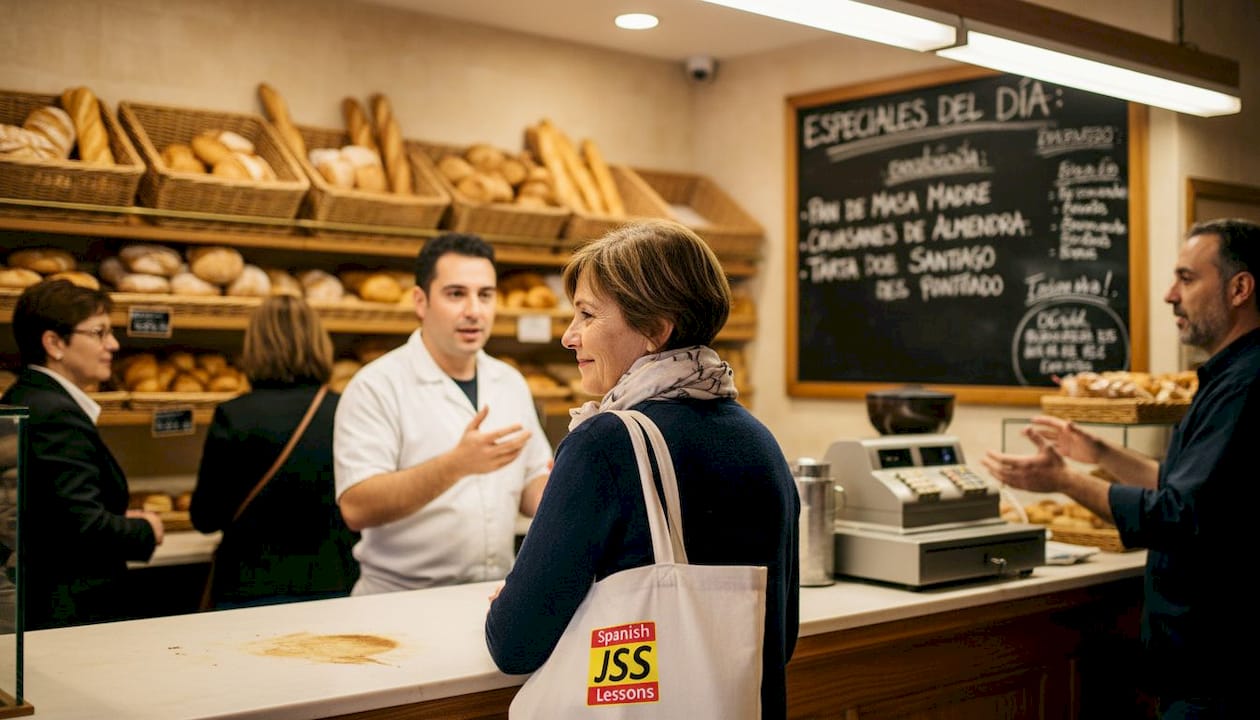
- Cafés and restaurants: Waiters rattle off the daily specials without pausing.
- Shops and markets: Prices, offers, and questions come at you without ceremony.
- Public transport: Announcements are fast, often distorted, and not repeated.
- Social gatherings: Group conversations overlap, shift, and accelerate constantly.
- Health and official appointments: Missing key information here carries real consequences.
When you cannot follow fast speech, miscommunications happen. You nod along and agree to something you did not understand. You miss a joke and feel excluded. You ask someone to repeat themselves three times and watch their patience thin. These moments chip away at your confidence and can make you retreat from using Spanish altogether.
On the other hand, when your ear is tuned to real Spanish, everything changes. You catch the humour in a conversation. You understand what your neighbour is telling you about the local fiesta. You follow the builder’s instructions without needing a translator. Immersive Spanish programmes rapidly build this kind of real conversation confidence through high contact hours with authentic speech. The social and cultural rewards of speaking with locals in Spain are enormous, and they begin the moment your listening catches up with your speaking.
Even practical tasks like shop Spanish in Spain become genuinely enjoyable rather than stressful when you can follow what is being said naturally.
Pro Tip: Focus first on the ten or fifteen most common rapid-fire phrases used in everyday Spanish settings. Mastering these gives you anchor points in fast conversations, so your brain is not starting from zero every time.
Barriers to understanding fast Spanish and how to overcome them
Understanding its value highlights the need to address the obstacles learners face. The good news is that each barrier has a practical solution.
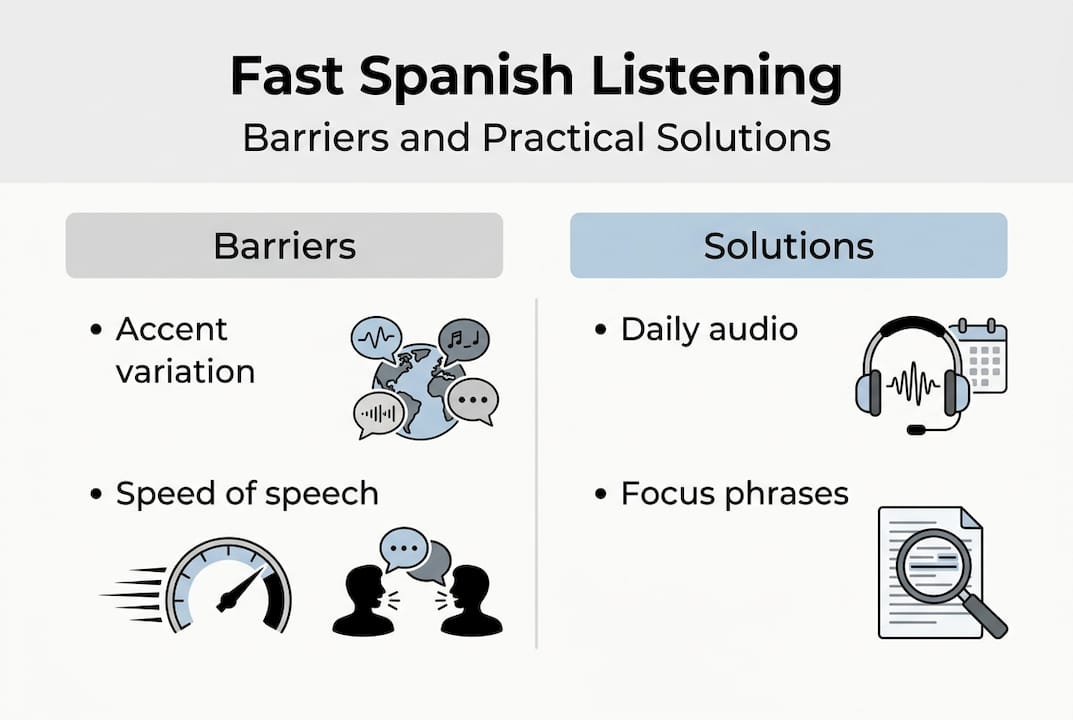
The main challenges are:
- Accent variation: Spain alone has multiple distinct regional accents, each with its own quirks.
- Word blending and elision: Sounds merge across word boundaries in ways that make familiar words unrecognisable.
- Local slang: Expressions shift by region, generation, and social group.
- Delivery speed: Native speakers simply do not slow down for learners.
Here are four proven techniques to work through these barriers:
- Use slow-down audio apps for ear training. Apps that allow you to reduce playback speed let you hear the individual sounds within fast speech before you attempt full speed. Gradually increase the pace as your ear adjusts.
- Practise with transcripts. Listen to a short clip of authentic Spanish, then read the transcript. Notice where sounds blended or disappeared. Repeat until you can hear what you previously missed.
- Chunk and segment long sentences. Rather than trying to process an entire sentence at once, train yourself to catch key words and build meaning from those. Context fills in the rest.
- Shadow and repeat. Listen to a short phrase, then say it aloud immediately, mimicking the rhythm and pace. Shadowing rewires your brain to process Spanish at native speed rather than translating it.
Comprehension increases through intensive, natural-speed listening practice, as seen in immersive language experiences. Exploring Spanish listening alternatives and enrolling in structured listening programmes can accelerate this process considerably. You can also try spoken Spanish practice lessons designed specifically for building ear-tuning skills.
| Barrier | Practical technique | Expected benefit |
|---|---|---|
| Accent variation | Listen to regional Spanish audio daily | Ear adjusts to multiple sound patterns |
| Word blending | Transcript-based listening exercises | Identify hidden sounds within speech |
| Local slang | Curated colloquial phrase lists | Recognise informal speech faster |
| Delivery speed | Shadowing and speed-adjusted playback | Brain processes at native pace |
Pro Tip: Stop translating in your head. The moment you try to convert Spanish into English before understanding it, you fall behind. Train yourself to feel the meaning of words directly, the same way you do in your mother tongue.
Practical tools and habits to improve fast Spanish listening
With common challenges mapped out, let’s look at proven ways to train your ear and make new habits stick.
The most effective tools for building fast listening skills include:
- Podcasts in European Spanish: Choose programmes made for native speakers, not learners, once you are past the beginner stage.
- Audio word lists: Tools like WordAmigo give you authentic pronunciation in context, not isolated sounds.
- Conversation exchanges: Speaking with native speakers, even briefly, forces your ear to adapt in real time.
- Graded audio programmes: These bridge the gap between slow learner audio and full native speed.
Programmes such as Delengua Granada or Pueblo Español provide high weekly contact hours and real-world listening exposure that classroom study simply cannot replicate.
| Tool | Best for | Limitation |
|---|---|---|
| Spanish podcasts (native) | Advanced ear training | Can overwhelm beginners |
| Graded audio programmes | Bridging slow to fast speech | May lack authentic slang |
| Conversation exchanges | Real-time adaptation | Requires scheduling and confidence |
| On-demand course lessons | Structured, repeatable practice | Self-discipline required |
The key is building daily micro-habits. Ten minutes of focused audio each morning is worth more than an hour of passive background listening once a week. Record yourself repeating phrases and compare your rhythm to the original. Shadow short clips before you move on to longer ones.
Exploring on-demand Spanish learning options means you can fit ear-tuning practice into your day without rearranging your life. Combining this with quality Spanish audio resources and regular practice lesson videos creates a habit loop that genuinely moves the needle.
The uncomfortable truth about mastering fast Spanish
Having seen the practical methods, let’s speak candidly about what truly drives progress. No technique, app, or course will do the work for you if you are not spending real time with real Spanish. Classroom skills give you a foundation, but they will never be enough on their own.
The truth is that feeling lost is part of the process. Every learner, no matter how diligent, goes through a phase where fast Spanish sounds like noise. That phase does not mean you are failing. It means your ear is being stretched. Immersion and relentless practice are proven to build fast listening ability far more effectively than traditional study alone.
Even experienced learners stumble when they encounter a new regional accent or a particularly fast speaker. The difference is that they keep going. Daily exposure to authentic Spanish audio, even in small doses, gradually makes the impossible feel ordinary. The learners who succeed are not the ones with the best memory or the most natural talent. They are the ones who kept listening, kept shadowing, and refused to retreat into comfortable, slow-paced materials. Unlocking confidence in Spain is less about reaching perfection and more about building the resilience to stay in the conversation even when it is fast and messy.
Ready to boost your Spanish listening for Spain?
If this guide has shown you anything, it is that fast Spanish listening is a skill you can genuinely build, step by step, with the right tools and consistent practice.
At James Spanish School, the 100-lesson course is built around exactly this challenge. Half the lessons focus on ear-tuning, training you to follow real spoken Spanish rather than just studying it on paper. James Bretherton, a dual-native speaker with 40 years in Spain, has designed the course around real conversation basics and genuine cultural immersion. Explore fluency tips for locals and discover how the JSS 100 lesson program can connect you with a community of learners on the same journey. Your ear is ready to be trained.
Frequently asked questions
How can I start understanding fast Spanish if I’m a beginner?
Begin with graded audio that progressively increases speed and focus on the most common everyday phrases before tackling full native-speed conversations. Repetition and patience are your best tools at this stage.
What is the best tool for improving Spanish listening speed?
Immersive audio programmes and recordings of genuine native speech are the most effective, as they expose your ear to the real rhythms and sounds of Spanish rather than a sanitised version.
How quickly can someone adapt to fast Spanish?
Many learners notice meaningful progress within a few weeks when they engage daily with authentic fast Spanish audio and real conversation practice, though the pace of improvement varies by individual.
Does understanding fast Spanish mean I’ll be fluent?
Not automatically, but strong listening skills make speaking and participating in conversations far more natural and confident, which in turn accelerates overall fluency considerably.