

Forget the image of sitting in a draughty evening class, textbook open, waiting for the teacher to call your name. Most adults assume that learning Spanish properly means fixed schedules, homework deadlines, and a classroom. That assumption is simply wrong. Self-paced digital resources like pre-recorded courses and apps have changed everything, giving you genuine access to practical Spanish whenever you want it. Whether you want to chat with your Spanish neighbours, handle a visit to the local health centre, or simply feel less lost on holiday, on-demand learning puts you in control from day one.
Table of Contents
- Defining on-demand Spanish learning
- How on-demand Spanish learning works
- Comparing on-demand and traditional Spanish learning
- Real-life advantages: practical skills and cultural insights
- Getting started with on-demand Spanish learning
- Explore innovative Spanish courses
- Frequently asked questions
Key Takeaways
| Point | Details |
|---|---|
| Flexible access | You can learn Spanish anytime and anywhere with on-demand resources. |
| Practical focus | On-demand learning prioritises real-world communication and cultural understanding. |
| Personalised pace | Self-paced courses let you repeat lessons or accelerate based on your needs. |
| Easy start | Getting started only requires basic technology and motivation. |
Defining on-demand Spanish learning
So what does “on-demand” actually mean when we talk about learning Spanish? In plain terms, it means you access your lessons whenever you choose, from wherever you happen to be, using a phone, tablet, or laptop. There is no timetable to follow and no class to catch up with if life gets in the way.
Digital resources for learners cover a wide range of formats. These include apps like Duolingo or Babbel, YouTube channels run by native speakers, subscription platforms with structured courses, and specialist schools offering pre-recorded lesson libraries. The common thread is flexibility. However you need to choose the course you do very carefully.
What separates on-demand learning from casual YouTube browsing is purpose. Good on-demand resources are built around practical, everyday Spanish. Think ordering food at a local bar, greeting a tradesman at your door, asking a pharmacist for advice, or understanding what the council letter actually says. This is the kind of Spanish that matters in real life, not the kind that helps you pass an academic exam.
“On-demand Spanish learning puts practical, everyday conversation at the centre, not grammar drills or test preparation.”
If you want a Spanish course like no other that is built entirely around this philosophy, you will find that the best options strip away unnecessary complexity and focus on what you genuinely need to say.
- Access lessons 24 hours a day, 7 days a week
- Learn on any device, at home or abroad
- Revisit difficult topics as many times as you need
- Focus on real conversations, not academic exercises
- Progress at your own pace without pressure
How on-demand Spanish learning works
With a clear definition in place, it helps to understand the mechanics. On-demand digital resources use a combination of pre-recorded video or audio lessons, interactive exercises, and progress tracking to keep you moving forward steadily.
Most platforms include features such as quizzes after each lesson, voice recognition tools that check your pronunciation, and spaced repetition systems that bring back vocabulary at the right moment before you forget it. Some include chatbot conversations that simulate real exchanges. Others, like James Spanish School, use dedicated pronunciation assessment and memory tools such as WordAmigo, which contain all these feature, alongside carefully structured lesson sequences.
Here is a straightforward way to get started with any on-demand resource:
- Choose your platform based on your goals, budget, and preferred learning style.
- Set a specific goal, such as holding a five-minute conversation with a neighbour within three months.
- Block out regular time in your week, even if it is just twenty minutes on a Tuesday morning.
- Complete the introductory lessons without skipping, even if some feel easy at first.
- Use the review features to revisit anything that does not stick immediately.
- Track your progress using the platform’s built-in tools or a simple notebook.
| Feature | What it does | Why it helps |
|---|---|---|
| Spaced repetition | Revisits vocabulary at timed intervals | Locks words into long-term memory |
| Voice recognition | Analyses your spoken Spanish | Improves pronunciation accuracy |
| Progress tracking | Shows lessons completed and scores | Keeps motivation high |
| Offline access | Downloads lessons for use without Wi-Fi | Lets you learn anywhere |
| Lesson replay | Unlimited replays of any lesson | Removes pressure to get it right first time |
Pro Tip: Set a recurring reminder on your phone for your chosen learning slot. Consistency beats intensity every time. Twenty minutes daily will outperform a two-hour session once a fortnight.
Exploring conversational Spanish methods that are built around real dialogue rather than grammar tables will make those daily sessions feel far more rewarding.
Comparing on-demand and traditional Spanish learning
Understanding how on-demand platforms work makes it easier to weigh them against the traditional alternatives. Both approaches have genuine strengths, and knowing the difference helps you choose wisely.
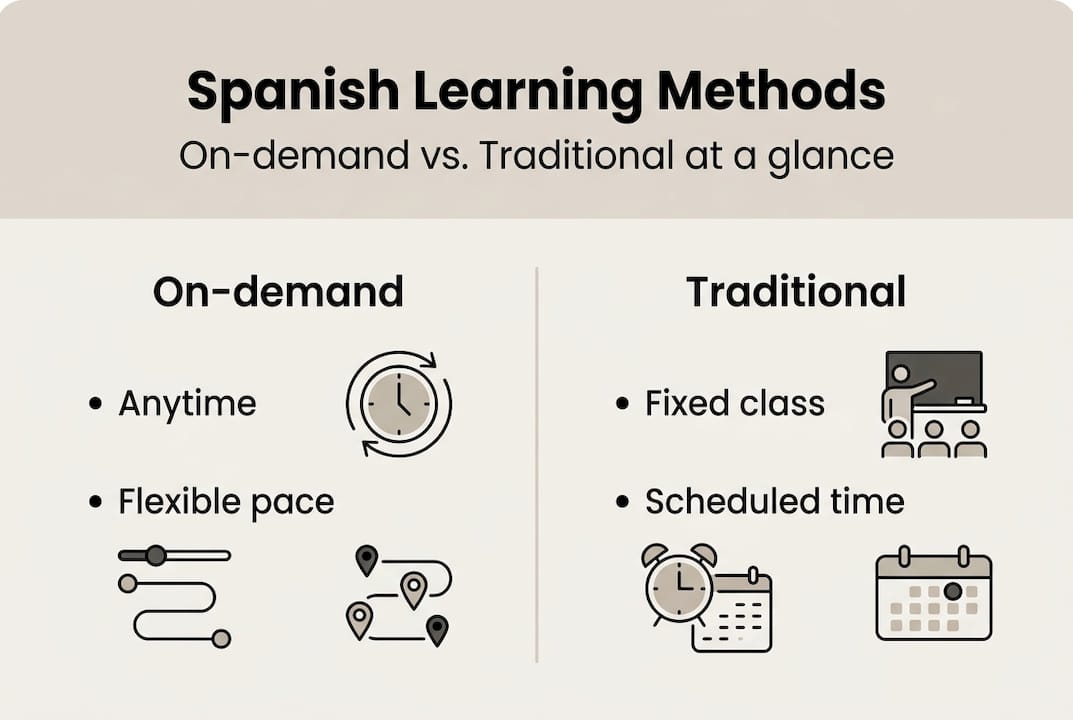
Self-paced on-demand learning removes the fixed schedule entirely, which is the single biggest barrier for most working adults. Traditional night classes or private tutors require you to show up at a set time, every week, regardless of what else is happening in your life.

| Factor | On-demand learning | Traditional classes |
|---|---|---|
| Schedule | Fully flexible, any time | Fixed weekly slots |
| Location | Anywhere with a device | Classroom or tutor’s location |
| Pace | Entirely your own | Set by the teacher or group |
| Accent exposure | Multiple accents and dialects | Usually one teacher’s accent |
| Accountability | Self-directed | External pressure from teacher |
| Cost | Often lower, one-off fee | Ongoing weekly cost |
| Personalisation | High, choose your own path | Limited by group needs |
Advantages of on-demand learning:
- Learn at 6am, midnight, or during a lunch break
- Exposure to a wide range of regional Spanish accents
- Repeat any lesson without embarrassment
- Pay once and access content indefinitely
- Tailor your focus to the situations you actually face
Challenges to be aware of:
- Requires self-discipline without external deadlines
- No live conversation partner built in, but AI assessment.
- Quality varies enormously between platforms
- Easy to stall if motivation dips
The key insight is that on-demand learning rewards people who are motivated by real goals. If you want to speak Spanish because you live in Spain, visit regularly, or work with Spanish speakers, that practical motivation is usually enough to keep you going.
Real-life advantages: practical skills and cultural insights
This is where on-demand learning genuinely earns its place. Practical, everyday skills are the whole point, and the best on-demand courses are built around the situations you will actually encounter.
Imagine arriving at a Spanish market and being able to ask the stallholder about the cheese, understand the answer, and respond naturally. Or picture calling your local council office and following what the person on the other end is saying without panicking. These are not fantasy scenarios. They are exactly what focused on-demand learning prepares you for.
Cultural knowledge matters just as much as vocabulary. Spanish communication has its own rhythms and customs. People greet each other differently depending on the region. Builders stop for a mid-morning snack that is almost sacred. Queuing works differently in a Spanish bank than it does in a British post office. Understanding these nuances stops you from accidentally causing offence or simply looking confused.
Good on-demand resources weave this cultural context into the lessons themselves, using audio clips of native speakers, short video stories, and real-life scenarios rather than invented textbook dialogues.
- Ordering food and drink confidently at a bar or restaurant
- Asking for directions and understanding the reply
- Speaking to health workers, pharmacists, and receptionists
- Handling tradesmen and understanding quotes
- Chatting with neighbours about everyday topics
- Understanding humour, idioms, and informal expressions
Pro Tip: Prioritise resources that use recordings of real native speakers rather than computer-generated voices. The difference in natural rhythm and pronunciation is enormous, and your ear will thank you for it later.
Getting started with on-demand Spanish learning
If you are ready to begin, the process is simpler than most people expect. On-demand resources are designed to welcome complete beginners, so there is no prior knowledge required.
- Pick your platform by reading user reviews and checking whether the content focuses on practical conversation rather than grammar theory.
- Define your goal clearly, for example: “I want to order food and ask for directions confidently within six weeks.”
- Create a realistic schedule that fits your actual life. Three sessions of twenty minutes per week is far better than an ambitious plan you abandon after a fortnight.
- Join an online community of fellow learners, whether a Facebook group, a forum, or a course community. Shared progress keeps motivation alive.
- Review what you have learned at the end of each week, even briefly. This cements new vocabulary and highlights gaps.
When choosing a resource, look for these qualities:
- Practical content focused on real conversations, not grammar tables
- Positive user reviews from people with similar goals to yours
- Clear support if you get stuck or have questions
- Transparent pricing with no hidden renewal fees
- Flexibility to learn at your own pace without expiry dates
Common pitfalls to avoid:
- Signing up for three platforms at once and spreading yourself too thin
- Setting unrealistic goals like “fluent in a month”
- Skipping the speaking and listening practice in favour of reading only
- Stopping after the first difficult lesson instead of replaying it
For a broader look at what is available, the best language learning apps guide from PCMag offers a useful starting point for comparing options across different budgets and learning styles.
Explore innovative Spanish courses
If everything above resonates with you, James Spanish School was built with exactly this kind of learner in mind. James Bretherton has lived in Spain for 40 years and speaks Spanish as a dual native. His A Spanish course like no other uses Radical Simplification to strip out confusing grammar jargon and replace it with plain English explanations that actually make sense.
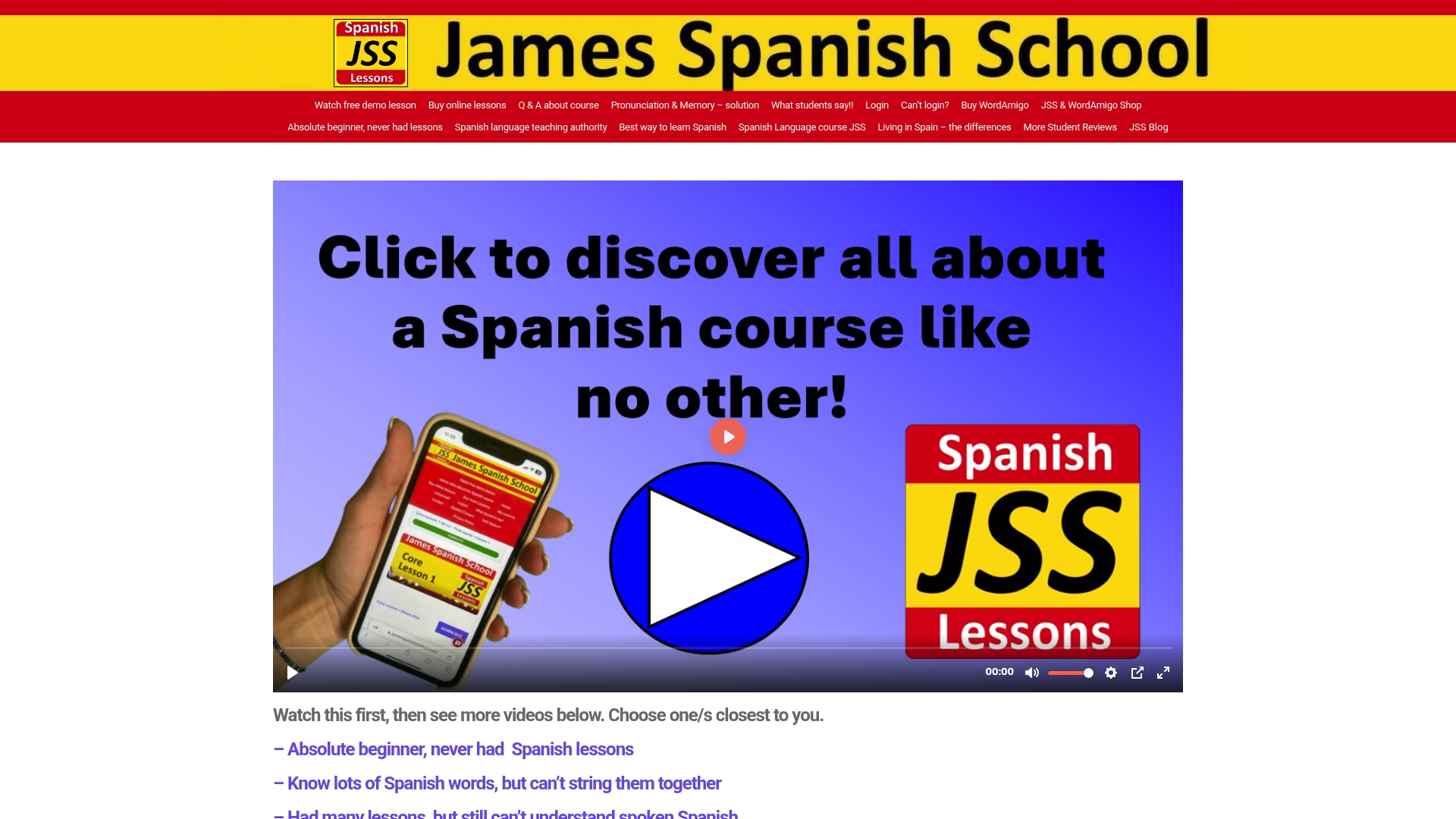
The 100-lesson course covers both sentence-building and ear-tuning, so you can follow fast spoken Spanish as well as produce it. Everything is available on demand, 24/7, with no expiry date and no countdown clock. You also get WordAmigo for pronunciation support and genuine cultural insider knowledge woven throughout. If a core lesson does not teach you something new, James will credit you with extra practice modules at no cost. That is a promise worth taking seriously.
Frequently asked questions
What makes on-demand Spanish learning different from night classes?
On-demand learning lets you study at any hour and from any location, without the fixed weekly timetable or classroom setting that night classes require. Self-paced digital resources mean your schedule, not the teacher’s, dictates when you learn.
Can I achieve conversational Spanish only with on-demand resources?
Yes, many on-demand platforms focus specifically on practical conversation and include interactive features that build real-life speaking and listening skills. The key is choosing a resource that prioritises everyday practical skills over academic grammar.
Are on-demand Spanish courses suitable for complete beginners?
Absolutely. Most platforms are designed to guide true beginners from the very first word, with clear introductions and the ability to replay lessons as often as needed. Starting at any time is one of the core advantages of this format.
What technology do I need for on-demand Spanish learning?
All you need is a smartphone, tablet, or computer with a reliable internet connection. Digital learning tools are designed to work across all common devices without any specialist software or equipment.
Recommended