

TL;DR:
- Direct-to-English Spanish teaches learners entirely in Spanish, avoiding English translation during instruction.
- This method uses visuals, gestures, and real-life scenarios to build meaning naturally, mirroring first-language acquisition.
Direct-to-English Spanish is defined as a language learning approach where Spanish is taught exclusively through Spanish, with no English translation used during instruction. The formal term for this is the Direct Method, a pedagogical approach that builds meaning through context, visuals, and oral practice rather than word-for-word translation. If you have ever wondered what is direct-to-english spanish and why it differs so sharply from classroom grammar lessons, the answer lies in how your brain forms language connections. Schools like Berlitz and Alliance Française have used this approach for decades, and James Spanish School draws on the same core principle: get you thinking in Spanish, not translating from it.
What is the Direct Method and how does it relate to direct-to-English Spanish?
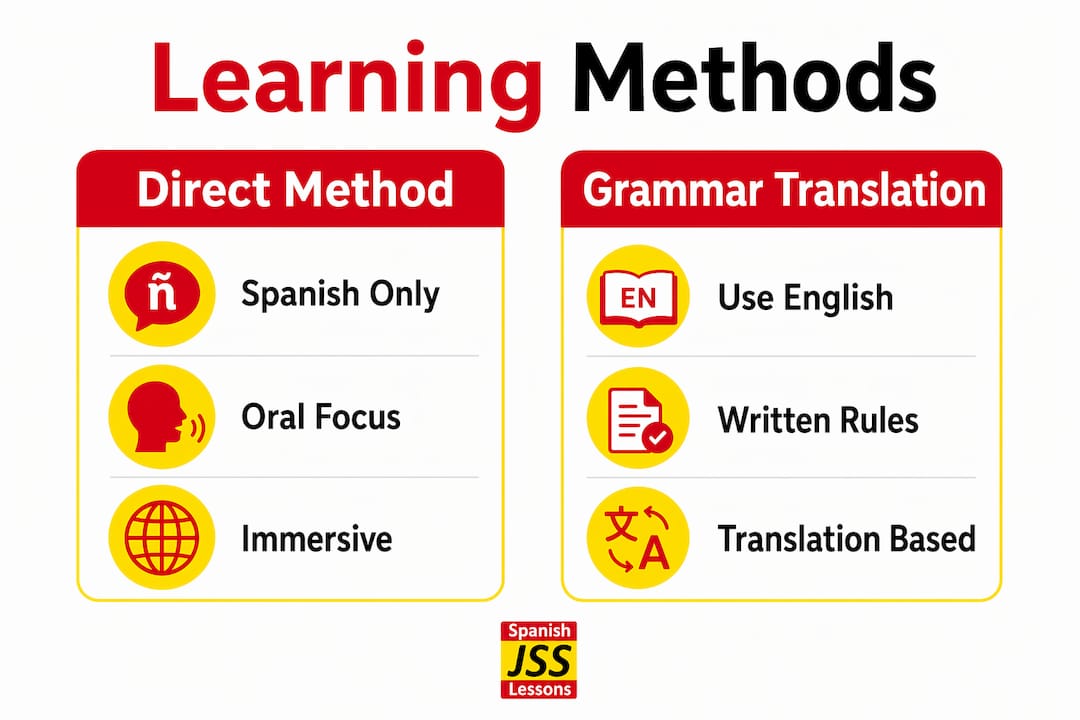
The Direct Method is the pedagogical foundation behind what most people call direct-to-English Spanish. According to Wikipedia), the Direct Method refrains from using learners’ native language and uses only the target language, building immediate audiovisual associations. That single principle changes everything about how a lesson feels and how quickly your brain adapts.
The method emerged as a reaction) against grammar-translation, which dominated European language classrooms throughout the 19th century. Grammar-translation teaches you to decode a foreign language by converting it into your mother tongue. The Direct Method rejects that entirely. It aims to imitate first-language acquisition, the same process you used as a child learning English, where meaning came from experience rather than explanation.
Oral primacy) is central to the Direct Method. Learners hear and speak Spanish before they read or write it. Grammar is taught indirectly, embedded in real situations rather than listed as rules on a page. Schools like Berlitz and Alliance Française) adopted this approach and built entire teaching systems around it, which is why it remains a foundational method in prominent language institutes today.
The contrast with grammar-translation is stark. Grammar-translation prioritises written language and explicit rule memorisation. The Direct Method prioritises comprehension and production in Spanish over any form of English mediation. For adult learners, this distinction matters enormously because it determines whether you will ever think fluidly in Spanish or always be one mental step behind.
Pro Tip: When you start a Direct Method course, resist the urge to write English notes beside Spanish words. That habit reinforces the very translation loop the method is designed to break.
How does direct-to-English Spanish work in practice?
Classroom interactions are conducted exclusively in Spanish), and meaning is conveyed through visuals, gestures, and physical demonstration rather than English explanation. A teacher holds up an apple and says the Spanish word. You associate the word with the object, not with an English label. That is the engine room of the whole approach.
In practice, the method relies on several techniques:
- Visuals and realia: Real objects, photographs, and drawings replace English definitions.
- Gestures and mime: Teachers use body language to convey verbs and emotions without switching language.
- Question and answer in Spanish: Every exchange stays in the target language, even when a learner is confused.
- Situational grammar: Structures are introduced through scenarios, not grammar tables.
- Repetition and oral drilling: Phrases are repeated aloud until they feel automatic.
The early stages can feel disorienting. You sit in a lesson where everything is in Spanish and your brain scrambles for an English foothold that never comes. That discomfort is not a flaw in the method. It is the method working. Learners often struggle initially) as they resist thinking in Spanish without English scaffolding, but this resistance is precisely what builds faster real-time processing later.
Learners progress through clear phases. Oral comprehension comes first. Speaking follows. Structural understanding develops last, supported by immersive contexts rather than translation. This mirrors the sequence in which children acquire their first language, which is why the approach produces more natural-sounding speech than grammar-translation ever does.

Pro Tip: Treat confusion as a signal that your brain is forming new connections, not as evidence that you are failing. The moment a Spanish phrase clicks without translation is the moment fluency begins.
What are the advantages and challenges of the direct-to-English approach?
The advantages of Spanish language direct translation avoidance are real and well documented. The core benefit is automaticity. Avoiding English during instruction) helps learners form direct connections with Spanish words and phrases, resembling first-language acquisition. That means faster responses in real conversation, because your brain is not running a translation programme in the background.
The key advantages include:
- Faster real-time comprehension in spoken Spanish
- More natural pronunciation and intonation from early exposure
- Stronger speaking confidence because oral practice dominates
- Better retention of vocabulary through contextual association
The challenges are equally real. The biggest is the mental habit of translating. A major challenge is that learners’ mental habit of translating) can slow down fluency development, which the Direct Method seeks to overcome. Many adults find the early weeks genuinely hard. Without English scaffolding, progress can feel invisible even when it is happening.
| Aspect | Direct Method | Grammar-translation |
|---|---|---|
| Language of instruction | Spanish only | English and Spanish |
| Grammar teaching | Situational and indirect | Explicit rules in English |
| Speaking practice | Central from lesson one | Often secondary to writing |
| Translation use | Avoided entirely | Core learning tool |
| Early learner comfort | Lower | Higher |
| Long-term fluency | Stronger | Often weaker |
The table above shows why the Direct Method suits learners who want to hold real conversations rather than pass written exams. The discomfort is front-loaded. The payoff comes when you find yourself replying to a Spanish neighbour without pausing to translate in your head.
How does direct-to-English Spanish differ from literal translation?
Direct-to-English Spanish is not the same as literal translation). The word “direct” causes genuine confusion here, so it is worth being clear. In the context of the Direct Method, “direct” means no English mediation, not word-for-word translation between languages.
Literal translation, sometimes called word-for-word translation, produces results that are often unnatural or outright wrong. Consider three examples:
- The Spanish phrase “tener hambre” translates literally as “to have hunger.” In English, you say “to be hungry.” A literal translation fails the speaker immediately.
- “Me llamo James” translates literally as “I call myself James.” Native speakers say “My name is James.” The literal version sounds odd in both languages.
- “Hace calor” translates literally as “it makes heat.” The natural English equivalent is “it is hot.” No native speaker would use the literal version.
These examples show why literal translations often yield unnatural or confusing results), unlike direct method approaches that focus on context and meaning. The Direct Method sidesteps this problem entirely by never asking you to translate at all. You learn that “hace calor” means the feeling of a hot day, not a string of English words.
Understanding this distinction is the key to understanding direct-to-English Spanish. The method is not a translation technique. It is a teaching environment designed to make translation unnecessary. You can read more about practical fluency techniques that apply this principle to everyday situations in Spain.
Pro Tip: When you catch yourself mentally translating a Spanish phrase into English, pause and try to picture the situation the phrase describes instead. Replace the English word with an image or a feeling.
What practical tips help English speakers succeed with this method?
Success with direct-to-English Spanish learning comes down to mindset as much as method. The learners who progress fastest are those who accept the discomfort of not understanding everything and keep going anyway.
- Embrace the gap: Not understanding every word is normal and expected. Context fills in meaning over time.
- Use contextual clues actively: Pay attention to gestures, tone of voice, and visual cues. They carry more information than you expect.
- Prioritise listening before speaking: Audio lessons fast-track real-life conversation by training your ear before your mouth. Spend more time listening than you think you need to.
- Avoid writing English translations: Keep your notes in Spanish, even if they are incomplete. The act of writing in English reinforces the translation habit.
- Practise conversation regularly: Conversational practice in Spanish, even short exchanges, builds the automaticity the method depends on.
- Repeat lessons: The Direct Method rewards repetition. Hearing the same Spanish structures in different contexts cements them faster than any grammar table.
The learners who struggle most are those who treat confusion as failure. Confusion is the gap between what you know and what you are about to know. The Direct Method is designed to close that gap through exposure, not explanation.
Key takeaways
Direct-to-English Spanish is the Direct Method in practice: a teaching environment where Spanish is the only language used, and meaning is built through context, not translation.
| Point | Details |
|---|---|
| Core definition | Direct-to-English Spanish means target-language-only instruction, with no English used during lessons. |
| Pedagogical basis | The Direct Method, adopted by Berlitz and Alliance Française, is the formal foundation of this approach. |
| Not literal translation | “Direct” refers to no English mediation, not word-for-word translation between Spanish and English. |
| Key challenge | The mental habit of translating slows fluency; the method works by breaking that habit through immersion. |
| Best practice | Prioritise listening and speaking, avoid English notes, and treat early confusion as a sign of progress. |
My honest view on the Direct Method after 40 years in Spain
I have spent four decades living and working in Spain, and I have watched hundreds of English speakers try to learn Spanish. The ones who crack it fastest share one trait: they stop waiting to understand everything before they speak. The Direct Method is built on that insight.
That said, I think the method is often misapplied. Pure immersion without any structural guidance can leave adult learners spinning their wheels for months. Adults are not children. You already have a sophisticated understanding of how language works. The most effective approach uses the Direct Method’s core principle, no English mediation, while giving you enough structural logic in plain English to understand why Spanish sentences are built the way they are. That is the balance James Spanish School is built around.
The other thing I would say is this: the discomfort of the early weeks is not a reason to switch methods. It is evidence the method is working. Every time your brain reaches for an English word and finds a Spanish one instead, that is a new neural pathway forming. Adults who understand why they struggle with Spanish are far better placed to push through it. Persistence, not talent, is what separates the learners who succeed from those who give up at week three.
— James
How James Spanish School supports immersive Spanish learning
James Spanish School applies the core principle of direct-to-English Spanish learning across its 100-lesson online course. Lessons are structured to build Spanish comprehension through context and oral practice, with James Bretherton explaining structure in plain English only where it genuinely helps adult learners.
The WordAmigo system uses AI-powered repetition to embed vocabulary and pronunciation without relying on English translation drills. Lessons are available on demand, 24/7, on any device, with no expiry date and no countdown pressure. The full course covers sentence-building and ear-tuning, the two skills that matter most for real conversations in Spain. If you want to learn Spanish the way it is actually spoken, not the way it is written in textbooks, this is where to start.
FAQ
What does “direct-to-English Spanish” actually mean?
Direct-to-English Spanish refers to a teaching approach where Spanish is taught exclusively through Spanish, with no English translation used during instruction. The formal term is the Direct Method, which builds meaning through context, visuals, and oral practice.
Is the Direct Method the same as full immersion?
The Direct Method and full immersion share the same core principle: no English during instruction. Full immersion typically refers to living in a Spanish-speaking environment, while the Direct Method applies the same principle within a structured lesson format.
Why does the Direct Method avoid English translation?
Avoiding English during instruction) forces learners to form direct connections between Spanish words and their meanings, which builds faster real-time comprehension. Translation creates a mental detour that slows fluency.
Is direct-to-English Spanish suitable for complete beginners?
The Direct Method works for beginners, though the early stages require patience. Learners often struggle initially) without English scaffolding, but this discomfort is temporary and leads to stronger fluency than translation-based methods.
How is direct-to-English Spanish different from learning Spanish grammar?
Grammar-translation methods teach rules explicitly in English and focus on written language. The Direct Method teaches grammar indirectly through situational use and oral practice, with no English explanation required.