

TL;DR:
- Spanish for health care provides ready-to-use phrases organized by clinical workflow to improve communication with Spanish-speaking patients. Using formal address, practicing common phrase patterns, and employing professional interpreters when necessary ensure accurate and respectful medical interactions. Memorizing short, complete phrases enhances confidence and reduces errors during routine patient care and emergencies.
Spanish for health care is defined as a set of ready-to-use clinical phrases and vocabulary that allow healthcare professionals to communicate directly with Spanish-speaking patients. This is not about achieving fluency or mastering grammar. It is about having the right words at the right moment. A language barrier in a clinical setting is not merely inconvenient. Research shows that 57.9% of reported process issues involved an inability to communicate diagnosis or care plans, causing 55.8% of cases to result in missed or delayed care. The examples of Spanish for health care in this guide are organised by clinical workflow, from patient intake through to emergency phrases and follow-up instructions, so you can apply them immediately.
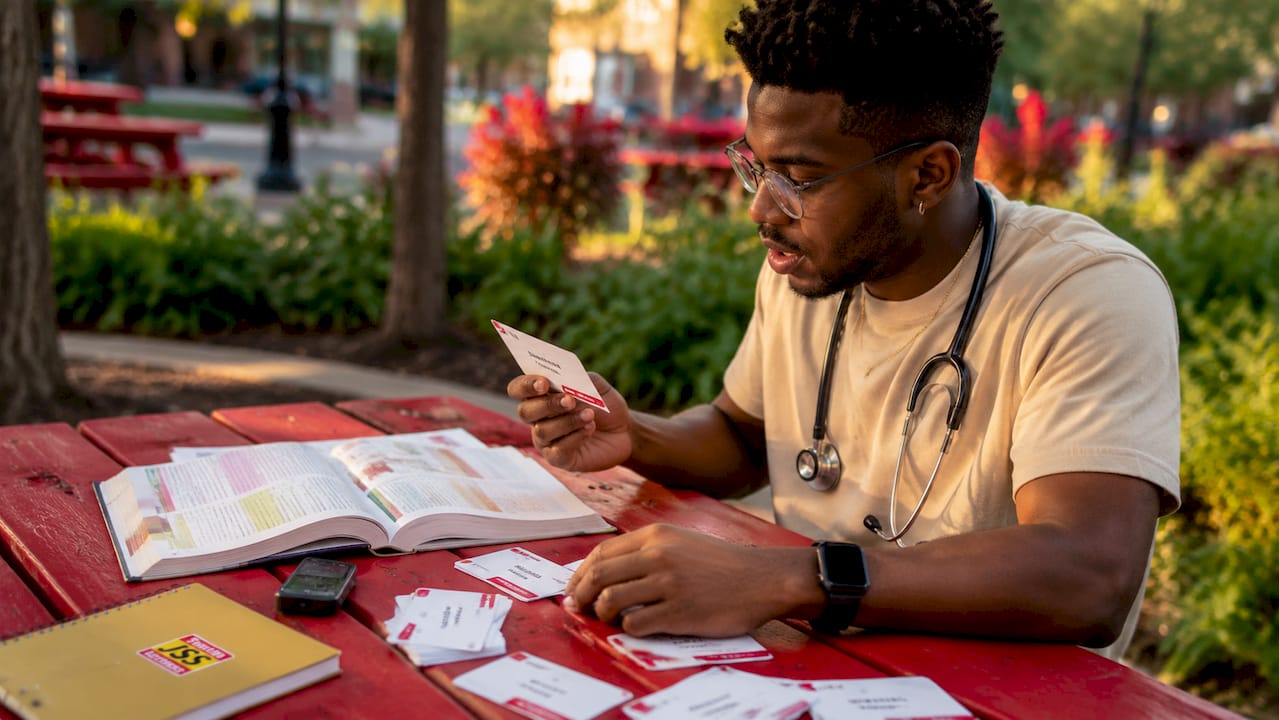
1. What are the best Spanish phrases for patient intake?
Patient intake is where most clinical encounters begin, and it is where clear Spanish vocabulary for health workers pays off fastest. A confident greeting sets the tone and reduces patient anxiety from the first moment.
The following phrases cover the core tasks at the front desk and during registration:
- Greeting and address: “Buenos días, ¿en qué le puedo ayudar?” (Good morning, how can I help you?)
- Name verification: “¿Cómo se llama?” (What is your name?)
- Date of birth: “¿Cuál es su fecha de nacimiento?” (What is your date of birth?)
- Paperwork: “Por favor llene este formulario.” (Please fill out this form.)
- Appointment confirmation: “Su cita es a las nueve y media.” (Your appointment is at nine thirty.)
- Insurance: “¿Tiene usted seguro médico?” (Do you have health insurance?)
- Waiting: “Por favor, tome asiento. El médico le atenderá en un momento.” (Please take a seat. The doctor will see you shortly.)
Notice that every phrase uses “usted,” the formal form of “you” in Spanish. This is not optional in a medical context. Formal address signals respect and professionalism, and it reduces the risk of a patient feeling dismissed or confused.
Pro Tip: Always use “usted” rather than “tú” with patients. Switching to the informal form can feel disrespectful to older patients and may cause confusion in clinical settings where clarity is non-negotiable.
2. How do you describe symptoms in Spanish?
Symptom description is the engine room of any clinical consultation. Getting this wrong leads directly to misdiagnosis. The structure “Me duele + body part” is the single most important pattern for pain expression in Spanish, and it trips up beginners who try to translate word for word from English.
The correct construction pairs the pronoun “me” with “duele” and then the body part. “Me duele la cabeza” means “my head hurts.” Saying “Mi cabeza duele” is grammatically awkward and marks you immediately as a non-native speaker, which can undermine patient confidence.
- “¿Qué le duele?” (What hurts?) — your opening question for any pain complaint.
- “¿Dónde le duele exactamente?” (Where exactly does it hurt?) — narrows the location.
- “¿Desde cuándo tiene estos síntomas?” (Since when have you had these symptoms?) — establishes duration.
- “¿El dolor es fuerte o leve?” (Is the pain strong or mild?) — assesses severity and type.
- “¿Es un dolor constante o intermitente?” (Is it constant or intermittent?) — identifies pattern.
- “¿Tiene fiebre?” (Do you have a fever?) — checks for systemic symptoms.
- “¿Tiene náuseas o vómitos?” (Do you have nausea or vomiting?) — screens for associated symptoms.
- “Me duele el pecho.” (My chest hurts.) — patient response example for chest pain.
- “Me duele la espalda desde hace tres días.” (My back has been hurting for three days.) — patient response with duration.
Pro Tip: Practise the “Me duele” structure until it is automatic. In a busy clinic, you will not have time to think about grammar. Drilling this pattern as a phrase, not a grammar rule, is the fastest route to confident use.
3. Emergency Spanish: critical phrases for urgent situations
Emergency Spanish must be short, direct, and delivered in the formal register. Under stress, both you and your patient will process language more slowly. Short, respectful commands using “usted” are the standard recommendation for EMTs and urgent care teams precisely because brevity reduces the chance of misunderstanding.
The following phrases cover the most critical emergency scenarios:
- Calling for help: “Necesito un médico urgentemente.” (I need a doctor urgently.)
- Requesting an ambulance: “Llame a una ambulancia.” (Call an ambulance.)
- Breathing difficulty: “No puedo respirar.” (I cannot breathe.)
- Severe pain: “Tengo un dolor muy fuerte.” (I have very strong pain.)
- Allergy alert: “Soy alérgico/a a la penicilina.” (I am allergic to penicillin.)
- Loss of consciousness: “Se ha desmayado.” (He/she has fainted.)
- Directing a patient: “No se mueva, por favor.” (Please do not move.)
Key principle: In an emergency, one clear sentence is worth more than a grammatically perfect paragraph. Memorise these phrases as complete units, not as individual words to be assembled under pressure.
Allergy disclosures deserve special attention. A patient saying “Soy alérgico a los antiinflamatorios” (I am allergic to anti-inflammatories) must be understood immediately. Practise listening for these phrases, not just speaking them.
4. Spanish instructions for follow-up care and medication
Clear medication instructions in Spanish prevent dangerous errors. The phrase structure for giving instructions uses the formal imperative, which sounds direct but respectful. Medication guidance phrases follow a consistent pattern that is easy to memorise once you understand the structure.
| Spanish phrase | English translation | Clinical use |
|---|---|---|
| Tome este medicamento dos veces al día. | Take this medicine twice a day. | Dosage instruction |
| Tome una pastilla con las comidas. | Take one tablet with meals. | Timing instruction |
| Descanse y beba mucha agua. | Rest and drink plenty of water. | Recovery advice |
| Vuelva en una semana para una revisión. | Come back in a week for a check-up. | Follow-up scheduling |
| Si los síntomas empeoran, vuelva inmediatamente. | If symptoms worsen, return immediately. | Warning sign instruction |
| No conduzca después de tomar este medicamento. | Do not drive after taking this medicine. | Safety warning |
Additional phrases for explaining procedures are equally useful:
- Blood pressure check: “Voy a tomarle la tensión arterial.” (I am going to take your blood pressure.)
- X-ray: “Necesitamos hacerle una radiografía.” (We need to take an X-ray.)
- Blood test: “Vamos a hacerle un análisis de sangre.” (We are going to do a blood test.)
Confirmation is a critical step that many healthcare workers skip. After giving instructions, ask: “¿Lo ha entendido todo?” (Have you understood everything?) and “¿Tiene alguna pregunta?” (Do you have any questions?). These two sentences close the loop and reduce the risk of a patient leaving with incomplete understanding.
5. How to build and practise your Spanish phrase bank
Organising phrases by clinical workflow is the single most effective way to build a usable Spanish phrase bank. Grouping vocabulary into intake, triage, examination, and discharge clusters means your brain retrieves phrases in the same sequence you use them at work. This reduces cognitive load during a real patient encounter.
The fastest gains for bilingual health workers come from memorising key phrase sets rather than pursuing full grammar mastery. A set of 30 to 40 well-chosen phrases, rehearsed as short chains of 5 to 10 lines, will cover the majority of routine clinical interactions. Isolated vocabulary lists, by contrast, are far harder to retrieve under pressure.
Practical methods for building your phrase bank include audio repetition, flashcard tools, and role-play with a colleague. Recording yourself speaking each phrase and then listening back is particularly effective for pronunciation. The Jamesspanishschool WordAmigo system uses strategic repetition across reading, listening, speaking, and writing to embed vocabulary permanently, which is exactly the kind of multi-modal vocabulary retention that clinical phrase learning requires.
One safeguard is non-negotiable. Qualified interpreters must be used when accuracy is critical for informed consent, diagnosis, or treatment decisions. Even well-intentioned Spanish phrases can carry wrong meanings if grammar is off. Basic phrase knowledge supports routine communication. It does not replace professional interpretation for complex clinical conversations.
Pro Tip: Build your phrase bank in the order you actually use phrases during a shift. Start with your greeting, move through intake questions, then symptom assessment, then instructions. Rehearsing in workflow order means the phrases come back to you in the right sequence when you need them most.
Key takeaways
Practical Spanish for health care works best when phrases are organised by clinical workflow, memorised as complete units, and supported by professional interpreters for complex decisions.
| Point | Details |
|---|---|
| Workflow organisation beats vocabulary lists | Group phrases by intake, triage, exam, and discharge to improve recall under pressure. |
| Formal address is non-negotiable | Always use “usted” with patients to maintain clarity and respect in clinical settings. |
| Emergency phrases must be short and pre-memorised | Brevity and formal commands reduce misunderstanding when stress is high. |
| Confirmation closes the communication loop | Always ask “¿Lo ha entendido todo?” after giving instructions to verify patient understanding. |
| Interpreters are mandatory for complex cases | Basic Spanish supports routine care but cannot replace qualified interpreters for consent or diagnosis. |
What I have learned from 40 years of real-life Spanish
The most common mistake I see healthcare workers make is treating Spanish as a grammar exercise. They spend weeks studying verb conjugations and then freeze the moment a patient speaks at natural speed. Real clinical Spanish is not about grammar. It is about having ten to fifteen phrases so deeply embedded that they come out automatically, even when you are tired or under pressure.
The second mistake is underestimating the formal register. Using “tú” instead of “usted” with a 70-year-old patient is not just impolite. It signals that you are uncertain, and uncertainty is the last thing a patient in pain needs to sense from their healthcare provider. The practical Spanish tips that actually work in real life are almost always about register and rhythm, not grammar rules.
My honest recommendation is this: learn your clinical phrases as complete sentences, not as word lists. Drill them in sequence. Use audio. Then use a qualified interpreter the moment a conversation moves beyond routine. That combination protects your patients and builds your confidence at the same time.
— James
Spanish learning resources for healthcare professionals
Healthcare workers who want to communicate confidently with Spanish-speaking patients need more than a phrase sheet. They need a system that embeds vocabulary and pronunciation so deeply that the right words come out under pressure.
James Spanish School offers a 100-lesson online course built around exactly this kind of practical, repeatable learning. The WordAmigo vocabulary system uses AI-powered repetition to lock in words and pronunciation through reading, listening, speaking, and writing. Lessons are available on demand, 24/7, on any device. There is no expiry date and no pressure. Whether you are starting from scratch or building on existing knowledge, the course is structured to give you real-world Spanish for real-world situations.
FAQ
What are the most useful examples of Spanish for health care?
The most useful examples are intake phrases, symptom questions, and medication instructions organised by clinical workflow. Phrases such as “¿Qué le duele?” and “Tome este medicamento dos veces al día” cover the majority of routine patient interactions.
Why is formal Spanish important in medical settings?
Formal address using “usted” signals respect and reduces confusion, particularly with older patients. It is the standard recommendation for all clinical and emergency Spanish communication.
When should a healthcare worker use a professional interpreter?
A qualified interpreter is mandatory for informed consent, diagnosis, and treatment decisions. Patient requests for interpreters must be honoured before non-emergency treatment proceeds.
How do I remember Spanish healthcare vocabulary under pressure?
Rehearsing short phrase chains in clinical workflow order improves retrieval under stress far more effectively than studying isolated vocabulary lists. Aim for sets of 5 to 10 phrases practised in sequence.
What is the correct way to express pain in Spanish?
The correct structure is “Me duele” followed by the body part, for example “Me duele el pecho” (my chest hurts). This construction is the standard for pain expression in Spanish and avoids the common beginner error of direct word-for-word translation from English.