

TL;DR:
- Spanish false friends look or sound like English words but have different meanings in Spanish, causing common mistakes for learners. Understanding their types, recognizing frequent examples, and practicing with thematic mini-bundles help learners avoid errors and build confidence in real-life situations.
Spanish false friends are words that look or sound like English words but carry entirely different meanings in Spanish. Linguists call them “false cognates,” and they are one of the most persistent vocabulary pitfalls for English speakers learning Spanish. A word like embarazada looks like “embarrassed” but actually means “pregnant.” Another classic, constipado, looks like “constipated” but means “suffering from a cold.” These mix-ups are not just amusing. In professional or medical settings, misuse of false cognates causes real errors with real consequences. Knowing what they are and how to handle them is not optional. It is the foundation of clear, confident Spanish.
What are Spanish false friends and why do they trip learners up?
Spanish false friends are defined as words that share a visual or phonetic resemblance with an English word but differ significantly in meaning. The formal linguistic term is “false cognates,” though “false friends” is the term most learners and teachers use in practice. Both labels describe the same trap: a word that feels familiar but misleads you the moment you use it.
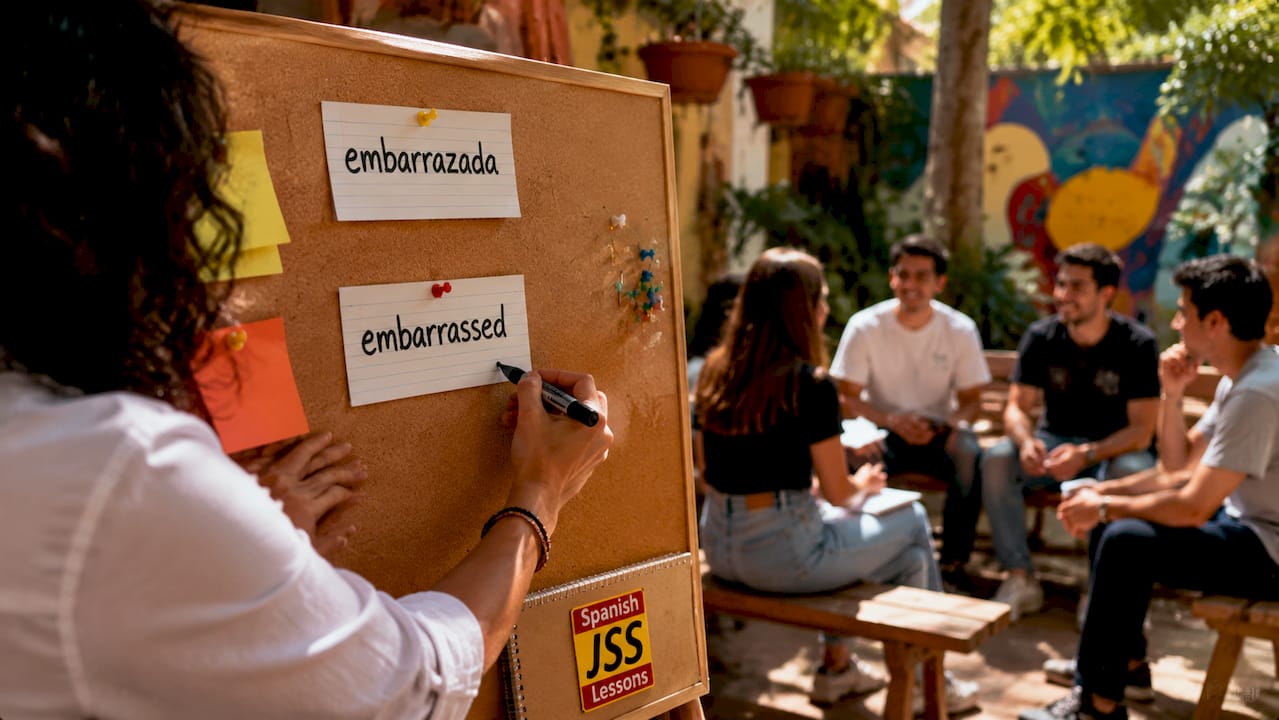
The danger is not just embarrassment. The false sense of familiarity that false cognates create causes learners to trust their intuition rather than stop and check the meaning. That psychological shortcut is what makes false friends so persistent. Even intermediate and advanced learners fall into the same traps repeatedly, precisely because the words feel so natural to use.
English and Spanish share a vast pool of vocabulary through their shared Latin roots. That overlap is genuinely useful. But it also creates hundreds of words that look like safe bets and are not. The more confident a learner becomes, the more likely they are to reach for a familiar-looking word without questioning it.
What are the main types of Spanish false friends?
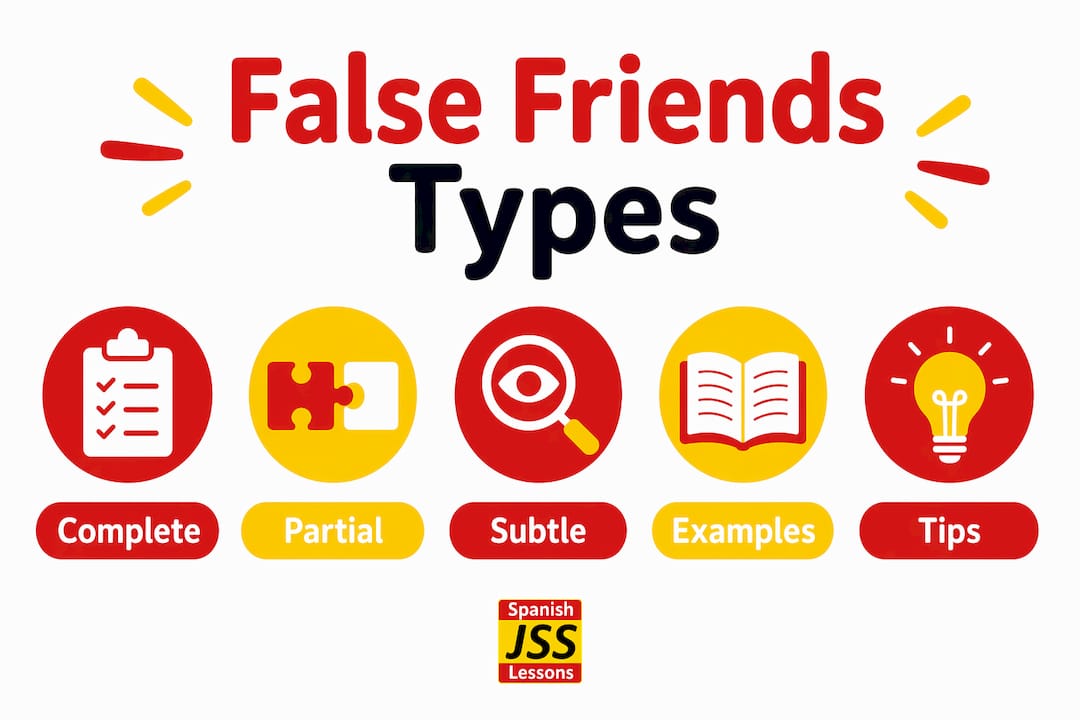
False friends are classified into three categories: Complete, Partial, and Subtle. Each type presents a different level of risk.
| Category | Example | English appearance | Actual Spanish meaning |
|---|---|---|---|
| Complete | embarazada | embarrassed | pregnant |
| Complete | constipado | constipated | suffering from a cold |
| Partial | actual | actual | current or present-day |
| Partial | asistir | assist | to attend |
| Subtle | realizar | realise | to carry out or achieve |
Complete false friends share zero semantic overlap with their English lookalikes. Embarazada means nothing close to “embarrassed.” These are the most dangerous because there is no grey area. Partial false friends share some meanings but diverge in others. Actual in Spanish means “current,” not “actual” in the English sense. You might use it correctly in one context and incorrectly in another. Subtle false friends are the trickiest of all. Realizar can occasionally overlap with “realise” in a loose sense, but its primary meaning is “to carry out” or “to achieve.” Learners often use it without realising the nuance is off.
Pro Tip: When you encounter a Spanish word that looks exactly like an English word, treat it as a suspect first. Check its meaning before you use it, not after.
Which common Spanish false friends should learners watch out for?
The following false friends appear constantly in everyday Spanish. Each one has caught out thousands of English speakers.
- Éxito looks like “exit” but means “success.” The Spanish word for exit is salida.
- Asistir looks like “assist” but means “to attend.” The Spanish for “to assist” is ayudar.
- Sensible looks like “sensible” but means “sensitive.” The Spanish for “sensible” is sensato.
- Embarazada looks like “embarrassed” but means “pregnant.” The Spanish for “embarrassed” is avergonzado/a.
- Constipado looks like “constipated” but means “having a cold.” The Spanish for “constipated” is estreñido.
- Librería looks like “library” but means “bookshop.” The Spanish for “library” is biblioteca.
- Molestar looks like “molest” but means “to bother” or “to annoy.” The Spanish for “molest” carries a far more serious meaning: abusar.
- Largo looks like “large” but means “long.” The Spanish for “large” is grande.
Each of these words appears in ordinary, everyday conversation. Librería comes up every time someone asks for directions. Sensible comes up in any discussion about feelings or character. Éxito appears in news headlines, song lyrics, and casual conversation constantly. The real-world impact of getting these wrong ranges from mild confusion to serious misunderstanding, particularly in medical or professional contexts where constipado and embarazada are used routinely.
Pro Tip: Write each false friend on a card with three columns: the English word you intended, the false friend trap, and the correct Spanish word. Practise reading all three aloud until the correct term feels automatic.
Why do Spanish false friends exist between English and Spanish?
Spanish false friends exist because English and Spanish share Latin roots but evolved through different paths over centuries. Both languages borrowed heavily from Latin, but they did so at different times and through different intermediary languages. English absorbed a large portion of its Latinate vocabulary through French, particularly after the Norman Conquest of 1066. Spanish evolved directly from Vulgar Latin spoken on the Iberian Peninsula.
Historical semantic divergence through intermediary languages is the core reason two words that once meant the same thing now mean something different. A Latin root word split into two branches. Each branch was shaped by the culture, geography, and usage patterns of its speakers. Over centuries, the meanings drifted apart.
“Words that share a common ancestor do not share a common destiny. Meaning is shaped by the people who use a language, not by the language’s origins.”
Cultural influences accelerated this drift. Spanish-speaking societies developed specific uses for certain words that had no equivalent pressure in English-speaking cultures, and vice versa. The result is a vocabulary minefield that looks safe on the surface. Learners who understand why false friends occur are better equipped to approach unfamiliar vocabulary with appropriate caution rather than false confidence.
How can learners effectively master Spanish false friends?
Mastering false friends requires a method, not just awareness. The following steps move learners from knowing false friends exist to genuinely avoiding them in conversation.
- Organise by theme, not alphabet. Thematic categorisation activates situational memory far more effectively than an A-to-Z list. Group false friends by context: medical terms, workplace vocabulary, social situations, and daily life. When you need a word in a real situation, your brain retrieves it from the right mental folder.
- Learn in mini-bundles. The most effective approach is to learn false friends as a trio: the English word you want to say, the false friend trap to avoid, and the correct Spanish equivalent. For example: “embarrassed” / avoid embarazada / use avergonzado. This three-part bundle hardwires the correct choice.
- Practise in full sentences. Isolated word pairs do not stick. Write and say full sentences using the correct Spanish term. “Estoy avergonzado por el error” (I am embarrassed by the mistake) is far more memorable than a flashcard.
- Pause when a sentence feels odd. A sentence that is grammatically correct but semantically strange is a strong signal that a false friend has crept in. Native speakers notice immediately when something sounds off. Train yourself to feel that same discomfort before you speak, not after.
- Treat each false friend as a vocabulary multiplier. Every false friend you learn correctly doubles your vocabulary gain. You learn the false friend to avoid and the correct term to use. That is two words for the price of one mistake. Reframing false friends as opportunities rather than obstacles changes how quickly you absorb them.
Learners who avoid common Spanish mistakes consistently report that structured vocabulary practice, rather than passive exposure, is what finally makes the difference with false friends. Context and repetition together are what make a word stick.
Pro Tip: Record yourself using the correct Spanish term in a full sentence. Play it back. Hearing your own voice say the right word correctly is one of the fastest ways to override an old habit.
Key takeaways
Spanish false friends are a predictable, learnable category of vocabulary error. Treating them as a system rather than a random hazard is the fastest route to getting them right.
| Point | Details |
|---|---|
| False friends are classifiable | Three types exist: Complete, Partial, and Subtle, each with different risk levels. |
| Intuition is the enemy | The false sense of familiarity is what makes these words dangerous, even for advanced learners. |
| Thematic grouping works best | Organising false friends by situation or topic improves recall far more than alphabetical lists. |
| Mini-bundles hardwire correct usage | Learning the English intent, the false friend trap, and the correct Spanish term together prevents intuitive errors. |
| Each error is a learning opportunity | Every false friend mastered adds two words to your vocabulary: the trap and the correct term. |
What I have learned after 40 years of watching learners tackle false friends
After four decades living in Spain and teaching English speakers to communicate in real Spanish, I have watched the same pattern repeat itself at every level. Beginners expect false friends to trip them up. Intermediate learners think they have moved past them. They have not.
The most stubborn errors I see are not from beginners reaching for embarazada instead of avergonzada. They are from confident learners who have stopped checking. They have built enough fluency to speak quickly, and that speed is exactly when false friends strike. The brain reaches for the familiar shape of a word and fires before the meaning has been verified.
What actually works is not rote memorisation. It is building a habit of mild suspicion toward any Spanish word that looks too much like an English one. That pause, even half a second, is what separates a learner who keeps making the same errors from one who genuinely progresses. Mistakes are not the problem. Repeating the same mistake without a system to correct it is. Embrace the error, build the mini-bundle, and practise the right word in a real sentence. That is the method that works in real-life Spanish, not in a classroom exercise.
— James
How James Spanish School helps you get past the false friend trap
False friends are exactly the kind of vocabulary pitfall that structured, real-life Spanish learning is built to address. At James Spanish School, the WordAmigo system uses strategic repetition to permanently embed the correct Spanish terms, covering pronunciation and meaning together so the right word becomes automatic.
The 100-lesson course organises vocabulary by real-life situations, which is precisely the thematic approach that research confirms works best for false friend retention. Lessons are available on demand, 24/7, with no expiry date and no pressure. Whether you are preparing for life in Spain or simply want to speak with confidence, Jamesspanishschool gives you the tools to get the right word out, every time. Explore the full course and resources and see how the method works in practice.
FAQ
What are Spanish false friends?
Spanish false friends, formally called false cognates, are words that look or sound like English words but have different meanings in Spanish. Classic examples include embarazada (pregnant, not embarrassed) and éxito (success, not exit).
How many false friends exist between English and Spanish?
The total number is not publicly listed, but the overlap between English and Spanish vocabulary through shared Latin roots means hundreds of potential false friends exist. The most commonly encountered ones in everyday life number in the dozens.
Why do false friends cause problems even for advanced learners?
The false sense of familiarity that false cognates create causes learners at all levels to trust intuition over meaning. Speed and confidence in speaking actually increase the risk of false friend errors.
What is the best way to learn Spanish false friends?
The most effective method is the mini-bundle approach: learn the English word you intend, the false friend to avoid, and the correct Spanish equivalent together, then practise all three in full sentences.
Are false friends the same in Latin American Spanish and European Spanish?
The core false friends between English and Spanish apply across both varieties, though regional vocabulary differences can introduce additional nuances. A learner’s guide to dialect differences covers how vocabulary varies between Latin American and European Spanish in more detail.