

What is adult language learning
TL;DR:
- Adult language learning involves deliberate effort by mature learners who utilize reasoning and patterns to acquire a new language. Consistent practice, active use, and structured vocabulary work lead to fluency, regardless of age or teaching method. Focus on real conversation, confidence, and cultural input accelerates progress in learning European Spanish.
Adult language learning is the deliberate, motivated acquisition of a new language by mature learners who draw on reasoning, pattern recognition, and self-regulation rather than the unconscious absorption that characterises childhood. The formal term in linguistics is adult second language acquisition, and understanding what sets it apart from how children learn is the first step to doing it well. Adults bring real cognitive advantages to the task. They can analyse grammar consciously, compare structures across languages, and apply deliberate memory strategies. If you are an English speaker considering European Spanish, the research is firmly on your side.
What is adult language acquisition, and what does science say?

Adult language acquisition is defined as the process by which a person past the critical period of childhood learns an additional language through conscious effort and structured exposure. The critical period hypothesis once led many people to assume adults simply could not achieve real fluency. Recent research dismantles that assumption entirely.
Late-life learners aged 60–83 reached around 80% accuracy in grammar retention after short-term training, regardless of whether they were taught explicitly or implicitly. That result matters because it shows the method is far less important than the act of showing up consistently. Adults do not need to mimic classroom children to succeed.
Adults also acquire complex grammatical structures within seven months, even with negligible exposure and no formal instruction. Speed and accuracy in identifying grammatical relationships both improved measurably over that period. The brain does not stop building language architecture after adolescence.
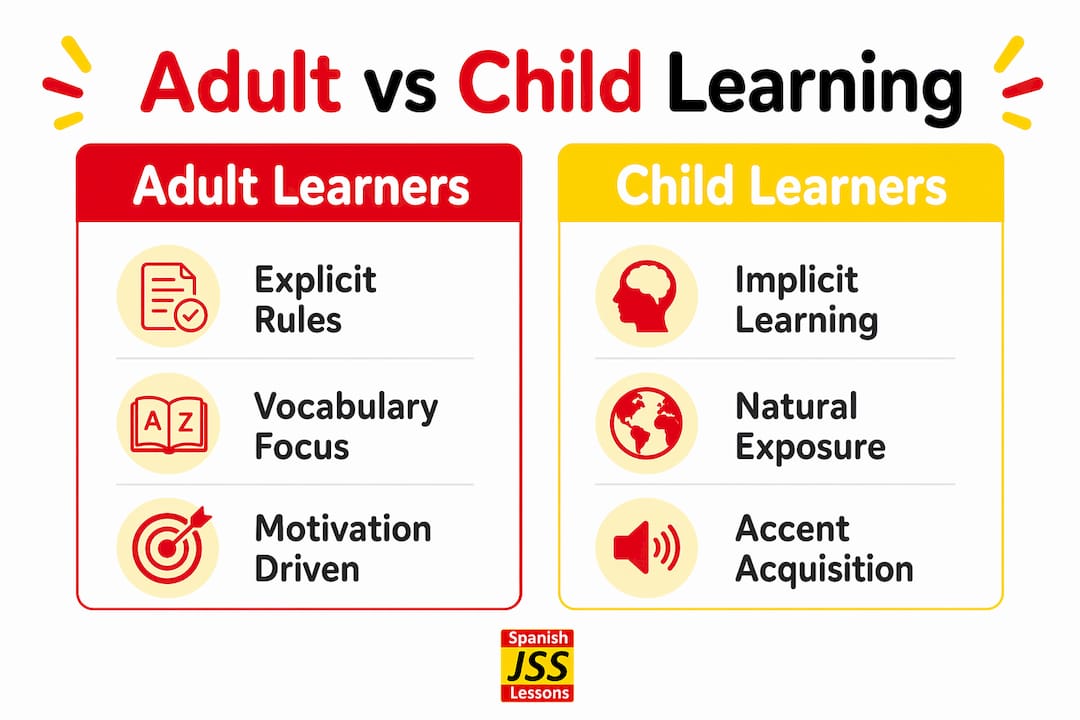
Adult vs child language acquisition: key differences
| Characteristic | Adult learners | Child learners |
|---|---|---|
| Grammar learning | Explicit, rule-based analysis | Implicit, unconscious absorption |
| Reading and writing | Adults often outperform children early on | Develops slowly over years |
| Pronunciation | Accented but intelligible | Near-native accent more likely |
| Motivation | Self-directed and goal-driven | Socially and environmentally driven |
| Metalinguistic awareness | High: can compare languages consciously | Low in early years |
Adults consistently outperform children in reading and writing during the early stages of language learning. That advantage comes directly from deliberate study and the ability to reason about language structure. Children win on accent. Adults win on almost everything else at the start.
Pro Tip: Focus your energy on communication, vocabulary, and grammar mastery rather than chasing a native accent. Adult learners who prioritise being understood make faster real-world progress.
How do adults learn languages differently from children?
Adults rely on an existing first-language mental framework to consciously compare grammar rules and acquire vocabulary strategically. A child absorbs language the way a sponge absorbs water, with no awareness of the process. An adult reads the label on the sponge, understands how it works, and then uses it deliberately. That difference is a genuine strength, not a limitation.
Psychological factors shape outcomes just as much as cognitive ones. An adult’s self-concept, meaning their belief in their own ability to learn, is a strong predictor of success. Adults who stay active in life, maintain social connections, and approach learning with confidence consistently achieve better results. Doubt and anxiety, by contrast, push learners toward passive consumption: watching videos, reading grammar books, but never actually speaking.
Performance anxiety and fear of errors cause adults to avoid active language use, which is precisely where real progress happens. Ego-management, the practice of treating mistakes as diagnostic information rather than personal failures, is the single most effective psychological shift an adult learner can make. Every error tells you something useful. Treat it that way.
Effective language learning strategies for adults
- Explicit grammar study: analyse sentence structure consciously, using plain-English explanations rather than Latin-derived terminology
- Active speaking practice: speak from the first week, even badly, because fluency builds through production not just comprehension
- Ego-management: reframe mistakes as data points, not embarrassments, to reduce anxiety and increase speaking frequency
- Spaced repetition: use vocabulary systems that revisit words at increasing intervals to move them from short-term to long-term memory
- Culturally relevant input: Spanish music, films, and conversations with locals build the ear for natural rhythm and speed
- Consistency over intensity: thirty minutes daily outperforms a three-hour weekend session every time
Motivation driven by emotional connection to the language produces better outcomes than purely practical reasons for studying. If you want to talk to your Spanish neighbours, order confidently in a local bar, or handle a visit to the doctor without a translator, that personal connection is a powerful engine. Use it.
Pro Tip: Write down your single clearest reason for learning Spanish and keep it visible at your desk or on your phone. Learners with a specific, personal motivation return to practice more consistently than those with vague goals.
Comparing adult language learning methods for European Spanish
The most common approaches for adult learners of European Spanish are explicit grammar instruction, full immersion, and mixed methods that combine structured study with real-world exposure. Each has genuine strengths, and the right choice depends on your circumstances and goals.
| Method | Strengths | Weaknesses |
|---|---|---|
| Explicit grammar instruction | Builds structural understanding quickly; suits adult reasoning style | Can feel dry; limited speaking practice |
| Full immersion | Fast ear-tuning; natural vocabulary acquisition | Overwhelming without prior structure; anxiety-inducing for beginners |
| Mixed method (structured + self-study) | Balances understanding with real use; adaptable to adult schedules | Requires self-discipline to maintain both strands |
| Audio lessons | Trains the ear for fast native speech; portable and flexible | Needs pairing with vocabulary and grammar work |
| Vocabulary builders with spaced repetition | Permanent retention of high-frequency words; pronunciation support | Less effective in isolation without sentence-building context |
Research comparing explicit and implicit instruction found no significant difference in proficiency gains between the two approaches for late-life learners. The teaching method matters far less than the learner’s consistency and confidence. That finding should be liberating. You do not need the perfect course. You need the course you will actually complete.
James Spanish School takes a mixed approach built specifically for English-speaking adults. The 100-lesson course combines sentence-building with ear-tuning modules, and the WordAmigo system uses AI with strategic repetition to embed vocabulary and pronunciation permanently. The best way to learn Spanish for most adult learners is a structured method that removes jargon and focuses on real conversation from the outset.
Module-based learning paired with vocabulary builders produces measurable improvements in real-life conversation skills. Structure gives you the engine room of sentence construction. Self-guided practice gives you the speed to use it when a native speaker replies at machine-gun pace.
Practical steps to improve your European Spanish right now
Adult learners who make consistent, active progress share a small number of habits. None of them require exceptional talent. All of them require showing up regularly.
- Practise daily, even briefly. Thirty minutes of focused study every day builds more fluency than sporadic long sessions. Set a fixed time and protect it.
- Speak from day one. Waiting until you feel ready is the most common reason adults plateau. Speak badly, speak often, and improve through doing.
- Use culturally grounded material. Spanish television, radio, and music from Spain train your ear for the specific rhythms of European Spanish, which differs meaningfully from Latin American varieties.
- Track your progress concretely. Note the sentences you could not construct last month that you can now. Visible progress sustains motivation better than abstract goals.
- Address pronunciation early. Mispronunciation that native speakers cannot decode is a confidence killer. Use a tool like James Spanish School’s WordAmigo system to lock in correct sounds alongside vocabulary from the start.
- Engage with real situations. Order in Spanish at a local restaurant, speak to Spanish-speaking neighbours, or join an online conversation group. Real stakes accelerate learning faster than any textbook.
- Learn to memorise Spanish vocabulary systematically. High-frequency words used in everyday life give you the fastest return on study time.
Adults who remain active in life activities demonstrate better language learning outcomes. The connection is psychological: an engaged, confident person brings the same energy to language practice. Learning Spanish is not separate from living well. For many expats and retirees in Spain, it is part of the same project.
Pro Tip: Build a short daily ritual around Spanish: five minutes of vocabulary review with your morning coffee, a Spanish radio station during a walk, and one sentence spoken aloud before bed. Small habits compound into real fluency.
For adults who find speaking anxiety a genuine barrier, the psychology of confidence in language learning is worth understanding directly. Confidence is not a personality trait. It is a skill that responds to practice and the right framing.
Key takeaways
Adult language learning succeeds when consistent practice, ego-management, and structured vocabulary work combine, regardless of the specific teaching method used.
| Point | Details |
|---|---|
| Age is not the barrier | Adults aged 60–83 reach around 80% grammar accuracy with short-term training, disproving age-related myths. |
| Method matters less than consistency | Explicit and implicit instruction produce comparable results; showing up daily predicts success more than course type. |
| Self-concept drives outcomes | Adults who believe in their ability and stay active in life consistently outperform anxious or passive learners. |
| Ego-management is non-negotiable | Treating mistakes as diagnostic data rather than failures is the most effective psychological shift for adult learners. |
| Structure plus real use wins | Combining sentence-building modules with ear-tuning and vocabulary repetition produces the fastest gains in European Spanish. |
What forty years in Spain taught me about adult learners
The adults I have seen struggle most are not the ones with poor memories or difficult accents. They are the ones who wait. They wait until their grammar is perfect before speaking. They wait until they understand every word before joining a conversation. They wait, and the wait becomes permanent.
The adults who succeed treat Spanish like a tool they are building while using it. They make errors in front of shopkeepers and laugh about it. They mishear a neighbour and ask them to repeat. They are not embarrassed by the gap between where they are and where they want to be, because they know the gap closes through use, not through study alone.
The other thing I have noticed is that adults consistently underestimate their own cognitive advantages. You already know how language works. You know what a verb is, even if you have never studied linguistics. You know how to construct an argument, follow a narrative, and ask a precise question. Those are not small things. A child learning Spanish has none of that scaffolding. You have all of it.
The research now confirms what I have observed for decades. Consistency and active use predict proficiency gains far more reliably than the specific method you choose. Pick a structured course that suits your life, speak from the first week, and treat every mistake as a step forward. That is the whole method, honestly.
If you are learning European Spanish to live, work, or retire in Spain, focus on the conversations you actually need: the doctor’s surgery, the town hall, the hardware shop, the bar. Master those, and the rest follows naturally.
— James
James Spanish School: built for adult learners of European Spanish
James Spanish School was designed from the ground up for English-speaking adults who want to speak real Spanish in real Spain. The 100-lesson course strips out the academic jargon and replaces it with plain-English explanations of how Spanish actually works.

The WordAmigo system handles vocabulary and pronunciation through AI with strategic repetition, locking words into long-term memory across reading, listening, speaking, and writing. Every lesson is available on demand, 24/7, with no expiry date and no countdown pressure. You learn at your pace, on your device, and repeat any lesson as many times as you need. Explore the full range of adult Spanish learning resources and find the starting point that fits where you are right now.
FAQ
What is adult language learning?
Adult language learning, formally called adult second language acquisition, is the deliberate process by which mature learners acquire a new language using conscious study, reasoning, and structured practice rather than childhood-style implicit absorption.
Can adults really become fluent in a new language?
Yes. Research shows that late-life learners aged 60–83 achieve around 80% grammatical accuracy after short-term training, and adults acquire complex structures within seven months even with minimal exposure.
What are the biggest challenges of adult language learning?
Performance anxiety and fear of making errors are the primary barriers. These push adult learners toward passive study rather than active speaking, which is where real fluency develops.
How do adults learn languages most effectively?
Consistency in exposure and active use predicts proficiency gains more reliably than any specific teaching method. Daily practice, ego-management, and structured vocabulary work produce the fastest results.
Is European Spanish harder for adults than other varieties?
European Spanish has distinct pronunciation patterns and vocabulary that differ from Latin American Spanish. Adults learning specifically for life in Spain benefit from why adults struggle with Spanish resources that address those specific differences from the outset.