

What is customer service Spanish
TL;DR:
- “Atención al cliente” is the standard Spanish term for customer service in Spain, emphasizing personal attention over just problem solving.
- Using the correct terminology and polite phrases like “¿Podría ayudarme?” ensures respectful communication and cultural appropriateness.
“Atención al cliente” is the standard Spanish term for customer service, and understanding it is the first step to communicating effectively in Spain. The phrase translates literally as “attention to the client,” which tells you something important: Spanish customer service culture places the emphasis on personal attention, not just problem resolution. If you are an English speaker living in, working in, or regularly visiting Spain, knowing this term and the phrases that surround it gives you a genuine advantage. Customer service in Spanish is now seen as a strategic tool for building loyalty, not simply a channel for handling complaints.
What is customer service in Spanish, and why does the term matter?
“Atención al cliente” is the preferred and standard phrase in Spain as of 2026, used across retail, banking, healthcare, and public services. The term carries a professional weight that the more casual “servicio al cliente” does not. When you walk into a shop, call a utility company, or visit a government office in Spain, the sign above the desk or the automated phone menu will almost always read “atención al cliente.” Recognising it immediately tells you where to go and who to speak to.

The term also signals something about expectations. Spanish customer service culture expects warmth and formality to coexist. A representative who is cold or abrupt, even if technically accurate, falls short of what Spanish customers consider good service. For English speakers, this is a useful cultural anchor: the word “atención” implies attentiveness, not just availability.
Understanding the correct terminology also protects you from sounding out of place. Using a Latin American variant in a Spanish context can create a subtle but real sense of disconnect, which matters when you are trying to build trust with a shopkeeper, a landlord, or a local authority.
What are the key Spanish phrases for customer service interactions in Spain?
Practical phrases are the engine room of any real customer service exchange. The following expressions cover the situations you are most likely to encounter, from asking for help to requesting someone speak more slowly.
Greetings and opening lines:
- “Buenos días / Buenas tardes” (Good morning / Good afternoon) — always open with this; it sets a respectful tone immediately.
- “¿En qué le puedo ayudar?” (How can I help you?) — the standard opening from a representative.
- “Quisiera hablar con alguien de atención al cliente.” (I would like to speak with someone from customer service.)
Asking for help and making requests:
- “¿Podría ayudarme con…?” (Could you help me with…?) — the conditional form here is not optional; it signals politeness.
- “Tengo un problema con mi pedido.” (I have a problem with my order.)
- “¿Podría darme más información sobre…?” (Could you give me more information about…?)
Asking for clarification:
- “¿Puede hablar más despacio, por favor?” (Could you speak more slowly, please?)
- “No he entendido bien. ¿Podría repetirlo?” (I did not understand well. Could you repeat that?)
- “¿Podría escribirlo, por favor?” (Could you write it down, please?)
Using conditional structures such as “¿Podría…?” rather than the direct “¿Puede…?” is a small shift that carries significant weight in Spain. It moves a request from a demand to a polite enquiry, which is exactly the register Spanish customer service expects.
Pro Tip: In Spain, opening any customer service interaction with a greeting before stating your request is not just polite, it is expected. Launching straight into your problem without a “buenos días” first can come across as rude, regardless of how correct your Spanish is.
How does customer service terminology differ between Spain and other Spanish-speaking regions?
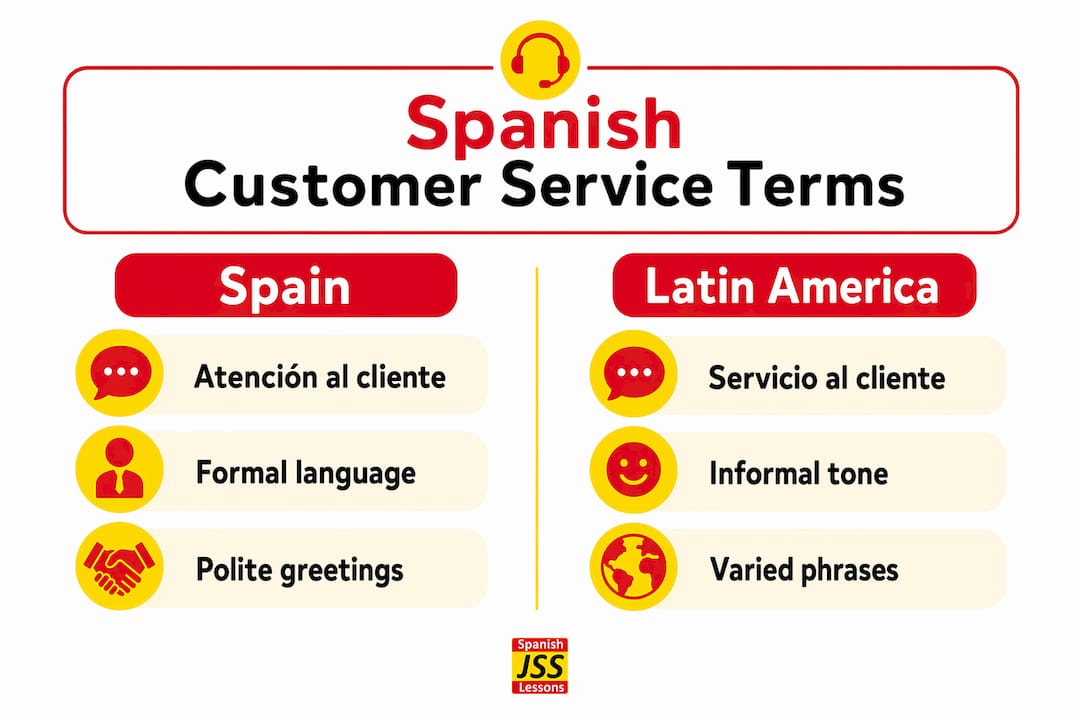
The gap between Spanish used in Spain and Spanish used across Latin America is wider than most English speakers expect. The terminology used in customer support is one of the clearest examples of this divide.
| Term | Where it is used | Register |
|---|---|---|
| Atención al cliente | Spain (primary term) | Formal, professional |
| Servicio al cliente | Latin America (widespread) | Standard, neutral |
| Soporte al cliente | Latin America (tech sector) | Technical, support-focused |
| Atención al consumidor | Spain (consumer rights context) | Formal, regulatory |
Using local terms is not a minor stylistic preference. In Spain, arriving at a customer service desk and asking for “servicio al cliente” marks you immediately as someone unfamiliar with local usage. It does not cause offence, but it does reduce the sense of connection and professionalism you are trying to project.
“Atención al consumidor” appears in Spain specifically in consumer rights contexts, such as formal complaints to a company or regulatory body. Knowing when to use it versus “atención al cliente” shows a level of linguistic awareness that earns respect.
The practical lesson is straightforward. A one-size-fits-all approach to Spanish does not work in professional settings. The Spanish spoken in Madrid is not the same as the Spanish spoken in Mexico City, and customer service terminology is one of the first places that difference shows up.
Pro Tip: If you are preparing for customer service interactions specifically in Spain, practise with European Spanish audio and vocabulary. Latin American Spanish courses, while excellent in their own right, will not train your ear for the accent, rhythm, or phrasing you will actually encounter in a Spanish shop or office.
What cultural and linguistic nuances should English speakers understand?
Language accuracy alone does not guarantee a good customer service interaction in Spain. Cultural expectations shape every exchange, and missing them can undermine even grammatically correct Spanish.
The most important rule is formality. Using “tú” instead of “usted” in a professional context can be perceived as disrespectful. “Usted” is the formal second-person pronoun, and it is the default in any customer-facing interaction in Spain until the other person explicitly invites informality. This is not a minor point of etiquette. It is the difference between sounding professional and sounding dismissive.
Key cultural expectations to keep in mind:
- Formality first. Always use “usted” with shop staff, officials, and anyone you do not know personally in a professional context.
- Active listening matters. Empathy and active listening are culturally expected in Spain, not optional extras. Nodding, using brief affirmations like “sí, entiendo” (yes, I understand), and pausing before responding all signal genuine attention.
- Avoid literal translations. Direct English-to-Spanish translations often produce phrases that sound blunt or even rude. “I want a refund” translated word-for-word lands very differently from “Quisiera solicitar un reembolso, por favor.”
- Tone carries as much weight as words. A calm, measured tone de-escalates tension far more effectively than a technically correct but clipped sentence.
Automated translations consistently fail to capture these nuances. They produce grammatically passable sentences that miss the cultural register entirely. This is why genuine language learning, grounded in real Spanish cultural habits, produces far better results than any translation tool. For a deeper look at the cultural layer beneath the language, the James Spanish School guide on Spanish cultural habits for expats is worth reading alongside this article.
Pro Tip: When handling a complaint or a tense situation in Spanish, slow your speech down deliberately. Native Spanish speakers interpret a measured pace as confidence and respect. Rushing through a sentence, even a correct one, reads as anxiety or aggression.
How can English speakers apply Spanish customer service skills in real interactions?
Knowing phrases and cultural rules is one thing. Deploying them confidently in a real exchange is another. The gap between the two closes with structured practice and a clear understanding of common scenarios.
- Start every interaction with a greeting. Walk up to a counter, answer a phone, or open a chat with “Buenos días” or “Buenas tardes.” This single habit immediately signals cultural awareness and sets a positive tone.
- State your need using a conditional phrase. Follow your greeting with “Quisiera…” (I would like…) or “¿Podría ayudarme con…?” rather than a direct statement. This is the natural register for customer service in Spain and will be recognised immediately as polite and professional.
- Handle complaints with structured language. For a complaint, use: “Tengo un problema con y me gustaría encontrar una solución.” (I have a problem with and I would like to find a solution.) This frames the issue constructively rather than confrontationally.
- Ask for clarification without embarrassment. “¿Podría repetirlo más despacio?” (Could you repeat that more slowly?) is a perfectly normal request. Native speakers in customer service roles hear it regularly and respond without judgement.
- Close with courtesy. End every interaction with “Muchas gracias por su ayuda” (Thank you very much for your help) and “Hasta luego” (Goodbye). These closing phrases complete the social contract of the exchange and leave a positive impression.

Mastering these interactions builds genuine confidence over time. The phrases above cover the majority of everyday customer service situations, from returning a purchase to querying a bill. Practising them in context, rather than memorising them in isolation, is what makes them stick. The James Spanish School resource on Spanish conversation in shops provides practical, scenario-based practice for exactly these situations.
For the cultural layer that sits beneath the language, understanding Spanish business etiquette gives you the full picture of what professional interactions in Spain actually look like.
Key takeaways
Customer service in Spanish, known as “atención al cliente” in Spain, requires both accurate terminology and cultural awareness to be genuinely effective in real interactions.
| Point | Details |
|---|---|
| Use the correct term | “Atención al cliente” is the standard phrase in Spain; avoid Latin American variants in professional Spanish contexts. |
| Formality is non-negotiable | Always use “usted” in customer service interactions until informality is explicitly invited. |
| Conditional phrases signal politeness | Phrases like “¿Podría ayudarme…?” are the expected register, not optional courtesy. |
| Cultural awareness outperforms translation | Automated translations miss the cultural register; genuine language learning produces far better results. |
| Practice builds real confidence | Rehearsing common scenarios, such as complaints and enquiries, prepares you for the pace and tone of real exchanges. |
How James Spanish School can help you communicate with confidence in Spain
Learning customer service Spanish is not just about memorising a phrase list. It is about understanding how the language works, why formality matters, and how to respond when a conversation moves faster than you expected.
James Spanish School was built specifically for English-speaking adults who need real, usable Spanish for life in Spain. The 100-lesson course covers sentence building and ear-tuning, so you can both speak and follow fast native speech. The WordAmigo system uses structured repetition to embed vocabulary and pronunciation permanently, which means the phrases you practise today will still be there when you need them at a service desk next month. James Bretherton has lived in Spain for 40 years and brings that lived experience into every lesson. You can explore the full course and start learning at your own pace at James Spanish School.
FAQ
What does “atención al cliente” mean in English?
“Atención al cliente” translates directly as “customer service” or “customer attention” in English. It is the standard term used in Spain for all customer-facing support functions.
How do you say customer service in Spanish for Spain specifically?
The correct phrase for Spain is “atención al cliente.” The Latin American variants “servicio al cliente” and “soporte al cliente” are understood but not the local standard in Spain.
Why is “usted” important in Spanish customer service?
Using “usted” rather than “tú” signals formality and respect in professional settings. Incorrect use of formality can be perceived as disrespectful and damage the interaction before it has properly begun.
What is the most useful Spanish phrase for asking for help?
“¿Podría ayudarme con…?” (Could you help me with…?) is the most versatile and culturally appropriate phrase for requesting assistance in a Spanish customer service context.
Does automated translation work for customer service Spanish in Spain?
Automated translation fails to capture regional idioms and cultural etiquette, which makes it unreliable for professional customer service interactions in Spain. Genuine language learning produces consistently better results.