

TL;DR:
- Spanish and English both follow a Subject-Verb-Object order, but Spanish allows flexible sentence structures for emphasis. Learners must understand that Spanish verbs indicate the subject, often omitting subject pronouns, and adjectives come after nouns; object pronouns precede verbs. Practicing native-like sentence patterns through conversation helps internalize these rules and develop fluent, natural speech.
If you have ever tried to learn Spanish and found yourself puzzling over why a sentence just “sounds wrong,” you have already encountered the challenge at the heart of what is Spanish structure in English terms. Technically, linguists call this Spanish syntax, the set of rules governing how words are arranged to form meaningful sentences. Spanish and English share more common ground than most learners expect, but the differences are sharp enough to cause real confusion. This guide cuts through that confusion, giving you a plain-English map of how Spanish sentences are built, where they depart from English patterns, and how to use that knowledge to start speaking with genuine confidence.
Table of Contents
- Key takeaways
- What is Spanish structure in English: the foundations
- How Spanish word order flexes
- Common pitfalls for English speakers
- Putting it into practice
- My honest take on learning Spanish structure
- How Jamesspanishschool helps you master this
- FAQ
Key takeaways
| Point | Details |
|---|---|
| Shared SVO foundation | Both Spanish and English follow Subject-Verb-Object order as their basic pattern. |
| Verbs carry the subject | Spanish verb conjugations signal who is speaking, so subject pronouns are regularly dropped. |
| Adjectives follow nouns | Descriptive adjectives come after the noun in Spanish, the opposite of standard English. |
| Object pronouns move forward | Direct and indirect object pronouns sit before the conjugated verb, not after it. |
| Flexibility is a feature | Spanish word order can shift to add emphasis or nuance in ways that English cannot. |
What is Spanish structure in English: the foundations
The starting point is reassuring. Spanish and English share the same basic sentence blueprint: Subject, Verb, Object (SVO). “María drinks coffee” and “María bebe café” follow identical logic. That shared foundation means your brain already has a working framework to build on.
Where things get interesting is the verb. In Spanish, the verb is the engine room of every sentence. Each verb ending changes to reflect who is performing the action, which is why subject pronouns are frequently omitted altogether. When a Spanish speaker says “Hablo español,” the ending “o” already signals “I,” so adding “yo” (I) is optional and often sounds unnecessarily formal. English cannot do this. Without “I speak Spanish,” the sentence collapses.
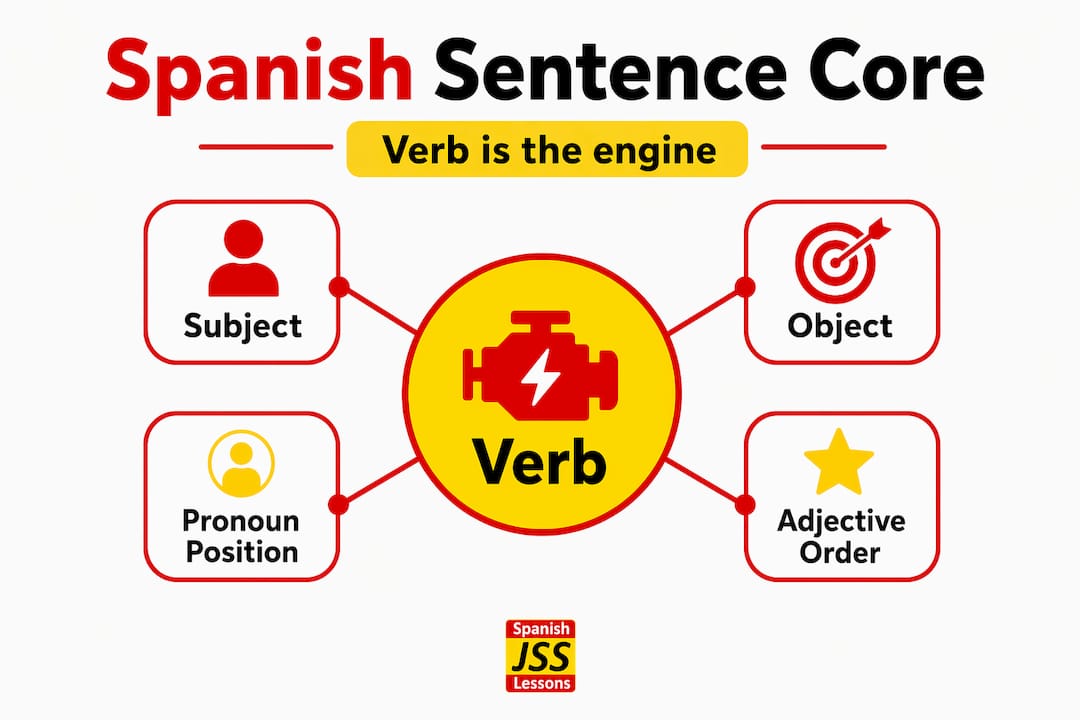
Understanding Spanish syntax from an English speaker’s perspective means grasping this one central truth: the verb does not merely describe an action, it also identifies the actor. That changes everything about how you read and build sentences.
Here are the core building blocks of Spanish sentence structure at a glance:
- Subject (often omitted): the person or thing performing the action
- Verb (conjugated): signals tense, person, and number; the non-negotiable anchor of every clause
- Direct object: the thing directly receiving the action (e.g., “the book” in “I read the book”)
- Indirect object: the recipient of the direct object (e.g., “her” in “I gave her the book”)
- Adjectives: descriptive words that, in Spanish, almost always follow the noun
- Negation: formed by placing “no” directly before the verb, with no change to word order elsewhere
Pro Tip: When reading a Spanish sentence for the first time, find the verb first, not the subject. The verb tells you who, what tense, and often why the sentence is structured the way it is. Build your understanding outward from there.
How Spanish word order flexes
English word order is relatively fixed. Move words around and the meaning either changes or the sentence breaks entirely. Spanish is a different proposition. Spanish sentence structure is more flexible than English, and that flexibility is not random: it is used deliberately to shift emphasis or focus.
Consider the difference between “El perro mordió al hombre” (The dog bit the man) and “Al hombre lo mordió el perro.” Both are grammatically correct in Spanish. The second version shifts the focus emphatically onto the man rather than the dog. In English, you would need extra words or stress in speech to achieve the same effect.

The table below maps the most significant word order contrasts between the two languages:
| Feature | English pattern | Spanish pattern |
|---|---|---|
| Basic sentence | Subject + Verb + Object | Subject + Verb + Object (flexible) |
| Adjective placement | Adjective before noun (“red car”) | Adjective after noun (“coche rojo”) |
| Questions | Auxiliary verb + Subject (“Do you speak?”) | Verb before subject, no auxiliary (“¿Hablas?”) |
| Object pronouns | After the verb (“I see him”) | Before the verb (“Le veo”) |
| Negation | “Not” after auxiliary (“I do not know”) | “No” directly before verb (“No sé”) |
| Double object pronouns | Indirect after direct (“Give it to me”) | Indirect before direct, both before verb (“Dámelo”) |
A few patterns deserve particular attention:
- Questions invert subject and verb. Spanish interrogative sentences place the verb before the subject and never require an auxiliary like “do” or “does.” “¿Hablas tú inglés?” translates literally as “Speaks you English?” but sounds perfectly natural to a Spanish ear.
- Adjectives follow the noun. Descriptive adjectives come after the noun in Spanish. “Una casa bonita” is “a beautiful house,” but word for word it reads “a house beautiful.”
- Negation is simple and consistent. The word “no” always directly precedes the conjugated verb, with no reshuffling of the sentence required.
- Object pronouns cluster before the verb. When both a direct and an indirect object pronoun appear together, the indirect pronoun comes before the direct pronoun, and both sit before the conjugated verb.
Common pitfalls for English speakers
Knowing the rules is one thing. Avoiding the traps is another. Most errors English speakers make in Spanish sentence formation come from unconsciously mapping English word order onto Spanish. These are the pitfalls that catch learners most regularly.
Placing object pronouns after the verb. Because English says “I see him” (subject, verb, object), learners say “Veo le” instead of the correct “Le veo.” Clitic pronouns must come before the conjugated verb in standard Spanish. It feels backwards at first, but it becomes natural with practice.
Keeping subject pronouns in when they are not needed. Over-using “yo,” “tú,” “él,” and so on is a common beginner habit. It is not wrong, but it sounds stilted. Spanish speakers drop the subject pronoun unless they are making a contrast or clarifying ambiguity.
Putting adjectives before nouns. This is one of the most automatic errors because English does it so consistently. Saying “una bonita casa” instead of “una casa bonita” is not catastrophic, but it signals that your mental model is still English-shaped.
Here is a summary of the most common errors and their corrections:
- ✗ “Veo le” → ✓ “Le veo” (object pronoun before the verb)
- ✗ “Yo hablo” (unnecessary subject) → ✓ “Hablo” (verb alone is sufficient)
- ✗ “una bonita casa” → ✓ “una casa bonita” (adjective after noun)
- ✗ “No hablo no español” → ✓ “No hablo español” (single negation, “no” before verb)
- ✗ “¿Tú hablas inglés?” (English question pattern) → ✓ “¿Hablas inglés?” (no subject needed)
Pro Tip: Stop thinking of Spanish sentences as English sentences in disguise. Organise meaning in verb-centred chunks: verb first, then attach the pronouns and objects around it. That single shift in thinking eliminates most pronoun placement errors immediately.
Exploring beginner Spanish building blocks in a structured way can help these patterns click into place much faster than trying to memorise rules in isolation.
Putting it into practice
Theory is only useful when it connects to real sentences. The table below compares English and Spanish sentences side by side, with notes on the structural differences at play:
| English sentence | Spanish sentence | Key structural note |
|---|---|---|
| I speak Spanish. | Hablo español. | Subject pronoun “I” dropped; verb ending signals person. |
| She doesn’t know him. | No le conoce. | “No” before verb; object pronoun “le” before verb. |
| It’s a beautiful house. | Es una casa bonita. | Adjective “bonita” follows noun “casa.” |
| Do you want coffee? | ¿Quieres café? | No auxiliary verb; verb comes first, subject dropped. |
| He gives her the book. | Le da el libro. | Indirect object pronoun “le” before verb; subject dropped. |
Now try applying this knowledge. Look at the following three sentences and decide which Spanish version is correct:
- “I am buying it.” Which is right?
a) Estoy comprandolo.
b) Le estoy comprando.
c) Estoy lo comprando. - “It is a red car.” Which is right?
a) Es un rojo coche.
b) Es un coche rojo.
c) Es coche un rojo. - “She doesn’t eat meat.” Which is right?
a) Ella no come carne.
b) Ella come no carne.
c) No ella come carne.
(Answers: 1a, 2b, 3a.)
With questions, the pattern to fix in your mind is equally clean. There are no auxiliary verbs like “do” or “does” in Spanish questions. “Do you know Madrid?” becomes simply “¿Conoces Madrid?” The verb does the heavy lifting and the subject disappears. Understanding how Spanish sentence works in real conversation, rather than in grammar textbooks, is what turns passive knowledge into spoken fluency.
My honest take on learning Spanish structure
In my forty years living in Spain and working with English-speaking learners, the single most common frustration I hear is this: “I know the rule, but I still make the mistake.” That gap between knowing and doing is real, and understanding why it exists changes how you approach the whole thing.
The truth is that most conventional methods teach Spanish structure the way you would teach a legal contract: clause by clause, rule by rule. What I have found actually works is something different. You need to internalise the verb as the spine of the sentence before you worry about anything else. Once your brain stops looking for a subject pronoun to anchor a sentence and starts reading the verb ending instead, everything reorganises itself naturally.
Flexible word order, which so many learners find alarming at first, is actually a gift. It means there is rarely only one correct way to say something. Once you stop demanding certainty and start trusting pattern recognition, your speaking accelerates noticeably.
What I have also learned is that real conversation beats written exercises every time. You will not internalise pronoun placement by reading about it. You will internalise it by saying “Lo veo” fifty times in real exchanges until the phrasing becomes automatic. That is why the ear-tuning element of learning matters just as much as sentence-building theory. The two work together, and neither is sufficient alone.
If you are serious about why Spanish structure matters for your day-to-day life in Spain, stop memorising grammar charts and start practising pattern recognition in real sentences. The structure will follow.
— James
How James Spanish School helps you master this
At James Spanish School, the entire 100-lesson course is built around the insight that adult English speakers learn Spanish best when grammar is explained in plain terms, not academic jargon. James Bretherton’s method of Radical Simplification means sentence structure is taught through real patterns and real conversations, not through memorising conjugation tables in isolation.
The course covers sentence-building and ear-tuning in equal measure, because understanding how Spanish syntax works on paper is only half the work. Following it at the machine-gun speed of native speakers is the other half. The WordAmigo vocabulary system uses strategic repetition to lock in both words and pronunciation, so the patterns you learn actually stick. Everything is available on demand, 24 hours a day, seven days a week, with no expiry date and no countdown clock. Explore the full course and learning materials and start building sentences that sound genuinely natural.
FAQ
What is the basic word order in Spanish?
Spanish follows the same Subject-Verb-Object order as English in most sentences, but word order is more flexible and can shift for emphasis or focus without breaking grammatical rules.
Why do Spanish speakers drop the subject pronoun?
Spanish verb conjugations encode person and number, making the subject clear from the verb ending alone. Saying “hablo” already means “I speak,” so adding “yo” is usually unnecessary.
Where do object pronouns go in a Spanish sentence?
Direct and indirect object pronouns precede the conjugated verb in Spanish. So “I see him” becomes “Le veo,” not “Veo le.”
Do adjectives go before or after nouns in Spanish?
Descriptive adjectives follow the noun in Spanish. “A beautiful house” becomes “una casa bonita,” with the adjective coming after the noun.
How are questions formed differently in Spanish?
Spanish questions invert the subject and verb and do not use auxiliary verbs like “do.” “¿Hablas inglés?” means “Do you speak English?” without any direct equivalent of “do” in the Spanish version.