

TL;DR:
- Most beginner Spanish sentences follow the subject-verb-object pattern with omitted subject pronouns.
- nouns have gender and number, affecting article and adjective agreement, but errors rarely hinder communication.
- Regular verbs follow predictable conjugation patterns, with key exceptions like ser, estar, and haber.
Most English-speaking adults who want to learn Spanish assume the grammar will defeat them before they even start. The verb tables look endless, the gender rules seem arbitrary, and the idea of dropping subject pronouns feels like a trap waiting to spring. But here is the reassuring truth: the vast majority of everyday conversations in Spain rely on a small set of repeating patterns. Master those patterns and you can chat with your neighbour, order at the bar, and negotiate with the plumber. This guide walks through the essential beginner structures of European Spanish, one clear layer at a time, so you can move from confusion to confident communication faster than you think.
Table of Contents
- Core sentence structure: the subject-verb-object foundation
- Gender, number and agreement: the details that matter
- Making sense of verbs: regular patterns and key exceptions
- Negatives, questions, and beyond: unlocking real communication
- A practical approach: why doing trumps memorising for beginners
- Take your Spanish further with tailored support
- Frequently asked questions
Key Takeaways
| Point | Details |
|---|---|
| Master SVO order | Beginner Spanish relies on clear subject-verb-object sentences for most daily situations. |
| Agreement matters | Matching gender and number between nouns, articles and adjectives is essential for correct speech. |
| Focus on practical use | Using real phrases and context-based practice speeds up understanding and conversational confidence. |
| Learn basic negation | Saying ‘no’ before a verb forms nearly any negative statement in beginner Spanish. |
Core sentence structure: the subject-verb-object foundation
With the big picture in mind, let’s clarify the foundational sentence structure used in beginner Spanish.
Spanish and English share the same basic word order: Subject, Verb, Object. That is genuinely good news. “I eat bread” in English maps directly to “Yo como pan” in Spanish. The engine room of sentence construction works the same way in both languages, which means you already have an instinct for how a Spanish sentence should feel.
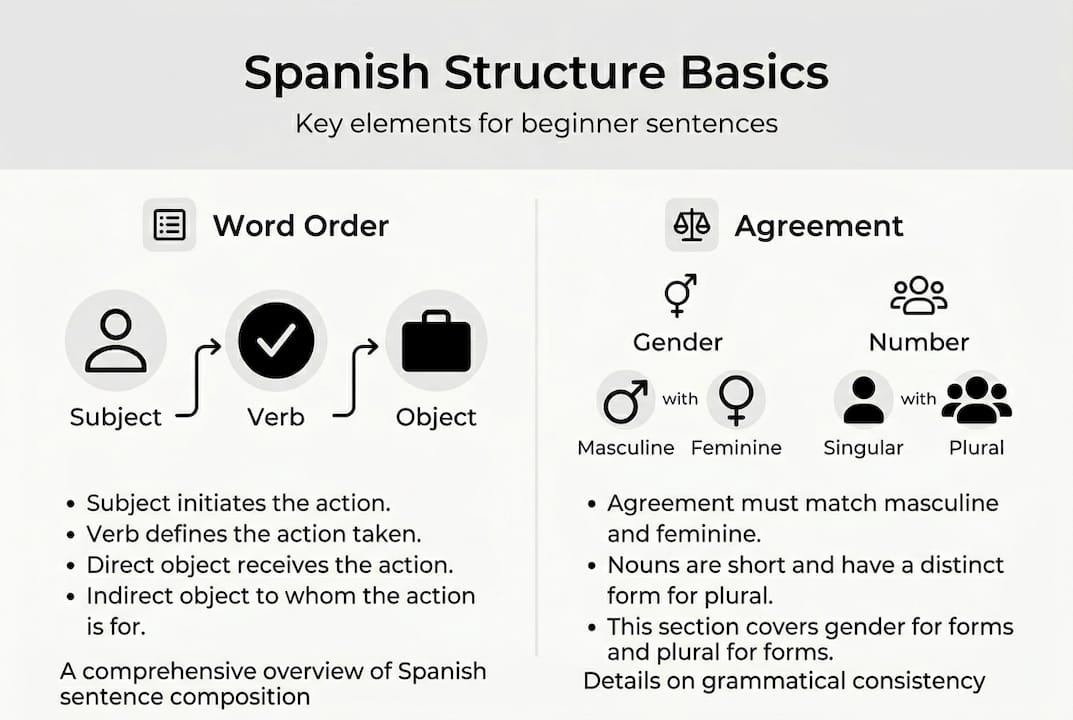
Where things get interesting is the subject pronoun. In English, you always say “I eat” or “she drinks” because the verb form alone does not tell you who is acting. In Spanish, the verb ending carries that information. “Como” means “I eat” all by itself. “Come” means “he/she eats.” Because the ending signals the person, subject pronouns are often omitted in everyday speech. Dropping “yo” is not lazy or informal; it is simply how the language works at beginner level and beyond.
This is actually a shortcut, not a complication. Once you learn the present tense endings for a verb, you automatically know who is doing the action without needing an extra word.
Here is a quick comparison to make this concrete:
| English sentence | Literal Spanish | Natural Spanish |
|---|---|---|
| I speak Spanish | Yo hablo español | Hablo español |
| She drinks water | Ella bebe agua | Bebe agua |
| We eat at eight | Nosotros comemos a las ocho | Comemos a las ocho |
| They live in Madrid | Ellos viven en Madrid | Viven en Madrid |
Notice how the natural Spanish column is shorter and more fluid. This is what real spoken Spanish sounds like. If you want to build this kind of fluency from the ground up, exploring Spanish basics for conversations is a practical first step.
Pro Tip: When you are starting out, it is perfectly fine to include the subject pronoun for clarity. Native speakers will understand you completely. Drop it gradually as the verb endings become second nature.
Understanding Spanish sentence order also helps you realise that most beginner sentences follow a predictable rhythm. Once that rhythm feels familiar, building longer sentences becomes far less daunting.
Gender, number and agreement: the details that matter
Now that you know how Spanish sentences are built, it is crucial to understand how words change to match gender and number.

Every Spanish noun is either masculine or feminine, and either singular or plural. This is not about biology; it is a grammatical category. “El libro” (the book) is masculine. “La mesa” (the table) is feminine. There is no deep logic to memorise for every word; you simply learn the gender alongside the noun itself.
Noun and adjective agreement follows a clear system of definite articles (el, la, los, las) and indefinite articles (un, una, unos, unas). The article must match the noun in both gender and number. Think of it as a simple handshake between words.
Here is a reference table to keep things clear:
| Masculine | Feminine | |
|---|---|---|
| Definite singular | el (the) | la (the) |
| Definite plural | los (the) | las (the) |
| Indefinite singular | un (a/an) | una (a/an) |
| Indefinite plural | unos (some) | unas (some) |
Adjectives follow the same agreement rule. “Un coche rojo” (a red car) uses the masculine form “rojo.” “Una casa roja” (a red house) switches to the feminine “roja.” The adjective changes its ending to match the noun it describes.
Here are the key patterns to keep in mind:
- Most masculine nouns end in -o and most feminine nouns end in -a, though there are common exceptions
- Adjectives ending in -o change to -e or -a for feminine forms
- To make any noun or adjective plural, add -s after a vowel or -es after a consonant
- Some nouns are the same in both genders and only the article signals the difference
- Learning new vocabulary as “el libro” rather than just “libro” builds the habit naturally
The good news is that getting gender wrong rarely causes a breakdown in communication. Spanish speakers will understand you and, more often than not, gently model the correct form back to you. Exploring the Spanish language structure is the focus of of the James Spanish School core lessons. They will ensure you practise these patterns in context rather than in isolation.
Making sense of verbs: regular patterns and key exceptions
Agreement aside, verbs shape the action of any sentence. Here is how to get comfortable with them from day one.
Spanish verbs come in three families, defined by their infinitive ending: -ar (hablar, to speak), -er (comer, to eat), and -ir (vivir, to live). Each family follows its own set of present tense endings, and once you know those endings, you can conjugate hundreds of verbs correctly without memorising each one individually.
Regular present tense conjugation for these three groups follows predictable patterns, and most beginner interactions only require the present tense. Here is a practical overview:
- -ar verbs (hablar): hablo, hablas, habla, hablamos, habláis, hablan
- -er verbs (comer): como, comes, come, comemos, coméis, comen
- -ir verbs (vivir): vivo, vives, vive, vivimos, vivís, viven
Notice that the “nosotros” (we) endings differ between groups but the “yo” (I) form always ends in -o for regular verbs. That single pattern covers a huge amount of daily speech.
Now for the exceptions. Three verbs break the rules so frequently that you simply need to know them:
- Ser (to be, permanent): used for identity, nationality, profession. “Soy inglés” (I am English).
- Estar (to be, temporary): used for location, feelings, states. “Estoy bien” (I am well).
- Haber (to have, auxiliary): used to form compound tenses. “He comido” (I have eaten).
The ser/estar distinction trips up many learners, but a practical rule helps: if you could replace “to be” with “to exist permanently,” use ser. If the situation is temporary or changeable, use estar.
Pro Tip: Focus on Spanish verb basics by learning the most common verbs in full before moving on. Depth before breadth pays off far more than a surface knowledge of fifty verbs.
Here,James Bretherton from JSS explains just why that is essential.
Negatives, questions, and beyond: unlocking real communication
Mastering verbs is key, but to really speak, you need to handle negatives and ask questions.
Forming a negative sentence in Spanish is remarkably simple. You place “no” directly before the verb and nothing else changes. Negatives use ‘no’ before the verb without any auxiliary verb like “don’t” or “doesn’t.” Compare:
- English: “I do not eat meat” (three words before the main verb)
- Spanish: “No como carne” (one word before the verb)
This is one area where Spanish is genuinely easier than English. There is no equivalent of “do/does/did” to construct. Just add “no” and you are done.
Questions work in a similarly accessible way. For yes/no questions, you can simply raise your intonation at the end of a statement, just as you might in casual English. “¿Comes carne?” (Do you eat meat?) uses the same words as the statement, with intonation doing the work. For open questions, Spanish uses interrogative words:
- ¿Qué? (What?)
- ¿Dónde? (Where?)
- ¿Cuándo? (When?)
- ¿Cómo? (How?)
- ¿Cuánto? (How much/many?)
Real communication starts the moment you can ask a question and understand the reply. Even a simple “¿Dónde está?” (Where is it?) opens up dozens of daily interactions.
The challenge, of course, is not forming the question but following the answer. Research into Spanish fluency development suggests that consistent practice over around four months produces measurable gains in complexity and fluency, with estimates of 600 to 750 hours for full proficiency. That sounds like a lot, but daily conversational practice compounds quickly.
For practical guidance on speaking Spanish fluently with real people in Spain, the focus should always be on getting your meaning across rather than achieving grammatical perfection. And if you want to practise forming Spanish questions in a structured way, targeted exercises make the patterns stick far faster than passive reading.
A practical approach: why doing trumps memorising for beginners
Understanding the building blocks is only the starting point. Your method matters more than memorising rules.
There is a persistent belief that adults must master grammar rules before they can speak. Decades of language research challenge that view directly. Input-rich, communicative learning consistently outperforms grammar-first drilling for adults who want practical, conversational Spanish rather than academic certification.
The reason is straightforward. Grammar rules are descriptions of language, not the language itself. When you are standing in a Spanish chemist’s trying to explain a symptom, you do not have time to mentally conjugate a verb table. You need patterns that have been absorbed through use, not rules retrieved from memory under pressure.
Mistakes are not failures; they are data. Every time a native speaker corrects you or models a better phrasing, your brain updates its internal map of the language. That process only happens if you are actually speaking. Sitting with a textbook and getting every exercise right teaches you to pass exercises, not to communicate.
The most effective approach for adult learners combines clear structural understanding with immediate communicative practice. Learn the pattern, use it in a real sentence, hear it used back to you. That cycle is what builds genuine confidence. For a deeper look at the best way to learn Spanish as an adult, the evidence consistently points toward active use over passive study.
Take your Spanish further with tailored support
With a clear foundation and practical strategies in hand, it is easier than ever to build your Spanish naturally.
James Spanish School is built around exactly this philosophy. Rather than drowning you in grammar terminology, the course explains Spanish structure through plain English, using Radical Simplification to make patterns feel logical and learnable. The 100-lesson programme covers both sentence-building and ear-tuning, so you can follow fast native speech as well as produce it.
Whether you are just starting out or looking to sharpen what you already know, mastering basic Spanish for real conversations is entirely within reach. Explore the starter resources for Spanish available through James Spanish School and take the first practical step towards speaking with confidence in everyday Spain.
Frequently asked questions
What is the most important structure to learn as a beginner in Spanish?
The most important is the subject-verb-object order, often using verb endings to signal the subject so the pronoun can be dropped. Getting comfortable with this pattern first gives you a reliable framework for building any sentence.
How do you make basic negative sentences in Spanish?
Place “no” before the verb without any additional auxiliary words, for example “No como carne” means “I don’t eat meat.” It is one of the simplest structural rules in the language.
Do adjectives go before or after nouns in beginner Spanish?
Adjectives follow the noun in most cases, such as “un coche rojo” (a red car), though a small number like “gran” may precede the noun for emphasis or a shift in meaning.
How long does it take to become conversational in Spanish?
Empirical benchmarks suggest 600 to 750 hours of study for proficiency, with notable conversational progress typically appearing after around four months of consistent, focused practice.