

How to memorize Spanish vocabulary
TL;DR:
- Most learners forget Spanish words quickly because they rely on passive review and isolated lists. Spaced repetition with contextual, real-life vocabulary and active recall enhances long-term retention and automatic fluency. Focusing on high-frequency, situational words and consistent, brief daily practice creates practical mastery for living in Spain.
You’re standing at the pharmacy counter in Spain, and the word you need vanishes completely. It was there last night when you studied your list. Now it’s gone, replaced by an awkward silence and a polite but puzzled stare from the pharmacist. This is one of the most common and demoralising experiences for English-speaking adults living in Spain, and it happens not because of a lack of effort but because of how vocabulary is typically studied. This guide cuts through the guesswork and delivers proven, practical techniques for memorising European Spanish vocabulary so that the right words are available when you actually need them.
Table of Contents
- Why most people forget Spanish words (and how to avoid it)
- Essential tools and tips for memorising Spanish vocabulary
- Step-by-step: The most effective way to memorise Spanish words
- Verifying progress and fixing common mistakes
- What most guides get wrong about memorising Spanish words
- Next steps: Memorise faster with expert Spanish resources
- Frequently asked questions
Key Takeaways
| Point | Details |
|---|---|
| Spaced repetition works | Reviewing vocabulary at increasing intervals is proven to boost long-term memory for Spanish words. |
| Active recall beats rereading | Forcing yourself to recall words strengthens memory far more than simply re-reading lists. |
| Prioritise daily vocabulary | Focus your efforts on the words you’ll use in actual conversations for faster, more meaningful progress. |
| Track progress and troubleshoot | Regularly assessing your recall and fixing common mistakes will ensure continued improvement and fluency. |
Why most people forget Spanish words (and how to avoid it)
The mechanics of forgetting are well understood, yet most learners ignore them entirely. German psychologist Hermann Ebbinghaus identified what is now called the “forgetting curve,” which shows that without any review, people lose roughly half of newly learned information within a day. For adult learners juggling daily life in Spain, this is not an abstract theory. It is the lived reality of studying on Sunday and drawing a blank by Tuesday.
The most common mistakes compound the problem:
- Relying on long lists: Writing out fifty words and reading them repeatedly gives a false sense of progress. Recognition is not the same as recall.
- Cramming sessions: Studying intensively for one or two hours once a week feels productive but produces short-lived memory traces.
- Passive rereading: Going over notes or a vocabulary page without testing yourself is one of the weakest study strategies available.
- No contextual anchor: Learning “el grifo” in isolation is harder than learning it through a sentence about calling a plumber.
“Memory is not a recording device. It is a reconstruction process, and what you rehearse is what you rebuild.”
The solution rests on a principle called spaced repetition, which means distributing your reviews over time rather than massing them together. Spaced conditions outperform massed practice on delayed recall tests, particularly for second-language vocabulary. Put simply, reviewing a word today, tomorrow, next week, and then a fortnight later locks it in far more reliably than reviewing it ten times in one sitting.
There is also a crucial link between context and retention. Using context not just lists when you learn vocabulary means each new word carries a situation, a feeling, or a sentence with it. That contextual anchor is what your brain grabs hold of when you are under pressure at the bank or the GP’s surgery. Prioritise words that fit your actual daily life in Spain. Obscure vocabulary can wait.
Essential tools and tips for memorising Spanish vocabulary
Understanding the forgetting process sets you up to work smarter. Here’s what you’ll need to memorise Spanish vocabulary efficiently.
The right tools reduce friction and keep you consistent. Here is a practical overview of what is available and what each does well:
| Tool | Type | Best for | Cost |
|---|---|---|---|
| Physical flashcards | Analogue | Beginners, tactile learners | Free |
| Anki | Digital app | Spaced repetition scheduling | Free |
| Mnemosyne | Desktop app | Detailed statistics, scheduling | Free |
| WordAmigo (JSS) | AI-powered system | European Spanish, pronunciation | 49.95 |
| Notebook tracker | Analogue | Progress logging, personalisation | Minimal |
When choosing a digital tool, look for these features:
- Custom word lists: You want to build lists around your actual life in Spain, not generic travel phrases.
- Feedback after each response: Knowing whether you were right or wrong is what drives memory consolidation.
- Intelligent scheduling: Spaced repetition systems use an algorithm that updates review intervals based on how well you recalled each item, so harder words appear more often.
- Listening component: Hearing Spanish pronunciation alongside reading it accelerates both memory and comprehension.
Tracking your progress matters more than most learners realise. A simple notebook where you log new words learned, words mastered, and words still causing problems gives you an honest picture of your trajectory. It also builds motivation. Seeing fifty words move from the “shaky” column to the “solid” column is genuinely encouraging.
The link between repetition and fluency is direct and well established. The learners who make the fastest gains are not always the most talented. They are the most consistent. Short, daily sessions of fifteen to twenty minutes outperform a two-hour marathon every Saturday.

Pro Tip: Set a fixed time each day for vocabulary review, even if it is only ten minutes. First thing in the morning with a coffee or just before bed works well for most adults. The habit is more important than the duration.
Step-by-step: The most effective way to memorise Spanish words
With your tools ready, let’s walk through the most reliable process for embedding Spanish words in your memory.
1. Select vocabulary that matters right now
Focus on words you will use this week. If you have an appointment at the health centre, learn the vocabulary for symptoms, appointments, and instructions. If you are shopping at the market, target food names, quantities, and transaction phrases. Real-life vocabulary rooted in your immediate context is processed differently by the brain. It carries emotional weight and practical urgency, both of which strengthen retention.
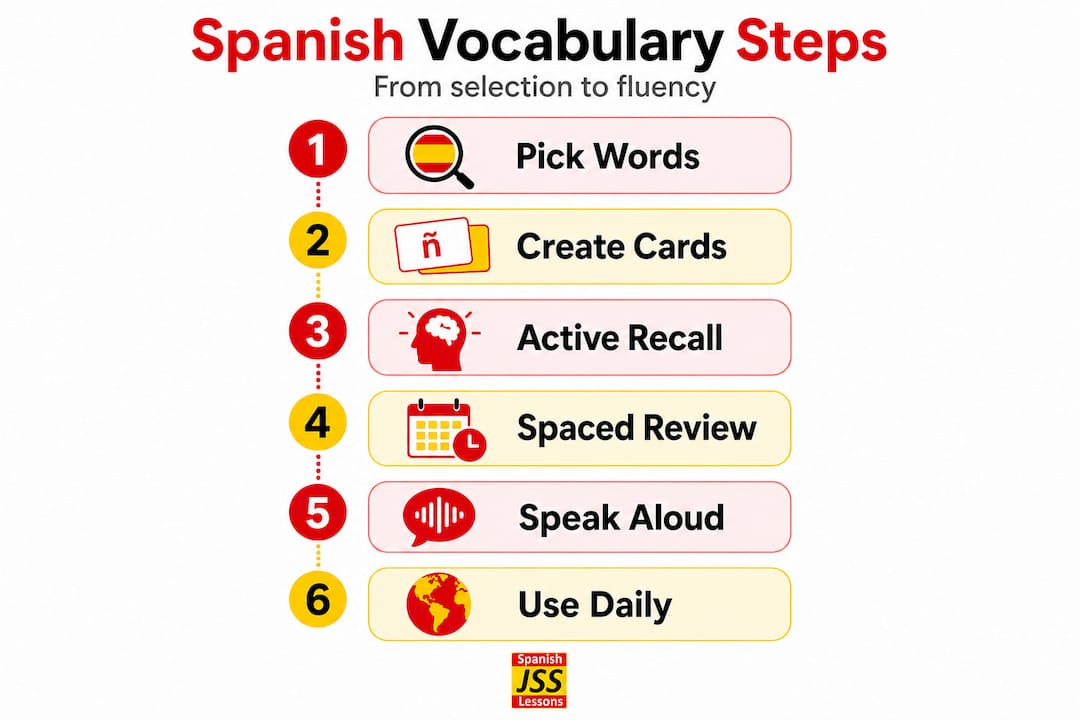
2. Create a flashcard for each word, with a sentence
Write the Spanish word on one side. On the other, write the English meaning and a short sentence using the word in context. For example: “Me duele la cabeza” (My head hurts) rather than just cabeza (head).
3. Use active recall at every review
Cover the answer, say or write the Spanish word from memory, then reveal it. Active recall testing is a significantly higher-leverage technique than passive review for both initial learning and long-term memory consolidation. The effort of retrieval is exactly what strengthens the neural pathway.
4. Schedule your reviews using spaced intervals
A reliable starting schedule looks like this: review on day one, day two, day seven, day fourteen, and then monthly. For long-term retention, spaced retrieval practice at increasing intervals consistently outperforms any other method. Digital tools like Anki handle this scheduling automatically, which removes the mental overhead entirely.
5. Say the word aloud every time
Pronunciation is not a bonus step. It is part of the memory process. Hearing yourself say el ayuntamiento (the town hall) activates a different memory channel than simply reading it. Over time, the sound of the word becomes its own retrieval cue.
6. Use the word in a real interaction as soon as possible
Even a brief exchange with a shopkeeper or a neighbour uses the word in a live context and cements it. Conversational Spanish practice, however brief, is worth far more than an extra twenty minutes of desk study.
Active recall vs. passive review: a direct comparison
| Approach | Method | Retention after one week | Effort required |
|---|---|---|---|
| Passive review | Rereading notes or lists | Low | Low |
| Active recall | Testing yourself before revealing the answer | High | Moderate |
| Spaced active recall | Active recall at scheduled intervals | Very high | Moderate |
| Contextual use | Speaking or writing with real people | Exceptionally high | High |
Pro Tip: Prioritise the ten words you are most likely to need in the next 48 hours. Reviewing these daily for a week will give you reliable access to them. Do not move on to the next batch until these feel automatic.
Verifying progress and fixing common mistakes
Once you’re using these strategies, here’s how to tell if they’re working and what to do if you get stuck.
Genuine progress looks specific. You are moving forward if you notice these signs:
- Words come to you automatically in conversation, without that fraction-of-a-second mental search.
- You use new words spontaneously in sentences rather than waiting to be prompted.
- Hesitation decreases noticeably over two to three weeks of consistent practice.
- You understand more of what is said to you, not just what you say yourself.
If progress stalls, these are the most likely culprits:
- Skipping reviews: Even one missed day disrupts the spaced repetition schedule. Missing three days in a row can push words back to near zero in terms of reliable recall.
- Sticking to isolated word lists: A word without a sentence, a situation, or a sound attached to it is fragile. One distraction and it disappears.
- Not listening enough: Reading Spanish vocabulary without hearing it regularly creates a recognition gap. You recognise words on paper but cannot catch them in fast natural speech.
- Avoiding output: If you only absorb Spanish and never attempt to speak or write it, your active vocabulary stays small regardless of how much you study.
The statistical case for spaced repetition over cramming is clear. Spaced practice consistently outperforms massed learning on delayed recall tests, which is precisely the test that matters in real life. Nobody cares whether you knew the word immediately after studying. What matters is whether you know it three weeks later when a plumber is explaining what is wrong with your boiler.
For stubborn words that simply will not stick, try building a vivid mental image that connects the Spanish sound to the English meaning. The stranger and more specific the image, the more durable the memory trace. Combining this with practising Spanish conversation in real interactions gives the word multiple pathways back to the surface when you need it.
What most guides get wrong about memorising Spanish words
Most vocabulary guides for Spanish learners operate on a flawed assumption: that the goal is to accumulate as many words as possible, as fast as possible. The advice tends to revolve around hitting milestones. Learn 500 words. Learn 1,000 words. Learn the top 2,000 most common Spanish words. It sounds logical. In practice, it produces learners who can recognise vocabulary in a quiet room but freeze the moment a Spaniard replies at natural speed in a regional accent.
The reality for adults living in Spain is quite different. You do not need 2,000 words. You need the right 300 to 400 words rehearsed to the point of automatic fluency, anchored in the specific situations you encounter every week. The vocabulary for dealing with your local ayuntamiento (town hall), ordering at a bar, describing a health problem to a doctor, or negotiating with a builder is finite, predictable, and highly learnable. Chasing a large vocabulary count at the expense of depth in your core set is counterproductive.
There is also a cultural dimension that standard guides overlook completely. European Spanish, particularly regional varieties spoken across Andalucía, Valencia, or Galicia, carries idiomatic expressions, local slang, and pronunciation habits that bear little resemblance to textbook Castilian. Learning vocabulary in isolation, without exposure to how it actually sounds in context, leaves learners baffled when real conversations happen at machine-gun speed. The words are in there somewhere. They just cannot surface quickly enough.
The most effective approach treats vocabulary as a tool for specific situations rather than an academic achievement. Small sets of high-priority words, reviewed frequently in real-life contexts, build the kind of automatic recall that makes everyday conversations flow. This is exactly the philosophy behind the real conversation workflow that experienced learners develop over time. Volume is not the goal. Reliability is.
Next steps: Memorise faster with expert Spanish resources
The strategies in this article work. But applying them alone, without structure or support, takes longer than it needs to. James Spanish School offers tools and resources built specifically for English-speaking adults living in Spain, covering every stage of the vocabulary journey.
The guided vocabulary builder applies the principles covered here through an intelligent, structured approach designed for real-life European Spanish. The WordAmigo system goes further still, combining AI-powered spaced repetition with accurate pronunciation modelling so that you learn words correctly the first time and keep them reliably. For a broader range of supporting materials and full Spanish resources, explore the complete collection. And if you want practical, tested tips for speaking with locals, James shares insights drawn from four decades of daily life in Spain.
Frequently asked questions
What is the fastest way to memorise Spanish vocabulary for daily life?
Active recall with spaced repetition is consistently the most efficient method for long-term vocabulary retention, particularly for the everyday interactions that matter most when living in Spain.
How often should I review Spanish words to remember them permanently?
Review new words the next day, then after three to four days, then after one week, two weeks, and monthly thereafter. Spaced retrieval at increasing intervals is what converts short-term recognition into permanent recall.
Is it better to memorise whole sentences or individual Spanish words?
Memorising words within sentences or short phrases gives your brain a contextual hook, which means you recall and use vocabulary far more naturally and reliably during actual conversations.
Why doesn’t cramming Spanish vocabulary lists work for long-term memory?
Massed practice produces rapid initial learning but equally rapid forgetting. Spaced practice outperforms cramming significantly on delayed recall tests, which is the only test that truly matters when you are living your daily life in Spanish.
What vocabulary should I focus on first as an English speaker in Spain?
Start with high-frequency verbs, connectors, and phrases tied directly to your daily routine: shopping, health appointments, home maintenance, and local bureaucracy. These words pay dividends immediately and build the confidence to extend your vocabulary further.