

TL;DR:
- Learning practical Spanish through situational dialogues improves fluency more effectively than memorizing isolated vocabulary. Focusing on core daily interactions, practicing consistently, and understanding cultural nuances help expats confidently navigate life in Spain. Engaging with real-life scenarios and contextual speech accelerates language acquisition beyond textbook rules.
Walking into a Spanish government office, a local pharmacy, or even a busy market without the right words is genuinely unsettling. That moment when a shop assistant fires off a rapid string of Spanish and you freeze, nodding blankly, is familiar to almost every English-speaking expat in Spain. The good news is that building practical Spanish does not require years of academic study. As beginner conversational learning shows, dialogue built around shopping, food, and everyday interactions produces far faster results than memorising isolated vocabulary. This article gives you the situational phrases, practical strategies, and clear understanding you need to navigate daily life in Spain with genuine confidence.
Table of Contents
- How to approach Spanish for everyday situations
- Top essential Spanish phrases by situation
- Why Spanish matters more than English for daily life
- Best ways to practise and remember everyday Spanish
- Our perspective: what truly unlocks Spanish for daily living
- Take your Spanish further: guided resources for real-life fluency
- Frequently asked questions
Key Takeaways
| Point | Details |
|---|---|
| Scenario-based learning is key | Real-life dialogue practice outperforms memorising vocabulary for daily Spanish use in Spain. |
| Phrase mastery unlocks access | Polite, high-frequency phrases open doors and help English speakers handle essential tasks confidently. |
| Spanish is essential in Spain | For full independence, relying on English is not enough—everyday Spanish makes the difference. |
| Practice routines accelerate progress | Regular short practice with real scenarios solidifies memory and builds speaking confidence. |
| Embrace mistakes to improve | Learning from everyday errors and using situational feedback leads to authentic fluency. |
How to approach Spanish for everyday situations
The most effective foundation for real-life Spanish is not a grammar textbook. It is a clear map of the situations you face every single day and the language tools those situations demand. When you know why you are learning a phrase, it sticks far better than a word plucked from a list.
Practical Spanish for daily life centres on real tasks, not abstract rules. Think about what your week actually involves. Here are the core situations every English-speaking adult in Spain encounters regularly:
- Buying food at a market or supermarket
- Ordering meals and drinks at a café or restaurant
- Asking for directions in the street or on public transport
- Handling simple transactions at banks, chemists, or post offices
- Speaking with tradespeople such as plumbers, builders, or electricians
- Communicating at the doctor’s surgery or hospital
- Dealing with local government offices and paperwork
- Socialising with Spanish neighbours and acquaintances
Each of these situations has its own language pattern. When you organise your learning around them, effective study methods show that retention improves dramatically because the brain links new language to a real context rather than an abstract slot in a vocabulary list.
Short, daily practice sessions of ten to fifteen minutes are far more productive than one long weekly session. Consistency beats intensity every time for adult learners.
One area that trips up many learners is register, specifically the difference between tú (informal “you”) and usted (formal “you”). In Spain, tú is used widely even between strangers in casual settings, but usted shows respect in official or formal encounters, such as speaking with a doctor or a government official. Getting this right sends a signal that you understand Spanish culture, not just Spanish words.
“Scenario-based dialogue practice around personal and routine exchanges is superior for preparing to function confidently in Spain.”
Pro Tip: Pick one real situation from your week and prepare five phrases for it before you need them. Rehearse those five phrases out loud every morning. By the weekend, they will feel completely natural.
There are also excellent Spanish tips for real fluency that focus on the small linguistic habits that separate functioning conversationalists from frustrated beginners.
Top essential Spanish phrases by situation
Knowing which phrases to learn is just as important as learning them. You do not need hundreds of words to get through most daily encounters. According to 200 essential survival phrases, grouping language by real-life tasks gives you a targeted toolkit that works immediately.
Below is a practical reference table covering the most common situations:
| Situation | Spanish phrase | English meaning |
|---|---|---|
| Greeting | Buenos días / Buenas tardes | Good morning / Good afternoon |
| Shopping | ¿Cuánto cuesta esto? | How much does this cost? |
| Ordering food | Quisiera una mesa para dos | I would like a table for two |
| Asking for help | ¿Me puede ayudar, por favor? | Could you help me, please? |
| Directions | ¿Dónde está la farmacia? | Where is the chemist? |
| Transport | ¿Este autobús va al centro? | Does this bus go to the centre? |
| Emergency | Necesito un médico | I need a doctor |
| Not understanding | ¿Puede repetirlo más despacio? | Could you repeat that more slowly? |
| Paying | ¿Me cobra, por favor? | Could I pay, please? |
| Politeness | Muchas gracias / De nada | Thank you very much / You’re welcome |
Here are additional context points for each core area:
At the supermarket or market
- ¿Tiene…? (“Do you have…?”) is your best opening line when searching for a product.
- Un poco más (“A little more”) or un poco menos (“A little less”) is essential at the deli counter.
- ¿Dónde están los…? (“Where are the…?”) helps you navigate large stores quickly.
Ordering food and drink
- La cuenta, por favor (“The bill, please”) is non-negotiable. Waiters in Spain rarely bring the bill unprompted.
- Sin gluten (“gluten-free”) or soy alérgico/a a… (“I am allergic to…”) could protect your health.
- Saying está muy rico (“it is very tasty”) after a meal creates an immediate positive impression.
At the Spanish in shops level, knowing how to browse without commitment is helpful too: Solo estoy mirando (“I am just looking”) prevents awkward hovering by attentive sales staff.
For a fuller breakdown of situations and phrases, the Spanish situations list organises these by frequency and urgency. You can also cross-reference with essential phrases for daily use to expand your toolkit progressively.
Pro Tip: The single most powerful phrase for a beginner is ¿Puede hablar más despacio, por favor? (“Could you speak more slowly, please?”). Locals respond kindly to it, and it buys you the thinking time that makes real conversation possible.
Why Spanish matters more than English for daily life
Some expats arrive in Spain assuming English will carry them through. In resort areas or popular coastal towns, it often does, at first. But as English alone is insufficient for independent long-term living in Spain, where Spanish remains dominant in most daily and official settings.
Consider the impact of English in Spain across different environments. While tourism hotspots may have bilingual signage, the further you move from major tourist zones, the less English you will encounter. The vast majority of administrative, medical, and legal interactions take place in Spanish, regardless of where you live.
Here is a comparison that illustrates the difference clearly:
| Setting | English usable? | Spanish required? |
|---|---|---|
| Tourist restaurant on the coast | Often yes | Helpful but not essential |
| Local village bar or market | Rarely | Almost always |
| Town hall or government office | Very rarely | Yes, in most cases |
| GP surgery or hospital | Sometimes partially | Strongly advisable |
| Spanish bank | Occasionally | Usually yes |
| Tradesperson (plumber, builder) | Very rarely | Yes |
| Neighbour or social interaction | Depends on individual | Strong advantage |
The situations where English falls short tend to be the highest-stakes ones: medical appointments, legal paperwork, local authority dealings, and emergency situations. These are precisely the moments when communication errors carry real consequences.
Several problem zones stand out for non-Spanish speakers:
- Medical emergencies: Describing symptoms accurately in Spanish can directly affect the quality of care you receive.
- Bureaucracy: Residency applications, tax declarations, and property paperwork almost always require Spanish or a paid interpreter.
- Tradespeople: Most local builders, plumbers, and electricians work in Spanish only. Misunderstandings cost money and time.
- Social inclusion: Without conversational Spanish, genuine integration into local community life remains out of reach.
Even basic polite Spanish transforms the experience. When you greet your neighbour with buenos días, thank the cashier warmly, or ask the pharmacist a simple question in Spanish, you are no longer a tourist. You become someone who belongs, and locals respond accordingly with greater patience, warmth, and helpfulness. Explore real Spanish conversation explained to understand how even short exchanges build meaningful rapport over time.
Best ways to practise and remember everyday Spanish
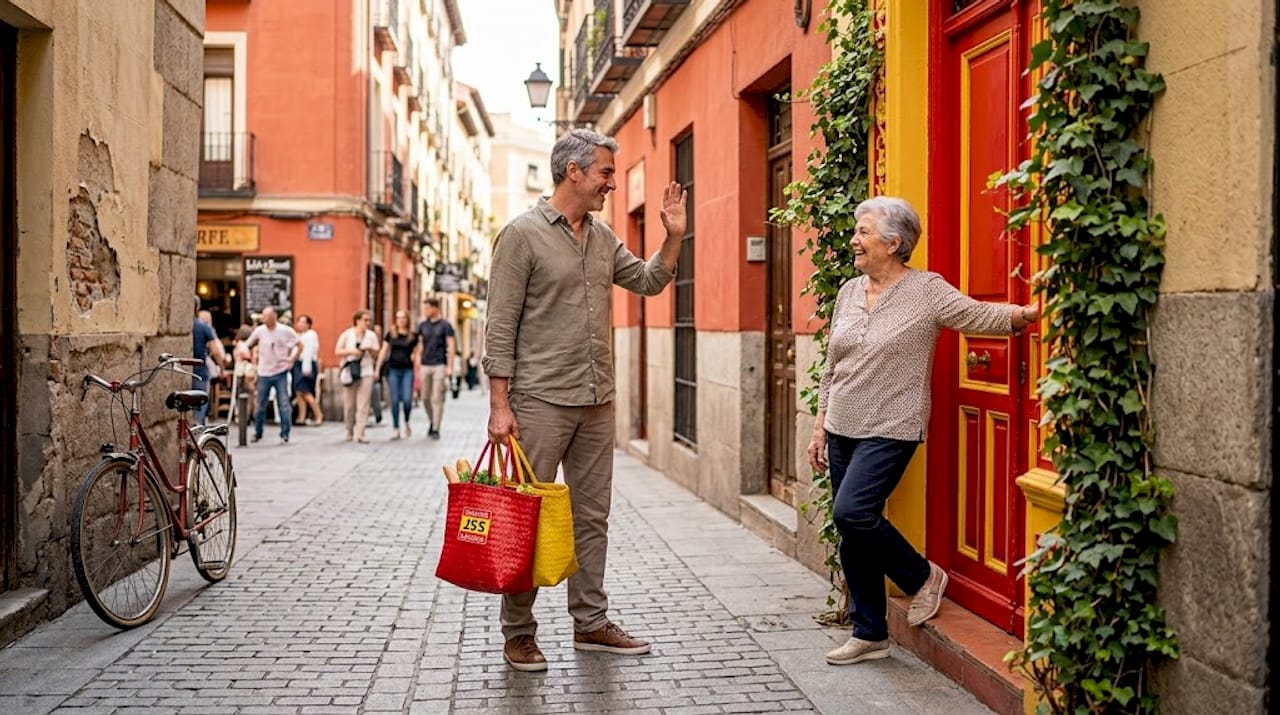
Knowing the phrases is one thing. Having them ready at the moment you need them is another matter entirely. That gap between knowing and doing is where most learners get stuck. Here is how to close it.
Daily listening and speaking of ten to fifteen minutes is the recommended baseline for practical readiness. It is not a large investment of time, but it must be consistent. And structured, scenario-based practice builds fluency far more effectively than working through isolated word lists.
Follow this step-by-step rehearsal method:
- Choose one scenario per week. For example, visiting the chemist. Write out the likely conversation from start to finish, both sides.
- Read it aloud twice. Focus on the phrases you would actually say, not just the vocabulary.
- Listen to native audio for that scenario. Even ten minutes of focused listening trains your ear to follow real-speed Spanish.
- Practise the “recovery” phrases. What do you say when you do not understand? What if the person speeds up? Rehearse these specifically.
- Use it in real life that week. Find the genuine situation and do it. Even a small success reinforces the whole session.
- Replay the scenario. After your real-world attempt, revisit your script. What worked? What caught you off guard? Adjust accordingly.
This cycle mirrors how first-language children naturally acquire language: through repeated, contextual exposure rather than rote memorisation.
Creating micro-dialogues is one of the most underused strategies for expat learners. A micro-dialogue is a short, realistic exchange of four to six lines covering one task. Write your own based on real conversations you have had or expect to have. Keep them specific to your life in Spain.
Fitting practice into daily life does not require restructuring your routine. Listen to a short audio Spanish lessons recording while having breakfast. Run through five phrases in your head during your morning walk. Repeat the dialogue from your weekly scenario while waiting for the kettle.
“Small, daily habits compound over weeks and months into genuine competence. The consistency of ten focused minutes beats one intense hour, every time.”
For learners who want structured support in advancing their language level, building on these daily habits with a proper framework makes the progress feel purposeful rather than random.
Pro Tip: Record yourself doing a short scenario script on your phone. Play it back and listen critically. Most people are surprised by how much they improve within a fortnight of doing this regularly.
Our perspective: what truly unlocks Spanish for daily living
Here is something most language guides will not tell you directly. The problem is rarely vocabulary. Most expats have seen plenty of phrase lists. The problem is what happens to those words the moment a native speaker replies at full speed, with a regional accent, and with the casual shorthand of real conversation.
That machine-gun pace of native replies is where confidence collapses. And no amount of extra vocabulary solves it. What solves it is rehearsed familiarity with specific situations so that the cognitive load drops enough to actually hear what is being said.
Mistakes are not just inevitable. They are the mechanism. Every time you produce an imperfect sentence and a local understands you anyway, your brain registers that the channel is open. That is when real learning accelerates. Obsessing over perfect grammar before speaking is the single most common reason adult learners stall.
Cultural awareness matters just as much as correct vocabulary. Knowing when to step aside in a queue, how to greet someone you have met once before, or how to decline an offer politely without causing offence, these are not extras. They are part of the language. Authentic spoken Spanish is inseparable from the culture it lives in.
The expats who genuinely integrate are not the ones with the largest vocabulary. They are the ones who showed up, tried, made errors with good humour, and kept going. Choosing warmth and cultural awareness over robotic translation accuracy creates the rapport that makes neighbours invite you in for coffee and tradespeople arrive when they say they will.
Take your Spanish further: guided resources for real-life fluency
If this article has confirmed that situational, scenario-driven Spanish is the right path, the logical next step is a structured learning resource built specifically around real life in Spain, not academic examinations.
James Spanish School offers exactly that. The Spanish Vocab Builder uses the WordAmigo AI system to embed vocabulary and pronunciation permanently through strategic repetition, solving the two frustrations that trip up most adult learners. Everything is available on demand, twenty-four hours a day, with no expiry date and no pressure. You can also explore practice Spanish lessons built around the genuine situations covered in this article, from market conversations to medical appointments, all explained in plain English by a dual-native speaker with forty years of life in Spain.
Frequently asked questions
What’s the fastest way to pick up spoken Spanish for daily situations?
Short, daily scenario-based rehearsal with high-frequency phrases is the most effective and practical method, particularly when combined with listening practice.
Is English really not enough to get by in Spain?
English may help in tourist areas, but Spanish is needed for most everyday interactions, official dealings, and genuine long-term independent living.
Which Spanish phrases should I master first?
Begin with greetings, polite requests, basic directions, ordering food, and emergency questions. Essential survival phrases grouped by situation give you the most useful starting point.
How can I practise for real conversations?
Rehearse short scripts, listen and respond to audio scenarios, and role-play everyday tasks with a partner or tutor. Scripted scenario rehearsal is particularly effective for building real-time confidence.