

Role of repetition in Spanish fluency
TL;DR:
- Repetition alone does not guarantee Spanish fluency; it must be meaningful, context-driven, and aimed at automatic recall.
- Effective repetition transforms conscious knowledge into procedural memory, enabling natural, confident conversation in Spain.
Repeating Spanish sentences might feel like progress, yet many English speakers in Spain spend months on the same phrases and still freeze when a native speaker replies at full speed. The uncomfortable truth is that repetition alone is not a magic formula. What matters enormously is the type of repetition you practise, the context in which you practise it, and whether your brain is genuinely processing meaning or simply mimicking sounds. This guide unpacks the science behind effective repetition, separates the methods that work from the ones that waste your time, and gives you practical strategies you can use today.
Table of Contents
- Why repetition matters for Spanish fluency
- Not all repetition is created equal: smart vs. rote practice
- How structured repetition techniques boost speaking skills
- Spaced repetition: cementing vocabulary and confidence for real conversation
- The biggest mistake learners make with repetition—and what actually works
- Take your Spanish further with expert-led, repetition-based courses
- Frequently asked questions
Key Takeaways
| Point | Details |
|---|---|
| Repetition builds automaticity | Moving from conscious practice to automatic speech is key for real Spanish fluency. |
| Smart repetition beats rote | Context-rich, meaningful repetition delivers true conversation skills, not robotic knowledge. |
| Structured techniques work best | Speaking loops, role-plays, and sentence stems make repetition practical and effective. |
| Spaced repetition aids retention | Interval-based review improves vocabulary retention and reduces blank moments in conversation. |
Why repetition matters for Spanish fluency
Real conversational fluency is not the same as knowing a lot of words. You could have a vocabulary of two thousand Spanish terms and still stumble badly the moment your neighbour asks you something unexpected at the front door. True fluency is about recall speed and confidence, the ability to retrieve the right phrase automatically, without consciously searching for it.
This is where repetition becomes genuinely powerful. Repetition supports fluency primarily by turning initially conscious knowledge into automatic, procedural skill, reducing working-memory load and speeding up retrieval. In plain terms, the more times you process and use a phrase correctly in context, the less mental effort it requires. Eventually, it simply arrives, the way native speakers produce language without thinking about grammar at all.
Psychologists call this procedural memory, the same type of memory that lets you ride a bicycle or touch-type without concentrating on every movement. When Spanish phrases become procedural, you free up mental space to focus on what you are saying rather than how to say it. That shift is what Spanish repetition boosts fluency and it is the difference between sounding like a learner and sounding like someone who actually lives in Spain.
Here are the signs that procedural fluency is developing in your spoken Spanish:
- You respond to a simple question without mentally constructing a sentence first.
- Familiar phrases arrive whole, not word by word.
- You notice when something sounds wrong, even if you cannot name the grammar rule.
- You can hold a short conversation while your attention is partially elsewhere.
- You self-correct naturally, mid-sentence, without losing your thread.
“The goal of language practice is not to perform phrases correctly in a controlled setting. It is to internalise them so deeply that they become reflexes.”
Pro Tip: Instead of drilling isolated vocabulary, focus on chunking useful Spanish expressions as complete units. Phrases like “¿Me puede decir…?” (Can you tell me…?) or “No lo entiendo bien” (I don’t quite understand) are far more valuable than twenty separate words, because you can deploy them instantly in dozens of real situations. Spanish is easier for English speakers than many assume, partly because these chunks transfer to so many everyday moments.
Not all repetition is created equal: smart vs. rote practice
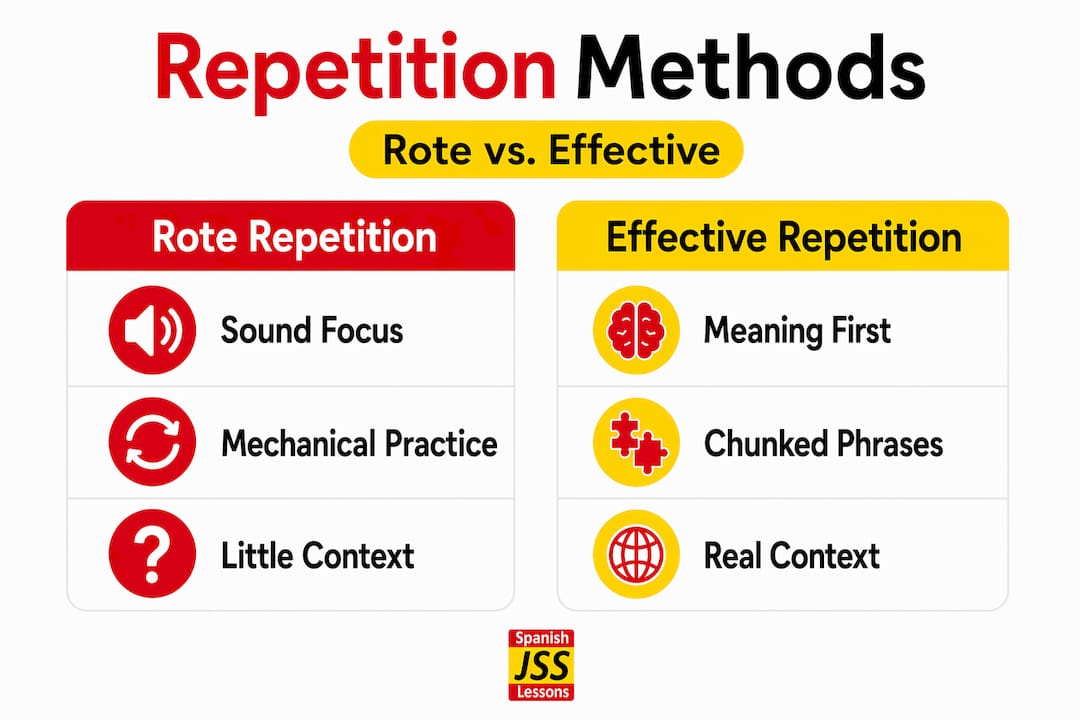
Following the science behind repetition, it is important to be honest about a trap that catches many adult learners: not all repetition is equally effective. Mindlessly repeating a phrase twenty times is very different from processing it meaningfully across varied contexts.
Not all repetition drives acquisition equally: repeating output drills may not produce the same results as repeated exposure to meaningfully processed language across varied contexts. In other words, parroting sentences without understanding them can build a thin layer of surface knowledge, but it rarely creates the fluency you need when a shop assistant veers off-script.
Compare the two approaches side by side:
| Feature | Rote repetition | Context-rich repetition |
|---|---|---|
| Focus | Sound and form | Meaning and use |
| Method | “Repeat after me” drills | Role-play, storytelling, real dialogue |
| Memory type | Short-term recall | Long-term procedural memory |
| Flexibility | Low (fixed phrases only) | High (adapt to real situations) |
| Transfer to conversation | Weak | Strong |
| Risk | Freezing when context changes | Minimal, adapts naturally |
Rote repetition is not entirely worthless. It can help with pronunciation and give beginners a foothold. But if it is your only tool, you will find yourself knowing phrases perfectly in a classroom and going completely blank at the pharmacy counter. That is why context beats vocabulary lists every time as a long-term strategy.
Here is how to make repetition genuinely meaningful:
- Process the meaning first. Before repeating a phrase, make sure you fully understand what it means and why it is structured that way. Understanding the logic helps the phrase stick.
- Connect it to a real situation. Visualise exactly where you would use this phrase. Is it at the supermarket checkout? Arranging a plumber? Talking to a doctor’s receptionist? Anchor it to a specific scene.
- Say it in slightly different ways. Change a word, adjust the tone, practise asking it as a question. Variation deepens memory far more than identical repetition.
- Use it at the first real opportunity. Meaning-based repetition reaches its peak when you test the phrase in an actual conversation, even a brief one. The moment of genuine use cements it like nothing else.
Pro Tip: After learning any new phrase, ask yourself honestly: “Could I use this comfortably at the bar, the town hall, or on the phone to a tradesman?” If the answer is no, that phrase is not yet ready for real-life Spanish situations. Keep practising until it feels natural, not just correct.
How structured repetition techniques boost speaking skills
Having established what ineffective repetition looks like, we can now focus on the practical tools that actually build automaticity in spoken Spanish. Structured repetition is not robotics. It is purposeful practice designed to simulate real conversation pressure while keeping the material manageable.
For speaking fluency, repetition can be implemented through structured speaking loops, including sentence stems, functional language, and role-play cycles, to promote automaticity and measurable progress. A sentence stem such as “Quería saber si…” (I wanted to know if…) gives you a launching pad for dozens of real-world requests. You are not memorising a fixed script; you are building a flexible engine.
The data on structured techniques is encouraging. Learners who practise speaking through loops and role-play consistently outperform those who rely on passive listening or reading alone:
| Technique | Fluency improvement | Accuracy improvement | Confidence rating |
|---|---|---|---|
| Sentence stem loops | High | Moderate | Very high |
| Role-play cycles | High | High | High |
| Functional phrase drilling | Moderate | High | Moderate |
| Passive listening only | Low | Low | Low |
| Grammar exercises only | Low | Moderate | Low |
The top structured repetition strategies for building real conversational ability include:
- Sentence stem loops: Take a core structure such as “¿Podrías…?” (Could you…?) and practise completing it with ten different endings across three or four sessions.
- Role-play cycles: Practise a specific scenario (booking a medical appointment, complaining about a delivery, asking for directions) repeatedly across several days, with small variations each time.
- Shadowing native speech: Listen to a short native phrase and repeat it immediately, matching speed and rhythm. This trains both pronunciation and fluency simultaneously.
- Conversation journals: Write two or three sentences each day about something that happened, then speak them aloud. Writing first slows thought enough to build accuracy; speaking next builds speed.
- Delayed recall practice: Study a phrase, wait an hour, then try to produce it from scratch without looking. This is far more powerful than immediate repetition.
You can find detailed guidance on these approaches and how to apply them in real Spanish life in these real-life Spanish fluency tips. If you want to go deeper on conversation practice specifically, there is excellent practical advice on how to practise Spanish conversation in ways that mirror real interactions rather than classroom exercises. And for anyone who wants to know how to reinforce Spanish speaking between lessons, small daily habits make an enormous cumulative difference.
Spaced repetition: cementing vocabulary and confidence for real conversation
From classroom techniques, we move to how scientifically optimised review schedules help you lock in vocabulary and expressions for long-term fluency. Spaced repetition is one of the most well-evidenced tools in language learning, yet many adult learners have never heard of it or think it is only for tech-savvy younger students.
Spaced repetition is simply the practice of reviewing material at gradually increasing intervals. Instead of studying a word ten times in one sitting, you study it once today, then again tomorrow, then in three days, then a week later. Each successful recall at a slightly longer gap tells your brain that this information is worth keeping in long-term storage. The result is dramatically better retention with less total study time.
Spaced repetition improves vocabulary retention by approximately 25% over traditional massed study methods. For adult learners juggling daily life in Spain, that efficiency gain is significant. It means you can maintain momentum with shorter, well-timed sessions rather than lengthy cramming that fades within days.
Setting up a basic spaced repetition plan does not require expensive software:
- Choose twenty to thirty priority phrases relevant to your actual daily life in Spain, not a generic textbook list.
- Review new phrases daily for the first three days, then every three days, then weekly.
- Mark phrases as “easy” or “needs work” after each session, and prioritise the ones that still feel shaky.
- Link each phrase to a real situation you regularly encounter, such as ordering at a bar, talking to your gestor, or speaking to school staff about your grandchildren.
- Use a small notebook or a phone app to track what you have reviewed and when. Consistency matters more than the tool you choose.
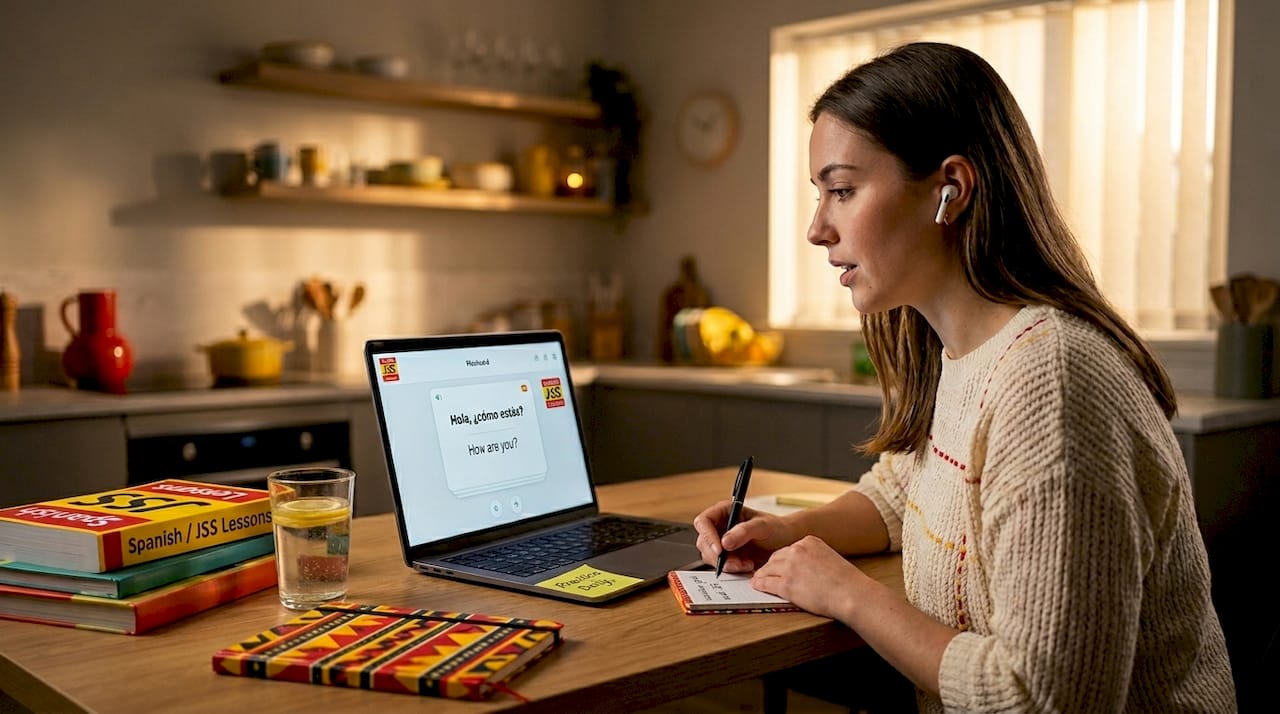
Digital language learning platforms that include repeated practice can measurably improve listening, speaking, reading, and writing skills. One study found significant improvements across all four skill areas after twelve weeks of weekly digital practice using structured repetition. That said, the technology is secondary to the principle. Even a handwritten set of phrase cards, reviewed at the right intervals, will deliver excellent results if you stick to the schedule.
For a practical walkthrough of how to structure your independent study, the guide on how to learn Spanish online covers the steps in plain, accessible language.
The biggest mistake learners make with repetition—and what actually works
After many years of working with English-speaking adults in Spain, one pattern stands out clearly. Most learners who plateau at a basic level are not lacking effort. They are repeating the wrong things in the wrong way, and they do not realise it.
The most common mistake is over-focusing on textbook phrases that sound polished but never arise in real conversation. Learners spend weeks perfecting “¿Dónde está la biblioteca?” (Where is the library?) when what they actually need is “Oye, ¿sabes si hay parking cerca?” (Hey, do you know if there’s parking nearby?) or “Me lo puede repetir más despacio, por favor?” (Can you repeat that more slowly, please?). The gap between what people study and what they actually say is wider than most admit.
The learners who genuinely break through to conversational fluency do something different. They pay attention to which phrases they actually attempt in real conversations, then go back and work specifically on those. They practise the same phrase across multiple settings until it feels as natural as saying “excuse me” in English. And they stay curious about Spanish small talk fluency, because small talk is the gateway to every deeper conversation in Spanish social life.
The mental shift is this: stop treating repetition as a performance task where the goal is to sound correct. Start treating it as a rehearsal for a specific real-world moment. Every phrase you practise should have a face, a place, and a purpose attached to it. Your neighbour, your butcher, the woman at the post office. When repetition is grounded in your actual daily life in Spain, it stops feeling like studying and starts feeling like preparation.
Pro Tip: If you would not use a phrase at the shops, at the bar, or to arrange a doctor’s appointment, it is probably not worth the repetition time right now. Be ruthless about relevance and your progress will accelerate noticeably.
Take your Spanish further with expert-led, repetition-based courses
Understanding what makes repetition work is one thing. Having a structured system that applies it consistently, and correctly, is another matter entirely.
James Spanish School builds effective repetition directly into every stage of the learning journey. The 100-lesson course uses sentence-building loops, ear-tuning practice, and on-demand access so you can repeat any lesson as many times as you need, with no countdown clock and no pressure. The WordAmigo Vocab Builder programme takes this further with AI-powered spaced repetition designed specifically for European Spanish, embedding vocabulary and pronunciation through a five-step retention loop covering reading, listening, speaking, and writing. All of it is grounded in real life in Spain, not academic exams. You can explore the full range of online Spanish lessons and find the right starting point for where you are now.
Frequently asked questions
How much repetition do I really need for Spanish fluency?
Regular, spaced repetition across brief daily sessions works best for lasting fluency. Spaced repetition improves retention by around 25% compared with traditional massed study, so short and consistent beats long and irregular every time.
Can I achieve Spanish fluency just by repeating phrases?
Not entirely. Using phrases in real-life contexts and genuinely processing their meaning is essential for usable fluency. Output drills alone are less effective than meaningful, contextually rich exposure to the language.
What is the difference between rote and effective repetition?
Rote repetition is mechanical and focuses on sound alone, while effective repetition processes meaning, applies varied contexts, and builds flexible recall. Context-rich repetition accelerates usable proficiency far beyond what robotic drills can achieve.
Does digital learning really improve Spanish skills through repetition?
Yes, provided the practice is structured and consistent. Weekly digital practice with repetition has been shown to improve listening, speaking, reading, and writing skills across all learners who maintain regular time on task.