

TL;DR:
- Native-like Spanish listening involves understanding fast, natural speech through rhythm and overall meaning rather than decoding every word.
- Practicing shadowing, targeting 70–80% comprehension, and exposing yourself to regional accents accelerates progress effectively.
You live in Spain. You study Spanish. You can read a menu, follow a classroom dialogue, even hold a polite exchange at the panadería. Then a neighbour starts chatting at full speed and your brain shuts down. What is native-like Spanish listening, really, and why does it feel so different from anything you practised before? The honest answer is that it is not about catching every word. It is about training your ear to process the rhythm, blending, and pace of real speech until meaning lands without conscious decoding. That shift in understanding changes everything.
Table of Contents
- Key takeaways
- What native-like Spanish listening actually means
- Common challenges for English-speaking adults in Spain
- Effective techniques for developing native-like listening
- Applying native-like listening in daily life in Spain
- Listening skill stages and realistic progression targets
- My honest perspective on this
- How Jamesspanishschool can help you get there
- FAQ
Key takeaways
| Point | Details |
|---|---|
| Speed is genuinely faster | Native Spanish runs at roughly 7.82 syllables per second, well above English, so blending is not a flaw in your listening. |
| Perfect word recall is the wrong goal | Aiming for global comprehension, not word-for-word accuracy, reduces panic and improves understanding. |
| The 70–80% zone is your training sweet spot | Materials at this comprehension level challenge without overwhelming and accelerate real progress. |
| Shadowing rewires your ear | Repeating speech simultaneously trains rhythm and intonation far more effectively than passive listening alone. |
| Daily short sessions beat occasional marathons | Consistent brief practice builds the auditory muscle memory that native-like listening depends on. |
What native-like Spanish listening actually means
Before you can improve your Spanish listening skills, you need to understand what distinguishes native comprehension from classroom comprehension. They are genuinely different things.
The most striking difference is speed. Native Spanish speakers produce around 7.82 syllables per second, compared with English at 6.19. That gap sounds modest until you experience it in real conversation. It translates to words arriving before your brain has finished processing the previous ones.
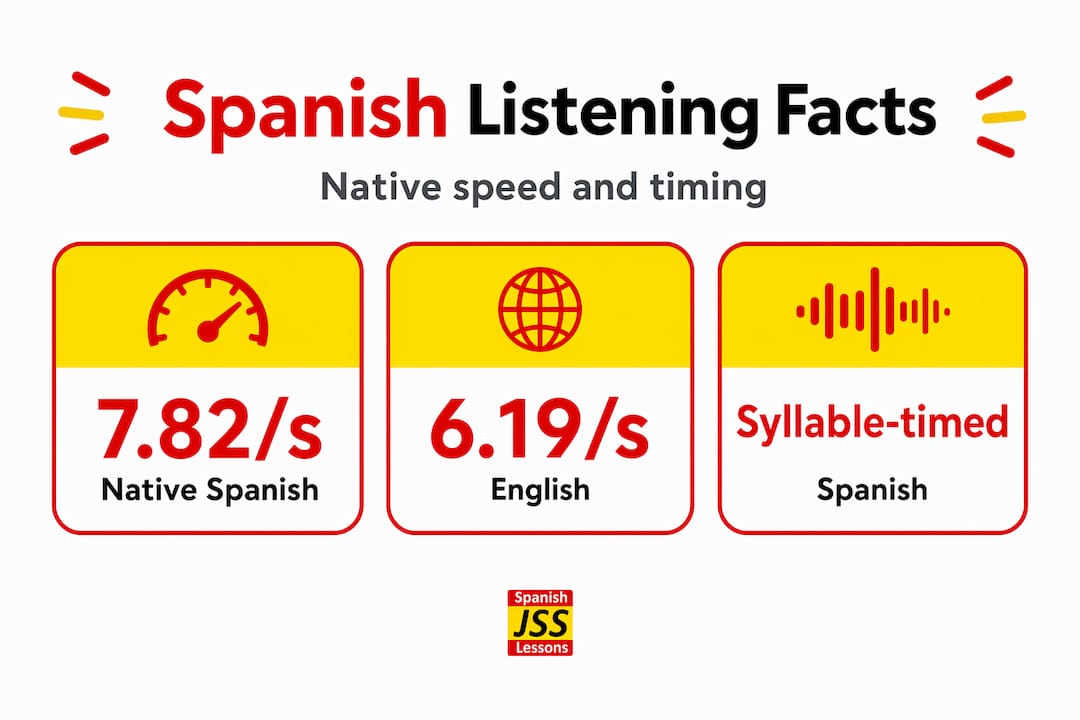
Spanish is also a syllable-timed language, which means each syllable carries roughly equal weight and duration. English, by contrast, is stress-timed, with some syllables stretched and others swallowed. When you hear Spanish at full pace, the even rhythm creates the impression of machine-gun delivery, a continuous stream with no obvious breathing space between words.
Then there is connected speech. In natural conversation, native speakers do not pronounce each word as a separate unit. Words blend at their boundaries. ¿Cómo estás? does not arrive as three distinct words. It arrives as something closer to comoestás, a single flowing sound. Understanding native Spanish means recognising those blended patterns rather than searching for textbook pronunciation.
Several other features shape native-like listening comprehension in Spanish:
- Content words carry the message. Skilled listeners focus on nouns, verbs, and key adjectives rather than tracking every article, preposition, and conjunction. Function words often blur and disappear at speed.
- Intonation signals intent. A question, a command, and a statement can use nearly the same words. Native comprehension relies heavily on pitch contours and stress patterns to distinguish them.
- Regional variation is real and significant. Accents across Spain differ considerably. Castilian, Andalusian, and Canarian Spanish sound markedly different, and even native speakers from one region occasionally struggle to follow another. If you have only practised one accent, you have only half the picture.
Developing native-like listening comprehension in Spanish is not about decoding perfection. It is about building a mental model of Spanish rhythm, sound patterns, and likely meaning so that your brain fills gaps automatically, just as a native speaker’s does.
Common challenges for English-speaking adults in Spain
Living in Spain gives you extraordinary exposure to real Spanish. It also means the gaps in your listening skills become apparent very quickly. Here are the obstacles that come up most often.
Speed and blending are the primary culprits. When words run together at pace, learners who were taught to listen for distinct words simply cannot keep up. The problem is not intelligence or effort. It is that the training method did not match the reality.
Regional accents multiply the difficulty. An English speaker who has learned largely neutral Castilian Spanish may find Andalusian speech almost incomprehensible at first. Dropped consonants, merged vowels, and regional vocabulary all require separate exposure to understand fully.

Native speakers do not naturally adjust their pace. Unlike a teacher, your neighbour, the plumber, or the woman at the health centre is not thinking about your comprehension. They speak at the speed that feels normal to them. Asking for clarification is entirely acceptable, and most Spanish people respond warmly to a polite request to repeat something, but you cannot ask every few seconds without the conversation collapsing.
The panic response is real and self-reinforcing. When you miss a phrase, anxiety spikes. That anxiety consumes cognitive resources you needed for the next phrase, and suddenly you have missed two sentences. Many learners recognise this pattern immediately.
The wrong definition of success creates unnecessary pressure. If you believe native-like Spanish listening means understanding every syllable, you will feel like a failure in almost every real conversation. Releasing that standard is not giving up. It is adopting the same approach a native listener actually uses.
Pro Tip: When you lose the thread in a real conversation, resist the urge to backtrack mentally. Keep listening forward. Global meaning accumulates across a whole exchange, not sentence by sentence.
Effective techniques for developing native-like listening
The good news is that Spanish listening skills are trainable through specific techniques. Here are the methods that produce the fastest, most durable results.
- Shadowing. This is the single most powerful technique for developing native-like listening comprehension. You listen to a native speaker and repeat what you hear simultaneously, not after. Shadowing activates listening, speaking, breathing, and articulation at the same time, which creates stronger memory traces than passive listening alone. The goal is not to produce perfect pronunciation. The goal is to lock in the rhythm, pace, and intonation patterns of real Spanish so your ear begins to anticipate them automatically.
- Gist listening before detail listening. Approach any new audio by listening first for the overall topic and general meaning, with no pressure to catch specifics. On a second pass, listen for particular details. This replicates how native listeners actually process speech and prevents the panic that comes from chasing every word on first exposure.
- Targeting the 70–80% comprehension zone. The ideal training window sits at roughly 70 to 80 per cent comprehension. Too easy (above 95 per cent) and your brain is not being challenged to fill gaps or process speed. Too hard (below 60 per cent) and frustration overtakes learning. Selecting material at this level keeps the brain alert and builds resilience efficiently.
- Exposing yourself to varied regional accents. Broad accent exposure prevents the brittle comprehension that collapses the moment you encounter an Andalusian speaker after only practising Castilian. Include podcasts, radio programmes, and television from different Spanish regions in your listening diet.
- Combining passive and active listening. Passive and active listening together build different parts of your comprehension system. Passive exposure, such as background radio while cooking, familiarises your ear with natural rhythm and register. Active practice, such as dictation and shadowing, builds precision and processing speed.
- Using social repair phrases in real conversations. Phrases like ¿Puedes repetirlo, por favor? or No te he entendido bien are not admissions of failure. They are the tools that keep conversation going while your skills are still developing. Native speakers use them too.
Pro Tip: Record yourself shadowing a 30-second native audio clip. Play both back together. The mismatch between your rhythm and the speaker’s rhythm will show you exactly where your ear is still behind, which is far more informative than a grammar exercise.
Applying native-like listening in daily life in Spain
Theory matters far less than what you actually do on Tuesday morning when the gas engineer arrives and starts explaining a fault at full conversational speed. Translating listening skills into real integration requires a practical mindset and consistent habits.
Consider building these practices into your daily routine:
- Short daily sessions of ten to fifteen minutes produce better long-term results than occasional long practice sessions. Consistency is what builds the auditory muscle memory that native-like listening depends on.
- Use conversations with your neighbours, shopkeepers, and tradespeople as training, not tests. Remove the internal grading and treat each exchange as exposure. The more volume you accumulate, the faster your processing speed develops.
- Build a toolkit of conversational repair phrases and use them without embarrassment. Managing comprehension gaps gracefully is a skill in itself. Spanish speakers genuinely appreciate the effort you are making and will almost always adjust or repeat when asked politely.
- Track your progress by revisiting audio you found difficult. A podcast that was largely incomprehensible three months ago may now feel manageable. That shift is real evidence of growth, and noticing it matters for motivation.
- Gradually widen the range of speakers you listen to. Start with clear, slower speakers and progressively include faster ones, regional accents, informal registers, and background noise. Each new layer strengthens the whole system.
The mental shift that makes the biggest difference is accepting that understanding the shape and intent of a conversation is a genuine success. You do not need the exact words to know whether your neighbour is complaining about the council, recommending a restaurant, or asking a favour.
Listening skill stages and realistic progression targets
Understanding where you are helps you choose the right material and set goals that actually motivate rather than deflate.
| Stage | Comprehension target | What to focus on | Indicator of progress |
|---|---|---|---|
| Beginner | 40–60% | Familiar topics, slow delivery, clear speakers | Recognising repeated words and phrases |
| Intermediate | 60–80% | Natural pace, varied topics, graded podcasts | Following the gist without losing the thread |
| Upper-intermediate | 75–90% | Regional accents, informal registers, fast speech | Catching main points and most detail |
| Near-native | 90–95% | Unscripted conversation, background noise, multiple speakers | Rarely needing clarification in daily exchanges |
The optimal challenge window sits at 70 to 80 per cent comprehension across most of the intermediate and upper-intermediate range. Aiming for perfect understanding at any stage other than near-native is counterproductive. It signals your materials are too easy, not that you are succeeding.
One insight worth holding onto: communication effectiveness matters far more than sounding or processing exactly like a native speaker. Integration into daily life in Spain does not require a perfect score. It requires confident, functional comprehension in the situations that actually arise. That is an achievable target with consistent, well-directed effort.
My honest perspective on this
After 40 years in Spain, I have watched hundreds of English-speaking adults go through the same cycle. They study hard, they feel confident reading Spanish, and then a real conversation floors them. The frustration is genuine, and I have a lot of empathy for it.
Here is what I have come to believe: the biggest obstacle is not speed, and it is not accents. It is the expectation that listening should feel like reading. In reading, you control the pace. In listening, the language comes at you on its own terms. The moment you stop trying to catch every word and start riding the rhythm, something shifts. I have seen it happen in lesson after lesson.
The learners who progress fastest are the ones who accept early that fast spoken Spanish is a different skill from textbook Spanish, and who treat every real conversation as practice rather than performance. They ask for repetition without shame. They listen to the radio even when they only catch half of it. They shadow speakers who are too fast for them, because that discomfort is exactly where the growth is.
Native-like is a useful direction, not a rigid destination. Get good enough that your neighbours feel comfortable talking to you naturally, and you are already where you need to be.
— James
How Jamesspanishschool can help you get there
If you recognise the frustration described in this article, Jamesspanishschool has built its entire programme around solving it. The 100-lesson course from James Spanish School is split between sentence building and dedicated ear-tuning sessions designed specifically to train your comprehension of fast, natural Spanish. There are no grammar terms to memorise and no countdown clocks to stress you out.

The WordAmigo system handles vocabulary and pronunciation retention through a five-step loop covering reading, listening, speaking, and writing. Everything is available on demand, 24/7, on any device. Whether you want to follow your doctor, chat with your neighbour, or simply stop dreading the phone ringing in Spanish, the course meets you where you are. Explore the current course options and find the right starting point for your level.
FAQ
What is native-like Spanish listening?
Native-like Spanish listening means understanding fast, naturally spoken Spanish through rhythm and global meaning rather than word-for-word decoding. It involves processing blended speech, regional accents, and intonation patterns the way a native speaker does.
Why do native Spanish speakers sound so fast?
Native Spanish runs at approximately 7.82 syllables per second, faster than English at 6.19. Combined with syllable-timed rhythm and connected speech blending, this creates the impression of machine-gun delivery to untrained ears.
How much Spanish do I need to understand to hold a real conversation?
Functional daily conversation in Spain is achievable at around 75 to 80 per cent comprehension, provided you use social repair strategies such as asking for repetition when needed. Perfect understanding is not required.
Does shadowing really improve listening comprehension?
Yes. Shadowing trains rhythm, intonation, and connected speech recognition simultaneously by engaging listening, speaking, and articulation at the same time. Research consistently shows it produces stronger auditory processing than passive listening alone.
How long does it take to develop native-like Spanish listening skills?
Progress depends on daily consistency and material quality. Short sessions of ten to fifteen minutes practised daily produce faster and more durable gains than occasional longer sessions, with noticeable improvement in real conversations typically appearing within a few months of consistent, targeted practice.