

TL;DR:
- Mastering Spanish pronunciation emphasizes pure vowels, proper stress, and distinct ‘r’ sounds for clear understanding. Consistent practice with shadowing, recording, and accurate stress placement accelerates fluency, making everyday conversations more natural. Focus on vowels and stress rules first; perfecting ‘r’ and rhythm can follow gradually for effective communication.
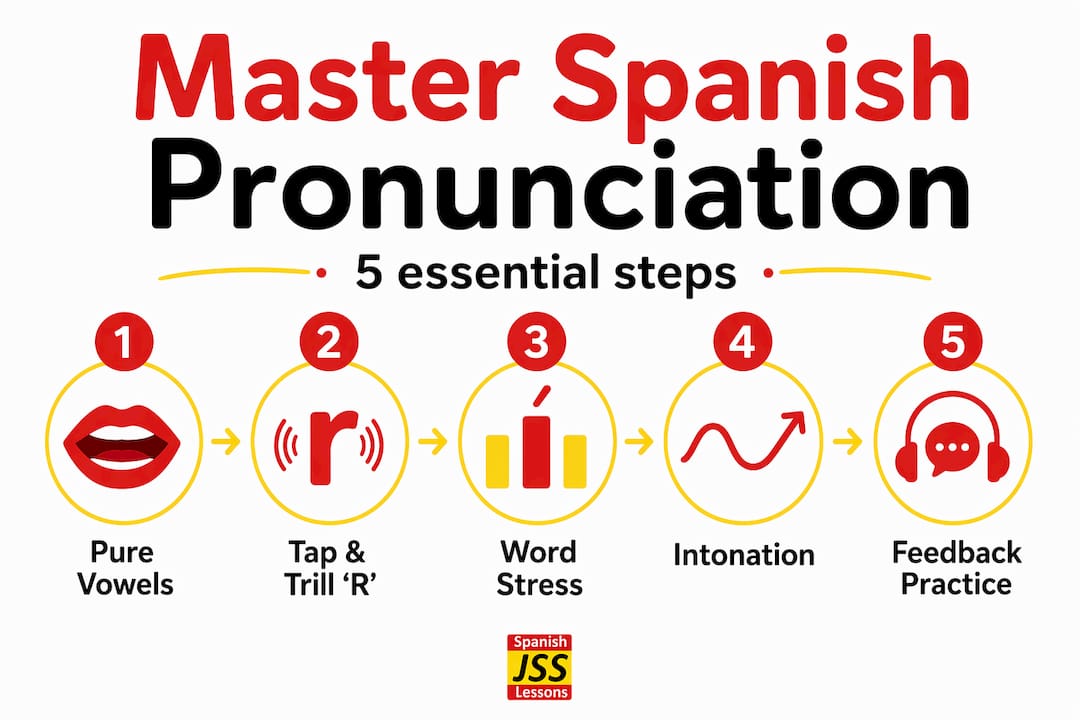
Getting your Spanish pronunciation right is not just about sounding polished. It is about being understood. For English speakers learning European Spanish, the gap between how you think you sound and how natives actually hear you can be surprisingly wide. This guide tackles how to master Spanish pronunciation by breaking down the five areas that matter most: vowels, the famous rolling ‘r’, word stress, smart practice habits, and the most common errors English speakers make. Work through these systematically and everyday conversations with neighbours, shop staff, and health workers will feel dramatically more natural.
Table of Contents
- Key takeaways
- How to master Spanish pronunciation: start with vowels
- Mastering the Spanish ‘r’ sounds
- Spanish word stress and intonation
- Effective practice techniques
- Common Spanish pronunciation mistakes
- My honest take after 25 years teaching in Spain
- Take your pronunciation further with James Spanish School
- FAQ
Key takeaways
| Point | Details |
|---|---|
| Pure vowels are non-negotiable | Spanish vowels never reduce or change quality, so practise each one in isolation before combining into syllables. |
| Tap and trill ‘r’ carry different meanings | Confusing the single tap with the trilled ‘rr’ changes word meanings, so drill them separately first. |
| Stress rules are largely predictable | Learn three simple rules for word endings and you will place stress correctly in the vast majority of Spanish words. |
| Shadowing builds natural rhythm | Imitating native audio almost simultaneously trains your mouth, ear, and brain to work together. |
| Mindful daily practice beats marathon sessions | Short, focused drills repeated consistently do more for pronunciation than occasional long study blocks. |
How to master Spanish pronunciation: start with vowels
If there is one thing that separates an authentic Spanish accent from an English-tinged one, it is the vowels. Spanish vowels are pure and do not diphthongise or reduce the way English vowels do. In English, the letter ‘a’ in an unstressed syllable often becomes a soft, lazy “uh” sound (the schwa). In Spanish, that same ‘a’ stays crisp and clean no matter where it appears in the word.
There are exactly five vowel sounds to learn: a, e, i, o, u. Each one has a single, fixed quality.
- A sounds like the ‘a’ in “father”. Mouth open, tongue flat.
- E sounds like the ‘e’ in “bed”, but slightly more closed. Lips slightly spread.
- I sounds like the ‘ee’ in “feet”, but shorter. Corners of lips pulled back.
- O sounds like the ‘o’ in “more”, but rounder and more forward. Lips form a circle.
- U sounds like the ‘oo’ in “moon”, but tighter. Lips push forward into a small circle.
The key physical discipline here is consistency. Explicit training is needed to maintain full vowel quality regardless of stress position, because English-speaking brains are wired to reduce unstressed vowels automatically. You have to consciously override that habit.
Start by drilling each vowel in isolation: say a ten times slowly, focusing on mouth shape. Then move to syllable combinations: ba, be, bi, bo, bu. Then try minimal pairs where a vowel change changes the meaning, such as pero (but) versus puro (pure).
Pro Tip: Record yourself saying a string of five pure vowels back to back: “a, e, i, o, u”. Play it back and compare with a native speaker recording. If any vowel sounds “woolly” or shifts in quality, that is your schwa habit showing up. Isolate and repeat until all five sound equally crisp.
Mastering the Spanish ‘r’ sounds
The Spanish ‘r’ causes more anxiety among English learners than almost any other sound. The good news is that there are really only two sounds to master, and they follow clear rules. There are two distinct Spanish ‘r’ sounds: the tap (a single ‘r’ in the middle of a word) and the trill (‘rr’ or any ‘r’ at the start of a word).
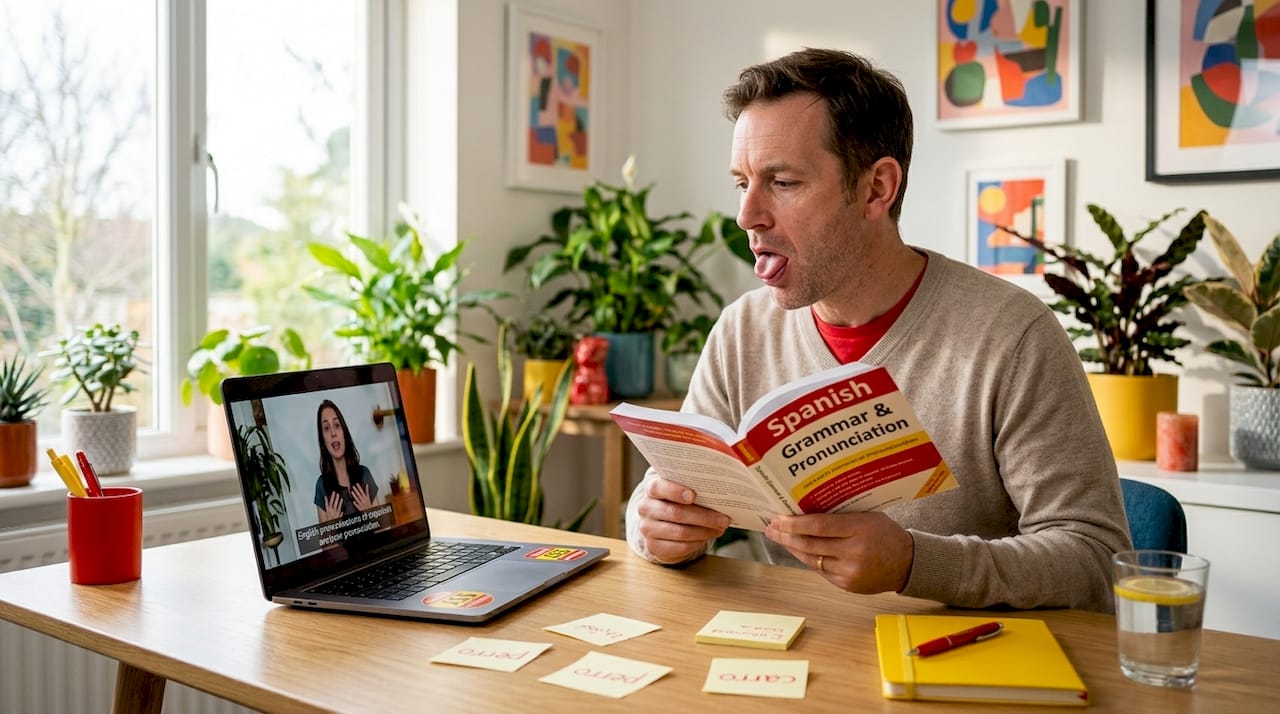
The tap is actually easier than most learners expect. It is the same quick flick of the tongue that many British English speakers use for the ‘t’ in “butter” or “water” in casual speech. The tongue tip touches the ridge just behind your upper teeth for a fraction of a second and bounces away. Think pero (but): one soft, quick tap.
The trill is a different matter. It requires the tongue tip to vibrate rapidly against that same ridge while a stream of air passes through. The word perro (dog) uses the trill, and getting it wrong would leave listeners confused about whether you mean “but” or “dog”.
Here is a step-by-step approach that works:
- Relax your tongue completely. Tension is the enemy of the trill. Let your tongue sit loosely in your mouth.
- Start with a ‘d’ or ‘t’ position. Place your tongue tip on the ridge behind your upper teeth.
- Blow a steady stream of air. Do not force it. Think of the sound a purring cat makes, aimed forward through the tongue tip.
- Try the word drr. English speakers often find the trill emerges naturally when preceded by a ‘d’ sound. Use this as a launching pad.
- Practise minimal pairs daily. Drill caro (expensive) versus carro (cart) until the difference feels automatic.
Pro Tip: If the trill simply will not come, try lying on your back and relaxing your jaw completely before attempting it. Gravity helps release the tongue tension that blocks most learners.
Rolling every ‘r’ sound is a very common learner error that actually removes the meaning contrast between tap and trill. Drill each sound separately before you attempt conversational use. The phonemic contrast between tap and trill is meaning-bearing, so treating them as interchangeable will genuinely confuse native speakers.
Spanish word stress and intonation
Get word stress wrong in Spanish and even perfectly pronounced individual sounds will not save you. Misplaced stress makes words harder to recognise for native listeners, even when every consonant and vowel is correct. The good news is that Spanish stress follows predictable rules based on word endings.
The three rules break down like this:
- Words ending in a vowel, ‘n’, or ‘s’ are stressed on the second-to-last syllable. Example: ha-BLO, ca-SA, co-MEN.
- Words ending in any other consonant are stressed on the last syllable. Example: ha-BLAR, pa-RED, es-PA-ñol.
- Any word with a written accent ignores both rules and is stressed on the accented syllable. Example: ca-FÉ, MÚ-si-ca, ta-xi-STÁS.
| Word ending | Stress rule | Example |
|---|---|---|
| Vowel, n, or s | Second-to-last syllable | hablan (HA-blan) |
| Other consonant | Last syllable | hablar (ha-BLAR) |
| Written accent | Accented syllable | café (ca-FÉ) |
Beyond individual word stress, European Spanish has a fairly level intonation pattern compared to British English. Statements tend to start mid-pitch and fall gently at the end. Questions in Spanish often rise at the end, but not as dramatically as in English. One practical exercise is to listen to short clips of native Spanish speech (Spanish radio or television news works well) and hum along to the melody without worrying about the words. This trains your ear and your voice to match the natural rhythm of the language.
Understanding rhythm matters as much as individual sounds. For a deeper look at why fast native speech feels overwhelming and how to work with it, this guide on fast Spanish explains the patterns that trip up most English speakers.
Effective practice techniques
Knowing the rules is one thing. Getting your mouth to follow them automatically is another. These techniques move pronunciation knowledge from your head into your muscle memory.
- Shadowing. This is the single most effective pronunciation technique available to independent learners. Shadowing involves imitating native audio almost simultaneously to build mouth, ear, and brain coordination. Choose a short clip of native Spanish (ten to fifteen seconds), listen once, then play it again and speak along at the same pace. You are not translating. You are copying rhythm, pitch, and sound in real time. Do this for ten minutes daily and your intonation will shift noticeably within weeks.
- Record and compare. Most learners are shocked the first time they hear a recording of their own Spanish. Use WordAmigo to record yourself reading a short paragraph aloud, then listen to a native speaker read the same text. Compare the two honestly. Note where your vowels drift, where your stress lands in the wrong place, and how your rhythm differs.
- Use pronunciation feedback tools. WordAmigo is by far the best tool for this. It provides instant feedback by listening to your spoken Spanish and identifying errors.
- Read aloud daily. Take any short Spanish text, a recipe, a news headline, a shop sign, and read it aloud slowly with deliberate attention to vowel purity and stress placement. Five minutes of this each morning builds habits faster than you might expect.
Pro Tip: When shadowing, slow the audio down to 75% speed using a podcast app or YouTube’s playback settings. This gives you time to match sounds accurately before building back up to full speed. It is far more effective than struggling at full pace from the start.
The role of regular, structured feedback in accelerating progress is something many learners underestimate. Feedback accelerates Spanish fluency in ways that solo practice simply cannot replicate, particularly for catching errors you have normalised.
Common Spanish pronunciation mistakes
Understanding where English speakers typically go wrong is half the battle. Here are the most frequent errors and how to correct them:
- Schwa substitution. Most English speakers unconsciously apply English vowel reduction, turning unstressed Spanish vowels into a soft “uh”. The word problema becomes something like “pruh-BLEH-muh” instead of “pro-BLE-ma”. The fix is deliberate vowel drilling until clean vowels feel natural in unstressed positions.
- Over-rolling every ‘r’. Rolling all ‘r’ sounds when only ‘rr’ and initial ‘r’ require a trill is extremely common. It sounds theatrical to native ears and, more seriously, it removes the meaningful contrast between words like caro and carro.
- Adding English diphthongs. English speakers tend to turn the Spanish ‘o’ into a two-part “oh-oo” glide, as in the English word “go”. Spanish ‘o’ is a single, steady sound. Train yourself to stop the vowel before it glides.
- Incorrect stress placement. When unsure, English speakers often default to stressing the first syllable, which is the most common stress position in English. In Spanish, most words stress the second-to-last syllable. Applying the three stress rules above eliminates most of these errors quickly.
- Ignoring written accents as stress guides. Many beginners treat written accents as decorative. They are not. They are explicit pronunciation instructions. When you see an accent mark, that syllable takes the stress, full stop.
The fastest way to self-correct is a combination of visual and audio feedback. Record yourself, compare to a native model, and note the specific pattern of error rather than just “I sound wrong”. Precision in identifying the mistake leads to precision in correcting it. For a broader look at how listening difficulties connect to pronunciation habits, Spanish listening challenges are often the flip side of the same coin.
My honest take after 25 years teaching in Spain
I have worked with hundreds of English-speaking adults who arrived in Spain with textbook Spanish and were genuinely baffled when locals struggled to understand them. The culprit, almost every single time, was vowels. Not the ‘r’. Not the accent. The vowels.
In my experience, the moment a learner genuinely commits to pure vowels, their Spanish clarity improves more in two weeks than it did in the previous two months. It is not glamorous work. It feels almost too simple. But the results are undeniable.
What surprised me most over the years is how much rhythm matters relative to individual sounds. A learner with slightly imperfect consonants but correct stress and clean vowels is almost always understood. A learner with perfect consonants but wrong stress or wobbly vowels often is not. The melody of the language carries more meaning than most learners realise.
The ‘r’ is worth practising, certainly. But I would not let frustration with the trill stall your overall progress. Start with vowels, then stress, then the ‘r’. In that order. That sequence, in my 40 years of experience, delivers results faster than any other approach I have seen.
Persistence matters more than perfection. Every week of honest practice brings you closer to the moment a Spanish neighbour stops and says “you speak well”. That moment is worth everything.
— James
Take your pronunciation further with James Spanish School
If this guide has highlighted how much precision goes into speaking Spanish clearly, the structured lessons at James Spanish School are built to take you the rest of the way. James Bretherton’s 100-lesson course includes dedicated ear-tuning modules and audio-led pronunciation drills designed specifically for English-speaking adults living in or moving to Spain.
The WordAmigo system within the course uses AI-powered strategic repetition to permanently embed both vocabulary and correct pronunciation, so words stay in memory and come out sounding right. Everything is available on demand, on any device, with no expiry date. You can explore the full range of pronunciation and audio lessons in the James Spanish School shop, or browse the complete starter course options to find the right starting point. Real conversations with real Spanish people, that is the goal.
FAQ
What are the hardest sounds for English speakers in Spanish?
The trilled ‘rr’ and pure vowel sounds are typically the greatest challenges. English speakers naturally reduce unstressed vowels to a schwa sound, which does not exist in Spanish.
How long does it take to improve Spanish pronunciation noticeably?
Most learners notice a clear improvement within two to four weeks of daily, focused practice on vowels and word stress. Consistent short sessions produce faster results than occasional longer ones.
What is the best way to practise Spanish pronunciation at home?
Use WordAmigo to shadow native audio is one of the most effective home practice methods. Combine it with daily reading aloud and a pronunciation feedback tool to accelerate self-correction.
Does incorrect word stress really affect understanding?
Yes, significantly. Misplaced stress affects intelligibility even when individual sounds are correct, because native listeners rely heavily on stress patterns to recognise words in fast speech.
Do I need a perfect accent to communicate in everyday Spanish?
No. Clean vowels, correct stress placement, and the basic ‘r’ distinction are sufficient for clear communication in most everyday situations. Perfection is not the goal. Being understood confidently is.