

TL;DR:
- Simple Spanish explanations use clear, jargon-free methods to teach core grammar, vocabulary, and pronunciation for practical communication.
- They emphasize sentence structure, pattern-based verb conjugation, and syllable division to help learners think in Spanish and improve fluency.
Simple Spanish explanations are structured, jargon-free breakdowns of core Spanish grammar, vocabulary, and pronunciation designed to help English-speaking adults build real communicative ability without drowning in academic terminology. The standard pedagogical term for this approach is Radical Simplification, a method championed by schools like James Spanish School, where dual-native speaker James Bretherton strips away the grammar labels that native children never encounter and replaces them with plain English logic. What is simple Spanish explanations, at its heart, is a commitment to teaching the language the way it actually works in daily life. Resources such as LibreTexts, SpanishLevel.com, and James Spanish School each demonstrate that learners who start with clear, minimal frameworks progress faster and with far greater confidence than those who begin with dense rule books.
What is the basic structure of simple Spanish sentences?
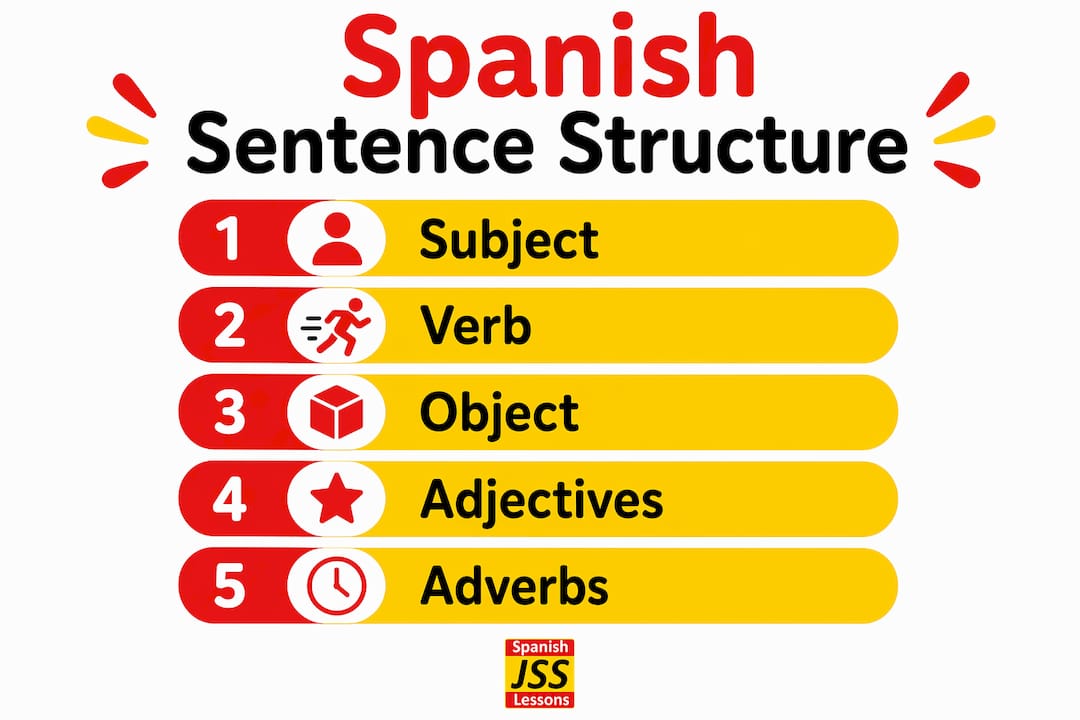
Simple Spanish sentences follow a subject plus predicate pattern, known formally as Sujeto + Predicado. The subject tells you who or what the sentence is about. The predicate contains the conjugated verb and any complements that complete the meaning.
According to LibreTexts, the subject-predicate framework is the engine room of Spanish sentence construction, with the conjugated verb carrying the weight of meaning. This matters enormously for English speakers, because Spanish word order is more flexible than English. You can say María come pan (María eats bread) or Come pan María and both are grammatically sound, though the emphasis shifts. English speakers who try to map their own word order directly onto Spanish will constantly trip over this flexibility.
Educators recommend focusing on sentence structure before introducing nuanced grammar, because it allows learners to form meaningful sentences from day one. The table below shows how the same idea is packaged differently in English and Spanish.
| English sentence | Spanish equivalent | What shifts |
|---|---|---|
| The dog eats meat. | El perro come carne. | Word order stays similar here. |
| She speaks Spanish well. | Habla bien el español. | Subject dropped; verb leads. |
| We are going to the market. | Vamos al mercado. | Subject pronoun omitted entirely. |
| The children play in the park. | Los niños juegan en el parque. | Article added before subject. |
The key insight from this table is that Spanish regularly drops subject pronouns because the verb ending already signals who is acting. English speakers find this unsettling at first, but once you accept that the verb is doing double duty, sentences become far easier to read and produce.
Pro Tip: When you read a Spanish sentence and feel lost, locate the conjugated verb first. Everything else in the sentence orbits around it.
How do you explain the Spanish present simple tense simply?
The present simple tense is the foundation of everyday Spanish communication, covering routines, general truths, and opinions. SpanishLevel.com describes it as your daily bread in Spanish, and that description is accurate. Before tackling past or future tenses, mastering the present gives you the ability to hold a real conversation about your life, your habits, and your surroundings.
Conjugation becomes manageable when you treat it as a three-step mechanical process rather than a memory exercise. Grouping verbs by infinitive ending reduces cognitive load significantly for English speakers, because each group follows a predictable pattern. The three infinitive endings are -ar (hablar, to speak), -er (comer, to eat), and -ir (vivir, to live).
The three steps are:
- Take the infinitive form of the verb, for example hablar.
- Remove the infinitive ending to find the stem: habl-.
- Add the correct ending for the subject pronoun you are using.
The endings for each group, matched to subject pronouns, are as follows:
- Yo (I): -o for all three groups (hablo, como, vivo)
- Tú (you, informal): -as for -ar, -es for -er and -ir (hablas, comes, vives)
- Él/Ella/Usted (he/she/formal you): -a for -ar, -e for -er and -ir (habla, come, vive)
- Nosotros (we): -amos, -emos, -imos (hablamos, comemos, vivimos)
- Ellos/Ustedes (they/you plural): -an for -ar, -en for -er and -ir (hablan, comen, viven)
Treating conjugation as a mechanical process by verb ending reduces language anxiety and lets you focus on meaning rather than memorisation. Once these patterns are in your muscle memory, you can conjugate any regular verb in the present tense within seconds.
Pro Tip: Practise conjugating the same verb aloud in all six forms every morning. Three minutes of this daily repetition embeds the pattern faster than an hour of written exercises.
What are simple explanations for Spanish pronunciation and syllables?
A syllable in Spanish is a sound unit centred on a vowel, produced in a single breath. This definition, drawn from LibreTexts, is the most practical starting point for any English speaker learning to read Spanish aloud. Spanish is a phonetically consistent language, meaning words are almost always pronounced exactly as they are written, once you understand the syllable rules.
Knowing how to divide words into syllables unlocks correct pronunciation and correct spelling simultaneously. The syllable-based approach also forms the foundation for later accentuation rules, so time spent here pays dividends across the entire language. James Spanish School’s pronunciation guide builds directly on this principle, linking each syllable to a natural breath unit so that speech develops a genuine Spanish rhythm rather than a stilted, word-by-word delivery.
The rules for dividing syllables follow a clear sequence:
- Every syllable must contain at least one vowel.
- A single consonant between two vowels joins the following vowel: ca-sa, me-sa.
- Two consonants between vowels split between them: car-ta, per-so-na.
- Never separate the letter pairs ch, ll, rr, qu, or gu, as these function as single sounds.
- Three consonants between vowels: the first two stay with the preceding vowel, the third joins the next: ins-tan-te.
| Word | Syllable division | Number of syllables |
|---|---|---|
| Panamá | Pa-na-má | 3 |
| Claro | cla-ro | 2 |
| Bien | bien | 1 |
| Escuela | es-cue-la | 3 |
| Tranquilo | tran-qui-lo | 3 |
Connecting syllable division to natural speech accelerates progress compared to memorising isolated sounds. When you hear a native speaker at machine-gun speed, your brain can segment the stream into familiar syllable units rather than a wall of noise.
Which basic Spanish vocabulary should simple explanations include?
Basic Spanish explanations are incomplete without a core set of vocabulary that learners can deploy immediately. The most practical starting point is greetings, question words, and the two verbs that confuse English speakers most: ser and estar, both meaning “to be” in English but used in entirely different contexts.
Ser denotes permanent traits and identity: nationality, profession, physical description, and relationships. Estar describes temporary states or location: how someone feels today, where something is, or what is happening right now. Mixing these two verbs is the single most common error among English-speaking beginners, and a clear, simple explanation of the distinction resolves it immediately.
| Spanish phrase | English meaning | Usage context |
|---|---|---|
| ¿Dónde está el baño? | Where is the bathroom? | Location (estar) |
| Estoy perdido/a | I am lost | Temporary state (estar) |
| Soy inglés/inglesa | I am English | Identity (ser) |
| ¿Cómo te llamas? | What is your name? | Introductions |
| Por favor / Gracias | Please / Thank you | Everyday courtesy |
| ¿Cuánto cuesta? | How much does it cost? | Shopping |
Beyond ser and estar, the essential phrases for practical communication include question words such as ¿Qué? (what), ¿Quién? (who), ¿Cuándo? (when), ¿Dónde? (where), and ¿Por qué? (why). These five words unlock the ability to ask for help, seek clarification, and navigate unfamiliar situations. For expats and retirees living in Spain, phrases like ¿Dónde está el baño? and Estoy perdido are not textbook exercises. They are survival tools used on the first day.
You can explore a practical vocabulary list that covers everyday situations from the chemist to the town hall, organised by context rather than alphabetical order, which is far more useful for real-life recall.
Key takeaways
Simple Spanish explanations work because they anchor learning in three fundamentals: sentence structure, verb conjugation by pattern, and syllable-based pronunciation, each of which builds directly on the last.
| Point | Details |
|---|---|
| Sentence structure first | Master subject-predicate logic before tackling complex grammar to form real sentences immediately. |
| Conjugation by pattern | Group verbs by -ar, -er, -ir endings and apply the three-step process to reduce memorisation effort. |
| Syllables unlock pronunciation | Dividing words into breath-based units builds natural rhythm and prepares you for accentuation rules. |
| Ser vs estar is non-negotiable | Learning this distinction early prevents the most persistent error English speakers make in Spanish. |
| Vocabulary by context | Organise new words around real situations rather than lists to accelerate practical recall. |
Why simplicity is the most underrated tool in language learning
After 40 years living in Spain and teaching English speakers to communicate in real Spanish situations, I have watched the same pattern repeat itself. Learners arrive with thick grammar books, colour-coded verb tables, and a head full of terminology they were never going to use. Within weeks, most of them are overwhelmed and convinced they lack the ability to learn a language. They do not lack ability. They lack a clear starting point.
The subject-predicate framework is not a simplification for beginners that gets discarded later. It is how the language actually works, and avoiding word-for-word translation by focusing on the verb-centred structure is a habit that serves you at every level. The learners who progress fastest are not the ones who study the most. They are the ones who stop trying to translate English into Spanish and start thinking in Spanish patterns instead.
The same principle applies to pronunciation. Most adults give up on sounding natural because they were taught sounds in isolation. Syllables are not an academic concept. They are the breath units your mouth already uses. Once you connect the written word to those breath units, the machine-gun speed of native speech becomes something you can parse rather than something that defeats you. Reviewing Spanish fundamentals regularly, even after you feel you have moved past them, is what separates learners who plateau from those who keep improving. Patience with the basics is not a weakness. It is the strategy.
— James
Start learning with James Spanish School today
Jamesspanishschool was built on the principle that adult learners deserve clear, honest explanations rather than academic complexity. The 100-lesson course covers sentence-building and ear-tuning in equal measure, so you can both construct Spanish and follow it when natives speak at full speed.
The WordAmigo system uses strategic repetition to embed vocabulary and pronunciation permanently, addressing the two frustrations that stop most adult learners in their tracks: words that will not stay in memory and mispronunciation that leaves native speakers looking blank. Everything is available on demand, 24/7, with no expiry date and no countdown pressure. If you are ready to build a real foundation in Spanish, explore the beginner course options and see exactly what Jamesspanishschool offers for English-speaking adults at every stage.
FAQ
What does “simple Spanish explanations” mean?
Simple Spanish explanations are clear, jargon-free breakdowns of core grammar, vocabulary, and pronunciation that allow English-speaking adults to understand and use Spanish without academic terminology. The approach prioritises practical communication over theoretical completeness.
What is the basic sentence structure in Spanish?
Spanish sentences follow a subject plus predicate pattern, where the conjugated verb sits at the centre of the predicate and carries the core meaning. Word order is more flexible than in English, and subject pronouns are frequently dropped because the verb ending already identifies the speaker.
How do you conjugate Spanish verbs simply?
Remove the infinitive ending (-ar, -er, or -ir) to find the verb stem, then add the ending that matches your subject pronoun. This three-step process applies to all regular verbs and reduces conjugation to a predictable pattern rather than a memorisation task.
What is the difference between ser and estar?
Ser describes permanent characteristics such as identity, nationality, and profession, while estar describes temporary states and location. Both translate as “to be” in English, which is why the distinction requires explicit explanation for English-speaking learners.
How do Spanish syllables help with pronunciation?
Each Spanish syllable is a sound unit built around a vowel and produced in one breath, making words phonetically predictable once you know the division rules. Connecting syllables to natural breath units builds rhythm and prepares learners for accentuation rules at more advanced levels.