

What is clear Spanish explanation
TL;DR:
- Using simple vocabulary and natural conversation markers makes explanations in Spanish easy for learners to understand.
- Learners should use practical phrases like “Necesito una explicación clara” to ask for clarity politely and directly.
A clear Spanish explanation is the use of simple vocabulary, direct phrasing, and natural conversational markers to communicate ideas in a way that learners can actually follow. For English speakers new to European Spanish, this concept is not just helpful. It is the difference between a lesson that sticks and one that leaves you more confused than before. James Spanish School calls this approach Radical Simplification: stripping away grammar jargon and replacing it with plain English logic that mirrors how native speakers actually think. Knowing what is a clear Spanish explanation means knowing which phrases to use, which linguistic tools to lean on, and how to ask for help without embarrassment.
Which phrases can you use to ask for a clear explanation in Spanish?
The phrase “Necesito una explicación clara” is one of the most recommended expressions for learners at any level. It translates directly as “I need a clear explanation” and works in classrooms, shops, and conversations with neighbours. It is polite, direct, and immediately understood by any native speaker.
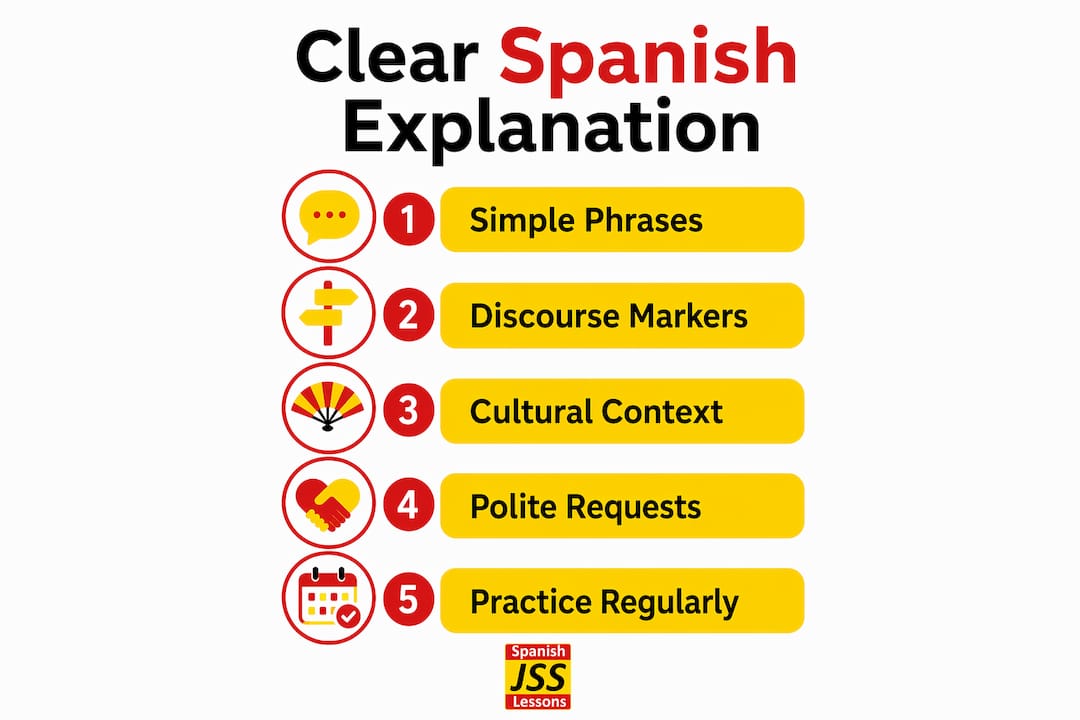
Knowing a handful of reliable phrases gives you real power in conversation. Here are the most useful ones, grouped by situation:
Formal or professional settings:
- Necesito una explicación clara, por favor. (I need a clear explanation, please.)
- ¿Podría explicármelo de otra manera? (Could you explain it to me another way?)
- ¿Me puede aclarar eso? (Can you clarify that for me?)
Everyday and informal settings:
- ¿Puedes explicar eso? (Can you explain that?)
- No lo entiendo. ¿Puedes repetirlo? (I don’t understand. Can you repeat it?)
- ¿Me aclaras eso? (Can you clear that up for me?)
The phrase “¿Me aclaras eso?” is particularly natural in everyday speech. It uses the verb aclarar (to clarify), which implies something was unclear before. Native speakers use it constantly, and it signals that you are engaged rather than lost.
Adding “por favor” to any of these phrases increases politeness without weakening the request. “Necesito una explicación más clara, por favor” is a phrase that balances respect and directness perfectly. Spanish culture values courtesy in communication, and this small addition goes a long way.
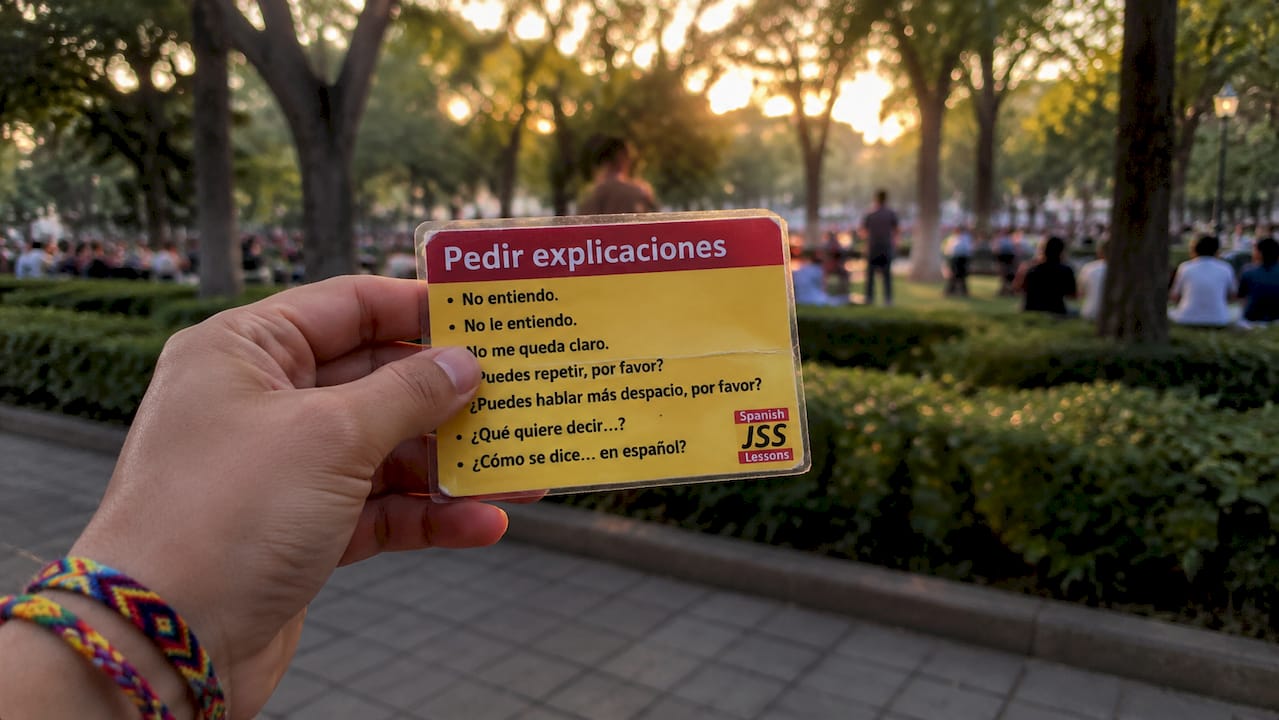
Pro Tip: Write three of these phrases on a card and keep it in your wallet for the first few weeks in Spain. Pulling it out is not a sign of weakness. Locals find it charming and will slow down immediately.
How do discourse markers like “es decir” and “es que” make explanations clearer?
Discourse markers are short phrases that signal what is coming next in a sentence. They are the connective tissue of natural speech, and Spanish uses them constantly. Learning them is one of the fastest ways to sound more fluent and to follow what others are saying.
“Es decir”: the “in other words” signal
“Es decir” functions as “in other words” in English. It tells the listener that a restatement or clarification is about to follow. Native speakers use it to rephrase something they feel was not clear the first time.
For example: El tren llega tarde. Es decir, no llegaremos a tiempo. (The train is late. In other words, we won’t arrive on time.)
This marker is valuable for learners in two ways. First, when you hear it, you know a simpler version of the previous sentence is coming. Second, when you use it yourself, you buy time to rephrase something you said badly. It makes explanations more accessible and helps you sound natural even with limited vocabulary.
“Es que”: the explanation softener
“Es que” acts as a bridge to further detail or justification in conversation. It softens what follows and signals that an explanation is coming. A rough English equivalent is “the thing is…” or “it’s just that…”
For example: No puedo venir. Es que tengo mucho trabajo. (I can’t come. The thing is, I have a lot of work.)
Used correctly, es que makes your Spanish sound far more natural. It is especially useful when you need to explain a situation without sounding blunt or abrupt.
Here is a quick comparison of how these two markers function differently:
- Es decir = restates or clarifies what was just said
- Es que = introduces a reason or justification for what was just said
Both markers help listeners follow your meaning without needing perfect grammar from you. They are the kind of tools that practical Spanish tips always recommend for real-life fluency.
Pro Tip: Listen for “es decir” and “es que” in Spanish television programmes or radio. You will hear them dozens of times per hour. Each time you spot one, you are training your ear to follow the structure of natural speech.
What strategies help simplify complex Spanish explanations?
Asking for a simpler explanation is a skill. Done well, it keeps the conversation moving. Done badly, it can feel rude or cause the other person to shut down. The key is combining the right phrase with the right tone.
The phrase “¿Puedes hacerlo más fácil de entender?” translates as “Can you make it easier to understand?” It is direct, friendly, and works in almost any informal setting. For a more formal version, ¿Podría simplificarlo un poco? (Could you simplify it a little?) adds the conditional tense for extra politeness.
Practical strategies for requesting simpler explanations:
- Ask for slower speech: ¿Puedes hablar más despacio, por favor? (Can you speak more slowly, please?)
- Request a repetition: ¿Puedes repetirlo? (Can you repeat it?)
- Ask for a simpler word: ¿Hay una palabra más sencilla? (Is there a simpler word?)
- Confirm your understanding: Entonces, ¿quieres decir que…? (So, do you mean that…?)
Cultural context matters here. Spanish speakers, particularly in Spain, tend to be direct communicators. Asking for clarity is not considered rude. Language experts advise that proactive clarification requests are a sign of serious engagement and actually accelerate learning. Locals respect the effort.
One nuance worth knowing: the words claro, claramente, and obviamente are not interchangeable. “Claro” often functions as a polite filler meaning “of course,” while claramente and obviamente carry stronger meanings of certainty or obviousness. Using obviamente where claro was expected can sound dismissive. Recognising these differences helps you use clarity expressions naturally rather than accidentally causing offence.
How can learners apply these techniques in real conversations?
Clear communication in Spanish is a habit, not a one-off skill. The learners who progress fastest are those who build clarity requests into every conversation from day one. Here is a practical sequence for doing exactly that:
- Start every new conversation ready to ask. Before speaking with a native speaker, remind yourself of two or three phrases you can use if you get lost. Having them ready removes the panic that causes learners to freeze.
- Use discourse markers when you speak. Dropping es decir into your own sentences signals to the listener that you are about to clarify yourself. This buys you a moment to find the right word and keeps the conversation flowing naturally.
- Confirm understanding before moving on. After a complex exchange, use Entonces, ¿quieres decir que…? to check your interpretation. This prevents misunderstandings from compounding over the course of a conversation.
- Practise in low-stakes settings first. Conversations with shop staff, market traders, and café workers are ideal. These exchanges are short, predictable, and forgiving. They are the perfect training ground for Spanish small talk and clarity techniques alike.
- Review and repeat. After each conversation, note which phrases you used and which ones you needed but could not recall. Revisit those phrases before your next outing. Repetition is what moves vocabulary from your notes into your mouth.
Confidence grows directly from clarity. Every time you successfully ask for and receive a clear explanation in Spanish, you prove to yourself that the language is manageable. That proof compounds over time. James Spanish School builds this principle into its 100-lesson course, pairing sentence-building with ear-tuning so that learners can both produce and follow clear Spanish in real time.
Key takeaways
A clear Spanish explanation relies on a small set of practical phrases, two key discourse markers, and the cultural confidence to ask for help when needed.
| Point | Details |
|---|---|
| Core request phrase | “Necesito una explicación clara” is the most direct and widely understood phrase for requesting clarity. |
| Politeness booster | Adding “por favor” to any request increases courtesy without reducing directness. |
| Discourse marker: es decir | Use “es decir” to signal a restatement or clarification, both when speaking and when listening. |
| Discourse marker: es que | Use “es que” to introduce a reason or justification, making speech sound natural and unhurried. |
| Confidence through practice | Asking for clarity is respected in Spanish culture and accelerates learning when done consistently. |
How James Spanish School supports clear Spanish communication
James Spanish School was built around one idea: Spanish explained in plain English, without the grammar jargon that trips up adult learners. The 100-lesson course covers both sentence construction and ear-tuning, so learners can follow fast native speech as well as produce it. The WordAmigo system uses strategic repetition to lock vocabulary and pronunciation into long-term memory, addressing the two frustrations that most adult learners share.
Every lesson is available on demand, 24/7, with no expiry date and no countdown pressure. James Bretherton, a dual-native speaker with 40 years of living in Spain, brings real cultural insight into every module, from how to ask a neighbour for help to navigating a conversation with a health worker. If you are ready to communicate clearly and confidently in European Spanish, the full course range is the practical next step.
FAQ
What does “clear Spanish explanation” mean for learners?
A clear Spanish explanation uses simple vocabulary, short sentences, and natural markers like es decir to make meaning easy to follow. It is the opposite of grammar-heavy instruction that leaves beginners more confused.
What is the best phrase to ask for a simpler explanation in Spanish?
“Necesito una explicación clara, por favor” is the most recommended phrase for learners. It is polite, direct, and understood immediately by any native speaker.
How does “es decir” help with understanding Spanish?
“Es decir” signals that a restatement or simpler version of the previous sentence is coming. Hearing it tells you to listen carefully for the clearer version of what was just said.
Is asking for clarification considered rude in Spain?
Asking for clarity is a sign of serious engagement in Spanish culture. Language experts confirm that proactive clarification requests are respected and actually speed up the learning process.
What is the difference between “claro” and “claramente”?
“Claro” is a polite filler meaning “of course,” while “claramente” means “clearly” with a stronger sense of certainty. Using them interchangeably can change the tone of a sentence significantly.