

What is 24/7 language learning
TL;DR:
- 24/7 language learning allows adults to study a new language anytime using on-demand tools and spaced repetition. It reduces social anxiety and boosts confidence by providing a judgment-free, flexible environment tailored to daily routines. Combining consistent practice with human interaction accelerates fluency and improves spontaneous language use.
24/7 language learning is a method of language acquisition that lets you study a new language at any hour, on any day, fitting practice around your life rather than the other way round. The formal term in applied linguistics is continuous self-directed learning, though most learners simply call it flexible or on-demand study. What makes it powerful is not the technology alone. It is the combination of consistent daily exposure, spaced repetition systems, and a low-pressure environment that removes the social anxiety blocking so many adult learners. James Spanish School is built on exactly this model: every lesson is available on demand, 24/7, with no expiry date and no countdown clock pressuring you to perform.
How does 24/7 language learning use technology to enable continuous study?
The engine room of around the clock language study is the spaced repetition system, or SRS. An SRS schedules vocabulary reviews at the precise moment your memory is about to forget a word, reinforcing it just in time. Modern algorithms such as FSRS are empirically more effective than older methods like SM-2, and research shows that maintaining hundreds of words requires as little as 15 minutes of daily review when the scheduling is done correctly. That figure matters because it means fluency is not reserved for people with hours to spare each day.

AI-powered tools extend this further by adapting to your level in real time. Adaptive AI tutors can adjust exercise difficulty, send proactive reminders, and personalise your study plan based on what you got wrong yesterday. This is a significant shift from fixed textbook curricula, which treat every learner as identical. The result is a study session that feels relevant rather than generic.
Mobile access is the third pillar. When your lessons live on your phone, you can practise Spanish vocabulary during a commute, revisit a sentence-building exercise before bed, or replay an audio drill while cooking. James Spanish School’s mobile Spanish learning approach is built around exactly this kind of flexible, anywhere access. The course works equally well on a phone, tablet, or laptop, with no software to install.
Key technology features that make 24/7 study work:
- Spaced repetition scheduling using algorithms like FSRS to time reviews optimally
- AI-generated adaptive exercises that match your current level and flag weak areas
- Instant feedback on answers, so errors are corrected before they become habits
- Push notifications and reminders that keep daily practice consistent without nagging
- On-demand audio and video that replicate the listening experience of real conversation
Pro Tip: Set a fixed 15-minute slot each morning for vocabulary review. Pairing a spaced repetition session with an existing habit, such as your first coffee, builds the daily routine that produces real retention.
What psychological benefits make 24/7 language learning effective?
Fear of making mistakes is the single biggest barrier to language mastery for adult learners. In a classroom or conversation group, every error feels public. That social pressure causes learners to stay silent, avoid complex sentences, and ultimately plateau well below their potential. AI practice environments remove that pressure entirely. You can mispronounce a word, construct a broken sentence, or forget a verb ending without anyone raising an eyebrow.
“Fear of mistakes is a major barrier to language mastery. 24/7 AI tools reduce this fear by providing a non-judgemental environment for learners, encouraging practice and mistakes as part of learning.”
This matters more for adult learners than for children. Children acquire language through relentless trial and error, completely unbothered by being wrong. Adults carry years of self-consciousness into the classroom. A private, on-demand study environment gives adults back the same freedom children have naturally, which is why mistake-friendly practice produces faster real-world gains than formal correction-heavy instruction.
Confidence builds through small, repeated wins. Completing a short lesson at 10 PM, recalling a word you reviewed yesterday, or understanding a sentence you would have missed a week ago, each of these moments reinforces the belief that progress is real. That belief sustains motivation far better than a weekly class where progress is harder to see.
Psychological benefits that continuous, flexible study supports:
- Reduced anxiety through private, judgement-free practice sessions
- Stronger motivation from visible daily progress rather than infrequent milestones
- Greater willingness to experiment with new vocabulary and sentence structures
- Habit formation that makes practice feel automatic rather than effortful
- Confidence transfer from private AI practice to real conversations with native speakers
Which study routines optimise 24/7 language learning results?
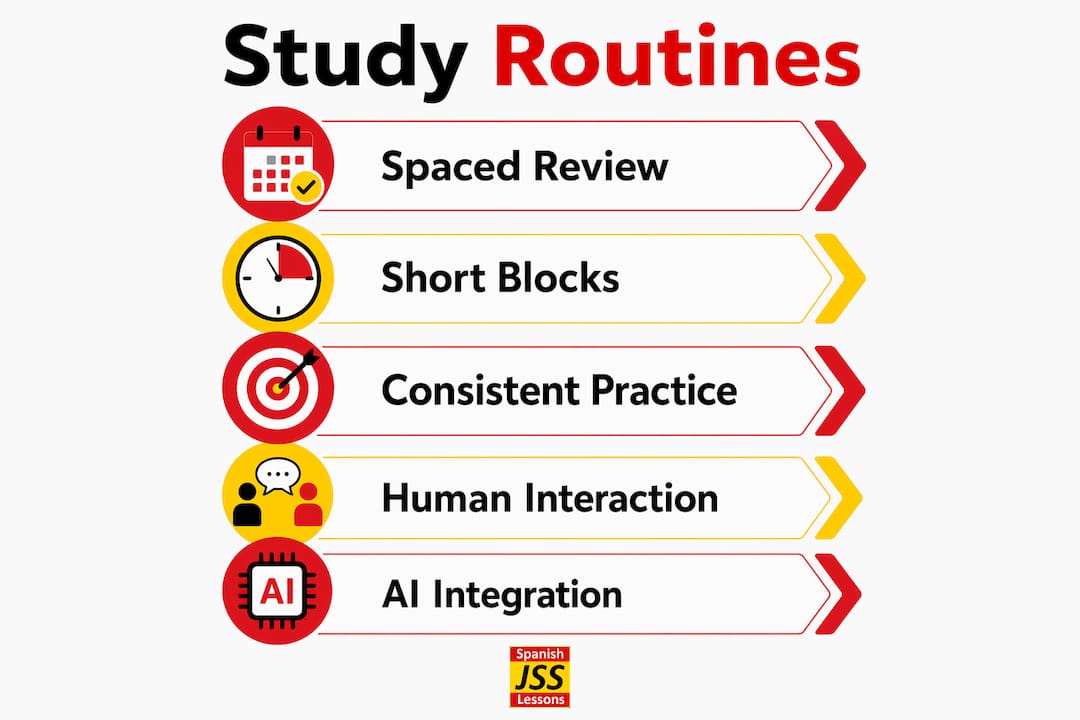
Consistency beats intensity. Daily practice of 30–60 minutes produces better language acquisition than a three-hour session once a week, because the brain builds neuro-cognitive habits through repetition over time, not through volume in a single sitting. This is not a motivational claim. It is confirmed by second language acquisition research and by the experience of polyglots who treat language learning as a daily discipline rather than an occasional effort.
The most effective daily routine combines three distinct activities, each serving a different cognitive function.
- Vocabulary review with spaced repetition (10–15 minutes). Use an SRS tool to work through your scheduled cards. Active recall, where you retrieve the word before seeing the answer, outperforms passive review such as re-reading a word list. The FSRS algorithm ensures you only review words that need reinforcement, so no time is wasted on vocabulary you already know solidly.
- Sentence-building practice (15–20 minutes). Work through structured sentence exercises that teach you how the language is assembled, not just what individual words mean. James Spanish School’s 100-lesson course dedicates half its content to this, using plain English explanations rather than grammar terminology. Understanding the structure of a sentence is what lets you generate new sentences spontaneously, rather than reciting memorised phrases.
- Ear-tuning listening (10–15 minutes). Replay audio at native speed. The goal is not to understand every word immediately. The goal is to train your ear to parse the rhythm, speed, and sound patterns of real speech. Native speakers do not slow down for learners, and the earlier you expose yourself to natural pace, the faster your comprehension develops.
| Study block | Duration | Primary benefit |
|---|---|---|
| Spaced repetition review | 10–15 minutes | Long-term vocabulary retention |
| Sentence-building exercises | 15–20 minutes | Spontaneous sentence generation |
| Ear-tuning audio | 10–15 minutes | Listening comprehension at native speed |
| Total daily commitment | 35–50 minutes | Consistent habit formation |
Chunking study time into these three shorter blocks also prevents cognitive fatigue. A single 45-minute session of mixed activity keeps focus sharper than 45 minutes of one task. For memorising Spanish vocabulary specifically, the combination of active recall and spaced scheduling is the most reliable method available.
How do you combine 24/7 learning with human interaction for real fluency?
AI tools are practice partners, not complete teachers. Best learning outcomes occur when AI drills are combined with real conversations, reading materials, and community involvement. This is the critical distinction between building a vocabulary and actually becoming fluent. Fluency requires the ability to respond spontaneously, read social cues, and handle the unpredictable direction of a real conversation. No AI replicates that fully.
Combining AI with human conversation accelerates communicative confidence and helps learners use language spontaneously rather than retrieving rehearsed phrases. The practical approach is to use your 24/7 tools to build the raw material, then deploy that material in real interactions. Think of it as rehearsing privately before performing publicly.
Ways to integrate human interaction with continuous digital study:
- Language exchange partners for weekly conversation practice in both directions
- Structured online lessons with a qualified tutor for targeted correction and feedback
- Reading authentic materials such as Spanish news sites, menus, or local notices
- Listening to native-speed podcasts or Spanish radio to extend ear-tuning beyond lesson time
- Joining expat or learner communities where Spanish is used in low-stakes social contexts
A Spanish conversation practice routine that pairs digital study with real speaking opportunities is the fastest route to genuine fluency. The 24/7 tools handle the volume and consistency. Human interaction handles the spontaneity and cultural nuance that no algorithm fully captures.
Pro Tip: After each AI study session, write two or three sentences in Spanish using the vocabulary you just reviewed. Send them to a language partner for quick feedback. This bridges private practice and real communication in under five minutes.
A well-structured Spanish practice workflow maps out exactly how to sequence AI tools, listening practice, and human conversation for maximum efficiency. The sequence matters as much as the individual components.
James Spanish School: structured learning for 24/7 learners
James Spanish School is built for English-speaking adults who want to learn Spanish at their own pace, without grammar jargon or classroom pressure.
The 100-lesson course is available on demand, every hour of every day, on any device. Half the lessons focus on sentence-building using plain English logic. The other half develop your ear for fast, natural Spanish speech. The WordAmigo system adds an AI-powered vocabulary and pronunciation layer, using strategic repetition to embed words permanently rather than temporarily. There is no expiry date, no countdown clock, and a cast-iron guarantee: if a core lesson teaches you nothing new, James credits you with extra practice modules at no cost. For adult learners who want structured, flexible, and genuinely useful Spanish, this is where to begin.
FAQ
What is 24/7 language learning?
24/7 language learning, formally known as continuous self-directed learning, is a method that lets you study a new language at any time using on-demand digital tools, spaced repetition systems, and AI-powered practice. It prioritises daily consistency over fixed class schedules.
How much time do I need each day for 24/7 language study?
Daily practice of 30–60 minutes is more effective than longer but infrequent sessions. Research in second language acquisition confirms that regularity builds the neuro-cognitive habits that produce lasting fluency.
Does AI replace a human tutor in 24/7 language learning?
AI tools act as practice partners, not complete teachers. Real fluency develops when AI drills are combined with human conversation, reading, and community involvement, as confirmed by language learning research.
Can spaced repetition really improve vocabulary retention?
Spaced repetition algorithms like FSRS schedule reviews at the optimal moment before forgetting occurs, enabling learners to maintain hundreds of words with as little as 15 minutes of daily review.
Is 24/7 language learning suitable for adult beginners?
Adult beginners benefit particularly from 24/7 on-demand study because it removes the social pressure of classroom errors, allows unlimited repetition of difficult material, and fits around work and family commitments.
Key takeaways
24/7 language learning works because daily consistency, spaced repetition, and a judgement-free practice environment combine to build fluency faster than any fixed-schedule classroom method.
| Point | Details |
|---|---|
| Consistency over intensity | Daily sessions of 30–60 minutes outperform longer, infrequent study for language acquisition. |
| Spaced repetition is essential | Algorithms like FSRS schedule reviews optimally, enabling retention of hundreds of words with minimal daily time. |
| Fear reduction accelerates progress | Private AI practice removes social pressure, encouraging the trial and error that fluency requires. |
| Human interaction completes fluency | AI tools build vocabulary and confidence, but real conversation is needed for spontaneous, natural speech. |
| Structure matters within flexibility | Chunking study into vocabulary review, sentence-building, and ear-tuning produces better results than unplanned practice. |