

TL;DR:
- Talking to Spanish neighbors requires respectful greetings and understanding social norms. Building rapport through small talk and face-to-face conversations is essential for effective communication. Proper formality and polite language help foster trust and goodwill in Spanish communities.
Knowing how to talk to Spanish neighbours is the single most useful social skill you can build as an English speaker living in Spain. The foundation is not perfect grammar. It is respectful greetings, the right level of formality, and an understanding of the unwritten social rules that Spanish communities run on. Greeting neighbours with “buenos días” or “hola” is a fundamental social expectation in Spain. Skipping that greeting in a shared hallway or lift is read as cold or dismissive, not neutral. James Spanish School was built precisely for this reality: real conversations with real neighbours, not academic exercises.
What key Spanish phrases should you learn for neighbourly conversations?
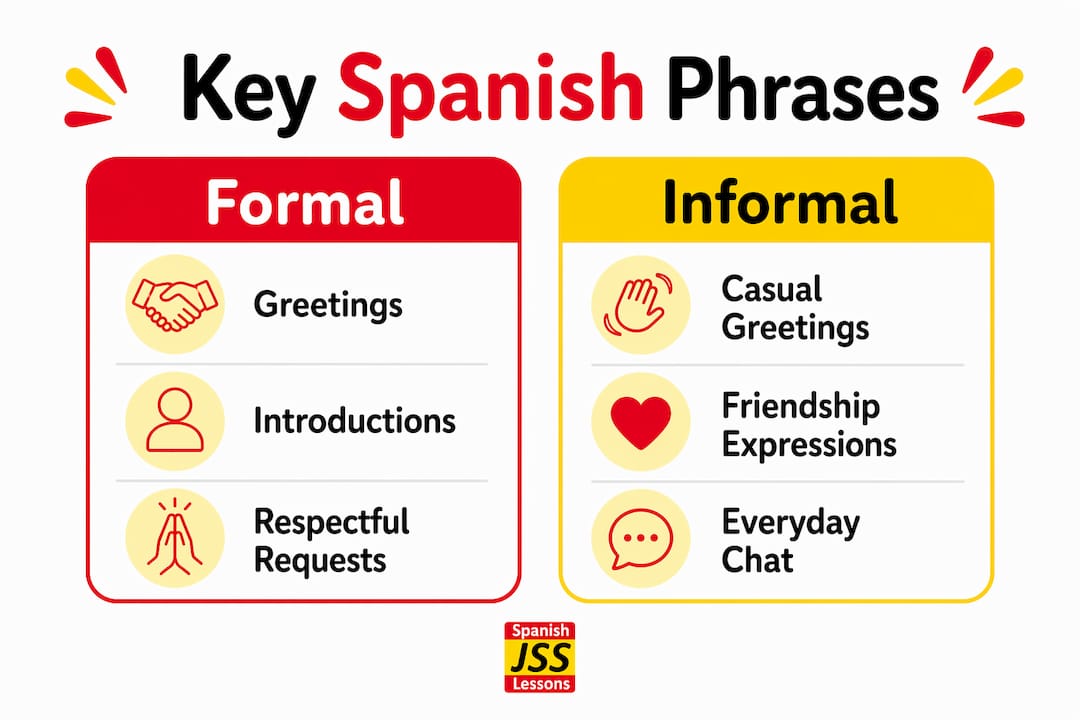
The most effective starting point for communicating with Spanish neighbours is a small set of reliable phrases. You do not need hundreds of words. You need the right ones, delivered with confidence and the correct level of politeness.
Greetings and introductions
Start with these every time:
- “Hola, buenos días / buenas tardes” — Hello, good morning / good afternoon
- “Me llamo…” — My name is…
- “Acabo de mudarme aquí” — I have just moved in here
- “Encantado/a de conocerte” — Pleased to meet you
- “Soy inglés/inglesa” — I am English
These phrases cover your first week of interactions. They signal friendliness and effort, which counts for a great deal.
Asking for help politely
Polite requests require a softening phrase before the actual ask. Spanish speakers value indirect, courteous language. The conditional form signals respect even when your Spanish is basic.
- “¿Podría ayudarme, por favor?” — Could you help me, please?
- “¿Sabe usted dónde está…?” — Do you know where… is? (formal)
- “¿Tienes un momento?” — Do you have a moment? (informal)
- “Lo siento, no hablo mucho español” — I am sorry, I do not speak much Spanish
- “¿Puede hablar más despacio, por favor?” — Can you speak more slowly, please?
Formal versus informal: “usted” and “tú”
Pronoun use in Spanish directly signals respect or familiarity. Use “usted” with older neighbours, people you have just met, or anyone in a position of authority. Use “tú” with neighbours your own age or younger, once a friendly rapport is established. Getting this wrong rarely causes offence, but getting it right earns genuine respect.
Pro Tip: When in doubt, start with “usted.” Your neighbour will almost certainly invite you to use “tú” if they prefer it, and that invitation itself builds warmth.
Short dialogues build confidence faster than vocabulary lists. Practise saying “Hola, ¿cómo está usted?” (formal) or “Hola, ¿cómo estás?” (informal) until it feels automatic. That single exchange opens every door.
How do Spanish cultural norms shape neighbour communication?
Language is only half the picture. Spanish neighbourhood culture has its own unwritten rules, and understanding them changes everything about how your conversations land.
Small talk is a prerequisite before any practical request in Spain. Asking a neighbour to turn down their music without first asking how they are feels abrupt and rude. A brief exchange about the weather, the local market, or a recent fiesta is not wasted time. It is the social currency that makes the actual request acceptable.
“Building rapport through small talk is a prerequisite for successful requests and neighbourly trust in Spain. Active participation in local traditions often does more for social integration than language perfection alone.”
Face-to-face conversation is the expected format for resolving any issue. Notes left under doors are perceived as cold or even passive-aggressive in Spanish culture. If something needs addressing, knock on the door. That single act of showing up in person signals that you respect the relationship enough to have a real conversation.
Key cultural habits worth knowing:
- Participate in local fiestas and community events. Active social involvement overcomes language barriers faster than any phrase book.
- Recognise the role of the “presidente de la comunidad.” This is the elected building representative who manages shared spaces and resolves disputes. Knowing who this person is, and greeting them regularly, puts you in good standing.
- Match your tone to the moment. Formal language in a tense situation signals respect. Casual language too early can feel presumptuous.
- Never rush a conversation. Spanish social exchanges have a natural pace. Cutting them short reads as disinterest.
Spanish cultural habits for expats go deeper than language. The social architecture of a Spanish community rewards patience, presence, and genuine warmth.
What is the best way to approach sensitive topics like noise?
Noise is the most common source of friction between neighbours in Spain. The good news is that indirect, apologetic language prevents most disputes from escalating, provided you handle the conversation face to face.
Follow this sequence when addressing a noise issue:
- Choose the right moment. Knock during the day, not late at night. Catching someone at a bad time makes the conversation harder before it starts.
- Open with a polite phrase. “Perdón, ¿tienes un momento?” (Sorry, do you have a moment?) signals that you are not there to confront, but to talk.
- Acknowledge the inconvenience of raising it. “Siento molestar” (I am sorry to bother you) softens the opening and shows empathy.
- State the issue indirectly. “Es que el sonido llega bastante a mi piso” (It is just that the sound carries quite a lot to my flat) is far less confrontational than “You are too loud.”
- Make a collaborative request. “¿Crees que sería posible…?” (Do you think it might be possible to…?) invites cooperation rather than demanding compliance.
- Thank them warmly. “Muchas gracias, te lo agradezco mucho” (Thank you very much, I really appreciate it) closes the exchange on a positive note.
Tone matters more than grammar in these moments. A respectful, apologetic delivery with basic Spanish will resolve most issues. A blunt demand in perfect Spanish will not.
Pro Tip: If the issue continues after one conversation, speak to the “presidente de la comunidad” rather than returning to the neighbour directly. This keeps the relationship intact and puts the resolution in the right hands.
Avoid written notes entirely unless the neighbour has already communicated with you in writing. The Spanish preference for face-to-face contact is not just cultural preference. It is the method most likely to produce a good outcome.
What practical steps help English speakers build conversation skills?
Preparation makes every neighbourly exchange easier. The gap between knowing a phrase and using it confidently under pressure is closed by practice, not by reading alone.
| Preparation step | Why it works |
|---|---|
| Learn foundational phrases from a structured course | Gives you reliable language you can use without hesitation |
| Use audio lessons for pronunciation | Trains your ear to follow fast spoken Spanish, not just textbook speech |
| Practise role-play dialogues | Builds the muscle memory needed for real-time conversation |
| Study local customs and regional expressions | Prevents cultural misunderstandings that language alone cannot fix |
| Carry valid photo ID at all times | Expats in Spain are legally required to carry ID, and it smooths administrative and social situations |
The biggest mistake English speakers make is preparing vocabulary without preparing their ear. Native Spanish speakers talk fast. Very fast. James Spanish School addresses this directly through “ear-tuning” lessons that train you to follow the machine-gun speed of natural conversation, not just the slow, clear speech of a classroom recording.
Mastering Spanish small talk is the single most practical skill you can build for daily life in Spain. It covers the weather, the local area, family, and weekend plans. These topics come up every single day in a Spanish community. Knowing how to navigate them confidently changes your entire experience of living there.
The WordAmigo system from James Spanish School uses strategic repetition to permanently embed vocabulary and pronunciation. It was built specifically by IT experts and long-time English expats who understood the exact frustrations of adult learners: words that will not stay in memory, and pronunciation that native speakers struggle to follow. That combination of structured learning and cultural insight is what separates useful preparation from generic study.
James Spanish School: Spanish for real life in Spain
Real neighbourly Spanish is not taught in most language courses. James Spanish School was built for exactly this situation: everyday conversations with neighbours, tradesmen, shop staff, and local officials.
The 100-lesson course covers sentence-building and ear-tuning, so you can both speak and follow replies. The WordAmigo system locks vocabulary and pronunciation into long-term memory through a five-step retention loop. You can access everything on demand, on any device, with no expiry date and no pressure. If you are ready to speak to your neighbours with confidence, the James Spanish School course gives you the phrases, the pronunciation, and the cultural knowledge to do it well.
FAQ
What is the most important phrase for greeting Spanish neighbours?
“Buenos días” (good morning) or “hola” (hello) are the essential greetings. Failing to acknowledge neighbours in shared spaces is perceived as impolite in Spain.
Should I use “usted” or “tú” with my neighbours?
Use “usted” with older neighbours or those you have just met, and switch to “tú” only once they invite it. Starting formal is always the safer and more respectful choice.
How do I raise a noise complaint with a Spanish neighbour?
Knock on their door during the day, open with “Perdón, ¿tienes un momento?”, and express the issue indirectly. Face-to-face conversation is far more effective than leaving a note.
Do I need to speak perfect Spanish to get on with my neighbours?
No. Respectful tone and formal language matter more than flawless grammar. Basic phrases delivered politely build more goodwill than perfect sentences delivered bluntly.
What role does the “presidente de la comunidad” play?
The “presidente de la comunidad” is the elected representative who manages shared building matters. Building a good relationship with this person is one of the most practical steps any expat can take.
Key takeaways
Communicating with Spanish neighbours requires respectful greetings, the correct level of formality, and a cultural understanding that values face-to-face conversation and small talk above all else.
| Point | Details |
|---|---|
| Greet every time | Saying “hola” or “buenos días” in shared spaces is a social expectation, not optional. |
| Match your formality | Use “usted” with older or unfamiliar neighbours; switch to “tú” only when invited. |
| Small talk comes first | Build rapport before making any request; skipping it reads as rude in Spanish culture. |
| Go face to face | Address sensitive issues in person; notes are seen as cold or passive-aggressive. |
| Tone beats grammar | Respectful, indirect language resolves conflicts more effectively than perfect Spanish. |