

TL;DR:
- Adult language learning benefits from their ability to analyze grammar, making deliberate practice more effective. Motivation, especially personal and emotional, drives adult fluency more than age or aptitude alone. Active speaking, writing, and daily habits are essential for progress beyond passive listening or watching.
The role of adults in language learning is defined by active cognitive engagement, personal motivation, and deliberate practice. Adult learners, known in language acquisition research as post-critical-period learners, bring a distinct set of strengths to the task. They use pattern recognition, logical reasoning, and life experience to process new language efficiently. Understanding how these strengths work, and where adults typically stumble, is the clearest path to real progress in Spanish or any other language.
How do adult cognitive abilities shape language learning?
Adults outperform children initially in vocabulary, reading, and writing. That finding surprises many learners who assume children are simply better at languages across the board. The truth is more specific. Children hold an advantage in pronunciation and accent acquisition, particularly before puberty. Adults hold the advantage everywhere else, at least in the early and intermediate stages.

The reason lies in metalinguistic awareness. Adults analyse grammar and language patterns consciously, a skill children do not yet possess. This means an adult can read a grammar rule, understand its logic, and apply it deliberately. A child absorbs the same rule unconsciously over months of exposure. For adults with limited time, conscious analysis is a genuine shortcut.
Research confirms that a balanced instructional approach, combining 50–60% explicit grammar with 40–50% communicative interaction, produces the best outcomes for adult learners. Pure grammar drilling and purely conversational methods each fall short on their own. The adult brain needs both the structural logic and the live practice to make language stick.
| Learner type | Strengths | Typical challenges |
|---|---|---|
| Adult learner | Vocabulary, grammar analysis, reading, writing | Accent reduction, spontaneous speech |
| Child learner | Accent acquisition, native-like pronunciation | Explicit rule learning, abstract grammar |
Pro Tip: Do not chase a native accent. Adults can master vocabulary and grammar to a high level. Communicative competence, being understood clearly, is a far more achievable and practical goal.
What motivational factors influence adults’ success in language learning?
Motivation influences adult fluency more than age or natural aptitude alone. Learners with a strong personal connection to the language sustain effort through difficulty and reach higher proficiency. That connection might be a move to Spain, a Spanish-speaking family member, or simply the desire to hold a real conversation with a neighbour. The specific reason matters less than its depth.
“The willingness to communicate despite mistakes is the primary factor distinguishing successful adult language learners. Fear of appearing foolish, not lack of ability, is what holds most adults back.”
The emotional dimension of adult learning is often underestimated. Adults carry social awareness that children do not. They worry about sounding foolish, making errors in front of others, or being judged. This self-consciousness is the largest barrier adults face, and it is emotional rather than cognitive.
Several motivational factors consistently predict adult success:
- Personal purpose. A concrete reason to learn, such as living in Spain, creates sustained drive that survives the inevitable difficult weeks.
- Emotional connection. Caring about the culture, the people, or the place makes vocabulary and phrases memorable rather than abstract.
- Active engagement. Learners who produce language, speak, write, and respond, progress faster than those who only consume it.
- Realistic goals. Adults who target fluency and clear communication, rather than a perfect accent, maintain confidence longer.
- Social accountability. Practising with others, even informally, creates a commitment that solo study rarely matches.
The impact of adults on language skills is clearest when motivation is tied to real life. An expat who needs Spanish to visit the doctor or deal with a builder has a daily reminder of why the effort matters. That daily reminder is more powerful than any study schedule.
Why is active adult involvement essential beyond mere exposure?
Passive consumption of language media rarely leads to fluency. Active production bridges comprehension and speech in a way that listening alone cannot. Watching Spanish television or listening to podcasts builds familiarity with sounds and rhythm. It does not build the ability to construct and deliver sentences under pressure. That skill requires practice in producing language, not just receiving it.
Active mediation significantly boosts linguistic and communicative performance compared to passive exposure. The research is clear on this point. Adults who interact, respond, and produce language outperform those who rely on input alone. Passive methods create a ceiling. Active methods remove it.
Four practical steps move adult learners from passive to active engagement:
- Speak from day one. Even single words and short phrases count as production. Waiting until you feel “ready” delays the most important practice.
- Respond out loud. When listening to a lesson or audio, pause and answer questions aloud rather than mentally. This trains the speech production pathway.
- Seek real interaction. Conversations with native speakers, even brief ones, expose you to the machine-gun speed of natural replies and force genuine comprehension.
- Write regularly. Composing sentences in Spanish, even simple ones, reinforces grammar and vocabulary in a way reading never does.
Adults also benefit from scaffolded social interaction, similar to the Language Acquisition Support System that children receive from caregivers. For adults, this means structured conversation practice, guided feedback, and a learning environment that supports risk-taking. The best way to learn Spanish combines this scaffolding with consistent daily production. Understanding what active learning in language actually means in practice helps adult learners move beyond passive habits quickly.
How can adults overcome self-consciousness to improve language learning?
Emotional self-consciousness is the largest barrier for adults in language learning, greater than any cognitive limitation. Adults fear appearing foolish. That fear stops them speaking, and not speaking is the single fastest route to a fluency plateau. Recognising this pattern is the first step to breaking it.
Accepting mistakes as evidence of progress, rather than signs of failure, changes the entire experience of speaking a new language. Children learn without embarrassment because they have no social reputation to protect. Adults can replicate that freedom deliberately, by reframing errors as data rather than judgements.
Practical strategies that reduce self-consciousness and build speaking confidence include:
- Practise in low-stakes settings first. Talk to yourself in Spanish while cooking or walking. No audience means no performance anxiety.
- Use structured repetition. Systems like the WordAmigo method from James Spanish School use strategic repetition across reading, listening, speaking, and writing to build confidence before live conversation.
- Set a “mistakes quota.” Aim to make a certain number of errors each week. This reframes mistakes as targets rather than failures.
- Build a habit, not a marathon. Consistent, low-intensity practice beats intense, sporadic sessions. Short daily practice prevents the burnout that derails most adult learners.
- Find a community. Practising with others who are also learning removes the pressure of performing for native speakers. Shared struggle reduces anxiety.
Pro Tip: The willingness to communicate despite imperfection is what separates adults who reach fluency from those who stall. Practical techniques for speaking with confidence are learnable skills, not personality traits.
Habit formation embedded in daily routines strongly predicts long-term adult success. Ten minutes of Spanish over breakfast, a short audio lesson during a commute, or a brief written exercise before bed all count. The cumulative effect of small, consistent actions outperforms the occasional long study session every time. For practical techniques tailored to adult learners, a guide for adults on building these habits across different languages offers useful frameworks that transfer directly to Spanish.
Key takeaways
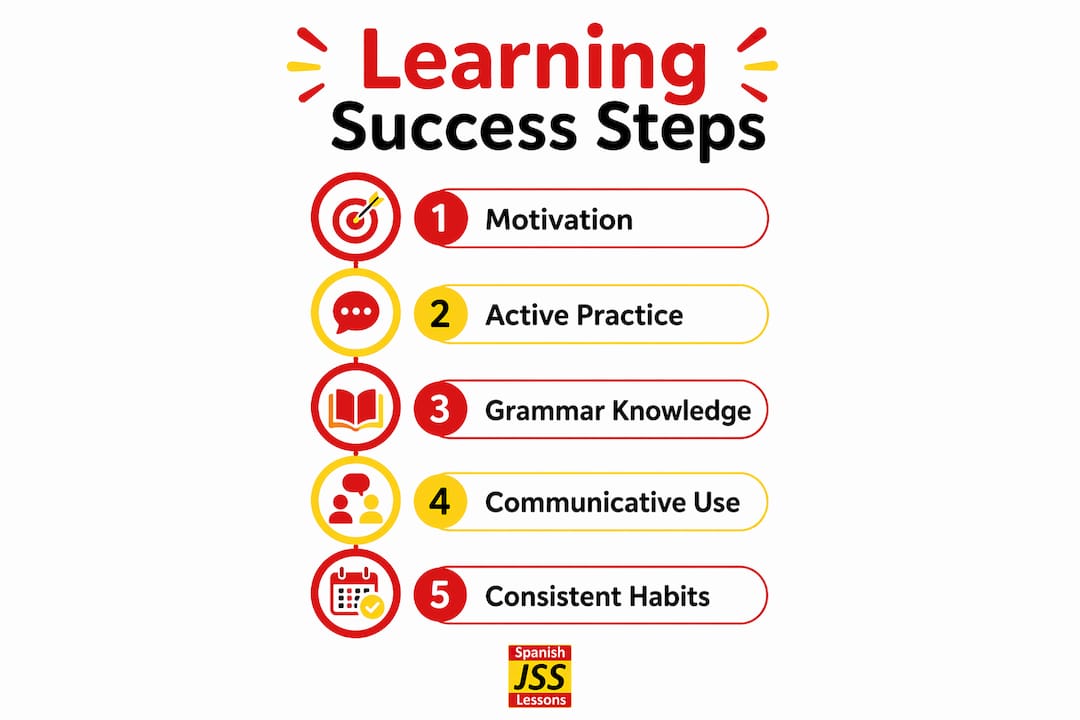
Adult language learning success depends on active production, personal motivation, and consistent daily habit rather than age or natural aptitude.
| Point | Details |
|---|---|
| Cognitive strengths are real | Adults outperform children in vocabulary, reading, and grammar analysis from the start. |
| Motivation drives fluency | A personal connection to the language sustains effort through difficulty and predicts higher proficiency. |
| Active production is non-negotiable | Speaking and writing regularly prevent fluency plateaus that passive listening cannot overcome. |
| Self-consciousness is the main barrier | Fear of mistakes, not lack of ability, is what most adult learners must address first. |
| Consistent habits beat intensity | Short, daily practice embedded in routine produces better long-term results than sporadic study sessions. |
How James Spanish School supports adult learners
Adults who understand their own learning strengths still need a course built around those strengths. James Spanish School was designed specifically for English-speaking adults, using a method called Radical Simplification that removes unnecessary grammar jargon and explains Spanish structure in plain English.

The 100-lesson course covers both sentence-building and ear-tuning, addressing the two areas where adult learners most often stall: constructing sentences quickly and following fast native speech. The WordAmigo system uses AI-powered strategic repetition to embed vocabulary and pronunciation permanently, solving the two frustrations that derail most adult learners. There is no countdown clock, no expiry date, and no pressure. You learn at your pace, on your device, whenever it suits you. Explore the full course range at the James Spanish School shop and find the programme that fits your life.
FAQ
Can adults really become fluent in a new language?
Adults retain the ability to learn new languages well into later life. With consistent active practice and strong personal motivation, fluency is a realistic and achievable goal.
Is age the main factor in adult language learning success?
Age is not the primary factor. Motivation and active engagement predict adult fluency more reliably than age or natural aptitude alone.
Why do adults struggle more with pronunciation than children?
Children acquire native-like accents more easily before puberty due to neurological flexibility. Adults can achieve clear, communicative pronunciation but are unlikely to eliminate their accent entirely, which is not a barrier to fluency.
How much time should adults practise each day?
Short, consistent daily sessions outperform long, infrequent ones. Even 15–20 minutes of active practice each day builds measurable progress over weeks and months.
What is the biggest mistake adult language learners make?
Relying on passive exposure, such as listening to podcasts or watching films without speaking or writing, is the most common mistake. Active production is what converts comprehension into real fluency.