

TL;DR:
- Mastering the Castilian Spanish accent involves practicing five pure vowels, syllable timing, and cultural fillers. Focused repetition of sounds and shadowing native speech help develop natural rhythm and pronunciation efficiently. Consistent use of regional fillers signals real fluency and cultural understanding.
Picking up an authentic European Spanish accent is a learnable skill built on targeted phonetic practice, cultural immersion, and deliberate muscle memory training. Linguists call this process accent acquisition, and the goal for learners heading to Spain is specifically the Castilian accent, the variety spoken across central and northern Spain. Knowing how to pick up Spanish accents the right way means focusing on vowel purity, sentence rhythm, and cultural speech patterns from day one. Shadowing, focused phonetics, and regional fillers are the three techniques most consistently backed by language experts in 2026.
What foundational sounds define the European Spanish accent?
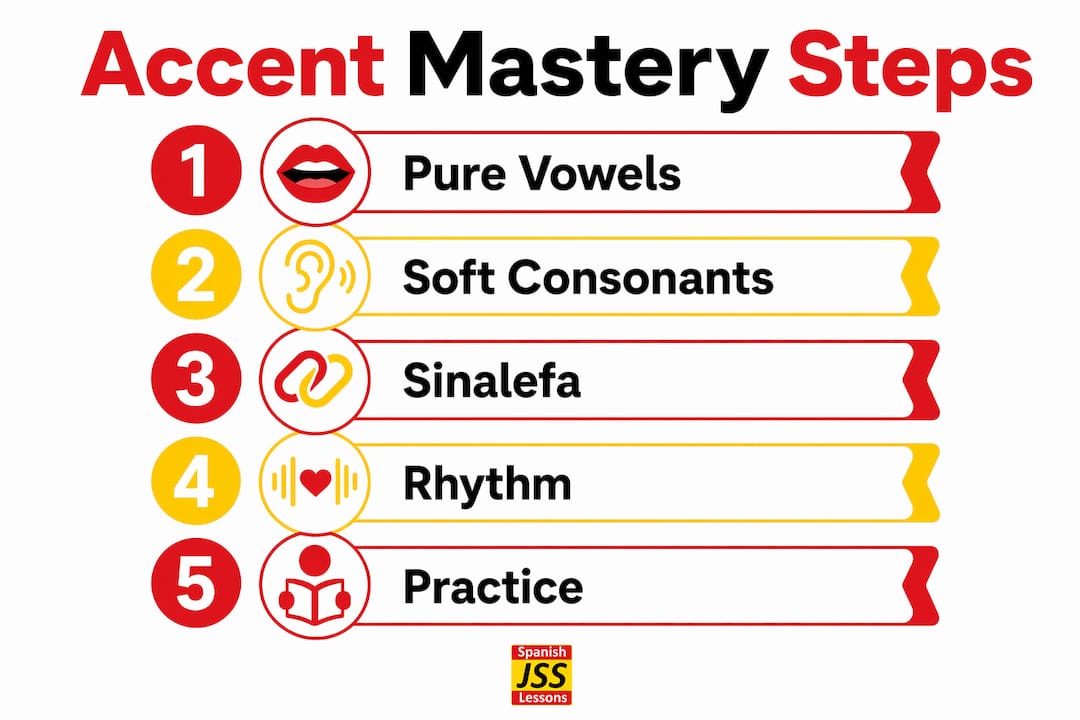
The Castilian accent rests on five pure vowel sounds, and pure vowel consistency is the foundation every linguistic expert agrees on before tackling complex features. In English, vowels shift and glide. In Spanish, each vowel stays fixed: “a” is always “ah”, “e” is always “eh”, and “i” is always “ee”. That consistency is what gives Spanish its clean, crisp sound.
Consonants matter just as much. The soft “d” in words like “cada” sounds closer to the “th” in “this” than the hard English “d”. The letter “c” before “e” or “i” produces the distinctive Castilian “th” sound, as in “gracias” pronounced “gra-thias”. This feature separates Castilian from Latin American Spanish and is one of the clearest markers of a European accent.
The rolled R and the tapped R are two separate sounds, and confusing them is one of the most common errors English speakers make. The rolled R is a muscle memory skill built by first mastering the softer tapped R, which sounds like the “tt” in the American English word “butter”. Practise minimal pairs, such as “pero” (but) versus “perro” (dog), to train your ear and tongue simultaneously.
The letter “h” is always silent in Spanish. “Hola” is “ola”. Pronouncing the “h” is an immediate giveaway of an English speaker. The letter “j” takes the opposite approach, producing a strong guttural sound from the back of the throat, as in “jamón”.
- Vowels: Keep all five vowels pure and short. Never glide them.
- Soft D: Practise the “th” sound in “this” and apply it to intervocalic “d” sounds.
- Castilian C/Z: Train the “th” sound for “c” before “e” or “i”, and for “z”.
- Tapped R first: Master the single tap before attempting the full roll.
- Silent H: Remove the “h” sound entirely from your muscle memory.
Pro Tip: Isolate one sound each week rather than trying to fix everything at once. Spend seven days on nothing but the soft “d”, then move to the Castilian “c”. Focused repetition builds the muscle memory that random practice never does.
How to adopt rhythm, intonation, and cultural speech patterns
Rhythm is where most English speakers fall apart. English is a stress-timed language, meaning stressed syllables arrive at regular intervals and unstressed syllables get squashed. Spanish is syllable-timed. Every syllable gets roughly equal weight and duration. Switching from stress timing to syllable timing is the single biggest shift you need to make to sound native in Spain.
Mastering “sinalefa” is the next step. Sinalefa connects vowels across words seamlessly, so “me encanta” flows as “men-can-ta” rather than two separate words. This vowel linking is often the biggest giveaway of a non-native speaker, yet most learners never practise it deliberately.
Shadowing is the most effective technique for absorbing rhythm and intonation together. Play a short clip of a native Spanish speaker, pause it, and repeat the phrase at the same speed and pitch. Do not translate. Mirror the melody. Active shadowing with 5–10 minutes of daily practice on targeted phonetic features is far more effective than unfocused immersion.
Cultural fillers are the finishing touch. Integrating regional fillers like “vale”, “pues”, “o sea”, “mira”, and “bueno” increases perceived native fluency significantly. These five words appear constantly in everyday Spanish conversation and signal that you understand how the language actually works, not just how it is written in textbooks.
- Use “vale” to confirm or agree, the way British English speakers use “right” or “okay”.
- Drop subject pronouns where context makes them clear. Say “voy” instead of “yo voy”.
- Use diminutives like “un momentito” to sound warmer and more natural.
- Adopt “pues” as a thinking pause instead of the English “um” or “er”.
- Avoid Latin American fillers like “órale” or “chévere” when speaking in Spain.
Pro Tip: Record yourself speaking for 60 seconds, then play a native speaker saying the same content. Compare the two recordings and note where your rhythm breaks down. Do this weekly and the gap closes faster than any other method.
What are the best tools and daily habits for accent acquisition?
The difference between passive and active listening is the difference between background noise and real progress. Passive listening, such as having Spanish radio on while cooking, builds familiarity but does not train your mouth. Active shadowing forces your brain and vocal muscles to work together.
| Technique | Strength | Limitation |
|---|---|---|
| Shadowing | Trains rhythm, speed, and intonation together | Requires focused attention; cannot be done passively |
| Transcription | Sharpens auditory discrimination between similar sounds | Time-consuming; best for short clips |
| Dictation | Connects listening with writing to reinforce phonetic patterns | Needs a reliable source of native-speed audio |
| Narration | Builds speaking confidence and fluency through self-directed speech | No external feedback without recording |
| Self-recording | Closes the gap between how you think you sound and how you actually sound | Requires honest self-assessment |
Practising with recordings and comparing them with native speakers closes the gap between learner and native accent more effectively than any other single habit. The key is regularity over duration. Five focused minutes daily beats one hour on a Sunday.
Stick to one regional accent. Focus strictly on Castilian to avoid mixing contradictory features like “ceceo” and “seseo”, which belong to different dialects and create confused, inconsistent speech. For a full breakdown of how regional accents differ, the complete regional accent guide at James Spanish School is worth reading before you commit to a target accent.
What common mistakes should English speakers watch for?
The most damaging mistake is trying to speak at high speed before mastering slow, precise syllable production. Authentic speed comes from slow, syllable-perfect practice built up over time. Rushing produces English-sounding errors that become habits. Slow down first. Speed follows naturally.
Here are the most frequent errors and how to correct them:
- Adding English glides to vowels. Say “no” in English and notice the vowel glides from “oh” to “oo”. In Spanish, “no” stays flat. Practise holding each vowel steady.
- Overpronouncing consonants. English speakers often hit consonants too hard. Spanish consonants are lighter. The “p” in “padre” has no puff of air behind it.
- Neglecting the tapped R. Most learners jump straight to the rolled R and fail. Build the tap first through words like “pero”, “cara”, and “hora”.
- Using the wrong regional slang. “Tío” and “tía” are Castilian. “Guay” means cool in Spain. Using Latin American slang in Madrid marks you as someone who learnt from the wrong source.
- Mixing dialect features. Castilian uses “vosotros” for the plural you. Latin American Spanish does not. Pick one system and stay with it.
- Ignoring sinalefa. Treating every word as a separate unit breaks the flow. Practise linking final vowels to opening vowels in the next word.
Building muscle memory takes repetition at slow speed. Practise Spanish pronunciation techniques with a structured approach rather than hoping exposure alone will fix ingrained habits.
Key takeaways
Picking up an authentic Castilian accent requires mastering five pure vowels, syllable timing, and cultural fillers before attempting speed or complex sounds.
| Point | Details |
|---|---|
| Vowel purity comes first | Keep all five Spanish vowels short and fixed; never glide them as you would in English. |
| Shadowing beats passive listening | Five to ten minutes of active shadowing daily outperforms hours of background exposure. |
| Sinalefa is the hidden key | Linking vowels across word boundaries is what separates natural-sounding speech from textbook Spanish. |
| Stick to one accent | Focus on Castilian exclusively to avoid mixing incompatible features from different dialects. |
| Cultural fillers signal fluency | Words like “vale”, “pues”, and “mira” signal genuine familiarity with how Spanish is actually spoken in Spain. |
Why accent is about identity, not imitation
Living in Spain for 40 years has taught me one thing above all else: the learners who sound most natural are never the ones who tried hardest to sound Spanish. They are the ones who listened most carefully and let the language settle into them gradually.
Accent acquisition, to use the proper linguistic term, is not about mimicking Spanish accents as a performance. It is about “accent agility”, adapting your rhythm, intonation, and fillers to fit your specific context in Spain. A retired teacher living in Salamanca needs different speech habits than a tradesman working in Valencia. The accent you build should reflect where you actually live and who you actually talk to.
The biggest trap I see English speakers fall into is chasing speed. They hear the machine-gun pace of a native conversation and assume that is the goal. Speed is a by-product of accuracy, not a target in itself. Slow down, get the sounds right, and the pace will come on its own within months.
Native speakers in Spain are genuinely appreciative of real effort. They notice when you use “vale” correctly, when your vowels stay clean, and when you do not mangle the Castilian “c”. They are far less bothered by a slight English accent than by someone who sounds like they are performing a caricature. Authenticity and cultural humility matter more than perfection.
— James
How James Spanish School can help you build a natural Spanish accent
Picking up a Castilian accent is far easier with structured guidance than with trial and error. James Spanish School was built specifically for English-speaking adults who want to speak Spanish as it is actually used in Spain, not the textbook version.

The 100-lesson course includes dedicated ear-tuning sessions designed to train you to hear and reproduce the sounds of real spoken Spanish. The WordAmigo system uses AI-powered repetition to embed pronunciation and vocabulary together, so the sounds you practise actually stick. James Bretherton, a dual-native speaker with 40 years in Spain, teaches you the cultural context alongside the phonetics. Explore the starter lessons and courses at James Spanish School to begin building your accent with a method designed around real life in Spain.
FAQ
What is the Castilian accent and why does it matter for Spain?
The Castilian accent is the variety of Spanish spoken across central and northern Spain, characterised by the distinctive “th” sound for “c” and “z”. Learners aiming to integrate in Spain should target this accent specifically rather than a generic or Latin American variety.
How long does it take to pick up a Spanish accent?
Consistent daily practice of 5–10 minutes on targeted sounds produces noticeable improvement within weeks. A natural-sounding accent typically develops over several months of structured, focused work.
What is sinalefa and why does it matter?
Sinalefa is the linking of a final vowel in one word to the opening vowel of the next, creating smooth, connected speech. It is one of the most commonly neglected features and one of the clearest markers of a non-native speaker when absent.
Should I learn the rolled R straight away?
No. The rolled R builds from the tapped R, which is the softer single-tap sound in words like “pero”. Master the tap first through minimal pair practice, then progress to the full roll.
Which Spanish fillers should I use when speaking in Spain?
The five most useful fillers for Spain are “pues”, “o sea”, “mira”, “bueno”, and “vale”. Using these correctly signals genuine familiarity with spoken Spanish and makes conversation feel far more natural to native speakers.