

TL;DR:
- Adults learn Spanish differently, requiring tailored tools and structured methods for success.
- Overcoming specific pronunciation and grammar challenges is possible through focused practice and repetition.
- Combining comprehensible input, explicit grammar, and early output accelerates adult language acquisition.
Most adults who try to learn Spanish hit a wall within the first few months. The lessons feel abstract, the pronunciation seems impossible, and native speakers fire back at machine-gun speed. Many learners quietly conclude that they’ve simply left it too late. That belief is wrong, and it’s costing people years of progress. The real obstacles are far more specific and far more solvable than most people realise. This guide explains the genuine cognitive and linguistic reasons why English-speaking adults find Spanish hard, and it maps out the practical approaches that actually move the needle.
Table of Contents
- The science behind why adults hit roadblocks
- Unique challenges English speakers face with Spanish
- Why traditional methods let adults down
- Special considerations: Dyslexia, age, and learning differences
- Our take: Why what you’ve heard about adult language learning is wrong
- Take the next step: Resources for adult Spanish learners
- Frequently asked questions
Key Takeaways
| Point | Details |
|---|---|
| Adult brains learn differently | Adults benefit from structured learning and metalinguistic awareness, not just imitation. |
| Some Spanish features are tougher | Pronunciation, verb forms, and grammar quirks require targeted strategies for English speakers. |
| Methods matter | App-based and classroom instruction often fall short—combine input, output, and explicit practice for success. |
| Learning barriers can be overcome | Dyslexia, age, and other challenges are surmountable using adapted resources and perseverance. |
The science behind why adults hit roadblocks
The frustration adult learners feel is real, but it isn’t random. There are clear neurological reasons why picking up Spanish feels harder at 45 than it did learning your first words as a toddler.
The most cited explanation is the Critical Period Hypothesis (CPH). In simple terms, the CPH suggests that the brain is especially receptive to language acquisition during early childhood. After puberty, the brain becomes more fixed in its phonological patterns, meaning the sound systems you grew up with become deeply ingrained. As one review of adult Spanish learning notes, adult brains are optimised for first-language phonological patterns, making native-like pronunciation harder after puberty, though fluency remains achievable via different paths.
“The question isn’t whether adults can learn Spanish. It’s whether they’re using the right tools for an adult brain rather than tools designed for a child.”
Importantly, the CPH is not a death sentence for adult learners. Research shows that proficiency declines gradually with age of onset rather than dropping off a cliff at a fixed birthday. There is no sharp cut-off point. Adults simply learn differently, not worse.
In fact, adults carry a significant advantage: metalinguistic awareness. This is the ability to think consciously about how language works. Children absorb language passively through immersion. Adults can analyse patterns, spot rules, and apply logic to speed up acquisition. When harnessed correctly, this analytical strength is a powerful shortcut.
Here is what science confirms about adult language learning:
- Pronunciation is harder to perfect, but clear and intelligible speech is very achievable
- Grammar can be learned faster through structured instruction than through passive exposure alone
- Adults retain vocabulary more efficiently when it is contextualised and emotionally relevant
- Motivation and consistency outweigh age as predictors of success
If you’re just starting out, exploring beginner Spanish steps built around adult learning principles will give you a much stronger foundation than generic apps or phrase books.
Unique challenges English speakers face with Spanish
Not all language pairs are equally difficult. English and Castilian Spanish differ in some very specific ways that catch adult learners off guard, particularly when targeting the European variety spoken in Spain.
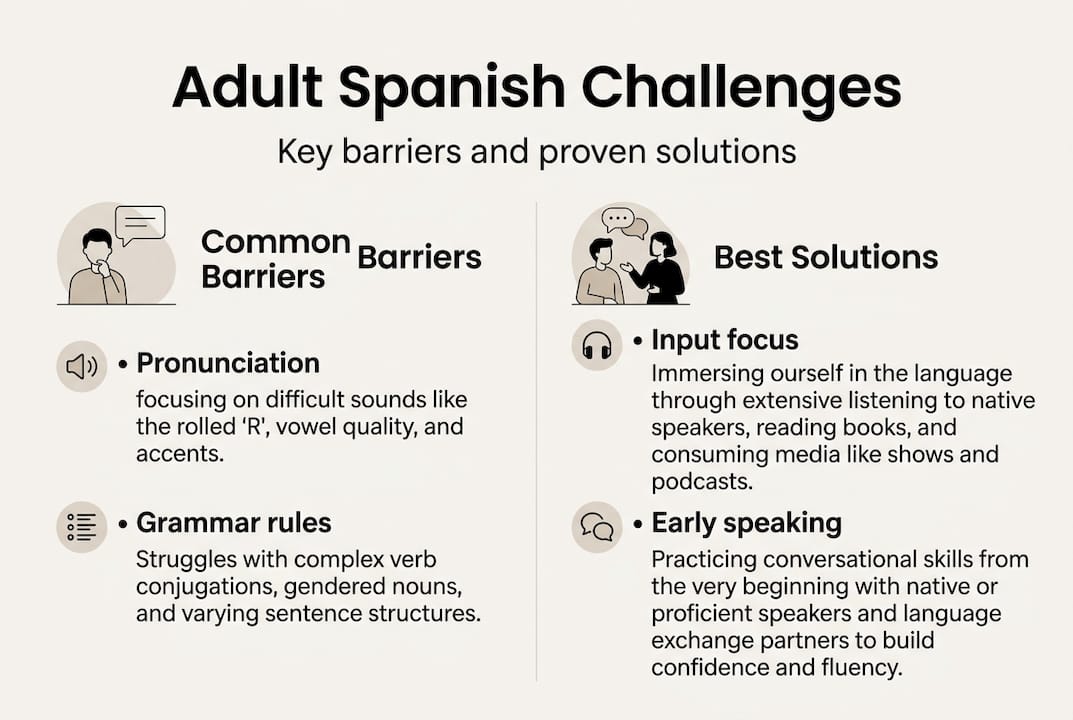
Phonologically, European Spanish contains sounds that simply don’t exist in English. The famous ceceo (the “th” sound used for the letters c and z in Spain) trips up learners who expect Spanish to sound like its Latin American cousin. The rolled r and the double rr require muscle memory that takes deliberate, repeated practice to build. Vowel sounds in Spanish are also shorter and crisper than their English equivalents, which can make listening comprehension harder than expected.
Grammatically, English-Spanish differences including the subjunctive mood, verb conjugations, and gendered nouns challenge adults who lack the metalinguistic intuition built up through years of formal grammar study. English speakers rarely think about grammatical gender. In Spanish, every noun is either masculine or feminine, and adjectives must match.

| Feature | English | European Spanish |
|---|---|---|
| Grammatical gender | None | Masculine / feminine for all nouns |
| Verb conjugation | Minimal (I go, he goes) | Six forms per tense per verb |
| Rhyming | None | Frequent and essential |
| Pronunciation of c/z | Always “s” or “k” | “th” sound in Spain |
| Rolled r | Does not exist | Required for clarity |
Some of the most commonly problematic areas for English speakers include:
- Rhyming: used constantly in Spanish to match noun and adjective.
- Ser vs. estar: two verbs for “to be”, each with distinct and context-dependent uses
- Reflexive verbs: a grammatical structure largely absent in everyday English
- False friends: words like embarazada (pregnant, not embarrassed) that mislead confident speakers
Exploring the specific Spanish cultural challenges that arise when living in Spain can be fun to.
Pro Tip: Focus on your personal “problem pairs” rather than trying to master everything at once. Identify the two or three features causing the most confusion and practise them through real output, speaking or writing, until they feel automatic.
Why traditional methods let adults down
Most adults who struggle with Spanish aren’t failing because of age or aptitude. They’re failing because the tools they’re using were designed for a different kind of learner in a different kind of setting.
Classroom-based methods and many popular apps lean heavily on rule memorisation. You learn that the subjunctive is formed by taking the first-person present tense, dropping the final o, and adding a specific set of endings. That’s technically correct, but it doesn’t help you use the subjunctive naturally in a conversation. The rule sits in your head like a locked cabinet; you know it’s there but can’t access it quickly enough when you need it.
As research into adult acquisition confirms, traditional methods fail adults due to over-reliance on rule-based learning. The idea is that you acquire language most efficiently when you’re exposed to material that is just slightly above your current level. Too easy and nothing new sticks. Too hard and the brain shuts down. Most apps pitch content far too high or far too low.
Here are the most effective techniques, ranked by impact for adult learners:
- Comprehensible input at the right level: listening and reading material you can understand with a little effort
- Explicit grammar instruction: not memorising rules, but understanding the structural logic behind patterns
- Spaced repetition for vocabulary: revisiting words at increasing intervals to lock them into long-term memory
- Early and regular speaking practice: output forces your brain to retrieve and consolidate what you’ve absorbed
- Deliberate pronunciation work: targeted practice on specific sounds rather than hoping exposure alone fixes it
| Technique | Traditional classroom | Effective adult method |
|---|---|---|
| Grammar | Rule memorisation | Structural pattern recognition |
| Vocabulary | Word lists | Contextualised spaced repetition |
| Speaking | Delayed until “ready” | Early and consistent output |
| Listening | Scripted dialogues | Real-speed, graded input |
The shift to on-demand learning has made it far easier to access the right kind of input at the right time. Understanding the best way to learn Spanish as an adult means accepting that the method matters as much as the effort. And when you’re ready to use what you’ve learned, practical guidance on fluency with locals in Spain can bridge the gap between classroom knowledge and real conversation.
Pro Tip: Don’t wait until you feel “ready” to speak. Start producing Spanish from day one, even badly. Output practice accelerates acquisition in ways that passive study simply cannot replicate.
Special considerations: Dyslexia, age, and learning differences
For some adult learners, standard hurdles are compounded by personal factors that rarely get addressed in mainstream language courses. Two of the most significant are dyslexia and older age.
Dyslexia and foreign language learning
Dyslexia affects how the brain processes written language, and its impact doesn’t disappear when you switch to a second language. Research shows that adults with dyslexia face greater deficits in oral production spontaneity, reading comprehension, spelling, and lexical diversity when learning foreign languages. In practical terms, this means reading-heavy methods and written exercises can actively slow progress for dyslexic learners.
Strategies that work well for dyslexic adult learners:
- Audio-first learning: prioritising listening and speaking over reading and writing
- Multi-sensory input: combining sound, visual cues, and movement to reinforce new material
- Shorter, more frequent sessions: reducing cognitive load by breaking study into smaller chunks
- Slowed input: accessing audio at reduced speed to allow processing time before returning to natural pace
Older adult learners (60+)
Learners over 60 face some additional challenges. Reduced working memory capacity and slower processing speed can make it harder to retain new vocabulary in the short term. As older adults struggle more with focus and memory retention, patience and repetition become even more important. The encouraging news is that language learning itself provides measurable cognitive benefits, including resilience against age-related mental decline.
The key adjustments for older learners include:
- Allowing more time per lesson without pressure from external deadlines
- Repeating material multiple times rather than pushing forward prematurely
- Connecting new vocabulary to personal experience, which deepens retention
- Celebrating incremental progress rather than comparing pace to younger learners
If you’re navigating these challenges, finding support for adult learners that acknowledges your specific circumstances makes a real difference. That means you need to carefully choose the best way to learn Spanish.
Understanding the full picture of learning Spanish challenges helps you plan realistically and stay motivated through the harder stretches.
Our take: Why what you’ve heard about adult language learning is wrong
The most damaging myth in adult language learning is that children are the gold standard. Adults watch toddlers absorb language effortlessly and conclude that immersion is the magic ingredient they’re missing. So they move to Spain, surround themselves with Spanish, and then wonder why, after two years, they still can’t follow a conversation at the market.
Immersion without structure is just confusion at high volume. Children succeed through immersion because their brains are wired for it and because they have years of total exposure with zero pressure. Adults don’t have that luxury, and pretending otherwise leads to frustration and stalled progress.
The adult analytical brain is genuinely powerful when it’s pointed in the right direction. Structured grammar, explained in plain English rather than academic jargon, gives adults a scaffold that children never need but adults absolutely benefit from. Pair that with targeted speaking practice and contextual immersion, and you have a method that works with your adult brain rather than against it.
For practical guidance on putting this into action, our speaking tips for adults show you how to move from knowing Spanish to actually using it with real people in real situations.
Take the next step: Resources for adult Spanish learners
If you’ve recognised yourself in any part of this guide, the good news is that the right support changes everything.

At James Spanish School, every element of the course is built around how adult brains actually learn. The 100-lesson programme combines sentence-building with ear-tuning, delivered on demand so you learn at your own pace with no expiry date and no pressure. Whether you’re exploring the best ways to start, working through beginner Spanish courses designed for real conversation, or getting to grips with the cultural nuances covered in our living in Spain tips, you’ll find a structured, encouraging path forward built specifically for you.
But here is a no-nonsense list of the basic things you need to do.
Frequently asked questions
Can adults achieve native-like Spanish pronunciation?
Adults rarely achieve fully native-like pronunciation, but clear and fluent speech is very achievable with targeted practice. The CPH confirms that adult brains process phonology differently, but this doesn’t prevent highly intelligible and confident spoken Spanish.
How long does it take for an English speaker to reach conversational Spanish?
Most adults need 600 to 750 hours of structured study to reach a B1 intermediate level in Spanish, which is sufficient for everyday conversation. Consistent daily practice significantly shortens the timeline compared to sporadic study.
What is the best way for adults to learn Spanish effectively?
The most effective method blends comprehensible input, explicit grammar practice, spaced repetition, and early speaking opportunities. No single technique works in isolation; the combination is what produces lasting results.
Does age make Spanish learning impossible for adults over 60?
Absolutely not. While older adults face greater challenges with memory retention and processing speed, language learning at any age brings measurable cognitive benefits and is entirely achievable with the right approach and realistic expectations.
One reply on “Why adults struggle with Spanish and how to succeed”
WordAmigo is proving very effective in aiding both pronunciation improvement and memory retention for both young and older English speakers.