

TL;DR:
- Real-life Spanish involves fast-paced, informal speech with regional idioms and body language.
- Practicing in settings like markets, cafés, and social gatherings enhances conversational skills.
- Consistent listening, speaking, and cultural engagement accelerate fluency beyond textbook learning.
What is real-life Spanish conversation?
Many learners spend months studying Spanish, only to freeze the moment a local speaks at full speed. Textbooks give you clean sentences and polished grammar, but real conversations don’t follow a script. A neighbour might greet you with a regional expression you’ve never heard. A market trader might fire back three questions before you’ve finished your first. Real-life Spanish conversations differ notably from textbook dialogues, and understanding that gap is the first step towards closing it. This guide explains what authentic Spanish conversation actually sounds like, where it happens, what you need to master, and how to practise it effectively.
Table of Contents
- Defining real-life Spanish conversation
- Practical settings: where real-life Spanish happens
- Elements of authentic conversation: what you must master
- Bridging the gap: how to practise and improve
- Why textbook Spanish fails and what actually works
- Take your Spanish further with James Spanish School
- Frequently asked questions
Key Takeaways
| Point | Details |
|---|---|
| Authentic settings matter | Practising Spanish in real-world situations is key to fluency. |
| Cultural context is crucial | Understanding jokes, gestures and slang helps you blend in and be understood. |
| Active practice accelerates progress | Frequent conversation and practical resources speed up learning far beyond classroom methods. |
| Modern tools make it easier | Audio recordings and conversation groups can simulate real-life scenarios anywhere. |
Defining real-life Spanish conversation
Textbook Spanish is built for clarity. Sentences are short, vocabulary is controlled, and speakers take polite turns. Real life is messier, faster, and far more interesting. When you order a coffee in a Spanish bar, the barista might respond with a joke, a question about your day, and a comment about the weather, all in one breath. That’s not a failure of communication. That’s Spanish working exactly as it should.
Basic Spanish conversations in everyday settings rely heavily on context. A single word like “venga” can mean “come on,” “okay,” “goodbye,” or “let’s go,” depending entirely on tone and situation. Textbooks rarely capture that kind of flexibility.
Here’s what sets real-life Spanish apart from the classroom version:
- Filler words and hesitation sounds: “Pues,” “o sea,” “bueno” are used constantly and rarely appear in course materials
- Regional idioms: Expressions vary dramatically between Andalucía, Murcia, Madrid, and Valencia
- Natural interruptions: Speakers talk over each other, finish each other’s sentences, and loop back mid-thought
- Body language: Gestures, eye contact, and proximity carry as much meaning as words
- Dropped syllables: Fast speech compresses words so that “para” sounds like “pa’” and “está” sounds like “’tá”
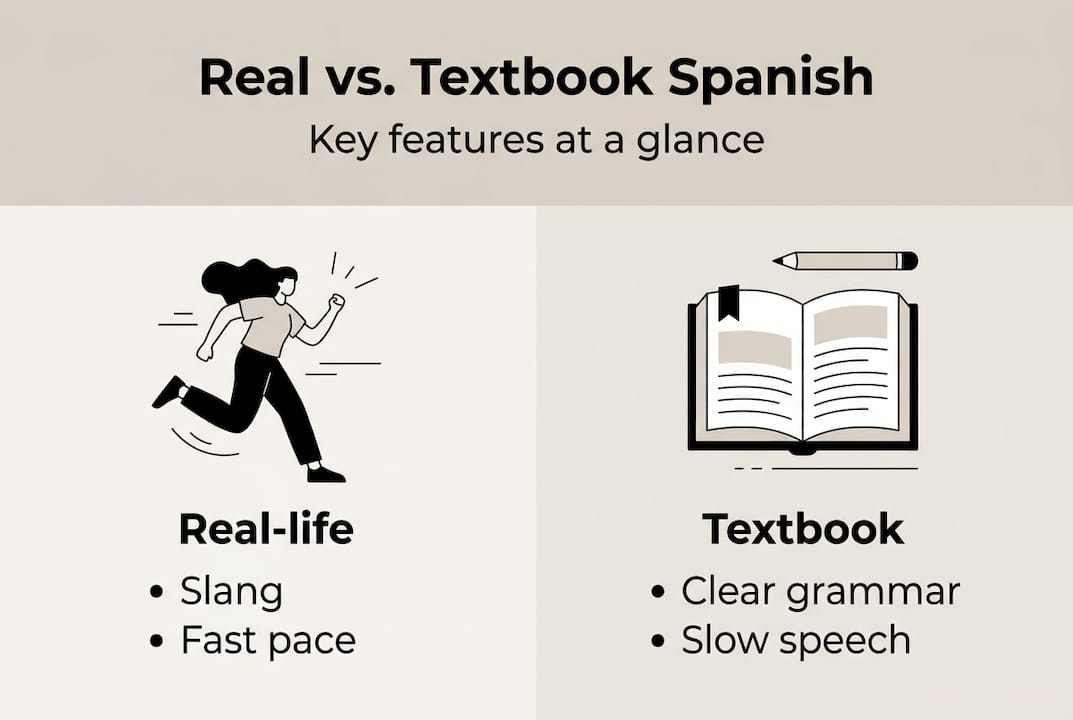
| Feature | Real-life Spanish | Textbook Spanish |
|---|---|---|
| Pace | Fast, variable | Slow, controlled |
| Vocabulary | Slang, idioms, fillers | Standard, formal |
| Structure | Fluid, overlapping | Rigid, sequential |
| Cultural nuance | Central | Minimal |
| Interruptions | Common | Absent |
You can explore real-life Spanish conversation examples to hear how these differences play out in practice. Listening to authentic exchanges, even short ones, trains your ear in ways that written exercises simply cannot.
Pro Tip: When listening to native speakers, pay as much attention to rhythm and body language as you do to individual words. The physical cues often tell you more than the vocabulary.
Practical settings: where real-life Spanish happens
Once you grasp what makes real-life Spanish unique, it helps to know where it naturally occurs. Real conversation skills are essential in shops, cafes, public transport, and social gatherings, and each setting brings its own unwritten rules.
| Setting | Why it matters | Key phrase type |
|---|---|---|
| Market stalls | Fast exchanges, local dialect | Prices, quantities, pleasantries |
| Doctor’s surgery | Precise vocabulary needed | Symptoms, appointments, instructions |
| Bank or town hall | Formal register, patience required | Documents, requests, clarifications |
| Bar or café | Relaxed, humorous, rapid | Orders, small talk, reactions |
| Public transport | Brief, functional | Directions, tickets, timing |
Knowing the setting helps you anticipate the register. A conversation at a market stall is nothing like a conversation at the town hall, even if both involve asking for something.
Here’s how to approach and sustain conversations in any of these settings:
- Start with a greeting. Even a simple “buenos días” signals respect and opens the exchange warmly.
- State your need simply. Use short, direct sentences rather than complex constructions.
- Listen for the key word in the reply. You don’t need to catch every word, just the one that answers your question.
- Use confirmation phrases. “¿Cómo?” (Sorry?) and “¿Puede repetir?” (Can you repeat?) are not signs of failure. Locals use them too.
- Close the conversation naturally. A warm “gracias, hasta luego” leaves a good impression and ends things cleanly.
Cultural cues matter enormously here. Spaniards often use humour to fill awkward silences, and indirect expressions are common when someone wants to avoid saying no outright. If a shopkeeper says “es que…” and trails off, they’re letting you down gently. Recognising that saves embarrassment on both sides.
For tips for fluency in Spain that go beyond vocabulary lists, focus on how conversations feel, not just what’s said. You can also build confidence through structured conversational Spanish practice before stepping into live situations.
Pro Tip: A simple greeting is never wasted. Starting with “buenas” in any setting immediately marks you as someone making a genuine effort, and locals respond warmly to that.
Elements of authentic conversation: what you must master
Understanding where real-life Spanish occurs naturally leads us to the key elements you need to master. Vocabulary alone won’t carry you. The learners who thrive in genuine exchanges are those who develop three core skills: active listening, cultural awareness, and natural response patterns.
Active listening means following the rhythm and tone of speech, not just processing individual words. Spanish speakers signal meaning through intonation constantly. A rising tone at the end of a sentence turns a statement into a question. A flat, quick delivery often means the speaker is wrapping up.
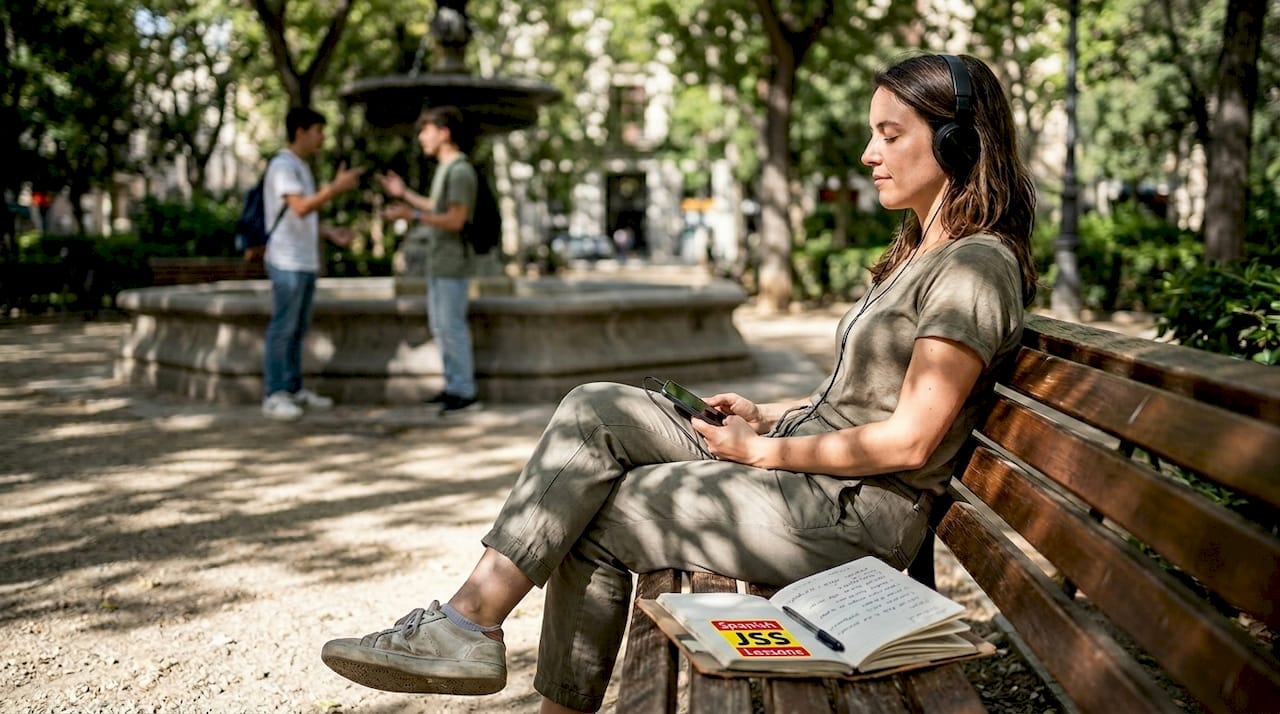
Cultural context shapes almost every exchange. Gestures, proximity, and shared humour are not decorative extras. They are part of the message. Cultural understanding and listening skills are as important as vocabulary, and neglecting them leaves you half-informed even when your grammar is perfect.
Here are the core elements of successful interaction:
- Listening for gist: Catching the overall meaning before individual words
- Recognising slang and idioms: Especially regional ones that don’t appear in dictionaries
- Matching intonation: Sounding natural rather than robotic builds trust with speakers
- Using filler words: “Pues,” “mira,” “hombre” keep conversation flowing and signal engagement
- Reading indirect meaning: What’s left unsaid is often as important as what’s spoken
Over 75% of Spanish speakers regularly use regional expressions and idioms that differ from standard Castilian, which means the version of Spanish you learn from a textbook may sound oddly formal or even foreign to locals in certain areas.
“The learner who adapts to local speech patterns, even imperfectly, connects far more effectively than the one who speaks perfect textbook Spanish with no cultural awareness.”
Building shop Spanish for confidence is one of the fastest ways to develop these skills in a low-pressure setting. Short, repeated interactions with shop staff train your ear and your responses simultaneously. Pair that with conversational practice lessons and you’ll notice real progress quickly.
Bridging the gap: how to practise and improve
Knowing the necessary elements, the final step is exploring how to bridge the gap between learning and real-life application. The good news is that consistent, targeted practice works faster than most learners expect.
Follow these steps to integrate real-life Spanish into your routine:
- Listen daily to authentic audio. Even ten minutes of native speech conditions your ear to natural pace and rhythm.
- Repeat out loud. Silent reading builds reading skills. Speaking builds speaking skills. They are not the same.
- Roleplay common scenarios. Practise ordering food, asking for directions, or explaining a problem before you need to do it for real.
- Record yourself. Hearing your own Spanish reveals pronunciation habits you’d never notice otherwise. Correcting your own pronunciation will improve your recognition of incoming words
- Seek feedback. A native speaker or a structured course can identify patterns you’re repeating incorrectly before they become habits.
Modern resources such as recordings and roleplay can help you adapt quickly to the pace and texture of real conversation. The key is regularity, not marathon sessions.
The most effective tools for authentic conversation practice include:
- Native audio recordings that reflect real speech, not studio-perfect enunciation
- Language exchange partners who speak Spanish as a first language
- Structured Spanish practice lessons designed around real scenarios
- On-demand learning platforms that let you revisit difficult material as often as needed
- Real Spanish audio resources built specifically for adult learners
Pro Tip: Record a short piece of Spanish speech, then record yourself saying the same thing. Compare the two. The gap between them is your personal improvement map. There are great tools that will help you do this.
Why textbook Spanish fails and what actually works
After forty years living in Spain, the pattern is unmistakable. Learners who rely entirely on grammar rules and written exercises often reach a frustrating plateau. They can write a correct sentence but can’t follow a conversation at normal speed. They know the vocabulary but miss the meaning.
The uncomfortable truth is that most traditional language courses are designed to be taught, not to be used. They reward accuracy in controlled conditions, not adaptability in messy ones. Real improvement comes from making mistakes in live situations and adjusting based on what actually happens next.
Cultural participation is the accelerant that textbooks can’t replicate. Sitting in a bar, listening to two locals debate football, absorbing the rhythm and the jokes, builds a kind of fluency that no grammar exercise can touch. You start to feel the language rather than translate it.
Authentic conversation also makes you a sharper listener. When you’re genuinely engaged in an exchange, your brain processes language differently. You stop searching for individual words and start reading the whole picture. For deeper insights on learning Spanish that reflect real experience rather than academic theory, that shift in approach makes all the difference.
Take your Spanish further with James Spanish School
If this guide has shown you anything, it’s that real-life Spanish is a skill built through exposure, practice, and the right kind of support. James Spanish School exists precisely for this purpose.
James Bretherton, a dual-native speaker with four decades of life in Spain, has built his 100-lesson JSS course around the conversations that actually matter: with neighbours, shop staff, health workers, and local tradesmen. Using Radical Simplification, the course strips away confusing grammar terms and focuses on how Spanish really works. Spanish conversation tools, fluency tips, and a beginner steps guide are all available on demand, whenever you’re ready to take the next step.
Frequently asked questions
Why is real-life Spanish conversation different from what’s in textbooks?
Real-life Spanish differs from textbook versions because it includes regional slang, cultural references, filler words, and a natural pace that structured exercises rarely capture.
How can I start practising real-life Spanish today?
Engage with native speakers in casual settings and use recordings and roleplay exercises to build familiarity with authentic pace and expression before stepping into live conversations.
What are the best resources for real Spanish conversation?
Native audio recordings, structured conversation lessons, and community language exchanges are most effective. Targeted audio resources like WordAmigo designed for adult learners are particularly useful for building ear-tuning skills.
Do I need to live in Spain to pick up real-life conversation?
No. Immersive online resources and regular interaction with native speakers mean you can develop strong real-life Spanish skills from anywhere in the world.