

TL;DR:
- Cultural nuances in Spanish influence pronoun selection, greetings, and indirect refusals, shaping authentic communication.
- Understanding these social patterns is essential for learners to connect deeply and sound socially credible in Spain.
The role of cultural nuances in Spanish extends far beyond vocabulary. It shapes which pronoun you choose, how close you stand to someone, and whether a polite refusal is even recognised as one. Tone, formality, and culturally expected phrasing determine whether your Spanish sounds local and socially credible, or whether it marks you as an outsider despite technically correct grammar. For English speakers learning European Spanish, grasping these subtleties is the difference between being understood and truly connecting.
What is the role of cultural nuances in Spanish?
Cultural nuances in Spanish are the unwritten social rules that govern how the language is actually used in Spain. Linguists and translation specialists refer to this as pragmatic competence: the ability to use language appropriately in social context, not just grammatically. The Spain Handbook, SpanishStep, and Ulatus translation research all confirm that cultural fluency sits alongside grammar and vocabulary as a core pillar of authentic communication.
These nuances cover a wide range of behaviours. Pronoun selection signals respect or familiarity. Greetings involve physical contact that would surprise most British learners. Refusals are rarely blunt. Each of these patterns reflects something deeper about Spanish values: warmth, social harmony, and a preference for relationship over transaction. Understanding Spanish culture at this level transforms your language from a tool into a genuine social asset.

How does pronoun choice reflect social hierarchy in Spain?
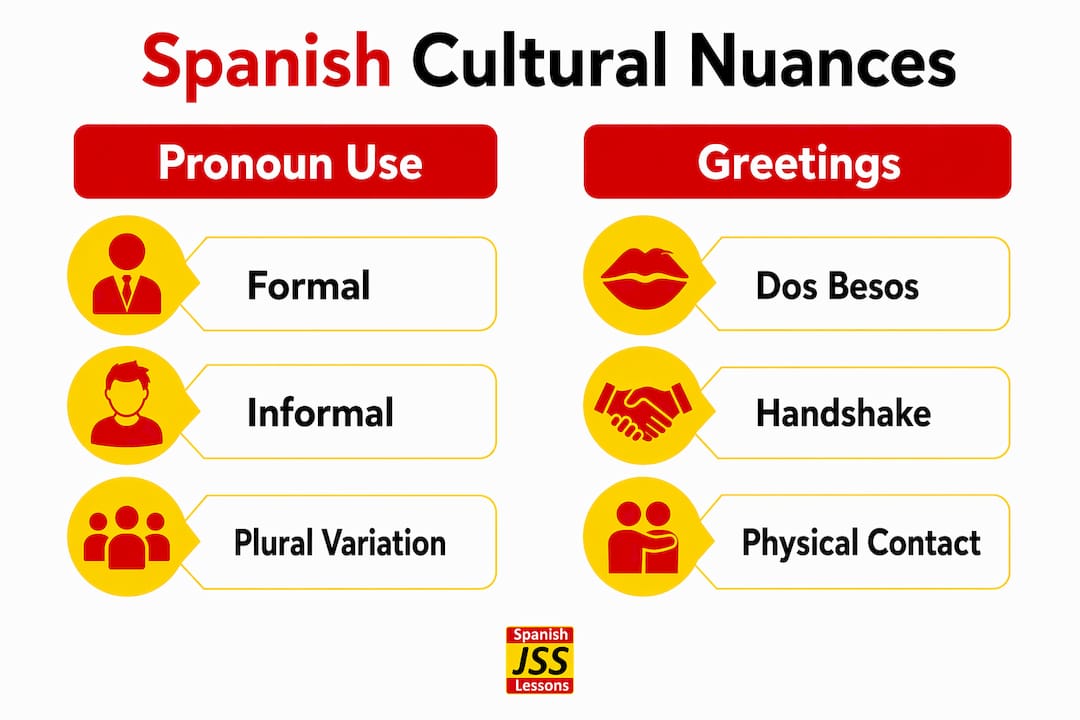
Spanish pronoun use is one of the most culturally loaded aspects of the language, and one of the most mishandled by English speakers. The distinction between tú and usted is not simply formal versus informal. It is a live social negotiation that signals respect, familiarity, and your reading of the relationship.
Here is how the system works in practice:
- Tú is used among peers, friends, family members, and in casual settings. Using it too early with a stranger or authority figure can read as presumptuous.
- Usted is reserved for formal or hierarchical situations: speaking to an older person, a doctor, a government official, or someone you have just met in a professional context.
- Vosotros is the informal plural “you all,” used exclusively in Spain. Latin American Spanish replaces it entirely with ustedes, so using vosotros immediately identifies you as someone learning European Spanish specifically.
- Switching from usted to tú should happen only when invited. The invitation is called tutear, and accepting it promptly signals social ease.
The deep knowledge item here is that tú and usted function as an interaction loop, not a fixed label. You begin formal, and the relationship evolves. Holding onto usted after someone has invited you to tutear creates distance rather than respect. It signals stiffness, not politeness. Mirroring the pronoun your interlocutor uses is the fastest route to social acceptance, as confirmed by Spanish etiquette research.
Pro Tip: When in doubt, open with usted. Most Spaniards will quickly invite you to switch to tú, and that moment of invitation is itself a warm social signal. Missing it by jumping straight to tú risks a poor first impression.
How do Spanish greetings and body language work?
Greetings in Spain are physical, warm, and governed by clear social rules. Getting them wrong is one of the most common sources of awkwardness for British learners, who are accustomed to considerably more personal space and far less contact.
- Dos besos (two cheek kisses) is the standard greeting in informal social settings. It applies between women, and between a man and a woman. The kisses are light, cheek to cheek, right side first. This happens on arrival and again on departure.
- Handshakes are the norm between two men meeting for the first time, and in professional or formal contexts regardless of gender. A firm, brief handshake signals confidence and respect.
- Physical proximity during conversation is noticeably closer than British norms. Light touches on the arm or shoulder indicate warmth and engagement, not intrusion. Stepping back repeatedly can be read as coldness or disinterest.
- Eye contact is expected and valued. Sustained eye contact during conversation signals that you are present and engaged, rather than distracted or evasive.
- Excessive please and thank you can actually sound odd. Casual Spanish transactions use por favor and gracias less frequently than English culture does. Tone and gesture carry much of the politeness load.
The practical implication is straightforward: lean in, make contact, and do not retreat. Spaniards read physical openness as social warmth. The British instinct to maintain distance can unintentionally communicate reserve or even unfriendliness. Adapting to Spanish greeting customs is one of the quickest ways to build genuine rapport.
Pro Tip: If you are unsure whether to go for dos besos or a handshake, follow the other person’s lead. They will initiate, and matching their gesture immediately shows social awareness.
How do indirect refusals work in Spanish communication?
Spanish speakers rarely say a flat “no.” This is not evasion. It is a deeply embedded politeness strategy designed to preserve social harmony and protect the dignity of both parties. For English speakers trained in direct communication, this is one of the most disorienting aspects of Spanish interaction.
The mechanics of an indirect refusal follow a recognisable pattern:
- Appreciation first: The speaker acknowledges the invitation or request positively before declining. “Qué buena idea” (what a good idea) often precedes a refusal.
- Softened explanation: The refusal arrives wrapped in reason. “Me gustaría, pero no puedo” (I would like to, but I cannot) is the classic structure.
- Conditional framing: The conditional tense (gustaría, podría) softens the rejection by implying willingness in principle, even when the answer is no in practice.
- Pragmatic signals: Phrases like “Es que…” (the thing is…) or “A ver…” (let’s see…) are pragmatic markers that signal a refusal is coming. Interpreting these signals requires listening beyond the literal words.
“Indirect communication preserves social harmony, requiring learners to interpret beyond literal meaning to grasp true intent.” — SpanishStep
The risk for English speakers is twofold. You may miss a refusal entirely because no direct “no” was spoken. Or you may interpret the softening language as genuine uncertainty and push further, which creates social discomfort. Learning to read these indirect communication patterns is as important as learning the vocabulary itself.
European Spanish vs Latin American Spanish: key cultural differences
Learners sometimes assume that Spanish is Spanish. The cultural and linguistic gap between European Spanish and Latin American varieties is significant enough to affect perceived authenticity and social credibility.
| Feature | European Spanish (Spain) | Latin American Spanish |
|---|---|---|
| Informal plural “you” | Vosotros | Ustedes only |
| Formal register | Usted used selectively | Usted often more widespread |
| Communication directness | Moderately indirect, warm | Varies widely by country |
| Physical contact in greetings | Dos besos standard | Varies; often one kiss or handshake |
| Tone in casual settings | Relaxed, expressive | Generally warm but regionally varied |
Mixing vosotros and ustedes is considered a fluency error in Spain. A learner who uses ustedes for the informal plural will be understood, but will sound as though they learned Latin American Spanish, which affects the sense of local authenticity. For learners targeting life in Spain specifically, this distinction matters from day one.
The cultural influences in Spanish also diverge in tone and directness. Mexican Spanish, for example, tends toward elaborate politeness formulas in formal settings. Argentine Spanish is notably more direct. Castilian Spanish sits in its own register, shaped by centuries of distinct social history. Recognising these differences is not about hierarchy. It is about precision and respect for the culture you are actually entering.
Practical tips for applying cultural nuances in daily life
Knowing the theory is one thing. Applying it in a real conversation with a neighbour or a market trader is another. These steps will help you move from awareness to instinct.
- Start formal, then follow the lead. Open every new interaction with usted and vosotros where appropriate. Let the other person set the register, then match it immediately.
- Watch before you speak. In social gatherings, observe how greetings unfold before you join in. You will quickly identify the local norm for that setting.
- Listen for pragmatic markers. When someone says “Es que…” or “A ver…”, slow down and listen carefully. A refusal or hesitation is likely following.
- Adjust by context. A conversation with a pharmacist calls for different language than a chat with a neighbour over the fence. Context shapes vocabulary and tone in equal measure.
- Practise polite phrases actively. Phrases like “¿Le importaría…?” (Would you mind…?) and “Con permiso” (Excuse me) signal cultural awareness even when your grammar is imperfect.
- Embrace physical warmth. Allow for closer proximity and light contact. Resisting it repeatedly will mark you as uncomfortable in Spanish social settings.
Pro Tip: The fastest way to internalise cultural nuances is repeated exposure in real settings. Markets, local bars, and community events in Spain offer far more cultural learning per hour than any classroom exercise.
Key takeaways
Mastering the role of cultural nuances in Spanish requires learning the social rules that govern pronoun choice, greetings, and indirect communication alongside the language itself.
| Point | Details |
|---|---|
| Pronoun use signals social standing | For business, start with usted, switch to tú only when invited to do so. |
| Physical greetings follow clear rules | Dos besos in social settings, handshakes in professional or male first meetings. |
| Indirect refusals require interpretation | Listen for conditional phrasing and pragmatic markers, not a literal “no.” |
| European and Latin American Spanish differ | Vosotros is Spain-specific; mixing it with ustedes signals a regional mismatch. |
| Cultural context shapes fluency | Tone, formality, and social behaviour determine whether your Spanish sounds authentic. |
What 40 years in Spain taught me about cultural fluency
Grammar gets you through the door. Cultural awareness keeps you in the room. That is the honest truth I have arrived at after four decades living and speaking Spanish in Spain.
The pronoun system is a perfect example of what I mean. Most learners treat tú and usted as a grammar rule to memorise. In reality, it is a live social dance. I have watched fluent speakers lose credibility in a single sentence by holding onto usted after a warm invitation to tutear. The grammar was correct. The social reading was wrong.
The indirectness is the other great challenge for English speakers. We are trained to say what we mean. Spanish social culture is trained to protect the relationship first and deliver the message second. When a Spanish neighbour says “A ver, es que tengo muchas cosas…” and trails off, that is a no. A clear, final no. Missing it and pressing further is the kind of social misstep that lingers.
What I have found is that cultural curiosity is the real accelerator. Learners who approach Spain with genuine interest in why things work the way they do absorb these patterns far faster than those who treat culture as a footnote to grammar. The cultural context behind everyday Spanish is not decoration. It is the structure itself.
— James
How James Spanish School helps you master cultural fluency

James Spanish School was built specifically for English-speaking adults who want to use Spanish in real life in Spain, not pass an academic exam. The 100-lesson course covers sentence-building and ear-tuning, but it also weaves in the social and cultural context that makes the language work. James Bretherton draws on 40 years of living in Spain to share the kind of insider knowledge you simply cannot get from a textbook: how to read a refusal, when to switch pronouns, and what your body language is communicating before you say a word.
The WordAmigo system embeds vocabulary and pronunciation through strategic repetition, so the phrases you need in real social situations stay with you. Explore the full course at Spanish as spoken in Spain and start learning the language the way it is actually lived.
FAQ
What are cultural nuances in Spanish?
Cultural nuances in Spanish are the unwritten social rules governing pronoun choice, greetings, politeness strategies, and indirect communication that determine whether a speaker sounds authentic and socially credible in Spain.
Why is vosotros only used in Spain?
Vosotros is the informal plural “you all” used exclusively in European Spanish. Latin American Spanish replaced it with ustedes centuries ago, so using vosotros immediately signals that a learner is studying Spain-specific Spanish.
How should I handle indirect refusals in Spanish?
Listen for conditional phrases like “Me gustaría, pero…” and pragmatic markers like “Es que…”. These signal a refusal even when the word “no” is never spoken, as SpanishStep research confirms.
When should I use tú versus usted in Spain?
Start with usted in any new or formal interaction, then switch to tú immediately when the other person invites you to do so. Holding onto usted after that invitation signals social distance.
Is dos besos always appropriate in Spain?
Dos besos is standard in informal social settings between women and between a man and a woman. Between two men meeting for the first time, a handshake is the norm. In professional contexts, a handshake applies regardless of gender.