

TL;DR:
- Spanish queuing relies on verbal communication where people ask who is last to establish their place. This social trust-based system functions in informal settings but is replaced by ticket machines in formal environments like banks. To adapt, foreigners should ask “Who is last?” upon arrival and acknowledge their position loudly to maintain the flow.
Spanish queuing culture is an informal, socially negotiated system where people verbally establish their place in a queue rather than standing in a rigid physical line. Instead of forming an orderly row, Spaniards ask a simple question on arrival, track their position through conversation, and trust the group to manage the order collectively. For English speakers moving to Spain or visiting regularly, understanding this system is not optional. It is the difference between fitting in and being permanently overlooked at the bakery counter.
What is Spanish queuing culture and how does it work?
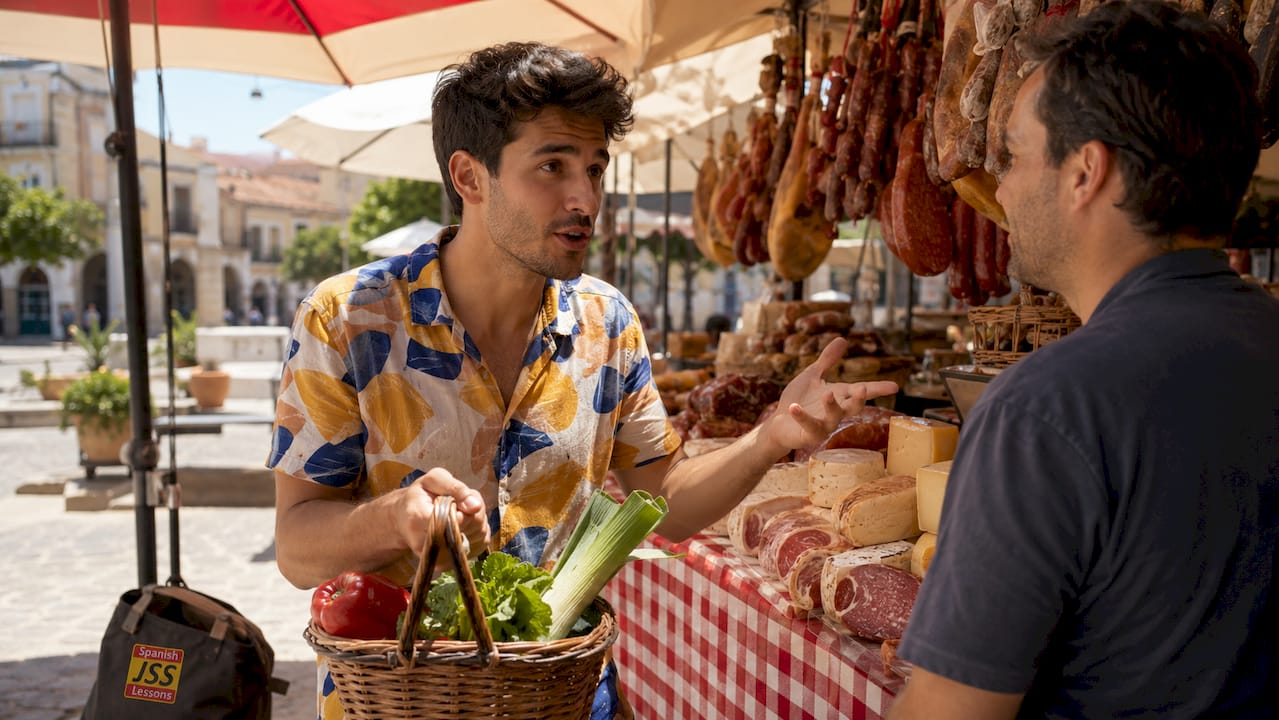
The standard term for this practice is the “invisible queue,” and it operates on a principle of verbal social negotiation rather than physical positioning. When you walk into a Spanish bakery, pharmacy, or deli, you will rarely see a neat line of people. What you will see looks, to British eyes, like a crowd of people chatting, browsing, or simply standing around. That crowd is, in fact, a perfectly functioning queue.
The system works because every person who arrives asks one question: “¿Quién es el último?” This translates as “Who is last?” The person who answers confirms they are currently last, and you mentally note that you are after them. You can then step away or browse freely, because your position is held not by your physical location but by the group’s collective awareness of who arrived when.
The key phrases you need are:
- ¿Quién es el último? (“Who is last?”) — use this every time you enter an informal queue
- ¿Quién da la vez? (“Who gives the turn?”) — a regional variant with the same function
- Yo soy el último / la última (“I am last”) — what you say when the next person arrives after you
Pro Tip: When someone new walks in after you, it is your responsibility to tell them you are last. This reciprocal system only functions when everyone participates. Staying silent is not neutral; it breaks the chain.
The invisible queue also allows genuine freedom of movement. People may wander, sit, or step outside briefly, and others will alert them when their turn is near, provided they identified themselves properly on arrival. This is not chaos. It is a distributed, self-managing system that has worked reliably for generations. You can read more about the origins of this behaviour in this detailed look at why Spaniards don’t queue in the conventional sense.
What social values shape Spanish queuing habits?
Spanish queuing behaviour reflects something deeper than a preference for informality. The invisible queue is rooted in social trust and a cultural preference for interpersonal interaction over impersonal, rigid structures. Waiting is treated as a communal experience, not a solitary inconvenience to be endured in silence.
In British culture, the queue is a moral institution. Standing in line signals patience, fairness, and respect for rules. Jumping a queue is a near-criminal act. In Spain, the equivalent moral signal is verbal participation. Engaging with the group, announcing your arrival, and acknowledging others demonstrates that you are a trustworthy member of the social moment. Silence, by contrast, reads as either ignorance or rudeness.
“What can appear disorganised to a foreign eye is actually a functional system where waiting is communal and polite participation requires verbal acknowledgement. The queue is not a line. It is a conversation.”
This distinction matters enormously for expats. Failing to ask who is last is interpreted as being unaware of, or indifferent to, the social group. The consequence is practical: you will simply be overlooked when your turn comes, because nobody knows where you fit in the order. The system is not designed to exclude you. It just requires you to opt in verbally.
Common misconceptions among foreigners include assuming that the person nearest the counter is next, or that arriving first guarantees priority without verbal confirmation. Neither is true. Position in a Spanish queue is a social fact, not a physical one. Understanding this shifts the entire experience from frustrating to fascinating.
When do formal queuing systems apply in Spain?
Not every setting in Spain uses the invisible queue. Formal establishments such as post offices and banks commonly use ticket machines with automated numbering systems. You take a numbered ticket on arrival, wait until your number appears on a screen, and approach the counter. This removes all ambiguity and requires no verbal interaction whatsoever.
The table below shows where each system typically applies:
| Setting | Queuing type | What to do |
|---|---|---|
| Bakery, deli, market stall | Informal / invisible | Ask ¿Quién es el último? on arrival |
| Pharmacy | Often informal | Ask on arrival; some use tickets |
| Post office | Formal ticket system | Take a numbered ticket from the machine |
| Bank | Formal ticket system | Take a numbered ticket from the machine |
| Medical centre | Mixed / appointment-based | Announce arrival at reception; observe group |
| Supermarket checkout | Physical line | Stand in the visible queue as normal |
Medical waiting rooms deserve special mention. Appointment punctuality in Spanish healthcare is fluid, and service order is often socially negotiated amongst patients in the waiting area rather than strictly governed by appointment times. Patients observe group cues and arrival order rather than relying on appointment slips alone. Announcing your arrival to reception and paying attention to who was there before you remains the safest approach.
The mixed environments are where English speakers most often come unstuck. A large supermarket deli counter may use tickets on busy Saturday mornings but revert to the invisible queue on a quiet Tuesday afternoon. When in doubt, look for a ticket machine first. If there is none, ask ¿Quién es el último?
Practical tips for adapting to Spanish queue etiquette
Adapting to Spanish waiting customs is straightforward once you accept that the system is verbal, not physical. The following steps will serve you well in the vast majority of everyday situations.
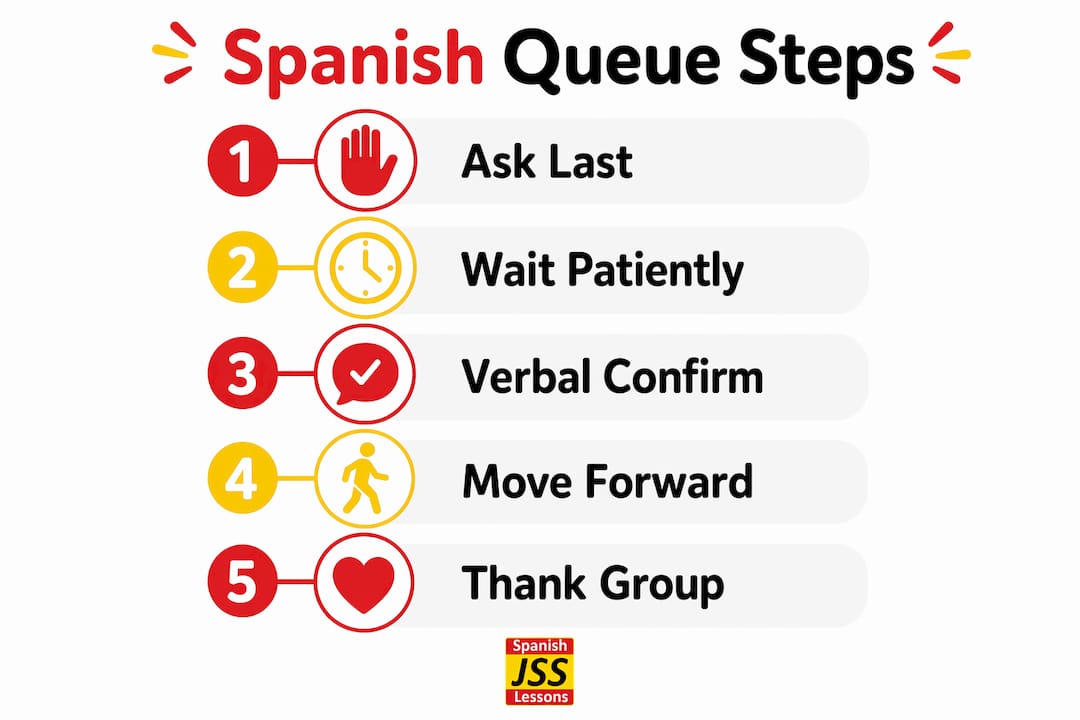
- Ask immediately on arrival. The moment you enter any shop or waiting area without an obvious physical line, say ¿Quién es el último? Do not wait, observe, or hover. Asking promptly is the polite act.
- Confirm your position out loud. When someone answers your question, make brief eye contact and acknowledge them. A simple “Vale, gracias” (“OK, thanks”) confirms the exchange and locks in your place.
- Announce yourself to the next arrival. When someone new enters after you, tell them you are last. Say “Yo soy el último” (or “la última” if you are a woman). This is your social obligation in the system.
- Stay loosely aware of the group. You do not need to stand rigidly in one spot, but keep an eye on the counter. The group will alert you when your turn approaches if you have identified yourself, but wandering too far risks missing your moment.
- Do not interpret conversation as queue-jumping. Spaniards often chat with shop staff or other customers while waiting. This is normal social behaviour, not an attempt to gain advantage. Relax and treat the wait as a social moment rather than a competitive exercise.
Pro Tip: Pronunciation matters here. If your Spanish is hesitant, the phrase ¿Quién es el último? can feel daunting at speed. Practising it aloud before you walk into a shop takes ten seconds and removes the anxiety entirely. James Spanish School’s spoken Spanish practice lessons include exactly this kind of real-life phrase work.
Successful adaptation requires a genuine mindset shift: from treating a queue as a rigid structure to treating it as a group activity. Once that shift happens, the system feels natural rather than chaotic. For a broader view of the cultural habits that shape daily life in Spain, the guide to must-know Spanish cultural habits for expats covers many of the same social dynamics in other contexts. Getting your pronunciation right also helps enormously; structured pronunciation training versus app-based learning is worth understanding before you commit to a method.
Key takeaways
Spanish queuing culture is a self-managed, verbal system where social participation replaces physical lines, and silent waiting is the single most common mistake English speakers make.
| Point | Details |
|---|---|
| The invisible queue is the norm | Most informal settings use verbal position-tracking, not physical lines. |
| One phrase unlocks the system | Asking ¿Quién es el último? on arrival is the essential act of joining any informal queue. |
| Silence is a social error | Failing to announce your arrival or update the next person causes you to lose your place. |
| Formal settings use ticket machines | Post offices, banks, and some pharmacies use numbered tickets; look for the machine first. |
| Medical queues are socially negotiated | Healthcare waiting rooms follow arrival order and group awareness, not strict appointment times. |
How James Spanish School helps you fit into real Spanish life
Understanding queuing norms in Spain is one piece of a much larger picture. Daily life as an English speaker in Spain involves dozens of small social codes: how to greet a neighbour, how to speak to a tradesman, how to navigate a government office. Getting these right requires real language, not textbook Spanish.
James Spanish School was built specifically for English-speaking adults who want to function confidently in everyday Spanish life. The 100-lesson course covers practical, real-world situations, and James Bretherton, a dual-native speaker with 40 years of life in Spain, shares the cultural insider knowledge that no grammar book includes. The WordAmigo system then locks vocabulary and pronunciation into long-term memory through strategic repetition, so the phrases you practise actually stay with you. Explore the full course range at James Spanish School and see how quickly real-life Spanish becomes manageable.
FAQ
What does ¿Quién es el último? mean and when do I use it?
It means “Who is last?” and you use it every time you enter an informal queue in Spain, such as at a bakery, pharmacy, or market deli counter. It is the standard phrase for joining an invisible queue and signals to the group that you are participating in the system.
Why do Spanish queues look so disorganised to British eyes?
Spanish queuing relies on verbal acknowledgement and social trust rather than physical lines, so there is no visible row of people. What appears disorganised is a functioning self-managed system where position is tracked collectively by the group.
What happens if I stay silent in a Spanish queue?
Remaining silent means nobody knows where you fit in the order. Expats who do not ask who is last are routinely overlooked when their turn comes, because the system depends entirely on verbal participation.
Do all places in Spain use the informal queue system?
No. Post offices, banks, and many pharmacies use automated ticket machines with numbered displays. Supermarket checkouts use standard physical lines. The informal verbal system applies mainly to smaller shops, market stalls, and some waiting rooms.
How does queuing work in Spanish medical centres?
Medical waiting rooms in Spain often follow arrival order and group awareness rather than strict appointment times. Appointment punctuality is fluid, so announcing your arrival at reception and observing who was present before you is the reliable approach.