

TL;DR:
- Making appointments in Spanish requires polite phrases, correct date structures, and structured dialogues for effective communication.
- Using conditional tense forms like “quisiera” and “querría” shows respect and improves cooperation in formal settings.
Making appointments in Spanish requires polite expressions, correct date structures, and a clear dialogue flow to communicate effectively. For English speakers living in Spain, knowing how to make appointments in Spanish is the difference between a smooth visit to the doctor, the town hall, or the bank, and a frustrating exchange that leaves both parties confused. This guide covers the core phrases, date and time formats, cancellation language, and a full sample conversation so you can walk into any appointment with confidence.
What are the key polite phrases for making appointments in Spanish?
The most important phrase to learn is “Quisiera hacer una cita,” which means “I would like to make an appointment.” This uses the conditional tense, which is the polite form in Spanish. The alternative, “¿Puedo hacer una cita, por favor?” works well too, though it is slightly less formal.
The reason the conditional tense matters so much is cultural. Avoiding the imperative mood is not just good manners in Spain. It directly affects how cooperative the person on the other end of the phone or desk will be. Many English speakers instinctively use direct forms, which can come across as blunt or even rude in formal Spanish settings.
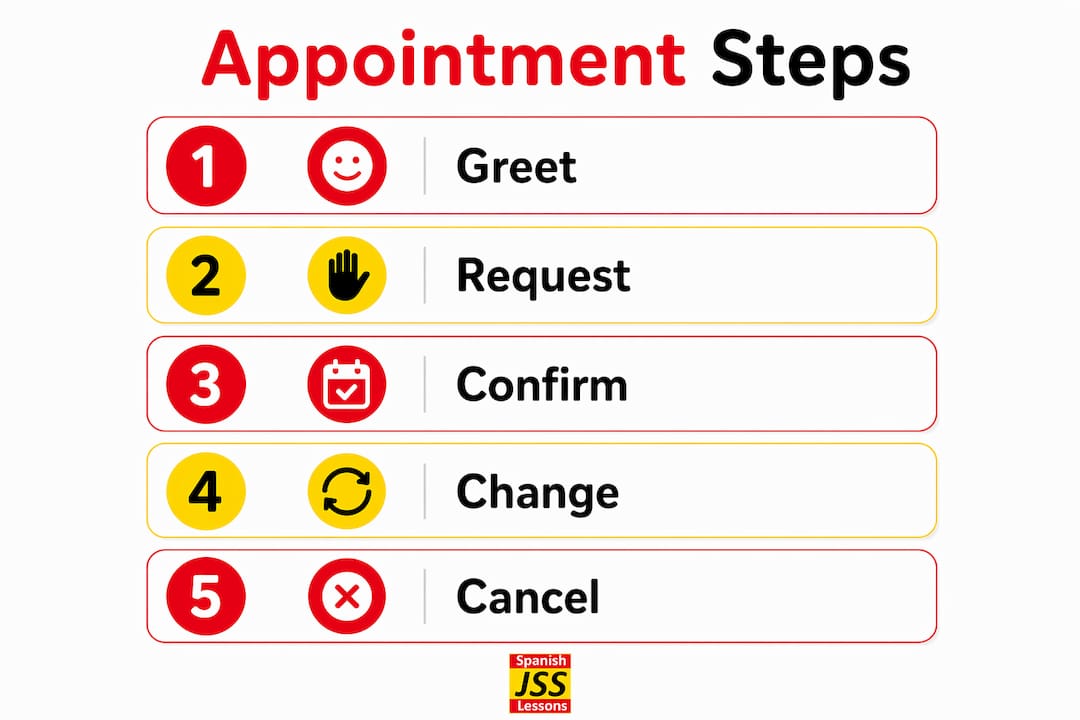
The four-step structure that appointment conversations follow is: greeting, stating your request, discussing availability, and confirming the details. Thinking of it as a structured dialogue, rather than a single sentence to memorise, makes the whole interaction far easier to manage.
Here are the core phrases to have ready:
- “Buenos días / Buenas tardes” — Good morning / Good afternoon (always open with a greeting)
- “Quisiera hacer una cita” — I would like to make an appointment
- “¿Puedo hacer una cita, por favor?” — Can I make an appointment, please?
- “Querría hablar con el médico” — I would like to speak with the doctor
- “Necesitaría una cita para esta semana” — I would need an appointment this week
- “¿Cuándo tienen disponible?” — When do you have availability?
- “Perfecto, muchas gracias” — Perfect, thank you very much
Pro Tip: Use “querría” and “necesitaría” instead of “quiero” and “necesito.” The conditional forms sound softer and more respectful, and native speakers notice the difference immediately.
The verbs “querría” and “necesitaría” are conditional forms of “querer” and “necesitar.” Using conditional tense verbs like these immediately signals politeness and cultural awareness. That single grammatical choice can change the entire tone of an interaction.
How do you express dates and times correctly for appointments in Spanish?
Spanish dates follow the order of day, then month, then year. The structure uses the preposition “de” between each element. So the 15th of march 2026 becomes “el 15 de marzo de 2026.” Spanish date structures place the day first, which is the opposite of the American format and slightly different from how British English speakers sometimes write dates informally.

One detail that trips up many learners: months and days of the week are not capitalised in Spanish. The Real Academia Española, which is the official authority on the Spanish language, confirms that “lunes,” “martes,” “enero,” and “febrero” are all written in lowercase. This applies in both handwriting and typed communication.
| English | Spanish | Notes |
|---|---|---|
| Monday | lunes | Lowercase in Spanish |
| Tuesday | martes | Lowercase in Spanish |
| 15 March 2026 | el 15 de marzo de 2026 | “de” links each element |
| At 10:30 AM | a las 10:30 | Use “a las” for times |
| At 1:00 PM | a la una | Singular “la” for 1 o’clock |
| Half past three | a las tres y media | Literally “three and a half” |
| Quarter past four | a las cuatro y cuarto | Literally “four and a quarter” |
Time expressions in Spanish use “a las” for most hours and “a la” only for one o’clock. This is a small but consistent rule that avoids confusion when confirming appointment times.
Pro Tip: When giving a date over the phone, say each element slowly and clearly: “el quince de marzo.” Receptionists often write while you speak, so pace yourself rather than rushing through the numbers.
The phrase “¿A qué hora?” means “At what time?” and is the standard question for checking when an appointment falls. “¿Qué día?” asks “Which day?” Combining these two questions covers the most common back-and-forth in any scheduling conversation. For more on Spanish for health care settings specifically, the vocabulary around times and dates follows the same patterns covered here.
How do you change or cancel an appointment politely in Spanish?
Changing or cancelling an appointment requires the same conditional politeness as booking one. The go-to phrase is “¿Podría cambiar la cita?” which means “Could I change the appointment?” The formula “¿Podría…?” combined with “por favor” is a classic softening strategy in formal Spanish communication. It is noticeably gentler than “¿Puede…?” and that difference matters in public offices.
Public administration offices in Spain expect a formal register. Using conditional forms significantly increases cooperation compared to direct imperative forms. This is especially true at the extranjería (immigration office), the Seguridad Social, and local council offices, where staff handle high volumes of requests and respond better to courteous language. If you need to reduce errors at the extranjería, getting the register right from the first sentence makes a real difference.
Useful phrases for cancellations and rescheduling:
- “Quisiera cancelar mi cita” — I would like to cancel my appointment
- “¿Podría cambiar la cita para otro día?” — Could I change the appointment to another day?
- “¿Sería posible aplazarla?” — Would it be possible to postpone it?
- “Necesitaría cambiarla, si es posible” — I would need to change it, if possible
- “Es que tengo un imprevisto” — The thing is, something unexpected has come up
That last phrase, “Es que…,” is worth memorising on its own. “Es que…” acts as a conversational softener when explaining reasons for rescheduling. It translates loosely as “The thing is…” or “It’s just that…” and signals to the listener that you are about to give a reasonable explanation rather than a demand. Native speakers use it constantly, and it makes your Spanish sound natural rather than textbook.
What does a typical appointment conversation look like in Spanish?
Viewing appointment making as a structured dialogue rather than a single phrase improves your ability to navigate the full conversation. The four stages are consistent across most settings, from a GP surgery to a hairdresser.
Here is how a typical exchange unfolds:
- Greeting. You say “Buenos días” and the receptionist responds in kind. Always open with a greeting before stating your purpose.
- Stating your request. “Quisiera hacer una cita con el médico, por favor.” You have used the conditional, named who you need, and added “por favor.” That covers the essentials.
- Discussing availability. The receptionist asks “¿Cuándo le viene bien?” (When suits you?) or “¿Tiene preferencia de día?” (Do you have a day preference?). You respond with “El martes o el miércoles, si es posible” (Tuesday or Wednesday, if possible).
- Confirming the details. The receptionist offers a slot: “Le puedo dar el martes a las 11:00.” You confirm: “Perfecto, el martes a las 11:00. Muchas gracias.”
| Stage | Your phrase | What it achieves |
|---|---|---|
| Greeting | “Buenos días” | Opens the interaction politely |
| Request | “Quisiera hacer una cita” | States purpose with conditional politeness |
| Availability | “El martes o el miércoles” | Gives options without being demanding |
| Confirmation | “Perfecto, muchas gracias” | Closes the exchange clearly |
Clear confirmations like “Entonces, la cita es el jueves a las 2:30, ¿correcto?” prevent misunderstandings. Repeating the day and time back to the receptionist is standard practice and shows you are organised. It also gives the other person a chance to correct any error before you hang up or leave.
One practical tip: speak at a measured pace. Native Spanish speakers often reply at speed, and the instinct is to match that pace. Resist it. Speaking clearly and at a moderate speed signals confidence, not uncertainty, and gives you time to process what is being said to you. For spoken Spanish practice in realistic dialogue settings, rehearsing these four stages repeatedly is the most effective preparation.
Key takeaways
Mastering appointment conversations in Spanish requires polite conditional phrases, correct date structures, and a clear four-stage dialogue framework.
| Point | Details |
|---|---|
| Use the conditional tense | “Quisiera” and “querría” signal politeness and get better results than direct forms. |
| Follow the four-stage structure | Greeting, request, availability, and confirmation cover every appointment scenario. |
| Dates go day, month, year | Write “el 15 de marzo de 2026” and keep months and weekdays in lowercase. |
| Soften cancellations with “Es que…” | This phrase explains your reason naturally and avoids sounding demanding. |
| Confirm details out loud | Repeating the day and time back prevents errors and shows you are organised. |
How James Spanish School can help you practise these conversations
Knowing the phrases is one thing. Feeling confident enough to use them in real time is another. James Spanish School was built specifically for English-speaking adults living in Spain who need practical Spanish for everyday life, not academic exams.
The 100-lesson course from James Spanish School covers sentence-building and ear-tuning, which is exactly what you need when a receptionist replies at speed and you have to process and respond quickly. The WordAmigo system embeds vocabulary and pronunciation through strategic repetition, so phrases like “Quisiera hacer una cita” become automatic rather than effortful. Everything is available on demand, 24/7, with no expiry date and no pressure. If you want to build real confidence for appointments, council offices, and daily life in Spain, the JSS course range is the place to start.
FAQ
What is the most polite way to ask for an appointment in Spanish?
The most polite form is “Quisiera hacer una cita, por favor,” using the conditional tense. Conditional verbs like “quisiera” and “querría” are standard in formal Spanish settings and produce better results than direct imperative forms.
How do you write dates correctly in Spanish?
Spanish dates follow the order of day, month, and year, linked by “de”: for example, “el 15 de marzo de 2026.” Months and days of the week are written in lowercase, as confirmed by the Real Academia Española.
How do you confirm an appointment in Spanish?
Repeat the day and time back to the receptionist using a phrase like “Entonces, la cita es el martes a las 11:00, ¿correcto?” This avoids misunderstandings and is standard practice in Spanish-speaking settings.
What should you say to cancel an appointment in Spanish?
Use “Quisiera cancelar mi cita, por favor” for a straightforward cancellation. To reschedule, say “¿Podría cambiar la cita para otro día?” and add “Es que…” followed by your reason to soften the request naturally.
Why does the conditional tense matter so much for appointments in Spanish?
Public administration offices and medical receptions in Spain expect a formal register. Using conditional forms like “¿Podría…?” and “Necesitaría…” signals respect and cultural awareness, and it directly increases how cooperative staff are in response.