

Getting Spain wrong is easier than you think. The social rules are unwritten, the meal times will catch you off guard, and what feels polite in Britain can land badly here. This spanish cultural faux pas list covers the missteps that matter most, so you can focus on connecting with people rather than recovering from awkward moments, including practical cultural faux pas useful for travellers and language learners seeking seamless integration by using an eSIM in Spain.
The most common errors English-speaking learners make include:
- Greeting incorrectly: skipping the “dos besos” or going in for a hug on a first meeting
- Eating at the wrong time: suggesting dinner at 7pm, or expecting a restaurant kitchen to be open at 6:30pm
- Over-tipping: leaving an American-style gratuity when a few coins or rounding up is the norm
- Rushing the sobremesa: leaving the table immediately after eating, rather than staying for conversation
- Taboo topics: raising money, religion, the Spanish Civil War, or Catalan independence with people you have just met
- Politeness overload: peppering every sentence with “por favor” and “gracias” in a way that sounds insincere
- Arriving early: turning up before the host is ready, which is considered intrusive
- Ignoring queuing etiquette: standing silently rather than asking “¿Quién es el último?”
- Dressing too casually: wearing beachwear or athletic clothes away from the beach or gym
Each of these carries a real social cost. Understanding why they matter is what turns a list into genuine cultural fluency.
Table of Contents
- How Spanish social etiquette works: greetings, meals, and public life
- Taboo topics and conversation norms to avoid
- How to show cultural adaptation and recover from mistakes
- Practical tips for English-speaking learners to avoid cultural errors
- Handling punctuality: the Spanish approach to time
- Gift-giving customs and how to handle a refusal gracefully
- Key takeaways
- Start learning Spanish the way it actually works in Spain
How Spanish social etiquette works: greetings, meals, and public life
Greetings
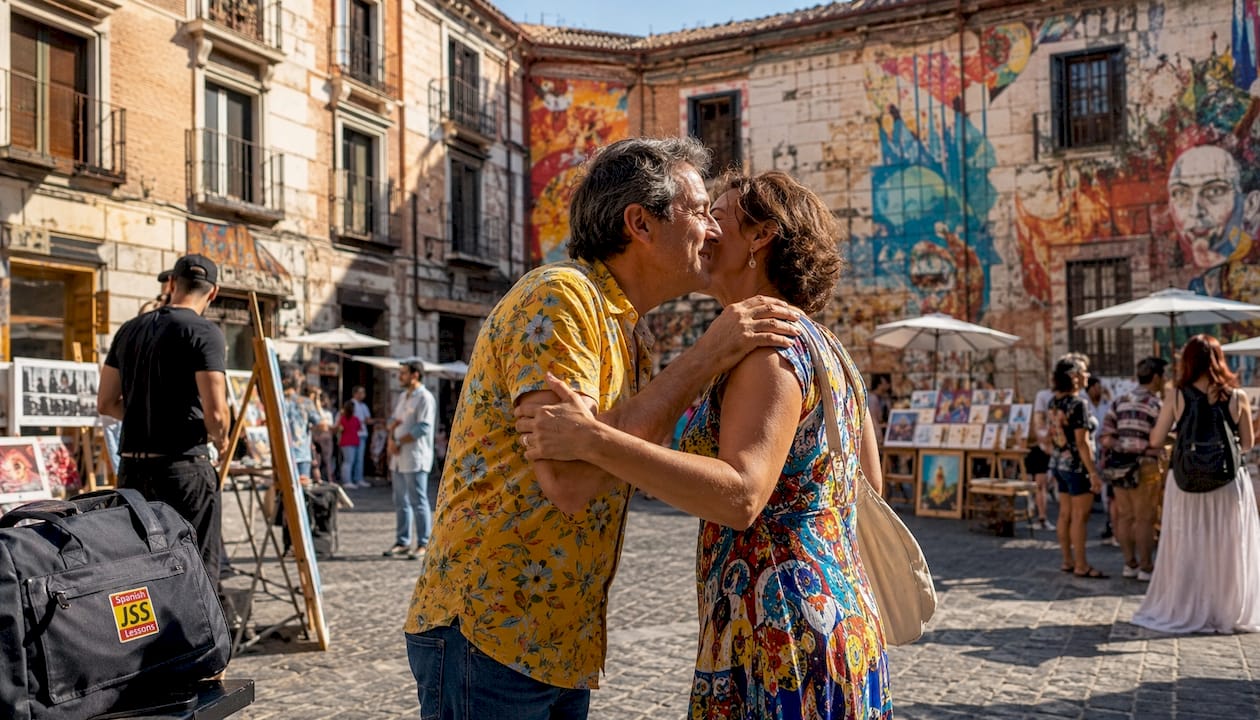
The “dos besos” is the standard social greeting between women, and between men and women. You lean in starting with the right cheek, and it applies even on a first meeting in casual settings. In professional or formal situations, a firm handshake is the expected norm. The mistake most learners make is hesitating or going straight for a hug, which reads as either cold or presumptuous depending on the context. When you walk into a small shop, café, or family gathering, greet the whole room, not just the person you came to see.
Meal times
Lunch in Spain is the main meal of the day, eaten between 14:00 and 16:00. Dinner rarely begins before 21:00. Arriving at a restaurant at 18:30 expecting a full kitchen is one of the most reliable ways to mark yourself as a tourist. The afternoon gap is not poor planning; it is a cultural rhythm built around climate, family, and lifestyle.
Pro Tip: When dining with Spaniards, keep both hands visible on the table, wait for the host or eldest person to say “¡Buen provecho!” before eating, and never guard a shared plate of tapas for yourself.
Tipping
Tipping is optional in Spain because wait staff receive a standard living wage. For a coffee, leaving small change is perfectly appropriate. At a fine-dining restaurant, a modest tip is considered generous. Leaving 20% as you might in the United States creates confusion rather than gratitude.
The sobremesa
After a meal, Spaniards stay at the table for conversation, coffee, and sometimes a digestif. This tradition, the sobremesa, is where real social bonding happens. Rushing away signals that you found the company dull. Factor it into your plans.
Public behaviour
Spaniards are comfortable with close physical proximity and will stand nearer than British social norms suggest. Overlapping conversations are normal and not considered rude. Loud English spoken in public transport, however, draws negative attention quickly. Dress neatly even for casual errands; athletic wear and flip-flops away from the beach are a reliable way to stand out for the wrong reasons.
Taboo topics and conversation norms to avoid
Spain is one of the most socially open countries in Europe. People discuss health problems over lunch, share family drama freely, and argue about football with genuine passion. Two subjects, however, are consistently off-limits in casual conversation: money and religion.
Personal finances are private in Spain. Nobody asks what you earn, what you paid for your flat, or how much your holiday cost. Bragging about wealth reads as tone-deaf, and direct questions about someone’s salary cross a clear social line. The silence around money is not embarrassment; it reflects a preference for social equality over status signalling.
Religion carries similar weight. Spain has a strong Catholic heritage, but faith is treated as intensely personal and rarely discussed openly, even among friends. Asking someone whether they attend church or believe in God can feel invasive, regardless of your intention.
Beyond money and religion, these topics require care:
- The Spanish Civil War: still emotionally raw for many families; listen first, never lead
- Catalan independence: you cannot know your companion’s position, so avoid taking sides
- Gibraltar and regional politics: capable of turning a pleasant evening tense very quickly
- Personal family matters: shared only when a relationship is established, not on first acquaintance
Safe ground for small talk includes food, travel, local culture, and sport. If a sensitive subject arises naturally, the phrase “¿Te importa si hablamos de esto?” (“Do you mind if we talk about this?”) shows respect before you proceed. Steering away from divisive subjects is not avoidance; it is how Spaniards prioritise social harmony over winning an argument.
How to show cultural adaptation and recover from mistakes
Spaniards are generally forgiving when they see genuine effort. Cultural integration is less about perfect etiquette and more about a visible, sincere willingness to adapt. Nobody expects a newcomer to get everything right immediately. What earns respect is observation, humility, and a readiness to mirror local behaviour.
James Bretherton, founder of James Spanish School and a dual-native speaker with 40 years living in Spain, makes this point consistently in his teaching: the learners who settle most comfortably are those who watch before they act. Notice how people greet each other in a specific setting before you commit to a style. Follow the host’s lead at the dinner table. Ask “¿Quién es el último?” when you join a queue rather than standing silently and hoping the system works itself out.
Pro Tip: When you make a mistake, a simple, warm acknowledgement in Spanish goes further than a lengthy apology in English. “Perdona, no lo sabía” (“Sorry, I didn’t know”) delivered with a smile signals exactly the right attitude.
Practical scenarios where adaptation shows most clearly include shopping (greeting the staff when you enter), dining (waiting for the sobremesa rather than asking for the bill immediately), and social gatherings (arriving slightly after the stated time rather than on the dot). Each small adjustment builds credibility over time. You can find deeper guidance on adapting to Spanish customs through James Spanish School’s dedicated resources.
Practical tips for English-speaking learners to avoid cultural errors
Language and culture are inseparable. Getting the words right without understanding the social context behind them produces exactly the kind of well-meaning awkwardness this article is designed to prevent. Here is what actually helps:
- Learn culturally loaded phrases first: “¡Buen provecho!”, “¿Quién es el último?”, “La cuenta, por favor”, and “Vale” will serve you in daily life far more than textbook grammar drills
- Calibrate your politeness: use “por favor” and “gracias” naturally, but do not attach them to every sentence; Spanish communication relies more on tone and warmth than on formal markers
- Embrace overlapping conversation: speaking over someone in Spain is not interrupting, it is engaging; silence can read as disinterest
- Be direct: Spanish communication is more straightforward than British norms; over-softening a point or relying on heavy sarcasm creates confusion rather than tact
- Respect regional identity: Catalonia, the Basque Country, and Galicia have their own languages and cultural pride; referring to everything as simply “Spanish” can feel dismissive in those regions
- Dress for the setting: smart-casual is the baseline for most social situations; religious sites require covered shoulders and knees
- Default to “tú”: modern Spain is informal, and “usted” in the wrong context creates unnecessary distance; mirror what the other person uses
The WordAmigo system, developed by James Spanish School with input from long-term English expats fully immersed in Spanish society, addresses the two frustrations that undermine cultural confidence most: vocabulary that will not stick and pronunciation that native speakers struggle to follow. Its five-step retention loop covers reading, listening, speaking, and writing, so the phrases you need in real social situations actually stay with you. For a broader look at avoiding common Spanish mistakes, James Spanish School’s practical guide is worth bookmarking alongside this one.
Handling punctuality: the Spanish approach to time
Punctuality in Spain is entirely context-dependent, and treating it as a single national trait is one of the most common missteps visitors make. For business meetings, medical appointments, and any formal or official setting, being on time is expected and lateness damages credibility. Arriving early to a private home, however, is considered intrusive because it catches the host mid-preparation.
For social gatherings, a relaxed approach to arrival time is the accepted norm. Turning up at the exact stated time to a dinner party at someone’s home is actually a minor social faux pas in Spain. The host needs that buffer to finish cooking or tidying. Arriving early is universally seen as rude, while a slightly later arrival is simply good manners.
The practical rule: be punctual for anything professional or official, and give yourself a little extra time before arriving at anything social and private. If you are used to British precision, this requires a conscious mental shift rather than a vague intention to “be more relaxed.”
Gift-giving customs and how to handle a refusal gracefully
Arriving at a Spanish home empty-handed is a clear social misstep. The custom is to bring a small, quality gift: a good bottle of local wine, artisanal chocolates, or a freshly baked pastry from a neighbourhood bakery all work well. The gesture matters more than the price. One firm rule: avoid chrysanthemums entirely, as they are associated with funerals and All Saints’ Day and carry an unmistakably sombre meaning.
When you receive a gift, the Spanish approach is often to set it aside rather than open it immediately in front of the giver. Do not read this as indifference; it is simply the local convention. Opening a gift on the spot and performing visible delight can actually feel performative in this context.
If you need to decline a gift or an offer, do so warmly and briefly. A simple “Es muy amable de tu parte, pero no hace falta” (“That’s very kind of you, but there’s no need”) handles the moment without awkwardness. Refusing too forcefully or repeatedly, on the other hand, can make the giver feel their gesture was unwelcome. One polite decline, delivered with genuine warmth, is always enough.
Key takeaways
Avoiding Spanish cultural faux pas comes down to three things: learning the unwritten timing rules, respecting conversational boundaries around money and religion, and showing visible willingness to adapt rather than expecting perfection from yourself.
| Point | Details |
|---|---|
| Meal times are non-negotiable | Lunch runs 14:00–16:00; plan around this, not against it. Dinner rarely starts before 21:00. |
| Tipping is optional | Staff receive a living wage; small change for coffee and around 5–10% for fine dining is generous, not obligatory. |
| Money and religion are private | Avoid both topics in casual conversation; they are considered too personal and divisive for social settings. |
| Punctuality depends on context | Be on time for professional settings; a relaxed arrival is expected and appropriate for social gatherings. |
| Adaptation earns forgiveness | Spaniards respond warmly to visible effort; a sincere attempt to follow local customs matters more than flawless behaviour. |
Start learning Spanish the way it actually works in Spain
James Spanish School was built specifically for English-speaking adults who want real-life Spanish, not exam preparation. James Bretherton’s 40 years of living in Spain inform every lesson, from the cultural habits covered in this article to the sentence structures you need for conversations with neighbours, tradespeople, and local officials. The WordAmigo system locks in vocabulary and pronunciation through a proven retention loop, so what you learn stays with you when it counts. Explore the full course at James Spanish School and start building the cultural and language confidence to feel genuinely at home in Spain.