

What is comprehensive language learning
TL;DR:
- Comprehensive language learning combines skills, culture, and technology to produce lasting fluency for adult expats.
- A CEFR-aligned approach emphasizes integrated practice, real-life tasks, and lifelong progression, tailored to adult goals and constraints.
Comprehensive language learning is a CEFR-aligned, whole-person approach that integrates listening, speaking, reading, writing, cultural competence, and technology to produce usable, lasting Spanish. For English-speaking adults moving to or living in Spain, this is the difference between a phrase book and a life skill. The rest of this guide explains what the approach covers, why it suits adult expats specifically, and how a self-paced course like James Spanish School puts it into practice.
Table of Contents
- What comprehensive language learning actually means
- Why adult expats need a different set of principles
- The components every good course must cover
- A self-paced plan for UK adult expats: 6–12 months to real progress
- Which tools and techniques actually support retention?
- How James Spanish School applies this approach in practice
- Key takeaways
- Useful sources and further reading
What comprehensive language learning actually means
The Council of Europe’s CEFR defines a comprehensive framework as one that describes the full range of language knowledge, skills, and use for communicative tasks across cultural boundaries. In plain terms: no single skill is treated in isolation. Grammar, vocabulary, listening, speaking, and cultural awareness are all part of the same engine.
The practical scope for an adult learner includes:
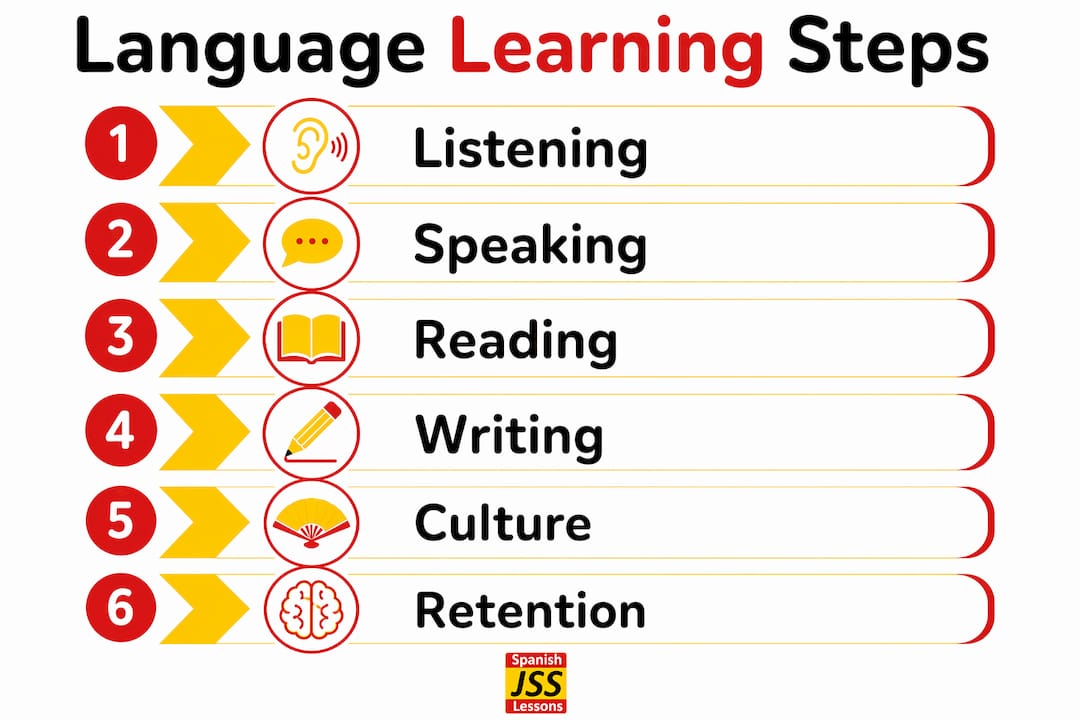
- Language skills: listening, speaking, reading, and writing as an integrated set
- Sociocultural competence: understanding how Spanish people actually behave, not just what the textbook says
- Pragmatic use: knowing when and how to use language in real situations (a doctor’s waiting room, a town hall queue)
- Affective factors: managing the emotional side of learning, including confidence and motivation
- Technology: using digital tools to reinforce and extend what you learn in lessons
- Lifelong progression: mapping your growth to CEFR levels (A1 through C2) so progress is visible and measurable
EU policy reinforces this. The European Commission’s 2018 staff working document explicitly recommends comprehensive strategies that include language awareness and continuity between formal and informal learning — exactly the kind of joined-up approach that works well for self-paced adult learners.
Why adult expats need a different set of principles
The core principles for adult learners are whole-person engagement, integrated practice, spaced retention, and task-based communication. These are not the same priorities a teenager in a classroom has.
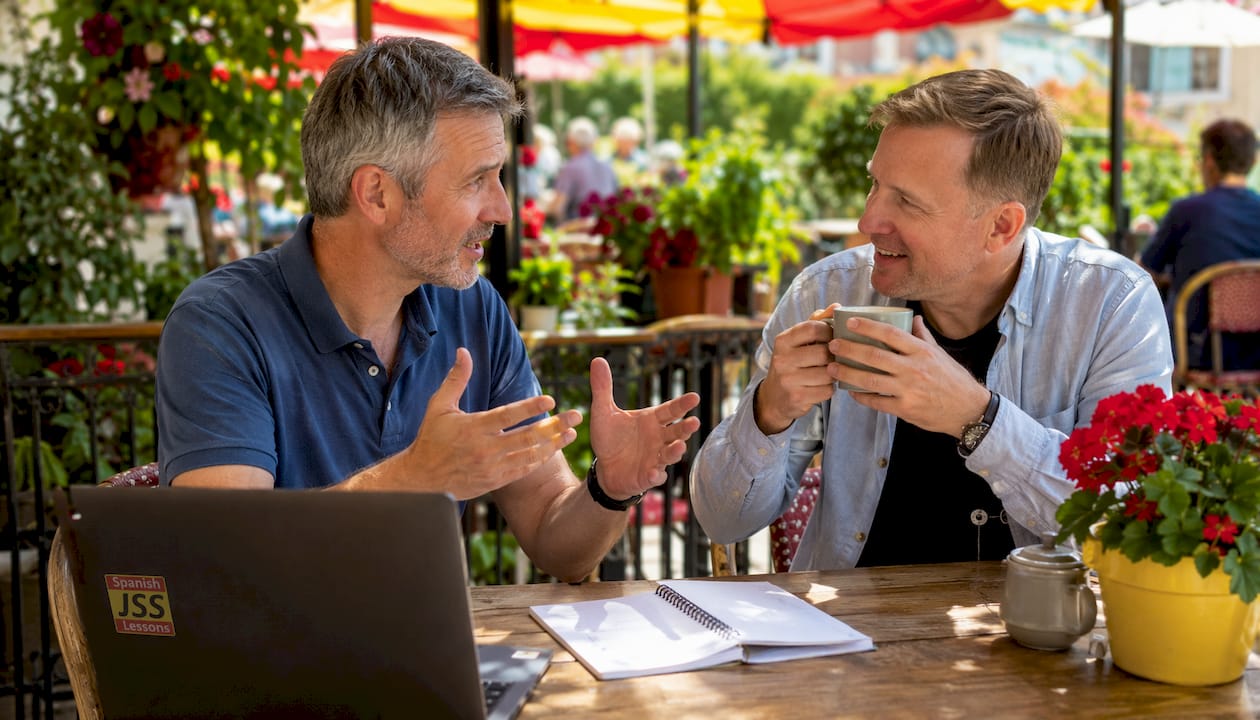
Adults come to language learning with clear goals (survive a medical appointment, chat with neighbours), real time constraints (work, family, life admin), and emotional baggage that younger learners rarely carry. Fear of sounding foolish in front of a shopkeeper is a genuine barrier. So is the perfectionist tendency to avoid speaking until every verb ending is memorised. A holistic approach treats the learner as a whole person, prioritising communicative competence and real-life needs over rule-based drilling.
Tailoring activities to your own goals and life context is what makes learning sustainable for adults. A retired expat in Andalucía needs different vocabulary from a professional in Madrid. Matching the course to your actual daily life keeps motivation alive.
Pro Tip: Perfectionism is the enemy of progress. Set a rule for yourself: speak before you feel ready. Low-stakes practice, such as ordering a coffee or asking for directions, builds the neural pathways that make fluency possible. Errors are data, not failures.
The components every good course must cover
A truly comprehensive programme delivers all of the following. Use this as a checklist when evaluating any course:
- Listening: graded audio from slow, clear speech to fast native conversation (“ear-tuning”)
- Speaking: micro-tasks such as short role-plays, repeating after a native speaker, and self-recording
- Reading: real-world texts (notices, menus, forms) rather than invented textbook passages
- Writing: dictation exercises and short written responses to consolidate what you hear and say
- Pronunciation: systematic attention to sounds that trip up English speakers (the Spanish r, vowel purity)
- Vocabulary in context: words learned inside sentences, not on isolated flashcard lists
- Grammar in context: structure explained through meaning and use, not Latin-derived labels
- Cultural competence: understanding social norms, regional habits, and unwritten rules
- Assessment tied to CEFR milestones: functional checkpoints (can you order food? register at the town hall?) rather than abstract test scores
Each component maps directly to expat life. Listening practice prepares you for the machine-gun speed of a Spanish builder explaining a quote. Pronunciation work means the pharmacist actually understands you. Cultural competence stops you accidentally offending your neighbours.
Pro Tip: Don’t skip the cultural layer. Knowing that Spaniards rarely queue the way British people do, or that a mid-morning coffee break is a near-sacred institution, makes real conversations far less baffling. Cultural insights like these are what separate a textbook learner from someone who genuinely fits in.
A self-paced plan for UK adult expats: 6–12 months to real progress
A self-paced framework of consistent study over several months can take you from zero to functional independence at CEFR A2/B1, covering the everyday tasks that matter most to expats. The key is structured progression, not marathon sessions.
| Month | Focus | Weekly hours | CEFR target |
|---|---|---|---|
| 1–2 | Sentence-building foundations, core vocabulary, pronunciation basics | 4–5 hrs | A1 |
| 3–4 | Listening practice, everyday transactions (shops, cafés) | 5–6 hrs | A1+ |
| 5–6 | Extended conversations, reading real texts, cultural context | 5–6 hrs | A2 |
| 7 | Medical, official, and social language; ear-tuning for fast speech | 6–7 hrs | A2+ |
| 12 | Consolidation, spontaneous conversation practice, review loops | 5–6 hrs | B1 entry |
Functional milestones to track your progress:
- Order food and drink, including specifying preferences
- Ask for and understand directions
- Register with a local town hall (padrón municipal)
- Manage a basic medical appointment
- Follow a conversation between two native speakers at normal speed
- Read and complete an official form
On-demand modules are ideal for “gap days” when life gets in the way. A 20-minute lesson on your phone during a commute counts. The flexibility of self-paced courses is not a compromise; it is what makes consistent progress possible for adults with real lives.
Which tools and techniques actually support retention?
The most effective tool categories for adult learners are AI-powered spaced repetition systems for vocabulary retention and structured listening workflows for pronunciation. Choosing the right technology matters more than choosing the most expensive one.
When selecting a tool, look for:
- Evidence of retention: does it use spaced repetition, not just random quizzes?
- Suitability for European Spanish: many apps default to Latin American pronunciation
- Integration with your course: a standalone app that contradicts your lessons creates confusion
- Cost and access model: one-time purchase or free tier beats a monthly subscription you abandon
Techniques to build into your weekly routine:
- Spaced repetition: review new vocabulary at increasing intervals to move it into long-term memory
- Shadowing: listen to a native speaker and repeat immediately, matching rhythm and intonation
- Focused listening: replay the same short audio clip until you catch every word, then check the transcript
- Contextualised vocabulary: learn words inside the sentences you will actually use, not in isolation
Technology makes language learning easier when it reinforces contextualised learning rather than replacing it. A tool that drills words in isolation misses the point. The goal is a web of connected knowledge, where a word triggers a sentence, a sentence triggers a situation, and a situation triggers confidence.
Pro Tip: Use the role of listening as your daily anchor. Even ten minutes of focused audio replay, without looking at a transcript, trains your ear faster than any grammar exercise.
How James Spanish School applies this approach in practice
James Spanish School’s Radical Simplification method maps directly onto every component of comprehensive language acquisition described above. The course strips out the grammar terminology that native speakers never use when learning their own language, replacing it with plain English explanations of how Spanish structure actually works. That is the engine room of sentence construction, made accessible.
The course delivers:
- 100 lessons split between sentence-building and ear-tuning, covering the full skill set
- WordAmigo: an AI-powered retention system built by IT experts and long-term English expats, using strategic repetition to permanently embed vocabulary and pronunciation
- The Five-Step Retention Loop: WordAmigo automates exposure across reading, listening, speaking, and writing in a single practice cycle
- Lifetime, on-demand access: available 24/7 on phone, tablet, or laptop, with no expiry date and no countdown pressure
- Cultural insider knowledge: James Bretherton’s 40 years of lived experience in Spain, covering everything from queuing habits to the builder’s mid-morning break
- Cast-iron guarantee: if a core lesson teaches you nothing new, James credits you with extra practice modules at no cost
A typical lesson outcome: after the sentence-building module on making requests, you can walk into a Spanish pharmacy, explain a symptom clearly, and understand the pharmacist’s reply at normal conversational speed. That is the functional test a comprehensive approach is built around.
James Bretherton is a dual-native speaker who has lived in Spain for 40 years. The course is built for adult language learners who need real-life Spanish, not exam results.
Ready to put a comprehensive approach into practice? Explore the full course at James Spanish School and start with lifetime access today.
Key takeaways
Comprehensive language learning works because it integrates all four skills, cultural competence, and a retention system into a single, CEFR-aligned framework that matches the real goals of adult expats.
| Point | Details |
|---|---|
| CEFR alignment matters | Map your progress to A1–B1 functional milestones, not abstract grammar scores. |
| Adults need whole-person methods | Emotional barriers like perfectionism are as important to address as vocabulary gaps. |
| All nine components are required | Listening, speaking, reading, writing, pronunciation, vocabulary, grammar, culture, and assessment must all be present. |
| Spaced repetition is non-negotiable | Tools like WordAmigo embed vocabulary permanently by automating the Five-Step Retention Loop. |
| Personalise to your expat goals | Align activities to the real tasks you face: appointments, forms, neighbours, tradespeople. |
Useful sources and further reading
- Common European Framework of Reference for Languages (Council of Europe): the primary reference for CEFR levels, milestones, and the definition of comprehensive language competence
- EU Commission staff working document on comprehensive language teaching (EUR-Lex): policy context for comprehensive approaches and language awareness in lifelong learning
- Holistic approach to language teaching (British Council / TeachingEnglish): practitioner explanation of whole-person pedagogy and communicative competence
- James Spanish School course shop: explore the 100-lesson European Spanish course with WordAmigo and lifetime access
- How to memorise Spanish vocabulary for everyday fluency: practical retention techniques from James Spanish School
- Cultural insights in language learning: partner guide on cultural competence and authentic exposure for language learners