

Guide to Spanish word families
A word family is a cluster of related words that share one root, and learning them together builds vocabulary far faster than memorising words one at a time. Learn the root vivir (to live), and you get vida (life), vivo (alive/lively) almost for free. Learn leer (to read), and lectura (reading) and lector (reader) follow the same pattern. The single highest-impact move you can make is picking one high-frequency root and mapping the two or three suffixes that turn it into a noun, an adjective, or an adverb. Doing this repeatedly over time multiplies your vocabulary substantially beyond the count of individual roots.
Key Takeaways
Spanish word families let learners multiply vocabulary by mapping one root through its common suffixes rather than memorising isolated words.
| Point | Details |
|---|---|
| Definition | A word family shares one root (raíz) across verbs, nouns, adjectives, and adverbs, such as vivir, vida, vivo. |
| Priority suffixes | Learn −ción, −dad, −ura, −ez, −mente, −dor, and −able first; they generate the largest number of usable words. |
| False friends risk | Cognate-looking words inside a family, such as sensible or embarazada, need context checks before you trust them. |
| Best next step | Pick one root today, map three suffixes, and write five original sentences before adding it to spaced repetition. |
| Guided practice | James Spanish School’s course and WordAmigo system reinforce family-based vocabulary across listening, speaking, and writing at Jamesspanishschool. |
Table of Contents
- Compact 5-step study plan you can start today
- What word families are and the main types you need to know
- Core suffixes that generate entire word families
- Ready-to-study themed word families for your flashcards
- Practical exercises and routines that make word families stick
- How James Spanish School applies word-family practice
- False friends versus true cognates in word families
- Spotting new word families while reading or listening
- If you want guided practice: the James Spanish School option
- Sources
Compact 5-step study plan you can start today
You do not need a semester of grammar to put word families to work. You need one root, twenty minutes, and a routine you will actually repeat.
- Step 1. Choose a root. Pick a verb or noun you already half know, ideally one that shows up constantly in daily conversation, such as trabajar, hablar, or sentir.
- Step 2. Map the common suffixes. Ask what noun, adjective, and adverb the root produces. Trabajar gives you trabajo (job), trabajador (worker/hardworking), and trabajosamente (laboriously).
- Step 3. Build five original sentences. Force yourself to use at least three family members in sentences about your own life, not textbook examples.
- Step 4. Add the family to a spaced repetition system. Group the words together on one card rather than scattering them across separate entries, so your brain learns the pattern, not just the word.
- Step 5. Review in context, not isolation. Reread your sentences aloud a day later, then again three days later.
A simple checkpoint schedule keeps this from fizzling out after week one and after initial learning. After some practice, review several families multiple times. Over time, work toward recognising a growing number of families on sight, in both reading and fast speech.
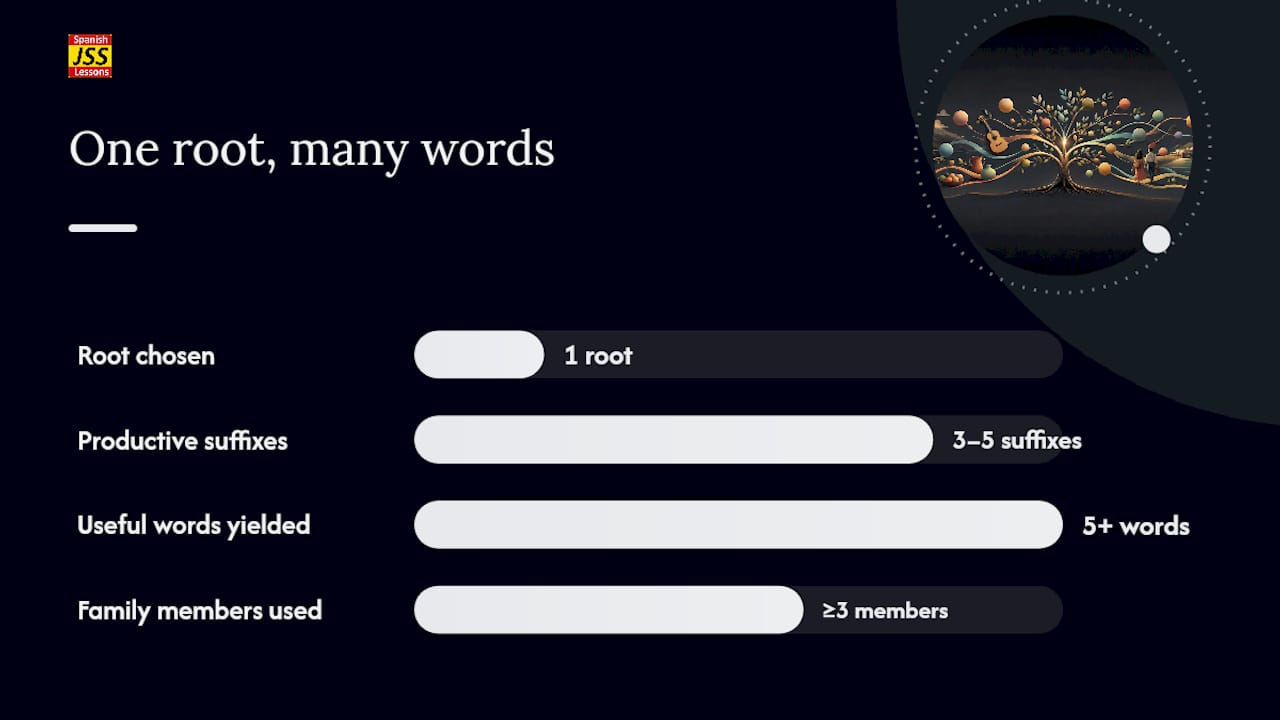
Pro Tip: Prioritise roots that appear constantly in graded readers, podcasts, or Spanish-language playlists before chasing obscure vocabulary. A SpanishStep analysis found that a single root plus three to five productive suffixes typically yields five or more genuinely useful words, which is a far better return on twenty minutes than memorising a random list.
What word families are and the main types you need to know
Spanish word families fall into two categories, and conflating them is the most common mistake learners make. Morphological families share a root and change meaning through prefixes or suffixes: feliz (happy), felicidad (happiness), felizmente (happily), infeliz (unhappy). Rhyming families merely share a sound pattern at the end of the word, such as -ón words like camión and avión, and knowing one tells you almost nothing reliable about the others’ meaning or grammar. Focus your energy on morphological families. They are the ones that genuinely multiply vocabulary.
Two terms are worth knowing, because Spanish grammar resources use them constantly. The raíz (root, also called lexema) carries the core meaning, and the gramema is the piece attached to it that signals grammatical function, tense, or category. In trabajador, trabaj is the raíz and -ador is the gramema marking “one who does this.” According to SpanishStep’s explanation of word families, this shared-root structure is precisely what lets learners predict the meaning of a word they have never seen before, simply by recognising the raíz.
Try this now: take the verb sentir (to feel) and write three derivatives without checking a dictionary. If you land on sentimiento (feeling), sensible (sensitive), and sentido (sense/meaning), you have already grasped the pattern that makes this whole method work.
Core suffixes that generate entire word families
A handful of suffixes do most of the heavy lifting in Spanish vocabulary building. Once you recognise them, unfamiliar words stop looking random and start looking like puzzles you can solve on sight. A university textbook chapter on word families lays out several of the most productive patterns, including adjective-to-noun transformations such as blanco (white) becoming blancura (whiteness), and triste (sad) becoming tristeza (sadness).

| Suffix | Grammatical shift | English cue | Example |
|---|---|---|---|
| −ción / −sión | verb → noun (action/result) | “-tion” | crear → creación |
| −dad / −tad | adjective → noun (abstract quality) | “-ity” | posible → posibilidad |
| −ura | adjective → noun (state/quality) | “-ness” | loco → locura |
| −ez / −eza | adjective → noun (abstract quality) | “-ness” | viejo → vejez |
| −mente | adjective → adverb | “-ly” | lento → lentamente |
| −dor / −or / −ista | verb/noun → agent noun | “-er/-ist” | trabajar → trabajador |
| −able / −ible | verb → adjective (capability) | “-able/-ible” | comer → comestible |
The suffixes −ura and −ez both turn adjectives into abstract nouns, but they are not interchangeable, and no reliable rule tells you which applies to a new adjective. Locura (madness) uses −ura; vejez (old age) uses −ez. The only dependable fix is exposure: read enough Spanish and the correct pairing starts to feel automatic, the same way native English speakers know “happiness” is right and “happinity” is wrong without ever studying the rule. University materials treat these endings as meaning cues rather than arbitrary decoration, which is the mindset shift that makes this whole suffix table useful rather than academic.
Ready-to-study themed word families for your flashcards
Grouping vocabulary by theme, rather than purely by root, gives you families you can actually deploy in conversation the same week you learn them. Course material from Spanish Academy’s guide to word families highlights everyday clusters such as agua, flor, leer, deporte, and sol as ideal starting points because they surface constantly in daily life.
Work and daily routine (trabajo): trabajar (to work), trabajo (job/work), trabajador/a (worker, or hardworking as an adjective), trabajoso (laborious). Sentence: “Mi trabajo es duro pero mis compañeros son muy trabajadores.”
Health (salud): saludar (to greet, note the false friend risk here), salud (health), saludable (healthy). Sentence: “Comer bien es la base de una vida saludable.”
Food (comer): comer (to eat), comida (food/meal), comedor (dining room), comestible (edible). Sentence: “El comedor está listo y la comida huele deliciosa.”
Emotion (sentir): sentir (to feel), sentimiento (feeling), sensible (sensitive), sensato (sensible/wise). Sentence: “Es una persona muy sensible, siempre pendiente de los sentimientos de los demás.”
Travel (viajar): viajar (to travel), viaje (trip/journey), viajero/a (traveller), viajado (well travelled). Sentence: “Después de tantos viajes, se ha convertido en un viajero experimentado.”
Prioritise the work, food, and health families first. They cover the situations you will actually encounter within days of starting to speak, whether that is ordering at a bar or explaining a symptom to a pharmacist.
Practical exercises and routines that make word families stick
Recognising a suffix pattern on paper is not the same skill as recognising it in fast, connected speech, and most learners never build the second one because they only ever practise reading. A handful of exercises close that gap.
Make five original sentences using at least three members of one family, focused on your own life rather than a textbook scenario. Shadowing, where you listen to a short clip and repeat it aloud in real time, forces you to notice how word groups blend together at native speed, and research on Spanish word groups shows that this kind of chunking practice meaningfully speeds up comprehension. Targeted reading works well too: pick a short article, and give yourself a strict rule to look up no more than five unknown words, prioritising ones that reveal a root you can reuse elsewhere. Production drills, where you’re given a root cold and must generate the noun, adjective, and adverb forms out loud within a few seconds, build the retrieval speed that separates recognising Spanish from actually speaking it.
Feed each family into your spaced repetition tool as a single grouped card rather than five separate ones. Systems like WordAmigo apply strategic repetition across reading, listening, speaking, and writing rather than a single flashcard flip, which matters because passive recognition (understanding a word when you hear it) and active recall (producing it unprompted) are genuinely different skills that need separate testing.
If you have twenty minutes, drill one family: five minutes mapping suffixes, ten minutes on sentence production, five minutes reviewing yesterday’s cards. With forty five minutes, add a short shadowing exercise using a clip that contains at least two members of your target family. With ninety minutes, work through three families end to end, including a written paragraph that uses all of them together, then read it aloud twice.
How James Spanish School applies word-family practice
James Spanish School builds its entire teaching method around removing unnecessary grammar terminology and instead showing learners the patterns directly, an approach founder James Bretherton calls Radical Simplification. Rather than explaining that −dor is an agentive suffix attached to a verb stem, the method simply shows you trabajar → trabajador and jugar → jugador side by side until the pattern clicks the way it did the first time you noticed “-er” makes an English verb into a person who does it.
A worked example from the course takes the root hablar (to speak) and maps it into habla (speech, as a noun), hablador/a (talkative, as an adjective), and hablante (speaker, as a noun) before dropping all three into a short exchange: “Es muy hablador, pero cuando habla de verdad, todos escuchan.” That single root, taught once, gives a learner three usable words and the confidence to guess a fourth the next time they meet it.
James Bretherton has lived in Spain for 40 years as a dual-native speaker, and the course’s 100 lessons split time between sentence-building and what the school calls “ear-tuning”: training your ear to catch these word families at the speed native speakers actually use them. The WordAmigo system layers a Five-Step Retention Loop on top of this, cycling vocabulary through reading, listening, speaking, and writing so that a word family is not just seen once but reinforced across every skill until it holds. Learners can explore the Family-themed practice lessons to see how this looks in a full sentence-building context.
False friends versus true cognates in word families
A true cognate shares both form and meaning across English and Spanish because both languages inherited the word from the same source, usually Latin. Nación and “nation,” información and “information,” posibilidad and “possibility” are all safe bets, and the −ción/−dad suffix patterns in the table above line up almost perfectly with English “-tion/-ity” endings for exactly this reason.
A false friend looks like a cognate but carries a different meaning, and word families make this trap worse, not better, because an entire family can mislead you at once. Embarazada looks like “embarrassed” but means “pregnant.” Sensible looks like “sensible” but means “sensitive,” while the Spanish word for “sensible” (as in level-headed) is sensato, a member of a different family entirely. Realizar looks like “to realise” (as in becoming aware) but actually means “to carry out” or “to accomplish.”
The practical fix is simple: never trust a cognate you have not seen in context at least once. When you meet a new derivative that looks suspiciously like an English word, check it against a sentence rather than assuming the resemblance holds, and flag any family where one member has already surprised you, because the rest of that family deserves extra scrutiny too.
Spotting new word families while reading or listening
Once you know the suffix patterns, Spanish text starts revealing its own structure without a dictionary. When you meet an unfamiliar word while reading, strip the ending first. If you see −mente, you already know it is an adverb, and the adjective underneath (drop the −mente, and often adjust the ending) is probably a word you already recognise. If you see −ción or −sión, you are looking at a noun describing an action or result, and the verb it came from is usually one conjugation change away.
Listening is harder because you cannot pause and inspect spelling mid-sentence, but the same instinct applies to sound. Spanish speech naturally clusters into short phonetic chunks, and once you can hear where one chunk ends and the next begins, spotting a stressed root inside a longer word becomes far easier, a skill covered in more depth in why Spanish listening is hard and how to beat it. Keep a small running list of roots that recur across a single podcast episode or news article; if the same root turns up three times with three different endings, that is a family worth stopping to map properly, because frequency inside real content is the best signal of which patterns are actually worth your time. Tools that combine listening drills with vocabulary building, such as the workflow approaches from Canary, can reinforce this same habit of catching roots by ear rather than only on the page.
If you want guided practice: the James Spanish School option
Working through word families alone gets you a long way, but a structured course closes the gap between recognising a pattern and using it instinctively mid-conversation, which is exactly where most self-taught learners stall. James Spanish School’s 100-lesson course was built for English-speaking adults who want that structure without wading through grammar terminology that never comes up when a native speaker is actually talking to you.
The course pairs sentence-building lessons with the WordAmigo system, so a root you learn in lesson twelve gets recycled through listening, speaking, and writing drills for weeks afterwards rather than fading after a single exposure. Everything runs on demand, with no expiry date, so a family you half-learn today can be revisited as often as it takes. If a core lesson genuinely teaches you nothing new, James Bretherton backs it with a cast-iron guarantee of extra practice modules at no cost. Browse the full course and current options at James Spanish School’s shop to see which starting point fits where you are today.
Sources
The RAE’s grammar guide to grupos sintácticos explains how word groups form around a grammatical nucleus, useful background for understanding why derivatives behave predictably inside phrases.
The university textbook chapter on word families offers a dense reference table of suffix patterns with dozens of worked adjective-to-noun examples, ideal for building your own suffix cheat sheet.
TuLengua’s Familias TIP database is a searchable tool for checking derivatives and assembling themed lists beyond the examples covered here.
FAQ
What exactly counts as a Spanish word family?
A word family is a set of words that share a root and change grammatical category through prefixes or suffixes, such as feliz, felicidad, and felizmente. Words that merely rhyme without sharing that root, like camión and avión, are not a true morphological family.
How many word families should I learn per week?
Learning several families per week is realistic for many learners studying twenty to thirty minutes daily, provided each family gets reviewed multiple times within that week rather than just once.
Do false friends appear inside entire word families or just single words?
They can spread through a whole family. Sensible means “sensitive” rather than “sensible,” and related forms in that family carry the same trap, which is why checking a new derivative against context matters more than trusting the resemblance to English.
Is memorising suffixes alone enough to build vocabulary quickly?
No. Suffix recognition tells you what grammatical category a word probably belongs to, but you still need sentence production and listening practice to use the word naturally, which is why a routine combining both works far better than suffix drilling on its own.
- 15.5 Word Families – Spanish for Reading and Translation
- Spanish Word Families Explained for Grammar and Vocabulary | SpanishStep
- Advanced Spanish Vocabulary: Word Families familia de palabras | Spanish Academy