

What is comprehensive Spanish guide
TL;DR:
- A comprehensive Spanish guide combines grammar, vocabulary, culture, and conversation into a structured learning system for adult learners. It emphasizes active noticing, contextual vocabulary, and daily practice to develop fluency effectively in European Spanish. Immersion, cultural understanding, and tailored methods are essential for success beyond passive study or generic language apps.
A comprehensive Spanish guide is an all-encompassing resource that combines proven language acquisition methods, cultural immersion strategies, and vocabulary retention systems to help adult learners achieve real fluency in European Spanish. The standard industry term for this type of resource is a structured language learning programme, and the best versions go far beyond grammar tables. They integrate listening, speaking, reading, and cultural understanding into a single, coherent system. Tools like Anki, platforms like Jamesspanishschool, and publishers such as Cambridge University Press each represent a piece of this puzzle. This article explains what a complete Spanish learning resource looks like, which methods actually work, and how to put it all together.
What is a comprehensive spanish guide and why does it matter?
A comprehensive guide to Spanish is defined by what it combines, not what it contains in isolation. Grammar alone does not produce fluency. Vocabulary lists alone do not produce conversation. The most effective Spanish study guide brings together sentence structure, pronunciation, cultural context, and memory retention into one coherent learning path.
For English speakers moving to or living in Spain, this distinction is critical. European Spanish, specifically Castilian Spanish as spoken across mainland Spain, carries regional vocabulary, distinct pronunciation patterns, and social norms that a generic Latin American course will not address. The word vosotros, for example, is used constantly in Spain but absent from most apps built for a global audience.
James Spanish School was built specifically around this gap. Founded by James Bretherton, a dual-native speaker with 40 years of living in Spain, the school’s 100-lesson course focuses on real-life conversations with neighbours, tradesmen, health workers, and local officials. That specificity is what separates a genuine Spanish language guide for beginners from a generic language app.
What are the most effective methods for learning european spanish?
Immersion paired with structured vocabulary systems accelerates fluency faster than either approach alone. That finding, drawn from research by Spanish Hackers in 2024, confirms what experienced teachers have observed for decades. High-volume comprehensible input, meaning Spanish you can mostly understand, trains your ear. Active recall, meaning retrieving words and structures from memory, locks them in.
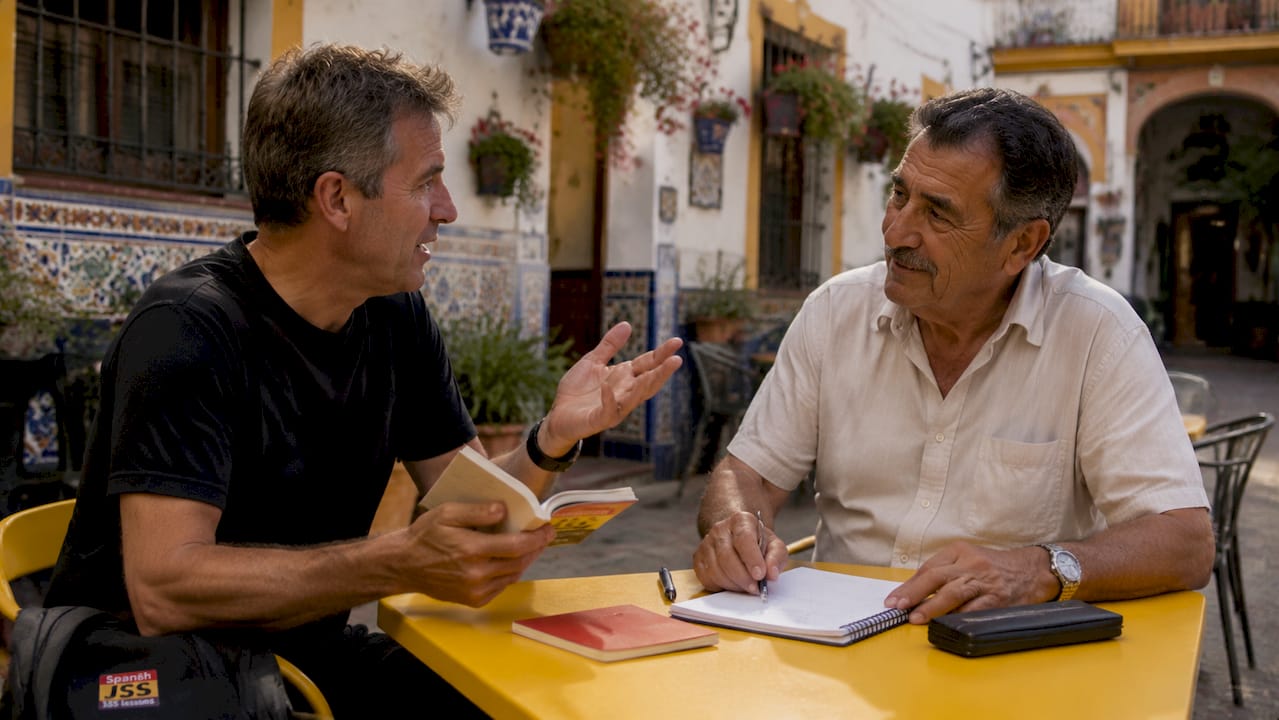
Adult learners face one specific barrier that children do not. Subconscious absorption, the way children pick up language through play and repetition, is insufficient for adults. Adults must use ‘Noticing’, which means consciously directing attention to specific language patterns during exposure. When you hear a native speaker use the subjunctive, you need to register it deliberately, not just let it wash over you.
Vocabulary: context beats cramming every time
Contextual vocabulary cards using full sentences are significantly more effective than simple word-to-word flashcards. A card that shows “Voy al médico mañana” (I am going to the doctor tomorrow) builds a mental template for real speech. A card that shows only médico = doctor does not. This exemplar-based approach is the engine room of natural speech production.
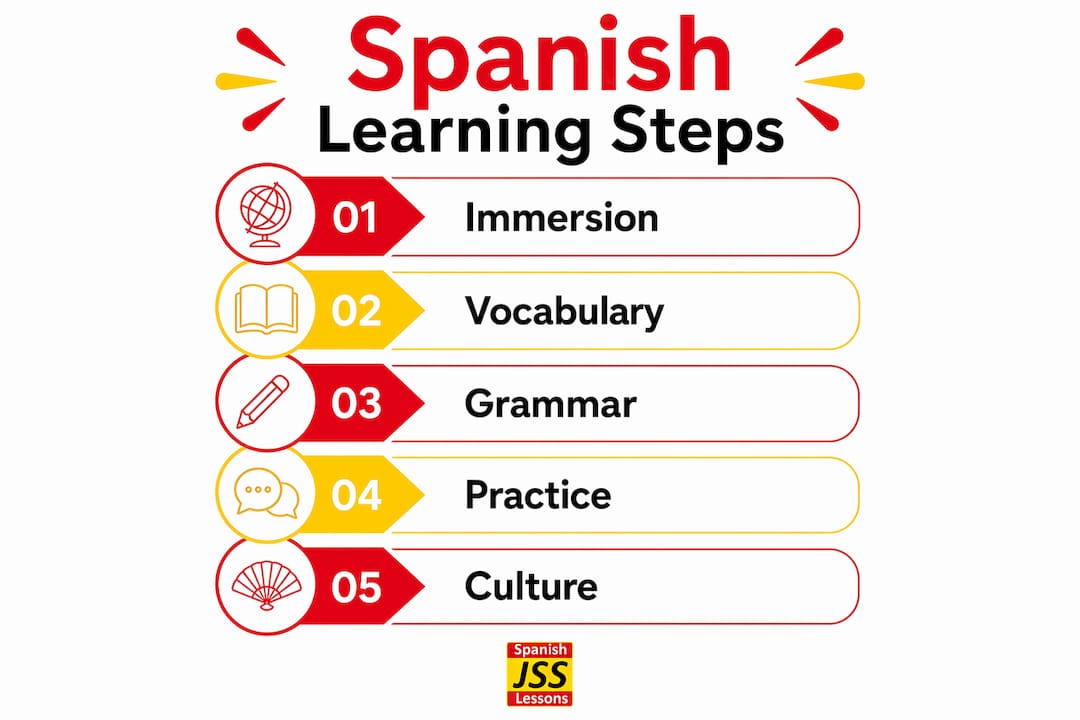
Tools like Anki and StudyCards AI both support sentence-level flashcards with spaced repetition. Jamesspanishschool’s WordAmigo system takes this further by automating a five-step retention loop across reading, listening, speaking, and writing. WordAmigo was built by IT experts and long-term English expats in Spain, specifically to solve the two most common frustrations: words that will not stay in memory and pronunciation that native speakers struggle to follow.
Pro Tip: Use bilingual reading, alternating between a Spanish paragraph and its English translation, to build comprehension without a dictionary. This technique accelerates reading speed and trains your brain to process Spanish in chunks rather than word by word.
Pro Tip: Build contextual vocabulary cards around situations you will actually face: at the pharmacy, at the town hall, with a builder. Generic word lists waste study time. Situation-specific cards build the vocabulary you need on day one in Spain.
Spanish also rewards learners who notice word families and prefixes for faster vocabulary growth. Recognising that -ción endings often correspond to English -tion words (nación, situación, conversación) can unlock hundreds of words in a single afternoon.
How does cultural immersion enhance a spanish learning programme?
Immersion is the fastest path to fluency when combined with structured vocabulary study. Living in Spain gives you constant exposure to real speech at natural speed. The challenge is that without a structured framework, that exposure becomes noise rather than input.
Cultural understanding affects tone, formality, and word choice in ways that grammar books rarely address. In Spain, the informal tú form is used far more widely than in Latin America. Spaniards address shop staff, doctors, and even strangers with tú in most regions. Using usted with a young shopkeeper in Madrid can sound oddly formal. These are the kinds of details that a genuine Spanish language guide for beginners must include.
Practical immersion strategies that work alongside structured study include:
- Listening to Spanish radio stations such as Cadena SER or RNE during daily tasks
- Watching Spanish television series with Spanish subtitles, not English ones
- Joining local social groups, sports clubs, or community events where Spanish is the only shared language
- Scheduling one or two weekly conversation sessions with a native speaker, either locally or via an online platform
James Spanish School addresses this directly. James Bretherton shares insider cultural tips throughout the course, from the unwritten rules of queuing at the panadería to the builder’s mid-morning breakfast break, which is a genuine social institution in Spain. These details matter because they determine whether your Spanish sounds natural or merely correct.
Cultural awareness is as important as grammar for effective communication in Spain. A learner who knows every verb conjugation but does not understand regional vocabulary or social register will still struggle in real conversation.
How does a comprehensive guide differ from typical apps or textbooks?
Most language apps and textbooks address one or two dimensions of learning. A complete Spanish learning resource addresses all of them together. The table below shows the key differences.
| Feature | Typical App or Textbook | Comprehensive Spanish Guide |
|---|---|---|
| Grammar coverage | Rules and tables | Rules explained through real examples |
| Vocabulary method | Word lists or translation drills | Contextual sentences with spaced repetition |
| Pronunciation | Minimal or text-based | Audio modelling with active practice |
| Cultural context | Absent or superficial | Integrated throughout every lesson |
| Progression path | A1 to A2 focus | A1 through to B1 and beyond |
| Adult-specific design | Rarely considered | Built around adult learning barriers |
The pure grammar approach produces learners who can pass written tests but freeze in conversation. Fluency depends on combining structured learning with conversational practice, immersive input, and consistency. No single app delivers all three. A blended approach using structured lessons, audio practice, and live conversation is the only reliable route to B1 level and beyond.
Adults often struggle without tailored strategies that integrate Noticing and meaningful practice. This is precisely why Jamesspanishschool uses what James calls Radical Simplification: removing grammar terminology that native speakers never use, and replacing it with plain English explanations of how Spanish structure actually works. The result is a course that feels logical rather than academic.
What daily routines make a spanish study plan actually work?
Daily 20–30 minute sessions are more effective than occasional long sessions for retention. Spaced repetition improves retention by up to 200% compared to massed practice. That means 25 minutes every day outperforms three hours on a Sunday afternoon, every time.
A practical daily routine for an English speaker learning European Spanish looks like this:
- Morning (10 minutes): Review vocabulary cards in Anki or WordAmigo. Focus on cards due for repetition, not new words.
- Midday (10 minutes): Listen to a short Spanish podcast or radio clip. Apply Noticing: identify one grammatical pattern or phrase you have not heard before.
- Evening (10–15 minutes): Complete one structured lesson from your course. Jamesspanishschool’s on-demand format means you can do this on your phone, tablet, or laptop at any time.
- Weekly (30–45 minutes): One live or online conversation session with a native speaker. Consistent conversation practice solidifies active language use in a way that solo study cannot replicate.
This routine integrates the three pillars of effective learning: structured input, vocabulary retention, and active output. None of the three works well in isolation.
Pro Tip: Avoid isolated grammar drills as your primary study method. Grammar is the skeleton of language, but you build fluency by practising whole sentences in real contexts. Drill a sentence pattern, not a conjugation table.
Organising vocabulary by use and word families accelerates speaking power. Group your new words by situation: health, shopping, home repairs, local government. You will use those clusters far sooner than a random alphabetical list.
Key takeaways
A comprehensive Spanish guide works because it combines structured input, contextual vocabulary, cultural immersion, and consistent daily practice into a single, coherent system.
| Point | Details |
|---|---|
| Definition matters | A comprehensive guide integrates grammar, vocabulary, pronunciation, and culture, not just one element. |
| Noticing accelerates adult learning | Consciously directing attention to language patterns during immersion is essential for adult learners. |
| Context beats cramming | Sentence-level vocabulary cards with spaced repetition outperform word-to-word flashcards every time. |
| Culture is not optional | Understanding Spanish social norms and regional vocabulary is as important as grammar for real fluency. |
| Daily consistency wins | Short daily sessions of 20–30 minutes produce significantly better retention than occasional long study blocks. |
What I have learnt after 40 years of living in spain
After four decades in Spain, I can tell you with confidence that the biggest mistake adult learners make is treating Spanish as a subject to study rather than a skill to practise. Grammar books give you the rules. Living in Spain gives you the pressure to use them. The combination is where real fluency happens.
The concept of Noticing changed how I think about teaching. When I first arrived in Spain, I absorbed the language through sheer immersion. But I was young, and I had time. Adult learners in their 40s, 50s, and 60s do not have the luxury of passive absorption. They need a system that makes every hour of exposure count. That is why I built the WordAmigo system the way I did, with a deliberate five-step loop that forces active engagement rather than passive listening.
I also want to be honest about cultural fluency. You can have perfect grammar and still offend a Spanish builder by not offering him a coffee at 10 in the morning. You can know every verb tense and still confuse a pharmacist because you used a Latin American term for a common medicine. These are not small details. They are the difference between being understood and being truly accepted. If you want to succeed with Spanish as an adult, you need a guide that takes culture as seriously as conjugation.
My honest view is that most complete Spanish learning resources underestimate adult learners. Adults are not slower than children. They are different. They bring life experience, strong motivation, and the ability to understand abstract patterns. The right method uses those strengths rather than fighting them.
— James
How James Spanish School supports your Spanish learning journey
James Spanish School offers a structured, on-demand course built specifically for English-speaking adults who want to speak real European Spanish, not pass an exam. The 100-lesson programme covers sentence construction and ear-tuning in equal measure, so you can both build sentences and follow native speakers at full speed.
The WordAmigo system sits at the heart of the vocabulary and pronunciation work, using AI-powered spaced repetition to permanently embed the words you need for daily life in Spain. Every lesson is available 24/7 with no expiry date and no countdown pressure. You can explore the full range of online Spanish lessons or browse the complete course catalogue at the JSS course shop. If you are ready to start, the resources are there whenever you are.
FAQ
What is a comprehensive spanish guide?
A comprehensive Spanish guide is a structured learning resource that combines grammar, vocabulary, pronunciation, cultural context, and conversation practice into a single programme. The best versions are designed specifically for the learner’s target region, such as European Spanish for those living in or moving to Spain.
How long does it take to reach conversational fluency in spanish?
With consistent daily study of 20–30 minutes combined with regular conversation practice and immersion, most adult learners reach conversational level within 12–18 months. Progress depends heavily on consistency and the quality of the methods used.
Is european spanish very different from latin american spanish?
European Spanish uses distinct vocabulary, the vosotros verb form, and different pronunciation patterns, particularly the Castilian th sound for c and z. For learners living in Spain, a course focused on European Spanish is significantly more practical than a generic global course.
Why do adults struggle more with spanish than children?
Adults require explicit attention to language forms alongside immersive experience because subconscious absorption alone is insufficient after childhood. The solution is structured Noticing combined with contextual vocabulary practice, which is precisely what tailored adult language courses are designed to deliver.
What is the WordAmigo system?
WordAmigo is an AI-powered vocabulary and pronunciation retention system developed by James Spanish School. It uses a five-step exposure loop across reading, listening, speaking, and writing to permanently embed vocabulary, solving the two most common adult learner frustrations: forgetting words and mispronouncing them.