

TL;DR:
- Accent marks in Spanish indicate stress patterns and clarify word meanings by distinguishing homographs. Learning the three default stress rules and practicing with native pronunciation tools helps learners master proper accent placement and improve communication confidence. Correct use of accents signals proficiency and respect for the language, especially in formal settings.
Spanish accent marks are defined as written symbols that indicate which syllable to stress and, in many cases, change a word’s meaning entirely. The role of accent in Spanish goes far beyond decoration. These small marks, called tildes, are a built-in pronunciation guide that makes the language more predictable than English. The Real Academia Española, Spain’s official language authority, governs their use through clear, learnable rules. For English speakers moving to Spain or building everyday fluency, understanding how tildes work is one of the fastest ways to sound clearer and be understood with confidence.
How do spanish accent marks guide correct pronunciation?
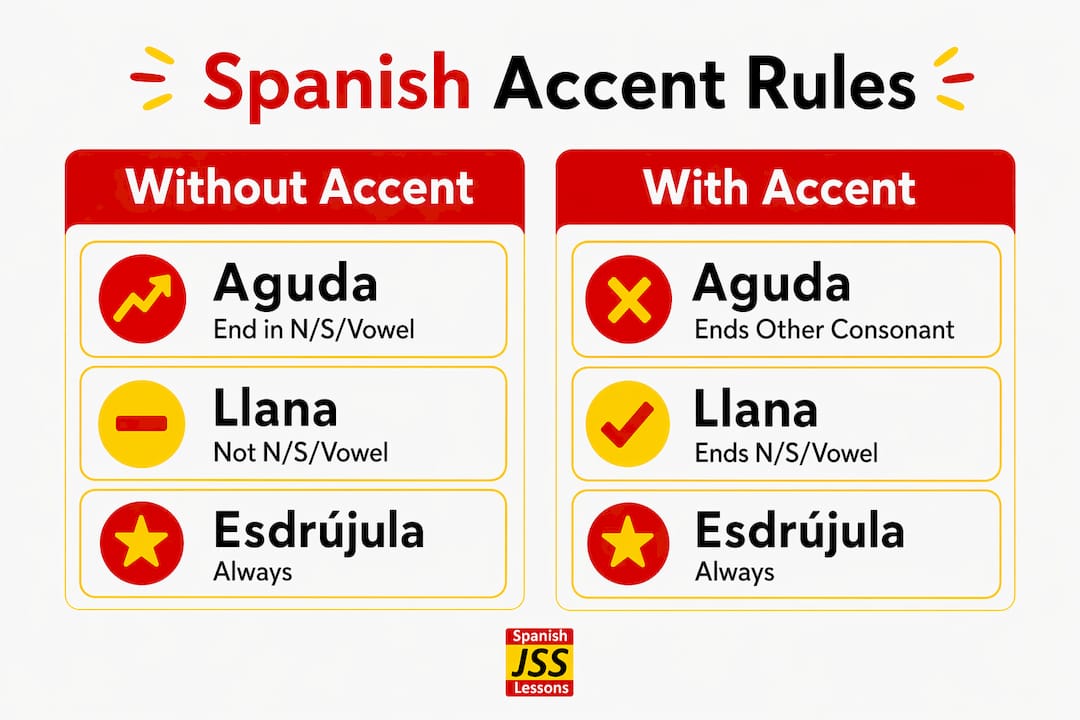
Spanish stress follows three default rules based on how a word ends. Once you know these rules, you can pronounce almost any word you see for the first time. A tilde appears only when a word breaks the default pattern, signalling exactly where to place the stress.
The three stress rules per the Real Academia Española work as follows:
- Words ending in a vowel, n, or s are stressed on the penultimate (second-to-last) syllable. Example: hablan (HAB-lan).
- Words ending in any other consonant are stressed on the last syllable. Example: hablar (ha-BLAR).
- Any word that breaks either rule carries a written accent mark to show the true stress. Example: café (ca-FÉ), música (MÚ-si-ca).
Spanish grammarians group words into three stress categories. Palabras agudas carry stress on the final syllable. Palabras llanas carry stress on the penultimate syllable. Palabras esdrújulas carry stress on the third-to-last syllable and always take a written accent mark without exception.
Compare this to English, where stress is largely unpredictable. Consider photograph, photography, and photographic: the stress shifts with no written signal at all. Spanish removes that guesswork entirely. Spanish phonology is built on just five pure vowel sounds, compared to the 12–14 vowel sounds found in many English dialects. That consistency means once you grasp the stress rules, the written language becomes a reliable pronunciation map.

| Word Type | Stress Position | Accent Mark? | Example |
|---|---|---|---|
| Aguda | Final syllable | Only if ending in vowel, n, or s | café |
| Llana | Penultimate syllable | Only if NOT ending in vowel, n, or s | árbol |
| Esdrújula | Third-to-last syllable | Always | música |
Pro Tip: When you encounter a new Spanish word, check the final letter first. That single habit tells you where the stress falls in the majority of cases, before you even look for a tilde.
How do accents affect meaning in spanish?
Accent marks in Spanish do not just guide pronunciation. They distinguish homographs where context alone would fail. Two words can share identical spelling yet carry entirely different meanings depending on the presence or absence of a tilde.
The most common meaning-changing pairs include:
- sí (yes) vs. si (if)
- tú (you) vs. tu (your)
- él (he) vs. el (the)
- más (more) vs. mas (but, archaic)
- papá (dad) vs. papa (potato or Pope)
- té (tea) vs. te (you, object pronoun)
Question words in Spanish always carry an accent mark when used in direct or indirect questions. ¿Qué? (what), ¿cómo? (how), ¿dónde? (where), and ¿cuándo? (when) all take tildes in interrogative and exclamative contexts. Accents guide intonation and sentence function in both speech and writing, signalling to the reader whether a sentence is a statement or a question even before reaching the punctuation mark.
The practical impact on comprehension is significant. A Spanish speaker reading “¿Donde esta tu papa?” without accents must rely entirely on context to determine whether you are asking about someone’s father or their potato. In fast spoken Spanish, that ambiguity can cause real confusion. Correct accent use removes the guesswork from both reading and listening.
Pro Tip: Practise writing the six most common minimal pairs every day for one week. The muscle memory of typing or writing the accented version will make correct usage automatic far sooner than studying rules alone.
Why does correct accent use signal learner proficiency?
Accurate use of written accents ranks among the top three indicators that native Spanish speakers use to judge a learner’s proficiency. This finding, confirmed in a 2019 study published in the Journal of Spanish Language Teaching, means that getting accents right is not a minor detail. It is a visible marker of how seriously you have engaged with the language.
The comparison to English is instructive. Confusing their, there, and they’re in a professional email signals carelessness or poor education to a native English reader. Omitting accents in formal writing carries the same weight in Spanish. Native speakers in Spain expect correct tildes in academic texts, business correspondence, and official documents. Missing them reads as a significant error, not a minor slip.
“Correctly using accents in formal communication impacts native-speaking perceptions greatly, associating proper use with education and professionalism.” — Spanish Accent Marks Explained: Complete Guide to Tildes
This matters practically for English expats in Spain. Whether you are writing to a local council, a health centre, or a school, correct accent use signals that you respect the language and have made a genuine effort to learn it. That perception opens doors. Native speakers become more patient, more willing to engage, and more likely to treat you as a capable communicator rather than a tourist.
Understanding the distinction between the written accent mark and phonological stress also helps. The written mark and phonological stress are technically separate concepts. The mark on the page is the acento; the emphasis in speech is the estrés. Conflating the two is a common learner error that can muddle both pronunciation practice and writing habits.
What practical strategies help english speakers master spanish accentuation?
Mastering Spanish accentuation patterns requires both written practice and active listening. Theory alone will not embed the rules. The following strategies build the habit quickly and effectively.
- Learn the three stress rules first. Before memorising any exceptions, drill the default rules until they are automatic. Write ten new words each day, identify their word type (aguda, llana, or esdrújula), and predict the stress before checking. This trains pattern recognition rather than rote memorisation.
- Use shadowing for pronunciation. Shadowing native audio means repeating what you hear immediately after a native speaker, matching rhythm, stress, and intonation. Experts highlight that just five minutes of daily focused shadowing boosts intelligibility noticeably within days. It is the single most effective method for connecting written accent rules to spoken output.
- Focus on vowel purity. Spanish vowels do not shift or reduce the way English vowels do. The a in papá sounds the same in every position. Keeping vowels clean and consistent makes stressed syllables stand out naturally, which is exactly what accent marks are signalling on the page.
- Practise with ear-tuning exercises. Listening to fast native speech and identifying where stress falls trains your ear to hear accent patterns rather than just individual sounds. Jamesspanishschool builds dedicated ear-tuning lessons into its 100-lesson course precisely because comprehension and pronunciation are two sides of the same coin.
- Write, do not just read. Typing or handwriting Spanish forces you to decide whether a word needs an accent mark. Reading passively lets your eye skip over tildes. Writing makes every decision conscious, which accelerates retention.
For a deeper look at how Spanish sentence structure supports correct stress placement, the guide on Spanish structure in English explains the underlying logic in plain terms that English speakers find immediately accessible.
Key takeaways
Accent marks in Spanish are a functional system, not an optional stylistic choice: mastering them improves pronunciation, comprehension, and how native speakers perceive your proficiency.
| Point | Details |
|---|---|
| Tildes mark stress exceptions | A written accent appears only when a word breaks the default stress rules. |
| Accents change meaning | Pairs like sí/si and tú/tu are distinguished solely by the presence of a tilde. |
| Proficiency signal | Correct accent use ranks in the top three indicators of Spanish learner proficiency. |
| Formal writing standard | Omitting accents in professional or academic texts is treated as a significant error by native speakers. |
| Shadowing accelerates learning | Five minutes of daily shadowing practice improves pronunciation and accent recognition faster than theory alone. |
After 40 years in spain, here is what i know about accents
Accents are not decoration. They are the engine of Spanish pronunciation. When you understand the three stress rules and the role of the tilde as an exception marker, the entire written language becomes readable at sight. You stop guessing. That shift happens faster than most learners expect, and it changes everything about how confident you feel speaking.
— James
How Jamesspanishschool helps you master spanish pronunciation
Understanding accent rules in theory is one thing. Hearing them in real spoken Spanish and producing them yourself is another challenge entirely.
James Spanish School is built around exactly this gap. The 100-lesson course combines sentence-building with dedicated ear-tuning sessions, so you hear how stress and accent marks translate into natural speech at native speed. The JSS Audio Portal gives you on-demand access to pronunciation practice you can repeat as many times as you need, with no countdown clock and no pressure. The WordAmigo system reinforces vocabulary and correct pronunciation simultaneously through strategic repetition, so the right stress patterns become automatic. If you are ready to move from knowing the rules to actually using them, explore the full course materials and see how the method works in practice.
FAQ
What is the role of accent marks in spanish?
Accent marks in Spanish indicate which syllable to stress and distinguish words that share identical spelling but carry different meanings. They function as a built-in pronunciation guide governed by the Real Academia Española.
Do spanish accent marks always change the meaning of a word?
Not always. Sometimes a tilde simply marks an exception to the default stress rules without changing meaning. In other cases, such as sí versus si or él versus el, the accent mark is the only signal that separates two entirely different words.
Are regional accents in spanish affected by written accent rules?
Written accent rules are consistent across all Spanish-speaking regions and are standardised by the Real Academia Española. Regional accents affect spoken pronunciation and intonation but do not change where tildes are placed in writing.
How quickly can a learner master spanish accentuation patterns?
Most learners grasp the three core stress rules within a few weeks of focused practice. Embedding correct written accent habits takes longer, but daily shadowing practice of just five minutes accelerates both pronunciation and written accuracy significantly.
Is it acceptable to omit accent marks in informal writing?
Native speakers in Spain may omit tildes in casual text messages, but in any formal, professional, or academic context, omitting accent marks is considered a significant error comparable to misusing their and there in English.