

TL;DR:
- Immersion enhances language learning by providing meaningful input and opportunities for active practice, leading to improved fluency. Receptive skills develop faster than speaking, which requires deliberate practice and feedback, especially with European Spanish. Combining immersion with structured grammar instruction yields the best results, even when practicing at home.
Language immersion is defined as the sustained exposure to a target language through meaningful, real-world contexts that require active understanding and response. The role of immersion in language acquisition is central to how adults develop genuine fluency, particularly in European Spanish, where regional accent, rapid speech, and cultural nuance demand far more than textbook study. Research confirms that immersion outperforms traditional classroom methods for overall proficiency, especially in listening comprehension and natural fluency. This guide explains how immersion works, what the evidence shows, and how you can apply it practically.
What is the role of immersion in language acquisition?
Immersion works through a mechanism linguist Stephen Krashen called the Input Hypothesis. The core idea is that learners acquire language when they receive input that is comprehensible but slightly beyond their current level, a concept expressed as “i+1.” This is not the same as simply being surrounded by a language. Immersion without comprehensible input yields little acquisition benefit; context and understanding are what drive progress.
There are two distinct modes of immersion: passive and active. Passive immersion means listening to or reading Spanish without the pressure to respond, such as watching a Spanish television series or listening to a podcast. Active immersion means producing language in real time, through conversation, writing, or structured speaking tasks. Both have value, but active immersion accelerates fluency because it forces the brain to retrieve and apply what it has absorbed.
Meaningful context is the engine room of the whole process. When you hear a Spanish phrase while ordering coffee in Madrid, your brain encodes it differently than when you read it in a grammar table. The emotional and situational context creates stronger memory traces. This is why input that is comprehensible, repeated, and slightly beyond current level across multiple real-world contexts drives genuine acquisition rather than passive exposure.
- Passive immersion: Listening to Spanish radio, watching films, reading menus or signs
- Active immersion: Speaking with neighbours, joining conversation groups, writing messages in Spanish
- Structured immersion: Guided lessons that combine input with explicit feedback on form
Pro Tip: Start with content you already know well in English, such as a familiar film dubbed into Spanish. Familiarity with the plot reduces cognitive load and lets your brain focus on the language itself.
Does immersion outperform traditional classroom learning?
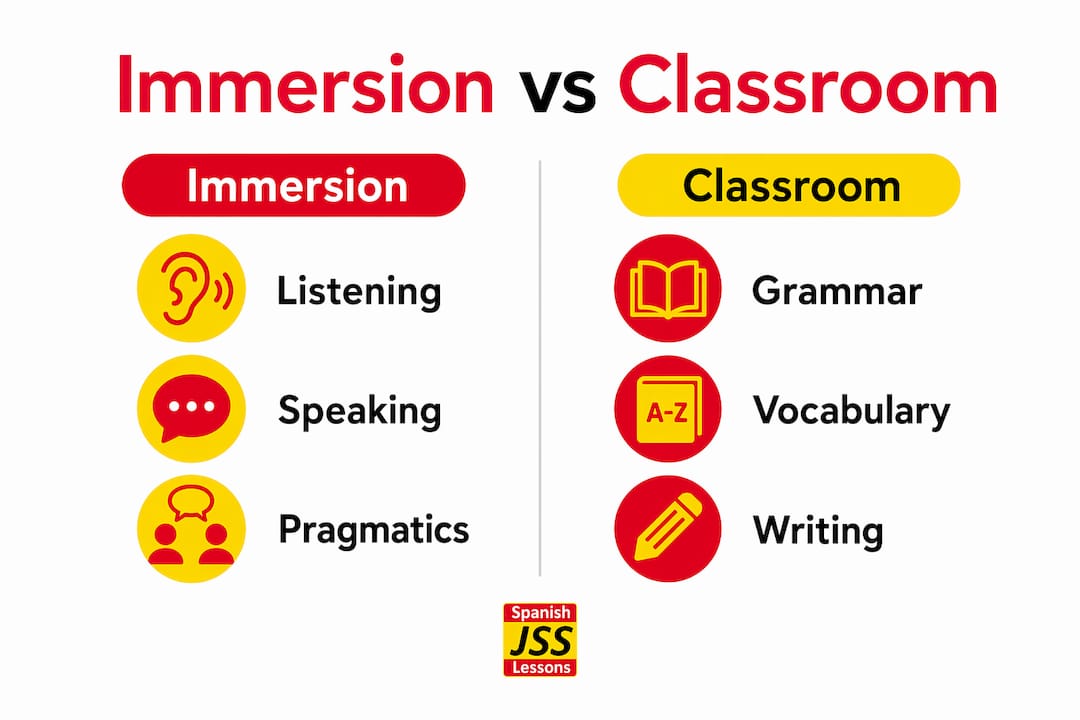
The research evidence is clear and consistent. Immersion learners outperform traditional classroom learners by a moderate margin, with effect sizes in the range of 0.4–0.6 for overall proficiency. That margin is meaningful. An effect size of 0.4 is roughly equivalent to the difference between one year and two years of standard classroom instruction.
The gains are not evenly distributed across all skills, however. Listening and reading improve first and most reliably. Speaking accuracy and grammatical precision lag behind, particularly in the early stages. This is not a flaw in immersion; it reflects how the brain processes language. Receptive skills build the internal model, and productive skills draw on it later.
“Explicit instruction combined with immersion leads to 20–30% higher grammatical accuracy than immersion-only approaches.” This finding matters enormously for adult learners of European Spanish, where grammatical gender, verb conjugation, and subjunctive use are non-negotiable for clear communication.
| Skill Area | Immersion Advantage | Key Limitation |
|---|---|---|
| Listening comprehension | Strong, develops early | Requires quality input sources |
| Reading fluency | Strong, develops early | Depends on vocabulary base |
| Speaking accuracy | Moderate, develops slowly | Needs explicit grammar support |
| Grammatical precision | Weak without instruction | Requires form-focused feedback |
| Pragmatic fluency | Strong over time | Needs sustained native interaction |
The practical conclusion is that immersion alone is not a complete method. Pairing it with structured attention to grammar produces the best outcomes. James Spanish School addresses this directly through its Radical Simplification approach, which explains Spanish structure in plain English rather than relying on academic grammar terminology.
How do listening and speaking skills develop at different rates?
Receptive skills and productive skills follow different timelines in immersion, and understanding this prevents a great deal of frustration. Receptive skills improve earlier than productive skills even in full immersion environments. You will understand far more than you can say, often for months. This is entirely normal and reflects the brain building its internal language model before it can reliably output.
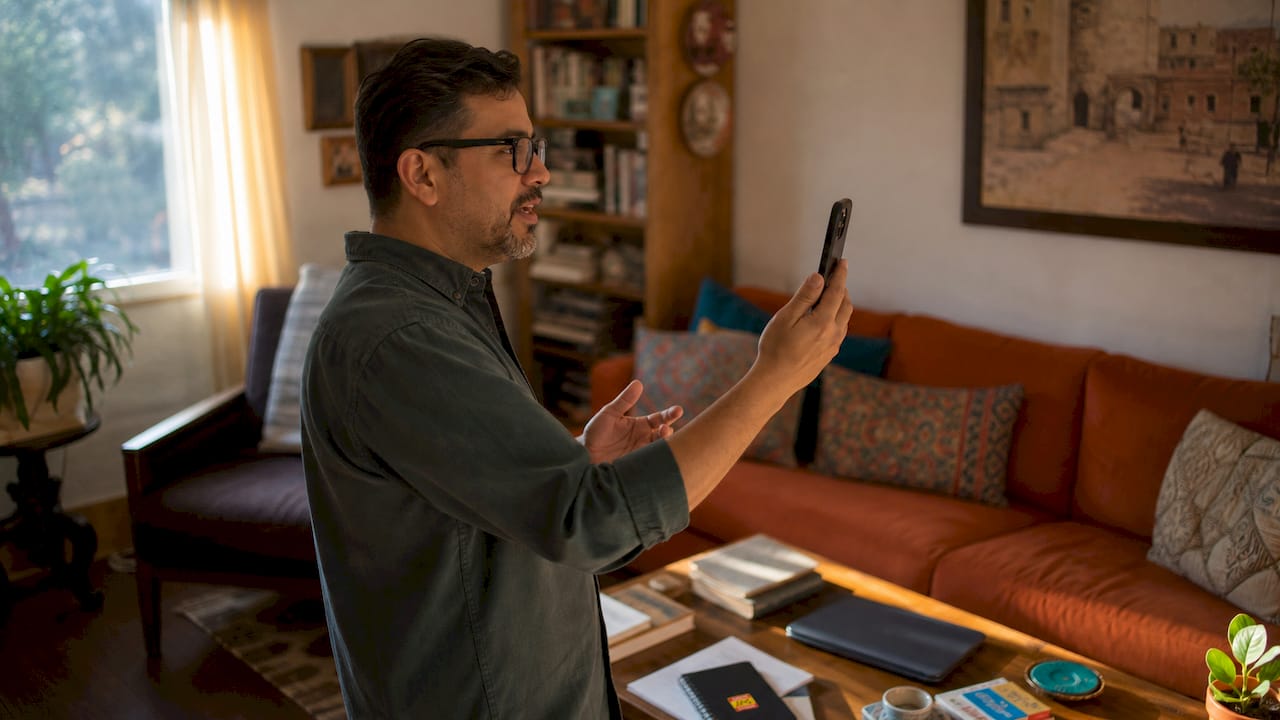
Speaking development is slower for a specific reason. Sustained interaction with native speakers is often difficult to achieve, even when living in a Spanish-speaking country. Native speakers switch to English when they sense difficulty, conversations stay transactional, and social integration takes time. The result is that many immersion learners develop strong listening skills but plateau in speaking.
Anxiety plays a significant role here. Fear of making mistakes in front of native speakers causes avoidance behaviour, which limits the very practice that would build confidence. Structured speaking activities such as conversation clubs, public speaking tasks, and guided role-play reduce this anxiety by creating a lower-stakes environment for production. The benefits of learning Spanish through active speaking practice extend well beyond fluency; they include confidence in everyday social situations that matter most to expats.
- Listening: Develops fastest; prioritise quality audio sources with clear European Spanish accents
- Reading: Builds vocabulary and grammar patterns; use graded readers before native-level texts
- Speaking: Requires deliberate practice; do not wait until you feel “ready”
- Writing: Reinforces grammar and vocabulary; even short daily messages in Spanish help
Pro Tip: Record yourself speaking Spanish for 60 seconds each day. Play it back after two weeks. The improvement is often more visible than you expect, and it builds the habit of speaking with confidence without waiting for a native speaker to be present.
How can you apply immersion effectively for european spanish?
Effective immersion is not accidental. It requires a deliberate structure, particularly for adult learners who do not have the luxury of childhood language absorption. The following sequence works for learners targeting European Spanish specifically.
- Build a foundation first. Attempting full immersion without a basic vocabulary and grammar framework is counterproductive. Aim for a working knowledge of the 500–1,000 most common Spanish words and core sentence structures before relying on immersion as your primary method.
- Use graded media with repetition. Spanish television series, podcasts, and films designed for intermediate learners provide comprehensible input at the right level. Repeating the same content multiple times is more effective than constantly seeking new material. Repeated exposure to manageable content supports retention and production far better than constant novelty.
- Create a daily immersion environment at home. Relocation to Spain is not a prerequisite. Daily focused sessions of ten minutes combined with passive environmental exposure, such as Spanish radio in the background, produce consistent gains over time. Change your phone language to Spanish. Label household objects. Make Spanish part of your daily routine.
- Schedule active production time. Passive listening alone will not produce a fluent speaker. Join a conversation group, find a language exchange partner, or use structured speaking modules. Jamesspanishschool’s ear-tuning lessons are specifically designed to help you follow the machine-gun speed of native replies, which is the single biggest barrier most adult learners face.
- Combine immersion with explicit grammar attention. Use your immersion exposure to notice patterns, then confirm them with structured explanation. This combination produces 20–30% higher grammatical accuracy than immersion alone.
| Approach | Best For | Limitation |
|---|---|---|
| Full environmental immersion | Listening and pragmatic fluency | Speaking accuracy without feedback |
| At-home immersion programme | Consistent daily progress | Requires self-discipline |
| Structured course plus immersion | Grammar accuracy and fluency | Needs quality course design |
| Conversation exchange | Speaking confidence | Uneven input quality |
What challenges do immersion learners commonly face?
The most common immersion pitfall is grammatical fossilisation. This happens when learners become fluent enough to communicate but never correct persistent errors, because no one corrects them in natural conversation. Immersion alone is not enough; explicit attention to grammar and form-focused feedback is required for full grammatical competence. Without it, errors become habits.
A second challenge is the difficulty of moving beyond transactional exchanges. Ordering at a bar or asking for directions is manageable. Joining a conversation about local politics or discussing a health concern with a Spanish doctor is a different matter entirely. Learners often struggle to initiate non-transactional conversations with native speakers, which limits the depth of fluency they can achieve. This is a particular concern for English-speaking expats in Spain, who can often function entirely in English within their social circle.
Practical solutions to the most common immersion challenges:
- Fossilised errors: Seek periodic feedback from a qualified teacher or structured course; do not rely solely on native speaker correction
- Transactional plateau: Deliberately seek out non-transactional contexts, such as local clubs, volunteer groups, or community events where Spanish is the only option
- Speaking anxiety: Use structured production activities before attempting open conversation; audio Spanish lessons that simulate real dialogue are particularly effective for building confidence
- Motivation dips: Set specific, measurable goals tied to real-life situations rather than abstract proficiency levels
- Uneven skill development: Recognise that listening will outpace speaking for some time; plan your practice accordingly rather than treating the gap as failure
Understanding why adults struggle with Spanish is the first step toward addressing those struggles systematically rather than blaming yourself for slow progress.
Key takeaways
Immersion accelerates language acquisition most effectively when comprehensible input, structured grammar instruction, and active speaking practice are combined deliberately rather than left to chance.
| Point | Details |
|---|---|
| Immersion outperforms classroom learning | Effect sizes of 0.4–0.6 confirm a moderate but meaningful advantage, especially for listening and fluency. |
| Receptive skills develop before productive skills | Expect to understand far more than you can say; plan speaking practice separately. |
| Grammar instruction is non-negotiable | Combining immersion with explicit grammar attention raises accuracy by 20–30%. |
| At-home immersion is achievable | Daily ten-minute sessions plus passive exposure produce consistent gains without relocating. |
| Active production reduces anxiety | Structured speaking activities build communicative confidence faster than passive listening alone. |
What I have learned after 40 years of living in Spain
The research confirms what I have observed directly over four decades of living in Spain and working with adult learners. Immersion is powerful, but it is not magic. The learners who make the fastest progress are not the ones who simply move to Spain and hope for the best. They are the ones who arrive with a working foundation, seek out genuine conversation beyond the expat bubble, and pay attention to the patterns they encounter every day.
The biggest mistake I see repeatedly is treating immersion as passive. People watch Spanish television for months and wonder why they still cannot follow a conversation at the local market. Passive exposure builds a receptive base, but it does not train your mouth or your ear for the speed and rhythm of real spoken Spanish. European Spanish in particular is fast, clipped, and full of regional variation. You need dedicated ear-tuning practice, not just background noise.
The second mistake is avoiding grammar entirely because it feels academic. Grammar is not about passing exams. It is about understanding why a sentence works, so you can build new ones on the spot. When you understand the structural logic of Spanish, immersion becomes ten times more productive because you start noticing patterns rather than just hearing noise.
My honest view is that the most effective immersion approach for adult learners combines a structured foundation, daily real-world exposure, and regular production practice. Technology now makes this possible without leaving home. The WordAmigo system at James Spanish School was built specifically to address the vocabulary and pronunciation gaps that prevent immersion from working as well as it should.
— James
Start your immersion journey with James Spanish School
James Spanish School brings together everything the research recommends: comprehensible input, structured grammar explanation in plain English, ear-tuning for fast native speech, and the WordAmigo system for vocabulary and pronunciation retention. The 100-lesson course is available on demand, 24/7, so you can build your immersion practice around your life rather than the other way around.
Whether you are preparing to move to Spain, already living there, or simply committed to real conversational fluency, the full course and learning tools at James Spanish School give you the foundation that makes immersion actually work. You can also explore the vocabulary builder introduction to see how the WordAmigo system embeds words permanently through strategic repetition across reading, listening, speaking, and writing.
FAQ
What is the role of immersion in language acquisition?
Immersion accelerates language acquisition by providing comprehensible, contextualised input and opportunities for active production. Research confirms it produces moderate to strong gains in fluency and listening comprehension compared to traditional classroom methods.
Does immersion improve speaking skills faster than listening skills?
No. Listening and reading skills improve earlier in immersion. Speaking accuracy develops more slowly and requires deliberate structured practice alongside environmental exposure to progress reliably.
How can i create immersion at home without moving to spain?
Daily ten-minute focused practice sessions combined with passive exposure, such as Spanish radio or television, produce consistent gains. Changing your phone language to Spanish and labelling household objects also reinforces daily contact with the language.
Is grammar instruction still necessary if I am fully immersed?
Yes. Studies show that combining immersion with explicit grammar instruction raises accuracy by 20–30% compared to immersion alone. Without it, errors become habitual and difficult to correct later.
How long does it take for immersion to produce noticeable fluency?
Most learners notice meaningful improvement in listening comprehension within three to six months of consistent immersion practice. Speaking fluency typically requires longer, particularly for European Spanish, where speed and regional accent add complexity.