

What is authentic spoken Spanish
TL;DR:
- Authentic spoken Spanish includes speed, contractions, regional vocabulary, and cultural nuances.
- Real fluency is achieved through context-rich practice and embracing imperfect, genuine conversations.
- Moving beyond textbooks involves active listening, mimicking, cultural immersion, and speaking confidently without fear of mistakes.
You’ve studied the textbook, you’ve memorised the phrases, and you feel quietly confident. Then a Spaniard opens their mouth at full speed and everything you’ve learned seems to evaporate. This experience catches out learners at every level, and it happens because textbook Spanish and authentic spoken Spanish are genuinely different animals. Understanding that gap, and knowing how to close it, is what separates someone who can translate exercises from someone who can hold a real conversation in a bar, a market, or a doctor’s waiting room.
Table of Contents
- What makes spoken Spanish ‘authentic’?
- Authentic Spanish vs. textbook Spanish: What’s the real difference?
- How context and culture shape real conversations
- Practical ways to master authentic spoken Spanish
- Why embracing imperfect, real conversation is the secret to fluency
- Take your Spanish to the next level with expert guidance
- Frequently asked questions
Key Takeaways
| Point | Details |
|---|---|
| Textbook vs. real speech | Textbook Spanish is clear but not how people actually speak on the street. |
| Context is crucial | The best Spanish fits the place, audience, and purpose of the conversation. |
| Imperfect is effective | Mistakes are part of learning and help you connect in real life. |
| Practical practice matters | Authentic Spanish fluency grows from using real conversations, not just studying rules. |
What makes spoken Spanish ‘authentic’?
Now that you know why textbook Spanish may fall short, let’s explore what authentic spoken Spanish actually means.
Authentic spoken Spanish is not simply Spanish spoken quickly. It is the full package: the rhythm, the regional flavour, the dropped syllables, the colloquial shorthand, and the unspoken cultural rules that native speakers absorb over a lifetime. When a Spaniard says “¿Qué pasa, tío?” in the street, they are not consulting grammar. They are performing a social ritual that carries warmth, familiarity, and belonging all at once.
The features that mark authentic speech are consistent, even if the vocabulary shifts from region to region. Here is what you will notice most:
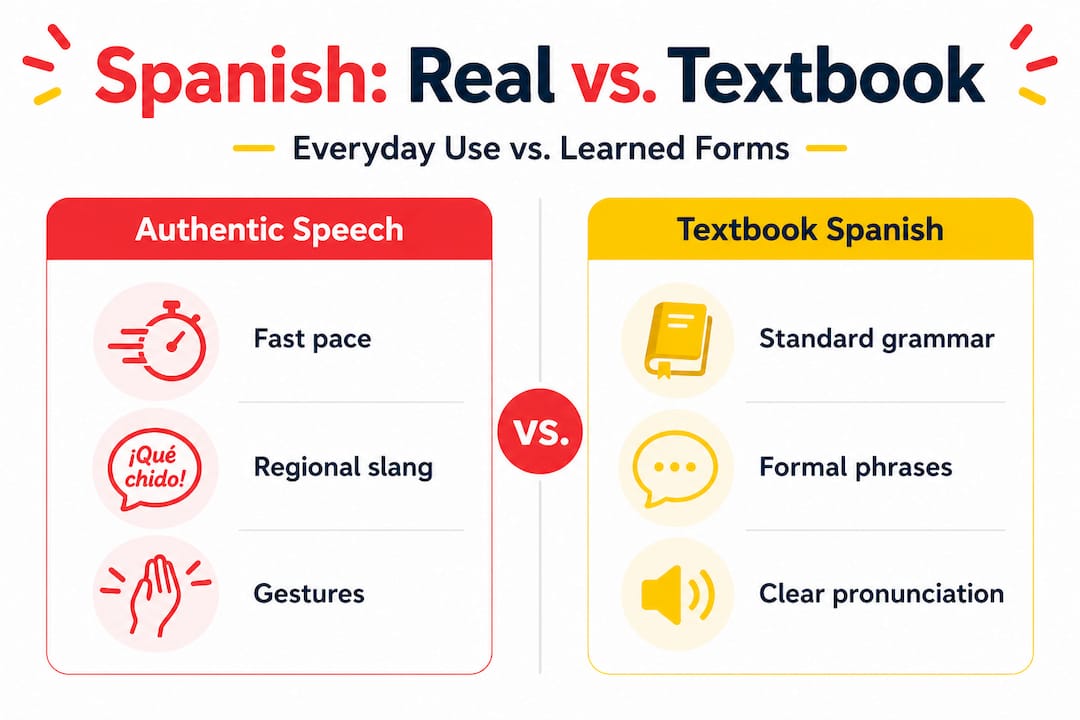
- Speed: Native speakers rarely slow down for effect. Words run together and syllables disappear.
- Contractions and reductions: “Para” becomes “pa”, “todo” shortens to “to” in casual speech.
- Filler words: “Bueno,” “o sea,” “pues,” “venga” carry conversations forward without adding information.
- Regional vocabulary: A “tío” in Madrid, a “tio” in Valencia, a “chaval” in Andalucía. Same meaning, different flavour.
- Intonation patterns: Rising and falling tones signal whether something is a question, a warning, or a joke.
- Informal expressions and slang: These shift constantly, especially among younger speakers.
Spanish philologist Lola Pons argues that the best Spanish is not a single standard variety but the version that matches purpose, message, form, and context. That insight is transformative for learners, because it shifts the goal from sounding like a textbook to sounding appropriate for the situation.
“El mejor español es el de coincidir finalidad, mensaje, forma y contexto.”
Lola Pons, filóloga
Pro Tip: When you hear a phrase you do not understand, focus on the context before you panic about the words. Gestures, setting, and tone often hand you the meaning before your brain even processes the vocabulary. As we explain at JSS, context beats vocabulary when you are building real fluency.
Authentic Spanish vs. textbook Spanish: What’s the real difference?
With a grasp of what authenticity means, let’s look closely at how it compares to what you may have learned in textbooks.
Textbooks are not useless. They give you structure, they introduce you to grammar patterns, and they ensure you can construct a grammatically defensible sentence. The trouble is that real speakers rarely speak in grammatically defensible sentences. They interrupt themselves, abbreviate, swap formal words for slang, and rely heavily on shared cultural knowledge to fill the gaps.
Consider a simple greeting. In a textbook you might learn: “Buenos días, ¿cómo está usted?” In real life, particularly among people of similar age or in informal settings, you are far more likely to hear: “¡Buenas! ¿Qué tal?” or simply “¡Ey!” with a nod.
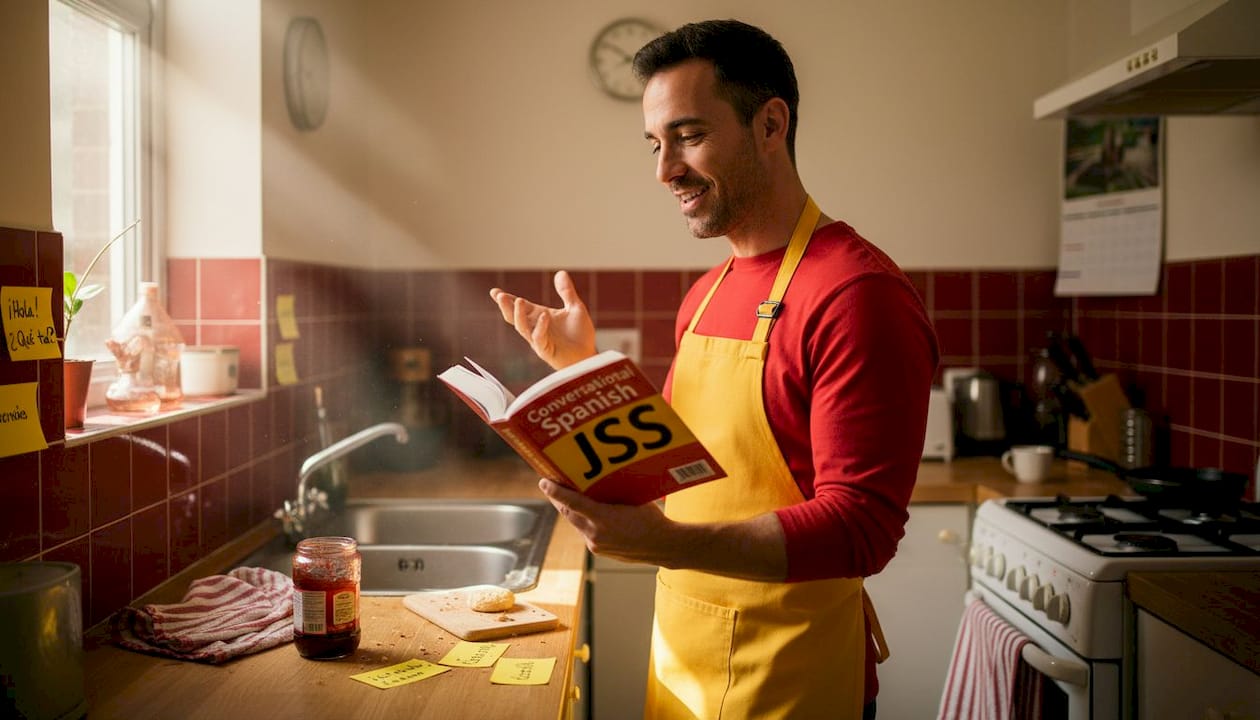
Here is how the two versions compare across several common situations:
| Situation | Textbook Spanish | Authentic spoken Spanish |
|---|---|---|
| Greeting a friend | Buenos días, ¿cómo estás? | ¡Buenas! ¿Qué pasa? |
| Asking for something | ¿Me puede dar un café, por favor? | Ponme un café, anda. |
| Expressing agreement | Estoy de acuerdo. | Claro que sí / Eso / Venga. |
| Saying goodbye | Adiós, hasta luego. | ¡Venga, hasta luego! / ¡Cuídate! |
| Asking the time | ¿Puede decirme qué hora es? | ¿Qué hora es? / ¿Tienes hora? |
The gap is not just stylistic. It reflects a fundamentally different purpose. Textbooks prepare you for written exams and formal encounters. Authentic speech is built for connection, not assessment. As the expert evidence confirms, textbooks provide useful structure but genuinely fail to prepare you for real speed and context.
Classroom teaching in most language programmes devotes the overwhelming majority of lesson time to written grammar and vocabulary lists. Colloquial language, cultural nuance, and the ear-tuning required to follow native speakers at full pace typically receive very little dedicated attention. This is precisely where many learners find themselves stuck, even after years of study.
If you want to build real skills for everyday fluency, the shift from textbook knowledge to authentic usage has to be deliberate and consistent.
How context and culture shape real conversations
Having drawn those distinctions, let’s see how context and culture further influence authentic Spanish.
Spanish is not one thing. It is a living language shaped by geography, age, social relationship, and the specific moment of the conversation. The Spanish spoken in a tapas bar in Seville sounds and feels different from the Spanish used in a government office in Madrid, which itself differs from the casual banter between friends on a beach in Valencia.
This regional and situational variation is not a problem to overcome. It is a feature of the language that makes it rich, expressive, and deeply human. The key is learning to read the situation so you can adjust your register accordingly.
Here is a practical snapshot of how speech changes across settings:
| Context | Region/Setting | Example phrase | Register |
|---|---|---|---|
| Ordering at a bar | Andalucía | “Ponme una cerveza.” | Casual |
| Thanking a stranger | Madrid | “Muy amable, gracias.” | Polite/Formal |
| Chatting with neighbours | Valencia | “¿Qué, cómo van las cosas?” | Friendly/Informal |
| Visiting the doctor | Nationwide | “Buenos días, tengo cita.” | Formal |
| Talking to a tradesman | Nationwide | “¿Para cuándo lo tendría?” | Direct/Practical |
Understanding these distinctions protects you from real embarrassment. Using overly formal language with a friendly shopkeeper can feel cold and odd. Using casual slang with a government official can undermine your credibility. Context is everything.
Here are three practical steps for adjusting your Spanish to the situation:
- Read the room first. Before you speak, take a moment to observe who you are talking to and what the setting demands. A market stall requires different Spanish from a medical consultation.
- Match your formality to theirs. If someone addresses you with “Amigo”, mirror it. If they use “tú” from the start, relax into the informal register with confidence.
- Use cultural cues, not just words. Greetings, small talk about the weather or the local football team, and even the appropriate moment to stop talking are all culturally guided. Observing these cues tells you far more than any phrase list.
Spanish culture rewards warmth and directness in equal measure. Understanding that a Spanish person saying “¡Hombre!” is an expression of surprise or greeting, not a literal reference to gender, is the kind of cultural knowledge that transforms your conversations. As the expert language research makes clear, the best Spanish matches message, purpose, form, and context together.
Pro Tip: When you arrive in a new town or region, listen before you speak. Give yourself a day or two to absorb the local rhythm and pick up the filler words people use most. Then mirror those patterns back. People notice, and they warm to you for it. For more on applying this in practice, explore these real-life fluency tips.
Practical ways to master authentic spoken Spanish
To turn all this insight into genuine skill, here is how you can start mastering real-world spoken Spanish.
The most important truth about language learning is this: you learn to speak by speaking, and you learn to listen by listening. A lot. Repetition, exposure, and active engagement with real spoken material are what build the neural pathways that make speech feel automatic. Here are five proven methods that accelerate that process:
- Listen to native Spanish daily. Even fifteen minutes of authentic audio, whether a podcast, a radio programme, or a television series, begins to tune your ear to real rhythms and intonation. Do not aim to understand every word. Aim to absorb the feel of the language.
- Mimic short dialogues out loud. Take a short clip of spoken Spanish and repeat it, matching the speed and intonation as closely as you can. This is not about perfection. It is about training your mouth and your ear to work together.
- Use structured interactive lessons. Lessons that focus on spoken patterns and real-life scenarios, rather than written grammar rules, give you frameworks you can actually use. Structured practice of spoken Spanish builds both your confidence and your accuracy simultaneously.
- Engage with cultural immersion. Watch Spanish films without subtitles, even briefly. Follow Spanish social media accounts. Read short news items in Spanish. Immersion does not require living in Spain. It requires consistent, engaged contact with the language as it is actually used.
- Find a language partner or conversation group. Speaking with a real person, even imperfectly, forces your brain to retrieve language under pressure. That pressure is valuable. It replicates the experience of genuine conversation in a way that solo study simply cannot.
Alongside those methods, here are the best resources to support your practice:
- Podcasts: Notes in Spanish, Coffee Break Spanish, and Spanish-language radio streams from stations like Cadena SER give you authentic spoken content at varying speeds.
- YouTube channels: Channels made by Spanish creators for Spanish audiences (not language-teaching channels) expose you to natural speech, regional accents, and current slang.
- Language exchange apps: Platforms such as Tandem and HelloTalk connect you with native speakers who want to practise English in exchange for Spanish conversation time.
- Targeted conversation practice: Scenario-based practice, for example rehearsing a visit to the pharmacy or a conversation with a landlord, prepares you for real situations with specific vocabulary already active.
As language research consistently confirms, authentic Spanish is best developed by matching your language use to real conversational contexts rather than abstract exercises. Building conversational Spanish confidence is a cumulative process, but the right methods make it far faster than grinding through grammar tables alone.
Consistent, context-rich practice is not glamorous. It is, however, the only reliable route to sounding like a person rather than a phrase book. Commit to it, and the improvement is inevitable. For further practical strategies, these real fluency practice methods are worth exploring in depth.
Why embracing imperfect, real conversation is the secret to fluency
Here is a view that runs counter to how most adults approach language learning: the pursuit of perfect Spanish is one of the most reliable ways to stay stuck.
Most learners spend enormous energy worrying about making mistakes. They rehearse sentences internally before speaking, second-guess their verb endings mid-sentence, and sometimes choose not to speak at all because they are not certain they have it right. The result is paralysis precisely when they need to be most active.
Real fluency does not mean being flawless. It means being understood, and more than that, it means building a genuine back-and-forth with another person. A native Spanish speaker who hears you attempt their language with warmth and genuine effort does not mentally score your grammar. They respond to you as a person. That response, and your ability to handle it in real time, is what fluency actually looks like.
“Fluency means being understood, not being flawless.”
The myth that there is one correct, superior form of Spanish worth chasing is precisely that, a myth. As Lola Pons reminds us, the best Spanish is not spoken in any particular city. It is the Spanish that fits the moment. That means your imperfect, enthusiastic, genuinely communicative attempt at Spanish may actually be better Spanish than a perfectly conjugated sentence delivered with hesitation and anxiety.
What builds real competence is trust in the process. Every stumble in a real conversation teaches you something that no classroom exercise can replicate. The word you mispronounced and had to repeat teaches pronunciation more deeply than ten drill exercises. The sentence that confused your listener forces you to find another way to express the idea, which doubles your vocabulary in that moment.
Pro Tip: Stop aiming to speak Spanish correctly. Aim to be understood. That shift in focus removes the fear, increases your output, and, paradoxically, improves your accuracy faster than careful preparation ever will.
For a deeper look at what real conversation looks and feels like in practice, explore this real-life conversation insight to understand how natural exchanges differ from anything you find in a coursebook.
Take your Spanish to the next level with expert guidance
If this article has sparked a determination to move beyond textbook Spanish and into the real thing, James Spanish School is built precisely for that transition. Every lesson within the JSS course is designed around authentic usage, real-life scenarios, and the cultural knowledge you need to feel at ease in Spain.
James Bretherton has lived in Spain for 40 years and brings that depth of experience to every lesson. The course balances sentence-building with dedicated ear-tuning, so you are not just learning what to say but genuinely training yourself to follow native speakers at full speed. Whether you want to practise practical Spanish fluency tips or explore why Spanish is easier for English speakers than you might think, the JSS approach makes real conversational fluency an achievable goal for any motivated adult learner.
Frequently asked questions
What is authentic spoken Spanish, in simple terms?
Authentic spoken Spanish is the way native speakers naturally communicate in everyday life, including their pace, informal expressions, and regional vocabulary, rather than the standardised version taught in textbooks.
Why does textbook Spanish differ from spoken Spanish?
Textbooks focus on standard, clear forms of the language, but real spoken Spanish is faster, more informal, and shaped by the context, culture, and relationship between speakers in ways that written exercises simply cannot replicate.
Do I need to speak perfectly to be understood in Spain?
Not at all. Native speakers respond warmly to genuine attempts at communication, and making mistakes is a natural and productive part of building real conversational fluency.
How can I practise authentic spoken Spanish if I don’t live in Spain?
You can listen to Spanish-language podcasts and media, join online conversation groups, use language exchange apps, and work through scenario-based lessons that replicate everyday situations you are likely to encounter.