

TL;DR:
- Mistake-friendly Spanish practice emphasizes communication over perfection, boosting fluency and confidence.
- Making errors in supportive environments helps long-term retention and real-world speaking skills.
- Focus on early speaking, low-pressure practice, and strategic correction for effective language learning.
Most Spanish learners share the same quiet dread: saying something wrong and looking foolish in front of a native speaker. That fear holds more people back than any grammar rule ever could. Yet the most fluent conversationalists are rarely the ones who studied hardest in silence. They’re the ones who spoke early, stumbled often, and kept going. Mistake-friendly practice prioritises communication fluency over perfection and encourages learning from errors. This guide explains what mistake-friendly Spanish practice actually looks like, why the research supports it, and how you can apply it to build genuine, everyday fluency in European Spanish.
Table of Contents
- Defining mistake-friendly Spanish practice
- Core strategies for supportive Spanish learning
- The science behind embracing mistakes in language learning
- Balancing correction and confidence: avoiding common pitfalls
- Why mistake-friendly practice is the secret to real conversational fluency
- Next steps: tools for mistake-friendly Spanish fluency
- Frequently asked questions
Key Takeaways
| Point | Details |
|---|---|
| Embrace mistakes | Mistake-friendly practice encourages real conversational progress by learning from errors. |
| Safe learning methods | Supportive spaces and error journals make practice less stressful and more effective. |
| Focus on fluency | Prioritising communication over perfection builds confidence and retention. |
| Balance correction | Gentle feedback and real exposure work better than constant grammar drills. |
Defining mistake-friendly Spanish practice
Now that we’ve set the stage, let’s define exactly what mistake-friendly Spanish practice means and how it fundamentally shifts your approach to speaking.
At its core, mistake-friendly Spanish practice is a learning philosophy that treats errors as useful data rather than personal failures. It replaces the pressure of getting everything right with the freedom to communicate, however imperfectly. The goal is not to eliminate mistakes but to keep talking, keep connecting, and keep building.
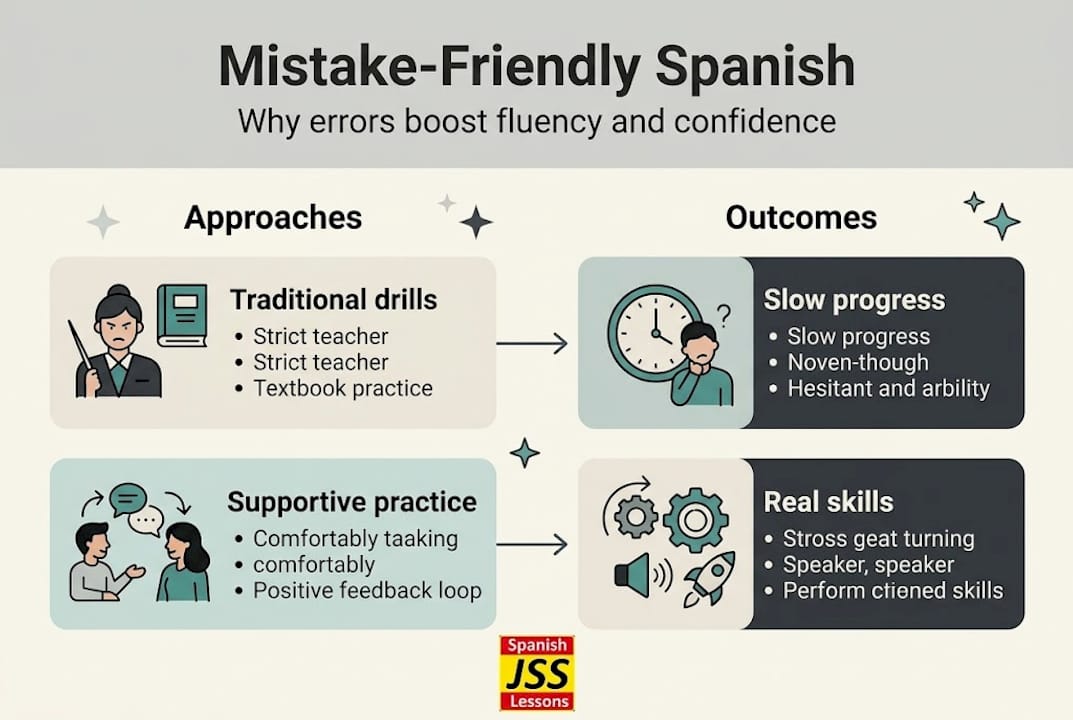
Traditional drill-focused methods often do the opposite. They reward accuracy and penalise deviation, which trains learners to stay quiet unless they’re certain. For adult learners especially, that silence becomes a habit. And silence never built fluency.
| Approach | Focus | Outcome |
|---|---|---|
| Traditional drills | Accuracy above all | Fear of speaking, slow progress |
| Mistake-friendly practice | Communication first | Faster fluency, growing confidence |
| Error journalling | Noticing patterns | Long-term retention and self-correction |
A supportive environment, combined with error journals and gentle feedback, forms the backbone of this method. These aren’t soft extras. They’re the engine room of the approach.
Here’s what mistake-friendly practice looks like in action:
- You attempt a sentence even when you’re not sure it’s correct
- You note errors afterwards rather than freezing mid-conversation
- You receive feedback that guides rather than shames
- You repeat attempts with adjustments rather than avoidance
- You measure progress by how much you communicate, not how little you stumble
“The goal is not a perfect sentence. The goal is a completed conversation.”
Error-making boosts long-term retention and confidence, according to empirical research in language acquisition. When you struggle to retrieve a word or construct a phrase, and then correct it, your brain encodes that knowledge more durably than if you’d rehearsed a flawless script.
This is why building real skills for everyday fluency matters far more than perfecting academic exercises. Real Spanish, spoken by real people in real situations, is messy, fast, and forgiving. Your practice should reflect that reality from the very beginning.
Core strategies for supportive Spanish learning
With its goals and benefits clear, let’s explore the specific methods that make mistake-friendly Spanish learning possible and effective.
Knowing that mistakes are acceptable is one thing. Having a structured way to practise is another. The following strategies give you a practical framework to start speaking Spanish with more confidence and less anxiety.
- Create safe practice settings. Self-talk is one of the most underrated tools available. Narrate your morning routine in Spanish, describe what you see on a walk, or rehearse conversations you’re likely to have. Nobody is listening, so nothing is at stake. This low-pressure environment lets you experiment freely.
- Try shadowing. Listen to short clips of native Spanish speech and repeat what you hear, matching rhythm and tone. You’re not translating. You’re absorbing. This builds your ear and your mouth simultaneously.
- Arrange one-to-one conversation sessions. A patient tutor or language exchange partner creates a contained, supportive space where errors are expected and welcomed. Ways to practise Spanish conversation range from structured lessons to casual video calls with native speakers.
- Keep an error journal. After any speaking session, jot down the mistakes you noticed. Note what you said, what you meant to say, and the correct version. Review it weekly. Patterns will emerge and you’ll stop making the same errors without even trying.
- Build a daily ten-minute routine. Consistency beats intensity every time. Ten focused minutes of Spanish self-talk or practice lessons each day will outperform a two-hour session once a fortnight.
Safe spaces, error journalling, and daily routines form the foundation of a genuinely effective mistake-friendly methodology. These aren’t complicated techniques requiring expensive resources. They’re habits.
| Strategy | Effort level | Impact on fluency |
|---|---|---|
| Self-talk | Low | High |
| Error journal | Low | Very high |
| Shadowing | Medium | High |
| One-to-one sessions | Medium | Very high |
| Daily ten-minute routine | Low | Very high |
Pro Tip: Keep a small notebook beside your phone or laptop. The moment a speaking session ends, write down the two or three phrases that felt uncertain. That act of writing is itself a memory reinforcement tool.

Having a few rescue phrases ready also helps enormously. Expressions like ¿Cómo se dice…? (How do you say…?) or No lo he entendido bien (I didn’t quite catch that) keep the conversation alive rather than grinding to a halt.
The science behind embracing mistakes in language learning
These core methods owe their success to principles rooted in language teaching research. Here’s what the science reveals.
The idea that mistakes help rather than hinder learning may seem counterintuitive, but the evidence is consistent. Studies confirm that making mistakes enhances long-term language retention, while error-tolerant environments measurably boost both fluency and confidence in adult learners.
One key reason is what researchers call desirable difficulty. When your brain has to struggle to retrieve or produce language, the resulting memory trace is stronger. A fluent phrase you rehearsed to perfection in isolation is far more fragile than one you fumbled in a real conversation and then corrected.
Communicative Language Teaching (CLT) is the academic framework underpinning much of this thinking. CLT places communication at the centre of language learning rather than grammatical accuracy. The core argument is simple: if you can make yourself understood and carry a conversation forward, you are succeeding. Errors are secondary concerns.
Key findings from CLT and related research:
- Adult learners in low-anxiety settings acquire language faster than those in high-pressure environments
- Meaningful communication practice produces more durable fluency than repetitive accuracy drills
- Learners who speak early in the process, even poorly, significantly outpace those who wait until they feel ready
- Error correction is most effective when it is gentle, delayed, and selective rather than immediate and comprehensive
“Anxiety is not a side effect of language learning. For many adults, it is the single biggest obstacle to progress.”
For adult learners, the emotional dimension is particularly significant. Years of formal education condition many people to associate speaking with being judged. Reframing errors as progress rather than failure is not simply motivational language. It is a psychologically grounded strategy.
Reinforcing Spanish skills through regular, low-anxiety exposure is how genuine competence develops. The science agrees with what experienced language learners have always known: you learn by doing, and doing involves getting things wrong.
Balancing correction and confidence: avoiding common pitfalls
Research shows the value of embracing mistakes, but true progress lies in balancing error correction and personal confidence.
Mistake-friendly practice does not mean abandoning all correction. It means being strategic about when, how, and how much correction you apply. Too little and errors fossilise. Too much and the learner shuts down.
Over-correction demotivates adult learners significantly, and most common errors, including ser/estar confusion and gender agreement, are best resolved through regular exposure rather than drilling.
Here are the most practical guidelines for keeping correction productive:
- Focus on communication-blocking errors first. If a mistake causes genuine confusion, address it. If the message still lands, let it go for now.
- Use recasting rather than correction. Simply repeat the phrase correctly in your response without making the error the focus of attention.
- Treat self-correction as a skill. Train yourself to notice and adjust mid-sentence rather than relying on external correction.
- Separate speaking time from reviewing time. Don’t pause conversations to analyse grammar. Do that afterwards, in your error journal.
Pro Tip: When practising with a partner, agree beforehand that they’ll note two or three errors to share after the conversation ends, not during. This keeps fluency front of mind while still capturing useful feedback.
The most common error categories for English speakers learning Spanish include:
- Ser vs. estar (two verbs where English uses one)
- Noun and adjective gender agreement
- Pronoun placement before verbs
- False friends (words that look like English but mean something entirely different)
“Perfection is not the entry requirement for a real conversation. Willingness is.”
For practical Spanish tips that connect grammar realities to everyday situations, focusing on what you can communicate right now is always more valuable than waiting until you feel perfect. That moment rarely arrives on its own.
Why mistake-friendly practice is the secret to real conversational fluency
Stepping back, here’s a perspective most textbooks ignore but experienced speakers know well.
After forty years of living in Spain and watching hundreds of learners struggle through the same patterns, James Bretherton the principal of James Spanish School says one truth stands out clearly. The learners who achieve real conversational fluency are almost never the ones who memorised the most. They are the ones who spoke the soonest and minded the errors the least.
Chasing error-free Spanish is a trap. It feels like diligence but it functions like avoidance. You keep studying, keep preparing, and keep telling yourself you’ll speak properly when you’re ready. But readiness built on perfection never quite arrives.
Real conversations in Spain are not graded. Your neighbour does not mark your verb endings. Your local shopkeeper is delighted you tried at all. Real skills in spoken Spanish are built in the arena of actual exchange, not in the rehearsal room of flawless scripts.
Confidence grows through visible progress. Every stumbled sentence that still gets a warm response is proof that you are already communicating. That proof is more powerful than any textbook grade.
Next steps: tools for mistake-friendly Spanish fluency
If you’re ready to turn these insights into action, these curated resources will help you start practising in a supportive, mistake-friendly way.
At James Spanish School, everything is built around real-life European Spanish, not academic perfection. James Bretherton’s 40 years of living in Spain inform every lesson, from practical sentence-building to the ear-tuning you need to follow native speakers at full speed.
Whether you’re preparing to live, retire, or spend extended time in Spain, the course meets you where you are and lets you move at your own pace. Start with tips for speaking fluently with locals, browse the resources for Spanish starters, or explore more practical fluency tips. The next conversation you have in Spanish could be more successful than you think.
Frequently asked questions
What are the main benefits of mistake-friendly Spanish practice?
Mistake acceptance boosts fluency and confidence, making it easier to hold real conversations, retain new vocabulary, and recover quickly when you lose your way mid-sentence.
How can I start practising Spanish in a mistake-friendly way?
Begin with low-pressure settings such as self-talk or casual chats, and keep an error journal to track patterns. Safe practice and error journalling are core strategies for sustainable progress.
Is it better to focus on accuracy or communication at first?
Communicative competence should come first, because CLT prioritises fluency over accuracy and waiting for perfection consistently slows practical improvement.
Which common Spanish errors should I worry less about?
Ser/estar and gender errors resolve most naturally through regular exposure to real Spanish rather than through intensive correction drills.
Recommended
- Practical Spanish tips for real-life fluency in Spain
- Essential European Spanish grammar tips for real conversations
- Why Spanish is easier for English speakers: 5 key steps
- Practical spoken Spanish: real skills for everyday fluency
- Hoe leer je snel Spaans? 7 bewezen tips voor resultaat – Bogaers Taleninstituut Tilburg