

TL;DR:
- Conversational Spanish in Spain is fast, colloquial, filled with regional idioms, and involves interruptions.
- Learning through real-life interactions, not just grammar, builds real confidence and fluency.
- Daily practice, listening, and engaging in informal settings accelerate speaking and comprehension skills.
Think conversational Spanish is just a handful of polite phrases and basic vocabulary? It is far more alive, fast, and culturally rich than most learners expect. In real Spain, a trip to the market or a chat with a neighbour can involve machine-gun-speed replies, overlapping voices, and expressions that never appeared in any textbook. The good news is that none of this needs to feel overwhelming. With the right approach, one built around real life rather than grammar rules, you can follow conversations, join in, and genuinely connect with people around you.
Table of Contents
- What does conversational Spanish really mean?
- How conversational Spanish works in real life
- Practical steps to build your conversational Spanish skills
- Mistakes, myths, and what to expect as you learn
- Why focusing on conversation beats grammar-first learning
- Take your Spanish conversation further
- Frequently asked questions
Key Takeaways
| Point | Details |
|---|---|
| Conversational Spanish explained | It’s natural, fast, and involves real-world language not found in textbooks. |
| Practical strategies matter | Daily practice and exposure in real settings outperform memorising grammar rules. |
| Common mistakes are normal | Almost everyone struggles with pace, listening, or slang at first — and that’s part of the process. |
| Conversation boosts confidence | Real conversation practice, not just studying, is the fastest route to Spanish fluency. |
What does conversational Spanish really mean?
Most people who start learning Spanish picture a classroom setting: neat sentences, clear pronunciation, and patient teachers waiting while you search for the right word. Real conversational Spanish in Spain is a different animal entirely. It is spontaneous, expressive, and shaped by local habits that no grammar book fully captures.
At its core, conversational Spanish is about engaging, not performing. Native speakers are not marking your accuracy. They want to know if you understood, if you can reply, and whether you can keep the exchange moving. Spanish proficiency research confirms that oral skills develop through interaction, not isolated grammar study, which is why classroom methods often fall short in the real world.
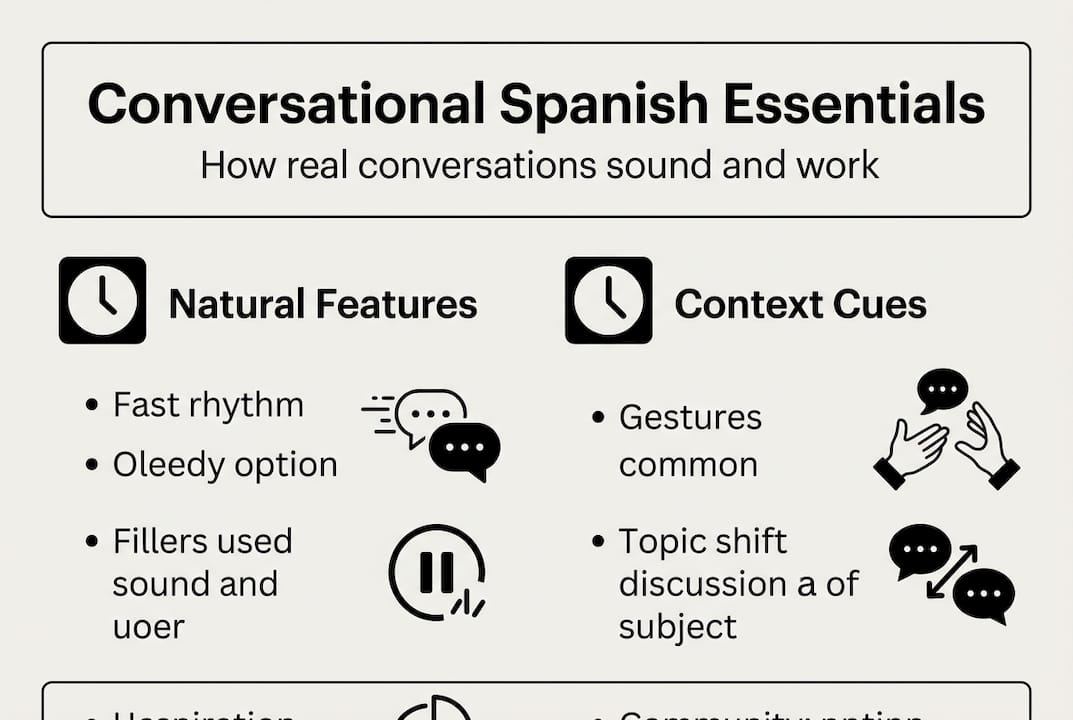
Understanding real-life Spanish conversation means accepting that speech is fast, filled with fillers, and peppered with regional idioms. Words like pues (well) and o sea (I mean) pop up constantly. Interruptions are not rude; they are a sign of enthusiasm and engagement.
Here is how traditional classroom Spanish compares to the conversational Spanish you will actually encounter:
| Feature | Classroom Spanish | Conversational Spanish |
|---|---|---|
| Pace | Slow and deliberate | Fast and natural |
| Vocabulary | Formal and textbook-driven | Colloquial and idiomatic |
| Grammar focus | High | Low in practice |
| Interruptions | Rare | Common and expected |
| Fillers used | None | Pues, o sea, venga, bueno |
| Setting | Structured | Markets, cafes, streets |
“Real-life speech in Spain features fast pace, fillers, regional idioms, and interruptions. Practice in markets and cafes is essential to build genuine conversational ability.”
What you will notice immediately when you arrive in Spain is that people do not speak in textbook sentences. A shop assistant might say something like “Pues, ¿qué te pongo?” before you have even opened your mouth. Learning Spanish small talk basics gives you a solid foundation for these spontaneous moments.
Key features of conversational Spanish in Spain include:
- Heavy use of filler words and expressions
- Regional accents that vary significantly across Spain
- Frequent use of diminutives and informal verb forms
- Topic changes mid-sentence
- Laughter, gestures, and non-verbal cues as part of communication
Once you accept that this is what real Spanish sounds like, the learning path becomes much clearer and far less intimidating.
How conversational Spanish works in real life
With a clearer understanding of what conversational Spanish is, let us explore how it unfolds naturally in everyday Spanish environments.
Spanish in real settings moves at a pace that surprises most learners. Whether you are ordering a coffee, asking for directions, or chatting with a tradesman, the authentic spoken Spanish you encounter will include fillers, regional phrases, and natural interruptions that are simply part of the rhythm.

Here are the most common conversational fillers you will hear across Spain:
| Filler | Meaning in context | When it is used |
|---|---|---|
| Pues | Well / So | Starting or continuing a thought |
| O sea | I mean / That is to say | Clarifying or rephrasing |
| Venga | Come on / Alright / Bye | Agreement or farewell |
| Bueno | Right / OK / Well | Transitioning between points |
| Hombre | Man / Seriously | Expressing surprise or emphasis |
| Mira | Look / Listen | Drawing attention |
Knowing these words will help you follow conversations even when other vocabulary trips you up. They act as signposts in the dialogue.
Here is a practical sequence for recognising and participating in fast-paced exchanges:
- Listen for fillers first. They signal that the speaker is continuing or changing direction, giving you a moment to catch up.
- Focus on key nouns and verbs. You do not need every word. The engine room of meaning is usually just two or three core words.
- Use short confirmations. Words like sí, claro, entiendo (yes, of course, I understand) keep the conversation moving while you process.
- Ask for repetition without panic. ¿Puedes repetir, por favor? is always acceptable and locals appreciate the effort.
- Practise listening to fast Spanish regularly so your ear gradually tunes in to the natural speed of native speech.
Pro Tip: When a native speaker interrupts you, do not freeze. Smile and use “perdona, continúa” (sorry, please carry on) to hand the floor back graciously. This shows social awareness and keeps the conversation warm.
Building familiarity with these rhythms takes time, but every interaction is a small lesson. The practical Spanish tips that make the biggest difference are the ones rooted in these everyday moments, not textbook exercises.
Practical steps to build your conversational Spanish skills
Seeing how conversational Spanish is used in the real world, it is time to break down what you can do, day-to-day, to master it practically and confidently.
Research into oral proficiency development shows that learners who maximise contact hours with Spanish, especially through real interaction, make significantly greater gains in complexity and overall proficiency. The method matters, but the consistency matters more.
Here is a practical sequence you can follow regardless of your current level:
- Start with sentence patterns, not grammar rules. Learn how to build a sentence by feel, just as you learned English as a child. Practical spoken Spanish is about structure you can use, not rules you need to memorise.
- Tune your ear daily. Spend ten minutes listening to spoken Spanish every morning. Radio, TV, or short audio lessons all count. The goal is to make fast speech feel familiar, not foreign.
- Practise in low-stakes settings first. A bakery order, a greeting to a neighbour, or asking for the bill. Small exchanges build real confidence faster than long study sessions.
- Repeat and recycle phrases. A handful of versatile phrases used well will carry you further than a large vocabulary used awkwardly. Work on reinforcing Spanish skills through regular repetition rather than constant new material.
- Record yourself speaking. Playback reveals patterns in your hesitation and pronunciation that you simply cannot hear in the moment.
- Use active learning strategies that keep you engaged and producing language, not just receiving it passively.
- Review what confused you. After any real conversation, note the words or phrases that tripped you up. Those are your most valuable next lessons.
Pro Tip: Attach Spanish to your existing habits. Make your morning coffee while listening to a short Spanish dialogue. Label items around the house. The goal is to practise Spanish conversation in small, consistent doses every single day rather than in long, occasional sessions.
Mistakes, myths, and what to expect as you learn
Armed with practical routines, you will advance. But it is important to know what hurdles and surprises most learners face along the way.
Every learner struggles with speed, listening, and slang early on. That is completely normal. The mistake is thinking that struggle means failure. Oral proficiency gains do not follow a straight line, and fluency rarely arrives on a predictable schedule.
Here are the most common misconceptions and the realities behind them:
- Myth: You need perfect grammar before you can hold a conversation. Reality: Locals care about meaning, not accuracy. An imperfect sentence that communicates is worth far more than a perfect one you never say.
- Myth: Native speakers will lose patience with you. Reality: Most Spanish people are warm and genuinely pleased when foreigners make an effort. A smile and a few words go a long way.
- Myth: If you do not understand, you have failed. Reality: Not understanding is a sign you are at the right edge of your ability. That discomfort is where learning happens fastest.
- Myth: Slang and idioms are too advanced to worry about early on. Reality: You will hear them immediately. Knowing a handful of fillers from day one puts you ahead of most learners.
- Myth: More study automatically means faster progress. Reality: More conversation means faster progress. Study supports it, but cannot replace it.
Expect native speakers to interrupt, switch topics, use gestures, and occasionally speak over each other. None of that is directed at you personally. Understanding fluency tips for locals includes knowing how Spanish social conversation actually flows, which is nothing like a classroom dialogue.
Pro Tip: Keep a simple notebook of every mistake that embarrassed you. Embarrassment is memorable, and memorable moments accelerate learning. The very phrases that made you blush are the ones you will never forget.
Using practice lessons for spoken Spanish alongside real-world interaction creates a powerful feedback loop that speeds up progress considerably.
Why focusing on conversation beats grammar-first learning
Here is the uncomfortable truth that most language courses never tell you: grammar knowledge and conversational ability are not the same thing, and chasing one does not automatically give you the other.
Grammar rules cannot prepare you for an interruption from a market trader or a rapid question from a health worker. What builds real confidence is exposure and practice, combined with the structural logic to understand how sentences fit together in plain terms. Audio lessons for Spanish conversation train your ear and your instincts simultaneously, which is exactly how first-language learning works.
Learners who prioritise conversation from the start retain phrases better because they have emotional and situational context attached to them. They also feel less nervous in daily exchanges because they have already experienced the discomfort and moved through it. Grammar-first learners, by contrast, often freeze the moment a real reply comes back at speed. Conversation-first learning builds adaptability, and adaptability is what everyday life in Spain actually demands.
Take your Spanish conversation further
If the practical steps in this article have given you a clearer picture of what conversational Spanish really involves, the natural next move is to build on that foundation with resources designed for real life, not textbook exams.
At James Spanish School, every lesson is built around the Spanish you will actually use: with neighbours, shop staff, tradesmen, health workers, and local officials. You can get practical tips that go straight to the heart of everyday interactions, explore the quickstart Spanish resources that learners are already using, or find out how online spoken Spanish lessons fit into your daily routine on demand, at your own pace, with no countdown clock.
Frequently asked questions
What is the difference between conversational Spanish and classroom Spanish?
Conversational Spanish focuses on real-life interaction with natural speech patterns, including fillers, idioms, and interruptions, while classroom Spanish typically emphasises formal grammar and written accuracy.
Can I become fluent in Spanish just by learning conversational phrases?
Conversational phrases are a strong and practical starting point, but significant fluency gains require regular exposure and real interaction over time rather than phrases alone.
What are the most useful settings to practise conversational Spanish in Spain?
Markets, cafes, and spontaneous social exchanges with locals are the best environments, as real-life practice in these settings builds the speed, flexibility, and listening skills that matter most.
How long does it take to gain conversational Spanish skills?
Research shows meaningful proficiency gains are possible within several months of consistent practice and contact, though individual progress varies depending on exposure and starting level.
Recommended
- Mastering Spanish small talk: real-world fluency
- Real-life Spanish conversation: what it means and how to use it
- Essential European Spanish grammar tips for real conversations
- Master basic Spanish: beginner steps for real conversations
- Hoe leer je snel Spaans? 7 bewezen tips voor resultaat – Bogaers Taleninstituut Tilburg