

TL;DR:
- Confidence in speaking Spanish depends on practical communication skills, not perfect grammar. Learning common phrases, cognates, and real-life scenarios builds fluency and reduces anxiety in daily interactions. Emphasizing willingness over perfection accelerates progress and fosters genuine connection with native speakers.
Standing at a Spanish shop counter, mouth dry, mind blank, watching the shopkeeper’s expectant face — that moment of freezing is something almost every adult learner knows. The gap between studying Spanish and actually speaking it in Spain feels enormous, and the anxiety that follows can be paralysing. But self-confidence and low anxiety directly shape how well you speak, which means the very fear of speaking is the biggest obstacle you face. The good news is that practical, research-backed steps can close that gap faster than you might think.
Table of Contents
- What you actually need to speak Spanish confidently
- Simple steps to practise and progress each day
- Overcoming anxiety and mistakes: what actually works
- How to know you’re making real progress
- Why confidence always beats perfection: lessons from real learners
- Take your Spanish speaking confidence even further
- Frequently asked questions
Key Takeaways
| Point | Details |
|---|---|
| Context beats grammar | Using Spanish in real situations builds much faster confidence than focusing only on rules. |
| Daily practice matters | Short, practical conversations every day increase fluency and self-assurance steadily. |
| Mistakes are progress | Embracing errors lowers anxiety and speeds up communication skills. |
| Confidence over perfection | Aim for being understood, not flawless speech, to connect effectively in Spain. |
What you actually need to speak Spanish confidently
Grammar is not the engine room of real conversation. Many learners spend months memorising verb tables and conjugation rules, only to find they still cannot order a coffee without going red in the face. The truth is that daily communication in Spain relies on a much smaller, more practical toolkit.
What you genuinely need for everyday Spanish life comes down to a handful of core areas:
- Greetings and social phrases: Hola, buenos días, ¿cómo estás? These open every door and signal respect.
- Directions and location: Knowing how to ask where the pharmacy is, or confirm you are on the right road, keeps you safe and independent.
- Shopping and money: Prices, quantities, and polite requests cover the vast majority of market and shop interactions.
- Food and drink: Menu vocabulary, allergens, and ordering phrases make eating out relaxed rather than stressful.
- Polite requests and apologies: Por favor, gracias, perdona — short phrases with enormous social power.
Research supports this approach clearly. Communicative learning from day one, focused on real-life Spain interactions like greetings, directions, and food, consistently outperforms grammar drills for building speaking confidence. You are learning a living language, not sitting an exam.
One of the most powerful and underused shortcuts is cognates. These are words that look or sound similar in English and Spanish, and there are thousands of them. Words like hospital, hotel, animal, natural, oficina (office), información, and restaurante are immediately recognisable. The moment you realise how many Spanish words you already know, anxiety drops and confidence rises. This is why real-life Spanish conversation feels far more achievable than textbook study suggests.
| Approach | Focus | Real-life result |
|---|---|---|
| Grammar-first learning | Rules, tables, conjugations | Paralysis under pressure |
| Communicative learning | Phrases, context, scenarios | Faster, more natural speech |
| Cognate awareness | Familiar word shapes | Immediate vocabulary boost |
| Cultural context learning | Spain-specific situations | Smoother, more relevant interactions |
Pro Tip: Before your next outing in Spain, write down five phrases you expect to need. Practise saying them aloud three times. This tiny preparation step dramatically reduces in-the-moment freezing.
Rather than starting with grammar rules, explore context vs. vocabulary lists to see why situational learning sticks far more effectively for adult learners.
Simple steps to practise and progress each day
With your essential toolkit in mind, let us build a practical daily path to spoken confidence. The key word here is daily. Short, regular practice beats the occasional long study session every time.
Here is a straightforward daily routine you can follow, even on busy days:
- Choose one scenario for the day. It might be the bakery, the chemist, or the town hall. Pick something real and relevant to your actual life in Spain.
- Learn three to five target phrases for that scenario. Not twenty words. Not a grammar chapter. Just three to five phrases that you will genuinely use.
- Practise those phrases aloud. Say them out loud, at normal speed, at least five times. Whispering in your head does not build the muscle memory your mouth needs.
- Use at least one phrase in a real interaction that day. Even a simple buenos días to the café owner counts. Real usage cements learning faster than any amount of desk study.
- Reflect for two minutes in the evening. What did you say? How did the local respond? What would you say differently next time?
Contextual learning beats isolated words for building the kind of fluency that holds up under pressure. When you learn a phrase in its natural setting, your brain stores it with context, emotion, and meaning attached — all of which make recall far quicker when you need it.
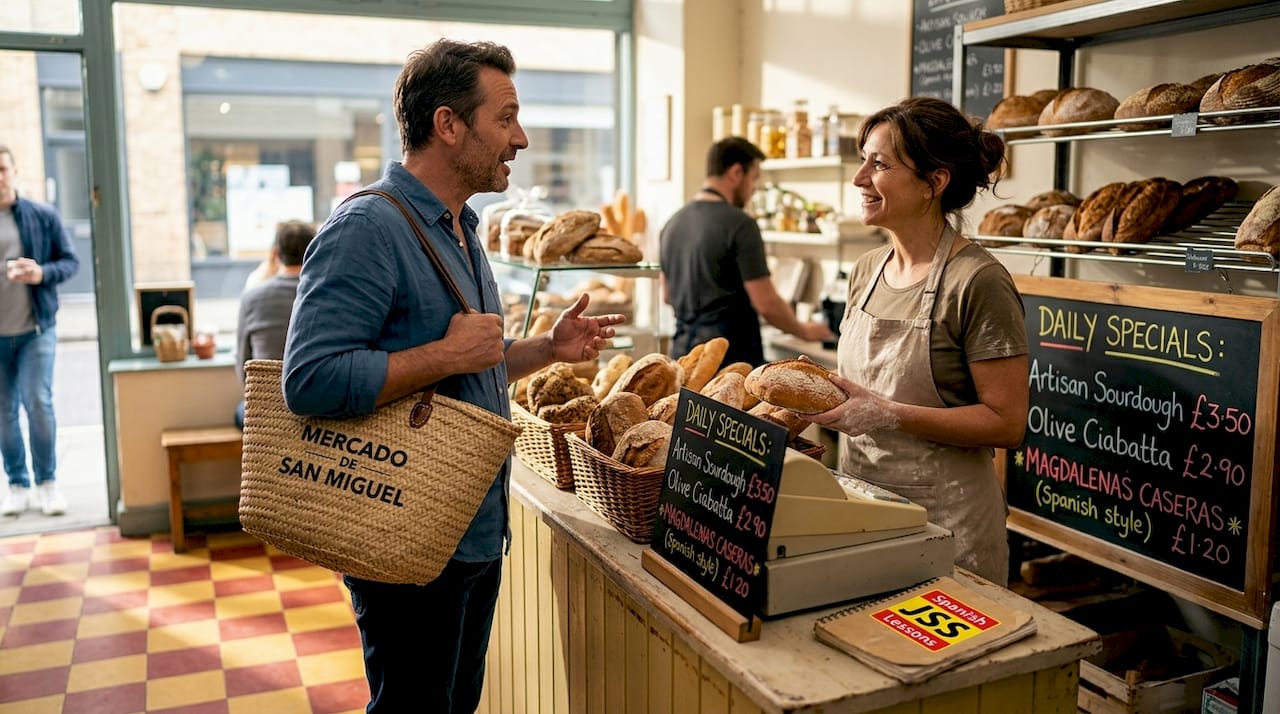
There are many ways to practise Spanish conversation that fit into a normal day without requiring a classroom or a study partner. The key is consistency over intensity.
| Day | Scenario | Target phrases | Real usage moment |
|---|---|---|---|
| Monday | Bakery | Ordering bread, asking price | Morning visit to the panadería |
| Tuesday | Café | Ordering coffee, asking for bill | Mid-morning break |
| Wednesday | Chemist | Describing a symptom, buying medicine | Afternoon errand |
| Thursday | Supermarket | Asking where something is, quantities | Weekly shop |
| Friday | Neighbour chat | Greetings, weather, simple questions | Chance encounter |
Following a Spanish conversation workflow like this transforms Spanish from something you study into something you live. That shift in mindset is where real confidence is born.
Pro Tip: Keep a small notebook or phone note labelled “phrases used today.” Writing down even one phrase you successfully used in a real conversation builds a visible record of progress that keeps motivation alive.
Overcoming anxiety and mistakes: what actually works
Once you are practising daily, the next hurdle is managing the anxiety that spikes every time a native speaker replies at machine-gun speed and you have absolutely no idea what they said. This is normal. Every learner faces it. What matters is how you respond to it.
The science here is clear and encouraging. Self-confidence and low anxiety directly impact speaking performance, and positive feedback measurably reduces foreign language anxiety scores. In other words, how you talk to yourself about your Spanish learning genuinely affects how well you speak.
Practical techniques that actually work include:
- Supportive self-talk. When you make a mistake, replace “I’m terrible at this” with “That was new information.” One phrase reframes failure as progress.
- Practise with a sympathetic partner. A friend, spouse, or fellow learner who encourages rather than corrects aggressively creates the low-anxiety environment where real learning happens.
- Celebrate communication wins, not linguistic perfection. Did the shopkeeper understand you? Did you get what you needed? That is a success, regardless of your grammar.
- Reflect on achievements, not gaps. At the end of the week, note what you could do that you could not do a month ago. Progress often feels invisible until you look back.
- Embrace the correction. When a native speaker gently corrects you, thank them. They are giving you a free lesson. Most Spaniards are enormously patient with learners who are genuinely trying.
“The goal of speaking Spanish in Spain is to be understood and to connect with people. It is not to perform flawlessly for an imaginary examiner.”
Understanding conversational confidence means accepting that mistakes are not evidence of failure. They are evidence of effort, and effort is exactly what gets you to fluency.
Learning how to handle Spanish small talk is one of the fastest ways to reduce anxiety in everyday settings. Small talk is low stakes, high reward, and most Spaniards genuinely enjoy a friendly exchange with someone making the effort to speak their language.
Pro Tip: If a native speaker replies too fast, it is perfectly acceptable to say ¿Puede hablar más despacio, por favor? (Can you speak more slowly, please?). Most people will smile and slow down without any awkwardness at all.
How to know you’re making real progress
Once you start reducing anxiety and focusing on growth, you are ready to measure tangible progress. Milestones matter. They remind you that the effort is working, and they keep motivation alive when the learning curve feels steep.
Here are some concrete milestones to watch for:
- You ordered a coffee, pastry, and asked for the bill entirely in Spanish without reverting to English.
- You understood directions given by a local, even if you needed them repeated once.
- You survived a full small-talk exchange with a neighbour, including their questions back to you.
- You handled a basic health appointment, describing your symptoms clearly enough to be understood.
- You negotiated a price or queried a bill at a market stall, in Spanish, and resolved it.
Each of these is a genuine real-world achievement. Supportive feedback reinforces positive speaking behaviour and reduces anxiety further, creating an upward spiral of growing confidence.
Use this simple self-check at the end of each week:
- Did I use at least one new phrase in a real interaction?
- Did I communicate a need and have it understood?
- Did a native speaker respond to me positively or helpfully?
- Did I handle an unexpected question or situation in Spanish?
If you can answer yes to even two of these, your Spanish is growing. For broader practical Spanish tips for real-life fluency in Spain, reviewing your progress through these lenses keeps you honest and motivated.
| Experience | Typical beginner | Confident speaker |
|---|---|---|
| Entering a shop | Panic, points, uses English | Greets, asks, thanks in Spanish |
| Getting directions | Smiles and nods blankly | Follows key words, confirms understanding |
| Ordering food | Points at menu, gestures | Orders clearly, handles questions |
| Health appointment | Uses translator or struggles | Describes basics, understands responses |
| Neighbour chat | Avoids or escapes quickly | Engages briefly, enjoys the exchange |
The jump from beginner to confident speaker is not about knowing more grammar. It is about logging real interactions and watching that table slowly fill with right-hand column experiences.
Why confidence always beats perfection: lessons from real learners
Here is something worth saying plainly: perfectionism is not a virtue in language learning. It is a trap. The learner who waits until they feel ready before speaking in Spain may wait for ever.
We have seen this pattern repeatedly at James Spanish School. Adult learners who arrive with impressive grammar knowledge but zero speaking confidence often struggle far more in real-life settings than learners with half the vocabulary but twice the willingness to try. One learner with a solid grasp of subjunctive tenses stood silent at a hardware shop for five minutes rather than risk making a mistake. Another learner with far simpler Spanish walked in, pointed at the shelf, said Necesito uno así, ¿lo tiene? (I need one like this, do you have it?) and walked out with exactly what she needed.
Fluency is not the absence of mistakes. It is the presence of willingness. Every Spanish speaker you admire made thousands of errors on the way to sounding natural. The difference is they kept going.
Spanish people, particularly in smaller towns and villages, respond warmly to the effort. They are not grading your subjunctive usage. They are deciding whether to help you. And a genuine, imperfect attempt in their language almost always wins their goodwill immediately. That is the real-life conversation experience that no grammar book can replicate.
The uncomfortable truth is that many language courses, whether apps, textbooks, or evening classes, accidentally reinforce perfectionism by grading every answer. Real life does not grade you. Real life just asks: did you communicate? If yes, you passed.
Prioritise being understood. Prioritise connecting with the people around you. Everything else, including your grammar, tidies itself up over time through repeated exposure and the small corrections that generous native speakers offer freely.
Take your Spanish speaking confidence even further
Building confidence in spoken Spanish is a journey, and having the right structure behind you makes every step more manageable and rewarding.
At James Spanish School, every lesson is built around the real life you are living in Spain, not abstract grammar exercises or academic exam preparation. James Bretherton’s 100-lesson course really focuses on covers both sentence-building and ear-tuning, so you can understand the replies you get, not just produce the questions. With tips for speaking with locals woven throughout, and cultural insights that go far beyond language, the course equips you for the situations that actually matter. Explore conversational Spanish confidence resources and see how a structured, Radical Simplification approach can turn daily anxiety into daily achievement.
Frequently asked questions
What are the most common mistakes when speaking Spanish in Spain?
Over-focusing on grammar rules and fearing errors are the two biggest obstacles; communicative learning focused on real interactions consistently beats grammar drills for building usable fluency.
How quickly can I gain confidence speaking Spanish?
Short daily practice of real interactions builds noticeable confidence within weeks, especially when positive feedback reduces anxiety and reinforces progress with each successful exchange.
What’s more effective: studying vocabulary or real conversations?
Practising phrases in realistic contexts leads to faster, more reliable real-life usage because contextual learning outperforms isolated word memorisation when it comes to under-pressure recall.
Can making mistakes in Spanish help me learn faster?
Yes, every mistake is genuinely useful learning data, and focusing on communication rather than perfection reduces foreign language anxiety over time, making you both more relaxed and more effective as a speaker.