

TL;DR:
- Module-based Spanish focuses on practical scenarios rather than traditional grammar rules.
- It offers flexible, scenario-oriented learning that builds confidence through real-life conversations.
- Consistent practice with modules leads to improved fluency and authentic communication skills.
You’ve been there. You sit down with a Spanish textbook, wade through verb conjugation tables, and still freeze the moment a shopkeeper fires words at you in rapid-fire Castilian. Traditional grammar-focused methods leave many adults feeling embarrassed rather than empowered. Module-based Spanish learning offers a completely different route, one built around the real conversations you actually need in Spain. Whether you want to chat with your neighbour, manage a doctor’s appointment, or simply order a meal or a coffee without that familiar moment of panic, this guide explains why the modular approach works, how it’s structured, and how you can use it to build genuine, practical fluency.
Table of Contents
- What is module-based Spanish learning?
- How are modules structured in Spanish education?
- Module-based vs traditional Spanish learning: a comparison
- Fluency and accuracy: outcomes of module-based learning
- Applying module-based learning for everyday fluency in Spain
- Why adults should break free from grammar drills
- Ready to transform your Spanish with modules?
- Frequently asked questions
Key Takeaways
| Point | Details |
|---|---|
| Focus on communication | Module-based methods prioritise real conversations over rote grammar for practical skills. |
| Learn at your pace | Modular courses let you choose the order and speed that fit your lifestyle, boosting motivation. |
| Consistency is key | Fluency and confidence improve most when you practise modules regularly with real-life goals. |
| Flexibility and personalisation | Adults can target modules matching their personal needs, from ordering food to socialising. |
What is module-based Spanish learning?
With the frustration of traditional methods fresh in your mind, let’s clarify what makes module-based Spanish learning different.
At its core, module-based learning organises content around themes, scenarios, or practical skills rather than grammar rules. Instead of working through a textbook chapter called “The Present Subjunctive,” you might work through a module called “Eating out in Spain” or “Talking to the doctor.” The focus shifts entirely from abstract theory to real-life application, which is a significant change in priority.
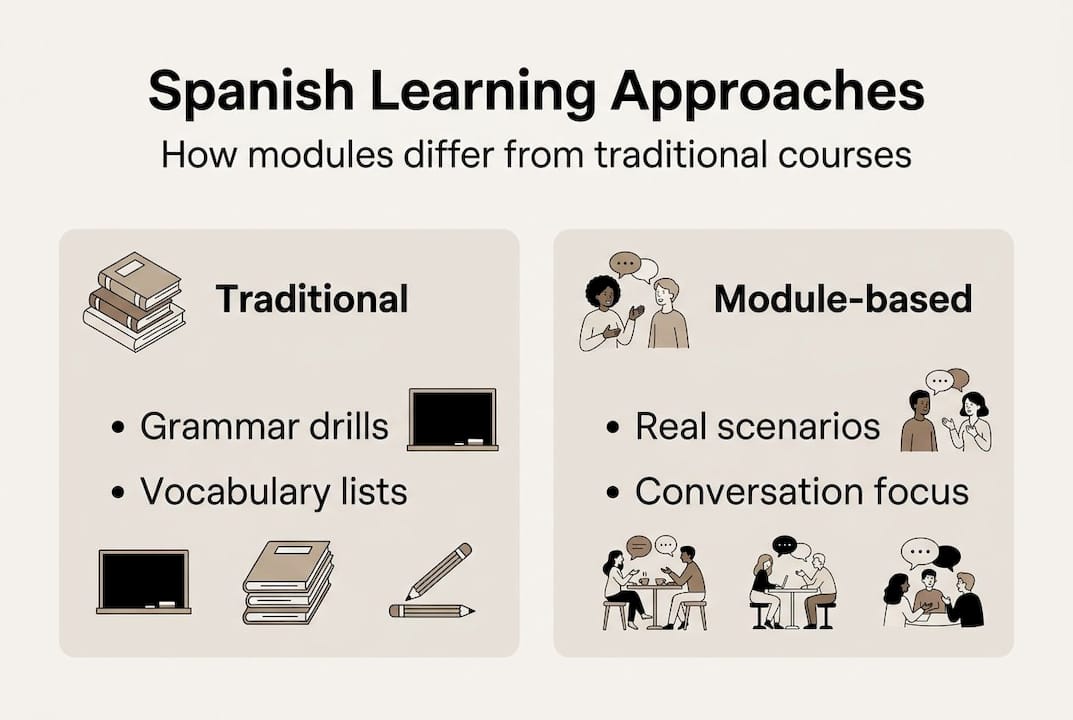
This matters enormously for adult learners. Most adults who want to speak Spanish are not preparing for an academic exam. They want to handle a conversation at the town hall, chat to the builder over a coffee, or understand what the pharmacist is recommending. Context-based Spanish learning is built on this exact principle: language sticks when it means something to you right now.
Here is what module-based learning typically looks like in practice:
- Theme-driven content: Each module covers a specific situation, such as shopping, transport, or health.
- Skill-focused goals: You practise the vocabulary and phrases you will genuinely use, not just study them.
- Flexible access: You can revisit modules as often as you like until they feel natural.
- Scenario-based progress: Confidence in one scenario carries over and boosts your approach to the next.
“Module-based learning works best for self-motivated adults and provides flexibility for both fluency and accuracy gains.”
This approach suits adults who want to prioritise everyday communication rather than perfection. It removes the paralysis that grammar lists often create and replaces it with a sense of genuine, growing capability.
How are modules structured in Spanish education?
Now that you know what modules are, let’s see how a module-based curriculum works in reality.
A well-designed modular Spanish course follows a clear internal sequence within each unit. That sequence is what makes the learning feel manageable rather than overwhelming. Rather than dumping fifty new words on you at once, each module guides you through a logical build-up.
A typical module progression looks like this:
- Introduction: Core phrases and key vocabulary for the scenario are presented in context.
- Practice: You work through guided exercises, listening tasks, or spoken repetition to embed the language.
- Cultural context: You receive practical insight into how native speakers actually use these phrases in daily life in Spain.
- Review and mini-assessment: You consolidate what you have covered and identify any gaps before moving on.
Here is how a sample module structure compares across different learning levels:
| Module stage | Beginner focus | Intermediate focus |
|---|---|---|
| Introduction | Core greetings, numbers | Extended dialogues, opinions |
| Practice | Repeating key phrases aloud | Responding in real time |
| Cultural context | Customs and social norms | Regional differences |
| Review | Phrase recall | Full conversation simulation |
This step-by-step build means you see immediate results rather than waiting weeks before you can say anything useful. Personalised module access also means you can log in and revisit whichever stage you need, with no time pressure.

Research confirms that consistency is crucial in avoiding stop-start learning cycles with modular approaches. Dipping in and out sporadically undermines the progress that steady, regular sessions build.
Pro Tip: Block out the same time slot each day, even if it is only fifteen minutes. Consistent short sessions outperform occasional marathon study every time.
Module-based vs traditional Spanish learning: a comparison
Understanding the structure is crucial, but how does module-based learning actually measure up to old-school methods?
Traditional Spanish courses tend to follow a grammar-first sequence. You learn tenses, memorise conjugation patterns, and study vocabulary lists before attempting any real conversation. For many adult learners, this creates a frustrating gap between what they know in theory and what they can actually say under pressure.
Here is a direct comparison:
| Feature | Traditional methods | Module-based learning |
|---|---|---|
| Content focus | Grammar rules and vocabulary lists | Practical scenarios and real dialogue |
| Flexibility | Fixed course sequence | Skip or repeat modules as needed |
| Confidence building | Slow, perfection-focused | Fast, use-focused |
| Adult relevance | Academic and exam-oriented | Everyday life in Spain |
| Engagement | Can feel dry and disconnected | Immediately practical and motivating |
The contrast is stark. On-demand Spanish learning allows you to pause, rewind, and repeat without the pressure of keeping pace with a classroom.
That said, module-based approaches are not a magic shortcut. Research shows that self-motivation and consistency are required, and outcomes vary between learners depending on whether they prioritise fluency or accuracy. The key benefits, though, are clear:
- You can focus on the scenarios most relevant to your life right now.
- You avoid wasting time on grammar you will rarely encounter in conversation.
- You build real confidence because you practise how real conversations actually flow.
- When exploring the best ways to learn Spanish, most experienced teachers agree the approach needs to match your personal goals.
Adults who adopt a modular method consistently report feeling more prepared for actual encounters with Spanish speakers than those who spent equivalent time on grammar drills alone.
Fluency and accuracy: outcomes of module-based learning
We have seen how the systems compare. Now let’s dig into what you can really expect for fluency and accuracy, the outcomes that matter.
Fluency and accuracy are two distinct goals, and it helps to understand how module-based learning affects each one. Fluency means being able to keep a conversation moving without grinding to a halt. Accuracy means producing grammatically correct sentences. Most adult learners need fluency first; accuracy tends to improve naturally with exposure and practice.
Here is a realistic progression you can expect:
- Weeks one to four: Core phrases from early modules begin to feel automatic. You stop translating in your head for simple exchanges.
- Weeks five to eight: You start connecting phrases from different modules. Conversations feel less fragmented.
- Weeks nine onwards: Accuracy begins to catch up with fluency as patterns become internalised through repetition.
Research confirms that fluency and accuracy vary individually, but module-based learning benefits self-motivated learners who commit consistently to the process.
Key insight: Learners who work through complete modules rather than cherry-picking vocabulary see stronger overall fluency gains.
Pro Tip: When you notice accuracy slipping, revisit the cultural context and review stages of that module rather than starting over from scratch. Targeted revision is more efficient than repetition for its own sake.
Understanding why repetition boosts fluency is one of the most useful things an adult learner can do. Repeated exposure to the same module in short bursts trains your brain to retrieve phrases quickly when you actually need them. It is also worth knowing common pitfalls in Spanish for adults so you can sidestep the mistakes that slow most learners down.
Applying module-based learning for everyday fluency in Spain
Knowing the benefits, here is how you can actually apply a modular approach to achieve real-life conversational Spanish in Spain.
The single most important shift is moving from vague ambition to specific conversational goals. “I want to speak Spanish” is too broad. “I want to order a meal, ask for the bill, and thank the waiter” is a goal you can achieve this week. Module-based learning works best when you assign a clear purpose to each unit you tackle.
Here is a practical set of habits to build:
- Set a scenario goal per module: Before starting, decide exactly which real situation you are preparing for.
- Practise with native materials: Use listening exercises and audio content within your modules rather than relying only on written text.
- Never skip the review stage: This is where accuracy gaps get spotted and fixed before they become habits.
- Track your progress visually: Tick off completed modules and note the scenarios you now feel confident handling.
- Mix your skills: Ensure each session includes some listening, some speaking aloud, and some interaction with the material.
Research supports the view that self-motivation and consistent application are the real engine room of progress with modular learning. Tools like audio Spanish lessons are particularly effective for training your ear to follow the machine-gun speed of native replies in everyday situations.
Pro Tip: After completing a module, test yourself by imagining the real scenario vividly. Picture the cafe, the queue at the pharmacy, or the conversation with the landlord. Mental rehearsal cements language far more effectively than passive re-reading.
Why adults should break free from grammar drills
After these practical steps, it is worth reflecting on why the module-based approach is such a needed revolution for adult learners.
Here is an uncomfortable truth: traditional grammar instruction was designed for children in full-time schooling, not for adults with busy lives who need to speak a language in real situations tomorrow. The obsession with conjugation tables and subjunctive moods has paralysed generations of perfectly capable adult learners.
Conversation skills open doors in Spain that textbook perfection never could. When you manage a conversation with a neighbour, even imperfectly, you build a relationship. When you handle a call to the bank, you gain genuine independence. Spanish people consistently appreciate effort and engagement far more than grammatical precision.
Module-based methods make it normal to attempt, make mistakes, and improve through actual use rather than waiting until you are “ready.” That shift in mindset is transformative. When rethinking Spanish lessons, the question should not be “Am I grammatically perfect?” but rather “Can I make myself understood and keep the conversation going?” For adults living or spending time in Spain, that second question is the one that genuinely changes daily life.
Ready to transform your Spanish with modules?
If you are excited to leave the grammar grind behind, here is how to take your first step.
James Spanish School is built around exactly this modular, practical philosophy. James Bretherton, a dual-native speaker with 40 years of living in Spain, has designed every lesson around the real conversations you will actually face, from chatting with tradesmen to navigating the health centre.
The JSS course contains a host of ready-made Spanish module packs covering key everyday scenarios, while contained within the full real world Spanish fluency programme for a structured journey from basics to confident conversation. Prefer to explore lesson by lesson? Browse the full range of online Spanish lessons and start exactly where your goals require. Everything is available on demand, with no countdown clock and no pressure.
Frequently asked questions
What makes module-based Spanish learning suitable for adults?
Module-based Spanish learning suits adults because it prioritises real-world skills and lets you learn at your own pace. Research confirms it works best for self-motivated adults and allows personalisation toward practical communication rather than grammar.
Will I speak Spanish fluently just by following modules?
Modules accelerate conversational fluency significantly, but consistent practice and real speaking opportunities remain essential. Consistency is crucial for sustained progress beyond the early stages.
How do I avoid giving up with module-based learning?
Set small, specific conversational goals for each module and review completed units regularly to maintain confidence. Consistency and goal-setting are the most reliable ways to prevent the stop-start cycles that stall so many learners.
Do I need to follow every module or can I skip around?
You can begin with the modules most relevant to your immediate needs, but working through all core modules ensures no gaps in essential conversational skills. Flexibility is a benefit, but structured completion consistently improves overall outcomes.