

TL;DR:
- Using Spanish in shops fosters genuine connections and enhances local experiences.
- Learning basic phrases and polite structures boosts confidence and practical communication.
- Practice through role-plays, real visits, and listening accelerates pragmatic fluency.
Most English-speaking adults heading into a Spanish shop assume a smile and a few pointing gestures will carry them through. They often do, just barely. But that bare minimum approach costs you something real: genuine connection, local knowledge, and the kind of warm exchange that turns a routine errand into a memorable moment. BBC Bitesize confirms that everyday shopping Spanish enables English-speaking adults to handle daily interactions with far greater ease. This guide gives you the practical language, cultural insight, and learning strategies to move beyond survival mode and into genuine conversation in Spanish shops.
Table of Contents
- Why Spanish conversation matters when shopping
- Essential phrases, vocabulary and polite structures
- Beyond basics: Handling negotiations, returns and regional differences
- How to practise Spanish conversation for real shop success
- A fresh take: Why real shop Spanish is a superpower most learners miss
- Ready to unlock real-world shop Spanish?
- Frequently asked questions
Key Takeaways
| Point | Details |
|---|---|
| Connection counts | Using Spanish in shops leads to better service, more engaging interactions, and open doors to local culture. |
| Phrase power | A few well-chosen phrases can handle 90% of shop situations, from paying to asking for help. |
| Practise for fluency | Role-plays and immersive shopping scenarios help you master real-world conversational Spanish much faster than memorising lists. |
| Know the differences | Bargaining and shop lingo can change between Spain and Latin America, so adapt accordingly for true fluency. |
Why Spanish conversation matters when shopping
With that context set, let’s explore why actually using Spanish matters so much in shops.
Walk into a small Spanish grocery or a neighbourhood bakery and you’ll notice something straight away. The shopkeeper greets every customer by name, lingers over a question about the family, and recommends the cheese that came in this morning. That is not a transaction. It is a relationship. And it happens in Spanish.
Spain’s shopping culture places enormous value on personal connection. Local shops are social spaces as much as commercial ones, and shop Spanish unlocks confidence in ways no amount of silent pointing ever will. When you greet the shopkeeper with a genuine buenos días and ask for help in their language, something shifts. You stop being a tourist and start being a person they want to help.
The numbers back this up. 77.3% of Spaniards actively choose local shops for the personalised service they offer, which means the staff in those shops are primed for conversation, not just cash. Arriving with a few well-placed phrases signals respect and opens the door to recommendations, shortcuts, and occasionally a little extra in the bag.
Using Spanish in real situations also accelerates your learning far faster than rote memorisation from a phrasebook. Conversation demands your brain process language under pressure, which is exactly how long-term retention happens. Spanish tips for real-life fluency consistently point to real-world practice as the most efficient route to genuine competence.
Here is a quick comparison of what changes when you shift from silence to Spanish:
| Situation | English-only approach | Spanish conversation ||
|—|—|—|
| Asking for a product | Pointing, guessing | Clear request, correct item |
| Getting recommendations | Rarely offered | Freely and enthusiastically given |
| Handling a problem | Stressful and unclear | Manageable with key phrases |
| Building rapport | Minimal | Natural and rewarding |
Key benefits of using conversational Spanish in shops:
- Shopkeepers are more forthcoming with advice and local knowledge
- You avoid embarrassing misunderstandings over quantities or prices
- You gain access to BBC shopping Spanish basics that help in everyday situations
- You build the confidence to take on harder conversations outside the shop
“In Spain, the shop is the village square. Conversation is the currency.” This sentiment captures something any expat who has spent time in a local mercado will recognise immediately.
Essential phrases, vocabulary and polite structures
Understanding why it matters is one thing; actually knowing what to say is another.
The most useful phrases are simple structures you can learn in an afternoon and use for a lifetime. Key phrases enable daily interactions including asking for locations, prices, payments and trying items. Start with these three:
- ¿Cuánto cuesta? (How much does it cost?)
- ¿Dónde está…? (Where is…?)
- ¿Puedo pagar con tarjeta? (Can I pay by card?)
Those three questions alone will handle the vast majority of your shopping needs. Beyond them, a small working vocabulary pays enormous dividends. Knowing that tienda means shop, supermercado is supermarket, panadería is bakery, carrito is a trolley, and cesta is basket means you can follow instructions rather than stand there blankly when a member of staff points you in a direction.
Polite structures matter enormously in Spain. A por favor (please) and gracias (thank you) are non-negotiable. Adding ¿Me puede ayudar? (Can you help me?) in a respectful tone will get you far further than any amount of raised volume in English. The mechanics of store vocabulary also involve verbs and polite structures that, once learned, apply across dozens of situations.
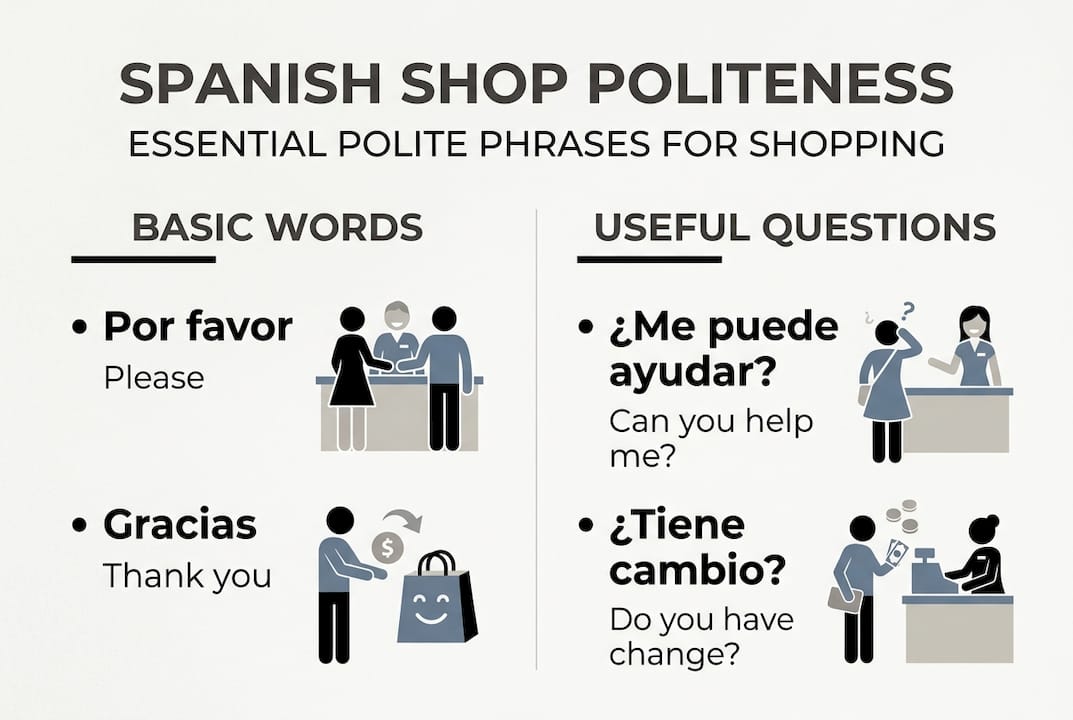
It is also worth knowing where regional vocabulary differs. Spanish spoken in Spain and in Latin America shares its foundations, but some shop words vary:
| Item | Spain | Latin America |
|---|---|---|
| Trolley | Carrito | Carrito / Carro |
| Bag | Bolsa | Bolsa / Funda |
| Till / checkout | Caja | Caja / Mostrador |
| Receipt | Ticket / Recibo | Recibo / Factura |
If you are shopping in Spain specifically, you are unlikely to encounter much confusion. But it is handy to know the differences if your travels take you further afield. For instance, if you ever visit a traditional Spanish charcuterie, the vocabulary around cured meats and cuts is surprisingly specific and well worth learning.
Pro Tip: Practise your key phrases aloud every day for a week before your trip. Saying them out loud, not just reading them, is what builds Spanish small talk for fluency and makes the words available automatically under pressure.
Beyond basics: Handling negotiations, returns and regional differences
Knowing phrases is key, but the real challenge is handling less predictable interactions.
Most of your shop visits will follow a familiar pattern. But some will not. A product is out of stock, the price on the shelf does not match the till, or you need to return something that did not work. These moments are where basic phrasebook knowledge runs out and real conversational ability matters.
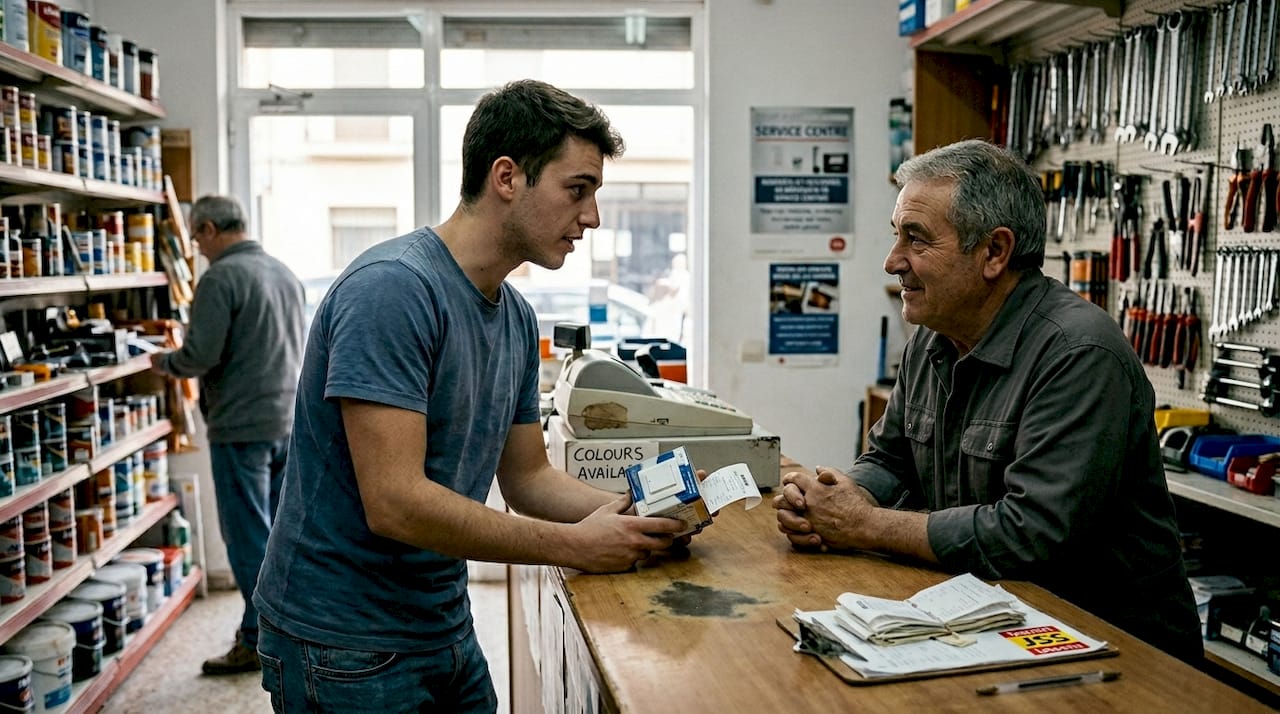
One key distinction worth understanding early: bargaining is more common in Latin American markets, where ¿Cuál es su mejor precio? (What is your best price?) is perfectly normal. In Spanish supermarkets and most shops, haggling is rare and can feel awkward for both parties. Save the negotiation for flea markets (mercadillos) and antique fairs, where it is expected and even enjoyed.
Returns are a different matter. Knowing how to handle a devolución (return) politely and clearly is genuinely useful. The structure to learn is:
- Quisiera devolver esto, por favor. (I would like to return this, please.)
- No funciona. (It doesn’t work.)
- ¿Puede cambiarme esto? (Can you exchange this for me?)
- ¿Me devuelve el dinero? (Can I have a refund?)
Using this kind of formulaic but polite language avoids the embarrassment of an awkward standoff at the till. Staff respond well to calm, structured requests.
Regional differences can also catch you out. Even within Spain, vocabulary and speed of speech vary considerably between Andalusia, Catalonia, and the Basque Country. The pace can feel like machine-gun fire to a learner’s ear, especially in busy shops.
“The fastest way to stop being rattled by fast Spanish is to listen for the patterns, not the words.”
Pro Tip: When you visit local shops, listen for phrases that come up again and again. Repetition in real environments builds your ear far faster than any classroom exercise. Visit Spanish shop conversation insights for more practical guidance on handling real-world exchanges.
For those keen on bargaining tips in situations where negotiation is appropriate, knowing when and how to open that conversation makes all the difference.
How to practise Spanish conversation for real shop success
Once you know what to expect, here is how to quickly build real-life shop fluency.
The single biggest mistake learners make is studying Spanish without ever practising the messy, unpredictable reality of a real conversation. Vocabulary lists are useful. Role-plays are transformative. Scenario practice accelerates learning in ways that passive study simply cannot match, particularly when it comes to the pragmatic skills you need in live situations.
Here is a step-by-step approach that works:
- Drill your core phrases until they feel automatic, not recalled
- Listen to authentic Spanish audio to tune your ear to real pace and rhythm
- Role-play specific shop scenarios, including awkward ones like a confused cashier or a missing item
- Shop in real Spanish-speaking environments as often as possible
- Review what tripped you up and target those gaps directly
- Repeat the cycle until the conversation feels easy, not effortful
The research supports combining methods. Combining vocab drills with immersion and role-play produces the strongest results across all learner levels. This is not one-size-fits-all; it is about stacking methods intelligently.
| Method | Confidence gain | Practical fluency | Speed of results |
|---|---|---|---|
| Phrase memorisation | Low | Limited | Fast initially, plateaus quickly |
| Classroom practice | Medium | Moderate | Steady but slow |
| Immersive role-play | High | Strong | Fast and durable |
For role-play shopping practice, structured scenarios that mirror real shop visits are particularly effective. The best ones put you in uncomfortable situations, a hurried assistant, a price dispute, a product you cannot name, because discomfort is where real learning happens.
Pro Tip: Simulate a conversation with a confused or impatient cashier. It sounds stressful, but getting comfortable in that scenario beforehand means nothing in a real shop will rattle you. Combine this with audio Spanish lessons that train your ear to follow practical Spanish skills at full native speed.
A fresh take: Why real shop Spanish is a superpower most learners miss
These strategies are powerful, but the real game-changer lies in shifting your mindset.
Here is something most language courses will never tell you. The shop is one of the best classrooms you will ever find, and almost nobody treats it that way. Most learners push through their shopping list in silence, relieved to escape without embarrassment. They miss something enormous.
Every visit to a Spanish shop is a low-stakes, high-reward language lab. The shopkeeper is not judging your accent. They are delighted you tried. A simple buenos días, ¿tiene pan de centeno? (Good morning, do you have rye bread?) does more for your confidence and your cultural belonging than a month of grammar exercises.
The deeper truth is that most conventional courses skip real shop talk in favour of rigid grammar instruction that nobody uses in natural conversation. They teach you to conjugate verbs correctly but not to ask for 200 grams of manchego without freezing. Pragmatic Spanish, the kind that works in real life, is where fluency actually lives. When you can chat easily in a shop, you belong. That sense of belonging is the engine that keeps learners going long after the initial motivation fades.
Ready to unlock real-world shop Spanish?
You have seen the practical side. Here is how to take the next steps quickly.
James Spanish School is built precisely for moments like these. Real shop conversations, real cultural context, and the kind of everyday Spanish that actually gets used. The 100-lesson course covers sentence-building and ear-tuning, so you can follow native speech at full speed, not just in slow, carefully enunciated classroom audio.
Whether you are preparing for a move to Spain, planning a long stay, or simply want to feel at home in a local market, the online Spanish lessons at James Spanish School give you structured, on-demand learning that fits your life. As soon as you the basic sentence structure, you into modules focused on Spanish for shop confidence and build from there. Every lesson is available 24/7, with no expiry date, no pressure, and a cast-iron guarantee backing every step.
Frequently asked questions
What are the most useful Spanish phrases for shopping?
The essential phrases are ¿Cuánto cuesta? (How much does it cost?), ¿Dónde está…? (Where is…?), and ¿Puedo pagar con tarjeta? (Can I pay by card?). These three key phrases cover the vast majority of everyday shop interactions.
Is bargaining common in Spain or only in Latin America?
Bargaining is standard in Latin American markets but is rarely practised in Spanish supermarkets and shops. Bargaining is more common in Latin America; in Spain, stick to mercadillos if you want to negotiate.
How can I quickly improve my Spanish for shop conversations?
Practise scenario role-plays, visit real shops whenever possible, and combine vocabulary drills with listening practice for the fastest progress. Scenario practice accelerates learning in pragmatic situations far more effectively than passive study alone.
What if I don’t understand a shopkeeper’s fast speech?
Calmly ask them to slow down: ¿Puede repetirlo más despacio, por favor? (Can you repeat that more slowly, please?). Most shopkeepers are happy to oblige when asked politely.